
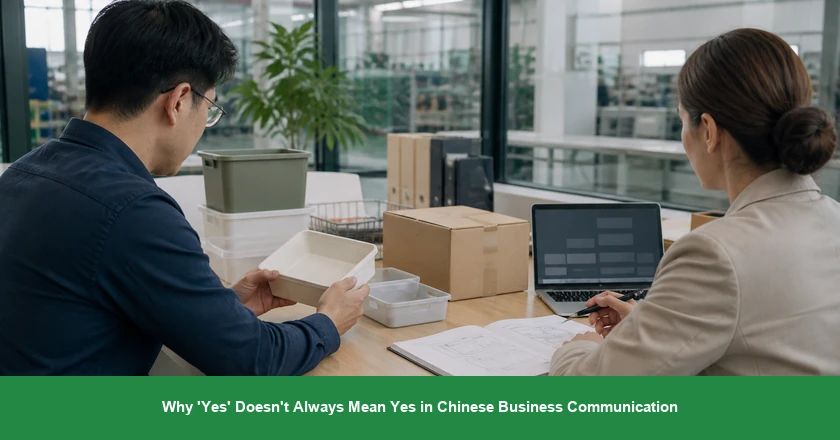
A positive reply is not an operating approval until the decision fields are complete. In a sourcing conversation, “yes,” “we will check,” or “we will try” may acknowledge the request, preserve a constructive exchange, or signal a possible route forward. None of those functions alone confirms which product version will change, who can authorize it, what it costs, or when the answer will return. Treating the reply as a decision before those facts exist is how a polite message becomes an avoidable order error.
What a Positive Reply Can and Cannot Authorize
Treat any positive reply as a prompt to check decision completeness before you act. For a material change, hold the affected scope when the message lacks one of four basics: the exact version or scope, the commercial term or impact, the person accountable for the decision, and a dated reply. A confirmed answer can authorize the named change; an acknowledgement can authorize only the next clarification. That distinction lets a buyer stay respectful without allowing uncertainty to travel into printing, production, payment, or dispatch.
- Do not decode one word. Read the message against the live product and order decision.
- Confirm the fields, not the tone. A friendly answer may still leave cost, timing, or ownership open.
- Keep the hold narrow. Pause the changed carton, specification, or price line—not unrelated work—until the record is complete.
- Give a reply path. Ask for the feasible option, owner, and return date instead of demanding a public refusal.
The Real Issue Is Decision Status, Not One Word
Directness and indirectness can require readers to consider context as well as literal wording. The University of Minnesota’s communication text contrasts literal wording with high-context communication, where context and connotation can carry added meaning. For a buyer, that is a reason to ask a bounded follow-up question—not a license to guess that a Chinese contact secretly means the opposite of what they wrote.
No single phrase has one fixed commercial meaning across people, roles, languages, or order conditions. The same “yes” can mean “I received your request,” “I think it may be possible,” “I need to check with the printer,” or “the change is approved under the stated terms.” An acknowledgement is simply a reply that shows the request was received or considered; it is not approval. The buyer’s job is to separate that communication function from the operating decision that must still be made.
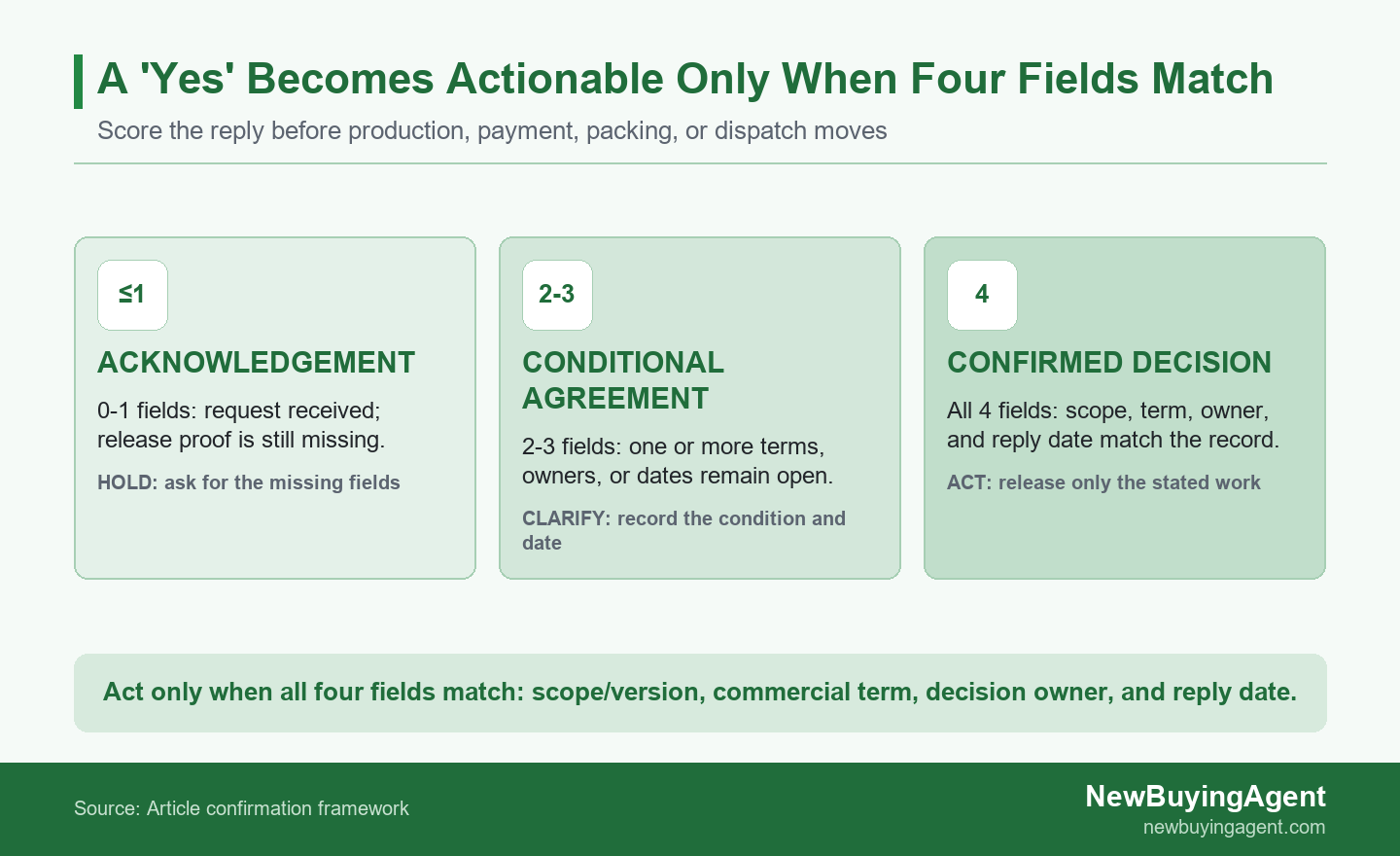
Risk ladder showing when a positive sourcing reply becomes a confirmed decision after four fields match
Relationship context can matter, especially when a contact is balancing a customer request against a production constraint they do not personally control. Yet culture is only one part of the situation. Seniority, language fluency, the urgency of the order, the channel used, the person’s authority, and the clarity of the original request all change what a brief reply can reasonably mean. A durable method therefore checks evidence that both sides can see rather than assigning intent to an individual.
Use a Four-Field Confirmation Ladder Before You Act
A sourcing change is confirmed only when the affected scope, commercial term, decision owner, and reply date are recorded together. This is an operating rule for material changes, not legal advice and not a test of anyone’s culture. It turns an unstructured message into a decision that can be checked by sales, purchasing, quality, production, and logistics before the change touches the order.
A complete product brief gives NewBuyingAgent the information needed to quote and supply a China-sourced product path around the active version and terms. When a buyer is starting a new product path, a brief with a defined specification, target market, commercial assumptions, and responsible owner prevents quotations from being compared against different versions of the same request. Buyers who need that starting point can turn a complete product brief into a China-sourced quote.
Four Fields Turn Acknowledgement Into Approval
The affected scope, commercial term, decision owner, and reply date are the four fields that make a sourcing change testable. Scope names the exact SKU, artwork file, sample, carton, material, or shipment line; “the packaging” is rarely enough. The commercial term states the price, minimum quantity, payment, tooling, timing, or other consequence that could change. The owner is the person or function who can decide, such as the printer, production manager, quotation contact, or shipping coordinator. The date says when the scoped answer will return, rather than leaving “we will check” open indefinitely.
For higher-risk changes, add the evidence that proves the field: a revised drawing, pre-production sample, laboratory result, inspection point, approval email, or updated order document. The four fields do not replace technical or compliance controls. They expose which control is still missing, so the buyer can hold only the part of the order that depends on it.
Three States Keep Ambiguity Out of Production
A reply with 0-1 fields is acknowledgement, 2-3 fields is conditional agreement, and 4 fields is a confirmed decision. A conditional agreement is a response that may support the request but still depends on a named condition or internal check. The ladder is intentionally simple: it gives the buyer a next action without pretending that every product, contract, or relationship carries the same risk.
| Fields present | Decision status | Buyer action |
|---|---|---|
| 0–1 | Acknowledgement | Hold the affected scope and request the missing fields. |
| 2–3 | Conditional agreement | Record the stated condition, identify the missing owner or term, and set a return date. |
| 4 | Confirmed decision | Issue or update the written record, then release only the stated work. |
Do not use the ladder to slow routine conversation. Use it when a reply could alter cost, product scope, quality criteria, timing, payment, packing, or dispatch. A safety issue, an expiring shipment window, or a regulatory question may require stronger escalation even when all four fields appear present.
Ask for Constraints Without Forcing a Public No
For an existing China supplier, NewBuyingAgent can provide China-side follow-up on production progress, quality management, and logistics when a decision cannot be clarified remotely. That is useful when the buyer already has a factory relationship but the active change needs someone local to confirm the current production fact, not merely pass messages between inboxes. Buyers in that position can see how NewBuyingAgent manages existing China factories.
A productive clarification asks for an option and its conditions. Instead of writing “Can you confirm yes or no?”, try: “Please confirm whether carton file V7 can be printed for the two listed colorways. If not, please state the workable option, price impact, person who will confirm it, and the date we will receive the proof.” The question makes it easier to surface a constraint without asking one contact to defend it publicly.
Move a Sensitive Issue to an Easier Response Path
Relationship trust and continuous communication can matter in China business partnerships, so a specific clarification request can be more useful than a public demand for a binary answer. The U.S. International Trade Administration’s China selling guide describes guanxi as relationship-based trust and notes the value of consistent communication and transparency. Here, guanxi means relationship-based trust and connection in business; it should support clear records, never replace them.
If the group reply remains vague, move the fact-finding step to a smaller call or direct message, then put the agreed result back into the shared record. Relationship context does not remove the need for a clear decision record: ask what is feasible and who must check it, rather than turning the exchange into an accusation. If a deadline is imminent, say so plainly and name the escalation point.
Channel matters too. The U.S. trade guide for doing business in China notes WeChat’s prevalence as a communication tool. Use that convenience to gather a fast clarification, but capture the decision in the purchase record, email, or approved version file where the responsible parties can retrieve it later.
Name the Owner and the Return Date
A request becomes actionable when it names the owner who can decide and the date by which that person will return a scoped answer. “We will check” is useful progress only when the buyer can see who is checking which question and when the answer will be available. Match the owner to the decision: a printer may confirm artwork feasibility, a production manager may confirm a schedule effect, and a quotation contact may confirm the cost.
A dated response also keeps a small uncertainty from becoming a silent assumption. If the owner cannot answer by the requested time, the response should identify the next workable path—use the existing file, wait for a proof, split the shipment, or revise the delivery plan. That gives the buyer an explicit trade-off to approve rather than a late surprise.
Convert Talk Into a Purchase Record Before Money or Production Moves
Under CISG Article 18, silence or inactivity does not in itself amount to acceptance. The UNCITRAL CISG Digest explains that boundary, subject to the convention’s scope and to the parties’ practices and agreement. This is not transaction-specific legal advice. It is a useful discipline for buyers: no reply is not a sound basis for releasing a revised commercial term, especially when a change affects payment, price, timing, or a product version.
Trade.gov describes a pro forma invoice as a record that can state quoted items, prices, terms of sale, payment terms, and an estimated shipping date. Its pro forma invoice guidance lists those commercial and timing details. A buyer does not need to force every decision into one document, but the final record should align with the live order: affected version, agreed cost or commercial term, accountable owner, next date, and any approval evidence needed to release work.
The record can be a controlled email recap, an updated purchase order, a revised pro forma invoice, an approved artwork file, or another system of record used by both parties. What matters is that the new fact is visible next to the old version it replaces. A chat screenshot without the file name, order line, or consequence may preserve the conversation but still leave the decision unclear.
Worked Scenario: A Polite Reply Hides an Unresolved Packaging Change
A reply with no carton version, cost, owner, or proof date should hold the affected packaging scope rather than release it. Consider this illustrative composite: a European home-goods brand is preparing a repeat order with an established China supplier. 2 colorways of a storage product are waiting for final carton-artwork release, with 1 carton artwork revision across the two colorways, and the buyer asks whether a new warning icon can be added without moving the planned packing date. The artwork is proposed, but no revised carton proof has been approved.
The sales contact replies in a group chat, “Yes, we will try our best.” A positive phrase acknowledges the request. The production and printing implications are absent. No owner or dated next action appears in the message. The buyer is tempted to release the existing artwork to save time. That would mix an unanswered change request with an older file that nobody has explicitly reapproved.
The message scores 0/4 on the confirmation ladder, so the buyer keeps only the affected carton scope open. The recap asks: “Can the printer use V7 for both colorways? Please confirm any incremental cost, the print owner, and the proof date. Until then, V6 remains the approved file.” The instruction does not accuse the contact of saying no; it identifies the decision that still needs evidence.
The contact then identifies a two-day proof delay and asks the printer to price the artwork change. The buyer records the revised file name, incremental cost, printer contact, and new proof date, then releases the changed carton only after the proof and timing match the shared record. The result is a known two-day trade-off rather than an unpriced artwork change hidden inside a polite reply. This is an illustrative composite scenario, not a client case and not a claim about every Chinese supplier response. Readers can review NewBuyingAgent sourcing case examples for public project context.
A Confirmation Brief Protects the Next Sourcing Decision
A confirmation brief should carry the active version, proposed change, commercial impact, decision owner, and reply deadline. Add the order number, the current approved document, and the evidence required for release when they apply. The purpose is not to create more paperwork. It is to make sure that a buyer, factory contact, printer, inspector, or logistics coordinator is answering the same question before work or money moves.
NewBuyingAgent can turn an unresolved sourcing message into a China-side follow-up path when the buyer provides the affected product, change, commercial impact, owner, and date. The appropriate route depends on whether the need is a new product-supply path or follow-up with an existing factory, but the same brief makes the next conversation concrete. When a live order needs that handoff, buyers can share a four-field confirmation brief with NewBuyingAgent.
Frequently Asked Questions
Does a quick yes mean the factory approved the change?
No, a quick yes does not authorize the change until the reply identifies the affected scope, commercial term, decision owner, and next date. A positive message should be followed by a written four-field confirmation before work moves forward. For small, reversible questions, the required detail can be brief. For a production, price, quality, packing, payment, or shipment change, the record should be explicit.
How should I ask for clarification without sounding accusatory?
Ask for confirmation of the specific version, term, owner, and date rather than asking whether the other person made a mistake. A useful message states the current approved item, names the requested change, asks for the feasible option and its consequence, and gives a deadline for the response. This approach makes it easier to surface a real constraint while keeping the issue tied to the order rather than to personal intent.
Should every sourcing decision be confirmed in writing?
Any decision that changes product scope, price, timing, payment, quality criteria, or shipment readiness should be recapped in a durable written record. Routine social messages and low-risk scheduling details do not need a formal document every time. The test is whether a reasonable person could later see the version, consequence, owner, and timing of the decision without reconstructing a long message thread.
When should a buyer involve a China-side sourcing partner?
Involve a China-side sourcing partner when a change affects production, quality, payment, packing, or dispatch and the responsible owner cannot confirm the next action clearly. Local follow-up is especially useful when the buyer needs to verify an active factory fact, coordinate between functions, or obtain a revised sample, proof, inspection result, or logistics update. The buyer should still define the commercial decision and release rule in writing.
NewBuyingAgent
Related Resources

Get Started Today
Let's Turn Your Sourcing Goals into RealityWeChat:+86 15157124615
WhatsApp:+86 15157124615
Address:Building 10 #39 Xiangyuan Road, Hangzhou, China