

For routine goods sourced from China for the United States, a parcel worth $800 or less is no longer a duty-free shipping plan. Current CBP guidance says covered shipments at or below $800 are no longer eligible for duty-free de minimis treatment. For non-postal shipments, CBP says the entry must be filed through ACE by a party qualified to make entry. The practical change is larger than one customs number: product data, country of origin, order structure, shipping method, and the entry handoff must be settled before a buyer treats a factory quote as a delivered-cost commitment.
De minimis treatment was the customs privilege that allowed some low-value imports to enter duty-free. That familiar shortcut made parcel value feel like the deciding fact. Under the current suspension, it is only one fact in a much longer eligibility and entry conversation. A sourcing team can prepare the China-side information; the buyer’s qualified customs party must determine the appropriate entry path and applicable charges for the actual goods.
What Buyers Must Verify Before They Use $800 in a Quote
A covered under-$800 parcel is not a current duty-free starting point. The global policy fact sheet explains why the familiar parcel-value shortcut no longer settles the question. Before approving a direct-from-China quotation, use four questions in this order:
- What rule is active now? Confirm current treatment for the shipment, rather than relying on an old marketplace rule or supplier shorthand.
- Is this one commercial order? Make the purchase-order relationship visible; do not let parcel count hide it.
- What exactly is being imported? Product description, composition, origin, quantity, and intended route are decision inputs, not admin cleanup.
- Who will make entry? Give the buyer’s qualified customs party complete facts before a delivery price, customer promise, or dispatch date is fixed.
These checks do not make an import slow by default. They prevent a fast quote from carrying a cost assumption that nobody has actually tested. They also preserve a clean division of work: the buyer owns the import decision, while the China-side team keeps product and shipment information consistent enough for that decision to be made.
Why the $800 Number and Today’s Eligibility Are Different
The confusion exists because two layers are being discussed as though they were one. The global operational change was announced for covered commercial shipments effective August 29, 2025. Executive Order 14324 set that all-country direction, and a February 2026 White House action continued the suspension. A buyer who sees $800 in a reference and stops there is mixing a statutory benchmark with the current operational treatment.
The difference matters most when a quote was built around direct parcels. A factory can still report a low product price and a courier can still offer a shipping price. Neither price answers whether the shipment receives duty-free treatment, which entry path is appropriate, or what charges may apply. Those questions attach to the imported goods and transaction, not simply to a label reading “under $800.”
The $800 benchmark is still visible in Section 321
The current preliminary text of 19 U.S.C. §1321 still contains the $800 benchmark. The privilege is not granted when one order or contract is forwarded in separate lots to obtain it. That is why the number remains in buyer checklists, supplier messages, and older logistics guidance. It is useful as historical and statutory context, but it does not by itself answer what treatment a covered shipment receives today.
Think of the number as a reference point that needs a current-status check. If the buyer’s costing sheet contains one line that says “under $800 = no duty,” the sheet has collapsed a legal rule, an operational policy, a product question, and an entry process into one unverified assumption.
The current suspension controls the operational question
A current CBP customer-service notice repeats that the August 29, 2025 action suspended duty-free treatment for low-value shipments from all countries. The CBP notice is a useful reality check for buyers who have only seen China-specific 2025 notices. For a routine covered shipment, starting with “it is below $800” skips the controlling question: what treatment is available now for this product, origin, route, and transaction?
Some goods and situations can have separate statutory or policy boundaries. That is precisely why the buyer should not turn a general article into a product-specific clearance conclusion. The safer commercial habit is to price the product and freight separately, flag the import assumption as pending, and give the qualified entry party the exact order facts early enough to change the plan before dispatch.
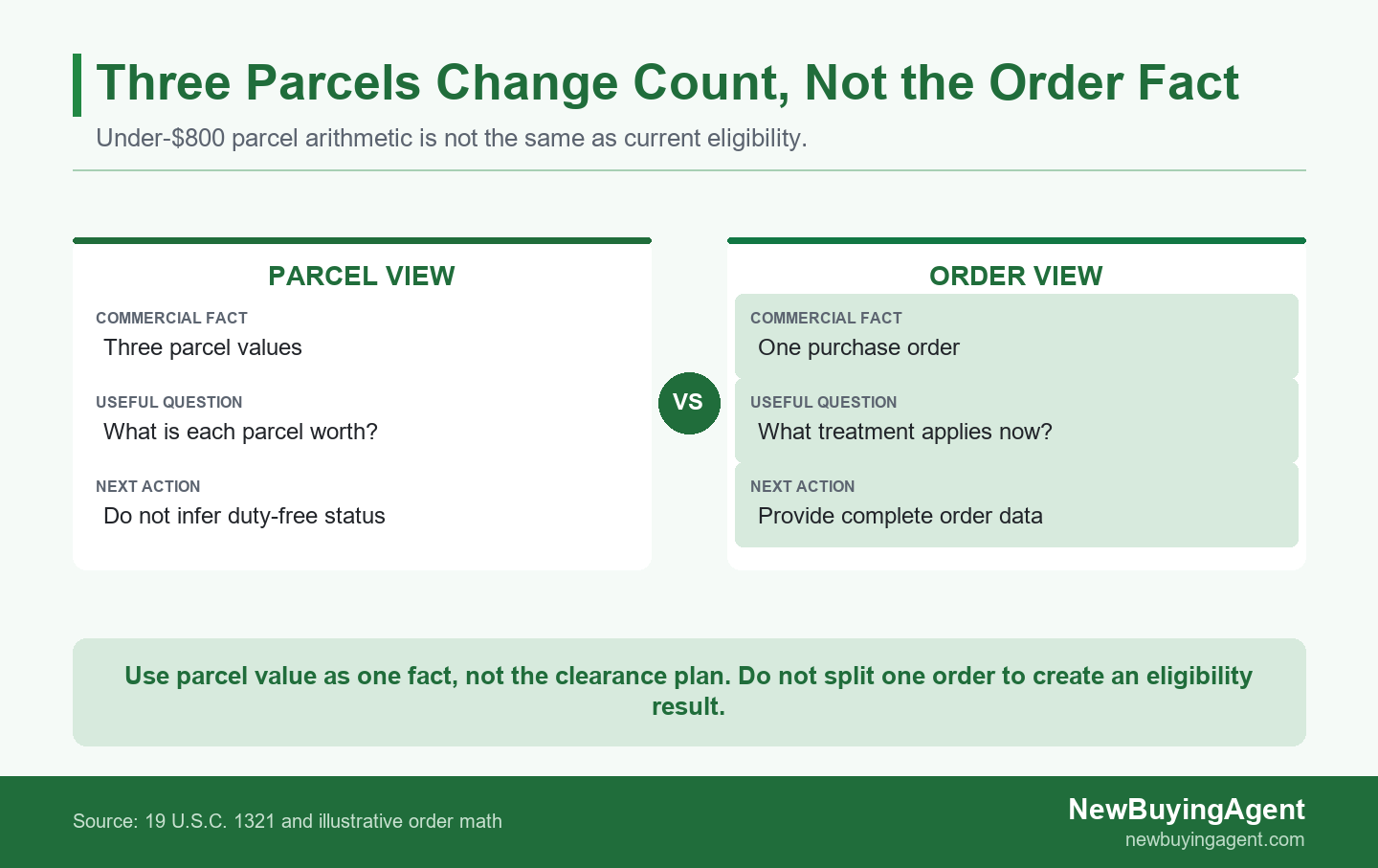
Side-by-side comparison showing three $800 parcels on the left and one $2,400 purchase order on the right, with the order-level facts guiding entry review
Build the Entry Conversation From Product Data, Not Parcel Value
The qualified entry party needs a real product and transaction record, not just a courier label. The current CBP low-value-shipment notice is a useful prompt to keep those records complete before dispatch. China-side sourcing coordination and qualified customs determination are separate responsibilities that must be connected by accurate product data. NewBuyingAgent can help maintain that China-side product and order record for a supply discussion, while the buyer’s qualified customs party retains the entry decision. That makes the buyer’s information packet part of the cost-control workflow, not a document task after the sale.
Start with the facts below before the buyer asks for an entry and duty view. They also make a supplier quotation more useful because the factory, logistics provider, and customs professional are working from the same version of the product and order.
| Buyer input | What to make specific | Why it changes the decision |
|---|---|---|
| Product identity | Plain description, material or composition, function, model, and unit quantity | A vague product name cannot support a reliable classification or cost discussion. |
| Origin and factory facts | Country of origin, production location, and whether a China factory is the actual producer | Origin is not interchangeable with ship-from location. |
| Commercial order | Purchase-order number, total value, invoices, and whether parcels belong to the same order | It reveals the transaction the parcel plan is trying to fulfill. |
| Shipment plan | Postal or non-postal route, carrier, packing list, departure timing, and destination | Mode and filing process may change the operational handoff. |
| Responsible parties | Importer of record, broker or other qualified entry party, and China-side information owner | Each person can act before the goods are already moving. |
For buyers who already work with a China factory, the hard part is often not finding another contact. It is keeping product descriptions, packing data, invoices, and timing aligned after a quote changes. In that situation, Ask NewBuyingAgent to manage your China factories when China-side follow-up is needed. That work can make the buyer’s packet more coherent; it does not replace the buyer’s broker, legal adviser, or importer responsibilities.
Landed cost means the total cost of bringing a product to its destination. It should be treated as a result of verified inputs, not a factory-price markup. A useful internal worksheet can keep product price, freight, potential import charges, brokerage or filing costs, destination handling, and contingency as separate fields. The worksheet remains honest even when one field is pending; it becomes risky only when a pending import assumption is silently written as zero.
A Single Order Should Not Be Split to Create an Eligibility Story
The Section 321 text does more than display a dollar amount. It says the privilege is not granted when one order or contract is forwarded in separate lots to obtain it. That language matters when a China order is deliberately divided into parcels that happen to sit at the same familiar value. The buyer should make the full order visible to the qualified entry party instead of presenting each parcel as though it were an unrelated transaction.
An eligibility story is the set of facts used to support a particular customs treatment. For this topic, it includes the goods, origin, purchaser, order, value, route, documents, and current rule. Three parcel labels may show three values; they do not erase the underlying commercial relationship. Splitting can also multiply labels, invoice references, tracking events, delivery exceptions, and customer-service exposure, so it is not automatically a simpler operations choice even before import charges are considered.
Shipment design can change how goods move. It should not be used to hide the commercial order that the entry decision needs to evaluate.
This is not a reason to avoid partial shipments when they are commercially necessary. A staged production release, backorder, or genuine separate purchase can be valid business activity. The difference is whether the documents and transaction facts truthfully show what happened. When the facts are clear, a qualified customs party can advise on the actual entry approach. When the facts are engineered around a desired number, the buyer has created a risk before the package is picked up.
An Illustrative $2,400 China Order: Three $800 Parcels Are Still One Order
Consider an illustrative order for 300 China-made accessories with a product value of $2,400 before freight. The Section 321 text is the relevant statutory context for the one-order boundary. Dividing one order into lower-value parcels does not change the underlying order relationship. Hold the illustrative three-parcel plan until the buyer’s qualified customs party reviews the complete order and product facts.
The parcel plan should pause before the buyer promises a delivered price
The buyer wants three courier parcels because the customer expects a quick direct delivery. One purchase order covers 300 China-made accessories valued at $2,400 before freight, with 3 parcels of $800 under 1 purchase order. The commercial documents still point to one product description and one China factory. The buyer has not confirmed the product classification, origin data, or intended entry process before quoting its customer. Calling the plan “three small shipments” does not answer those missing questions.
The first observation is arithmetic: 3 × $800 = $2,400. The second is documentary: all three parcels trace to the same purchase order. The anti-splitting boundary makes that order relationship material, while current CBP guidance removes the old assumption that a covered under-$800 parcel starts duty-free. No duty rate needs to be invented to reach the commercial conclusion: the cost model is incomplete.
The buyer should pause this parcel design for qualified entry review, then supply a plain product description, composition, country-of-origin information, total quantity, invoice, packing plan, intended route, and the same-order relationship. The result may be a revised price, a different timing decision, or a confirmed plan; the article cannot choose among them because it does not classify the real goods. The useful result is that the buyer avoids promising a delivered price based solely on parcel arithmetic.
The verification gate is simple: do not make a customer-facing delivered-cost promise until the buyer’s qualified customs party has reviewed the actual product and transaction. This is an illustrative scenario, not a tariff quote or a clearance prediction, and the entry decision stays with the buyer’s own qualified professional. For broader China-sourcing context, Review NewBuyingAgent success stories.
Make the China Supply Brief Useful to the Entry Review
China-side sourcing coordination and qualified customs determination are separate responsibilities that must be connected by accurate product data. NewBuyingAgent can help turn a defined requirement into a China supply discussion: product details, quantities, factory communication, packing requirements, and target timing can be assembled before the buyer requests the import review. That is a useful supply role because it reduces conflicting versions of the same order; it is not a claim to determine duties or legal eligibility.
Use one controlled product brief rather than rebuilding the facts in separate supplier, carrier, and broker messages. Name the item in plain language, then add the material or composition, model or variant, unit count, purchase-order total, origin, packing condition, destination, and requested timing. Attach the same current invoice and packing draft that the buyer expects the entry professional to review. If the supplier changes the material, unit count, carton quantity, factory, or planned route, record that change before someone reuses the earlier file. This does not decide classification, applicable duties, or entry eligibility. It does prevent a China-side quote from drifting away from the commercial facts that need review. A buyer who keeps those fields synchronized can compare factory responses, revise the shipping plan, and give the responsible customs party a clearer record without asking a sourcing partner to make the customs determination.
When the product need is defined, buyers can Ask NewBuyingAgent to supply products from China. Give the team the product description, quantity, destination, required packing, target shipping date, and any product documents already available. Keep the customs assumptions visible in parallel, including who will make entry and which qualified party needs the final commercial file.
A practical handoff is short but complete: send the purchase-order total, a unit-level product description, material or composition where relevant, origin information, invoice and packing draft, shipment method, consignee details, and the intended customer promise. Then ask the qualified customs party what facts it still needs. This sequence gives the buyer a chance to correct a quote, consolidate a document set, or change timing while the decision is still reversible.
Before any China-side follow-up begins, reconcile six fields across the working files: the product description, unit quantity, total purchase-order value, origin statement, packing version, and planned route. If one of these changes, circulate the updated fact rather than allowing an old invoice or courier instruction to remain in the handoff. This is especially important when a factory release is staged, the buyer changes quantities, or a customer deadline compresses the shipping plan. A sourcing partner can chase the correct factory records and help make the commercial file consistent. The buyer and qualified customs party still decide whether the goods can move on the proposed timetable and what entry process is appropriate. That division keeps product-supply coordination useful without turning it into a customs conclusion.
If those inputs are ready, include the destination and decision date with the product request so the China-side discussion starts from the same facts that later reach the entry review. Attach the latest invoice and packing draft whenever they are already available. Send your product brief to NewBuyingAgent.
Frequently Asked Questions About the $800 Rule
Does the $800 threshold still make a China shipment duty-free?
No. For routine covered goods, current CBP guidance says a value at or below $800 does not by itself create duty-free de minimis treatment. The buyer still needs to establish the product facts, current treatment, shipment route, and appropriate entry path. A specific item may have separate boundaries, so the importer’s qualified customs party should evaluate the real transaction rather than a general article. Product price alone cannot settle the likely charges or filing approach, so a seller should keep those items pending until the commercial file is reviewed. The relevant costing decision should follow that review, not a marketplace listing or a courier-value label.
Can one purchase order be split into smaller parcels?
Do not treat splitting as a way to create a de minimis result. Section 321 says the privilege is not granted where one order or contract is forwarded in separate lots to obtain it. Commercially valid partial deliveries should still be documented truthfully, but the buyer should disclose the full order relationship and obtain advice for the actual shipment plan. That review should happen before labels, invoices, or customer commitments lock the parcel design. A staged release needs documents that match the genuine production and delivery facts. The operational reason for the split should therefore be visible in the same commercial file as the order total.
Who determines the entry type and applicable duties?
A party qualified to make entry should determine the appropriate entry process, using complete product and transaction facts from the importer. CBP’s current guidance distinguishes that filing responsibility for non-postal shipments. The China-side factory, sourcing partner, carrier, and buyer may all provide information, yet their information does not replace the responsible entry determination. NewBuyingAgent can help prepare China-side product and factory records for the commercial file, while the qualified entry party retains its determination role. Assigning that responsibility early prevents a supplier quote from being mistaken for a customs conclusion and gives the buyer time to correct the plan before dispatch.
Why does $800 remain in legal references?
The $800 amount remains visible because statutory text and current operating treatment are different reference layers. The Public Law 119-21 record states that the future statutory change is scheduled for July 1, 2027. That date belongs to the future statutory timeline; it is not a current shipment instruction.
The statutory benchmark and the current suspension are different layers. That is why the number remains visible in legal references even though it does not settle today’s operational treatment. The enacted Public Law 119-21 record is also relevant to the future statutory change scheduled for July 1, 2027. That future date does not reverse the operational suspension in force today, and it should not be used to predict a product-specific outcome before current guidance is checked. A buyer should verify the current status again when planning the actual shipment and retain the current guidance with the order file.
NewBuyingAgent
Related Resources

Get Started Today
Let's Turn Your Sourcing Goals into RealityWeChat:+86 15157124615
WhatsApp:+86 15157124615
Address:Building 10 #39 Xiangyuan Road, Hangzhou, China
