


A China construction-materials order is not ready merely because a factory price looks attractive or a sample looks close to the drawing. The costly gaps usually appear later: the quoted finish does not match the approved record, the batch differs from the sample, the carton labels cannot be mapped to the installation zone, or nobody owns the destination-market approval question. A construction materials buying agent in China is most useful when these connected decisions are visible before production and consolidation—not when the work is reduced to chasing a low unit price.
A resilient purchase follows a clear chain: define the material and intended use, specify the evidence and approval owner, release the correct batch, then deliver cartons in a sequence the site can use. The buyer should appoint qualified advisers for any destination-market, engineering, regulatory, customs, or legal decision.
Four Project Controls That Must Move Together
Specification, evidence, batch release, and site sequence must move together for a project-material order. A purchase can be commercially approved yet still be operationally unready if any one of those controls remains open. The following four questions should be answered against each material package, not held in separate email threads.
- Specification: What exact material, dimension, finish, performance, revision, and intended use is being bought?
- Evidence: Which document, sample, test record, label, or declaration is required, and who is qualified to approve it?
- Batch release: How will the physical lot, its records, and the approved reference be matched before packing?
- Site sequence: Which cartons belong to which zone, installation phase, and arrival priority?
Use an unresolved answer as a hold signal, not a post-order administration task. This gives the commercial, China-side, freight, and site teams one shared release condition.
Start With a Procurement Basis of Design
A buyable project line must identify intended use, destination, approval owner, and evidence need before price can be meaningfully compared. Put these fields next to the product description at the start. Otherwise, two factories can appear to be quoting the same item while one is pricing a different finish, packing method, test condition, document set, or revision. NewBuyingAgent can use this defined brief to support China-side product sourcing and follow-up without becoming the project’s approval authority.
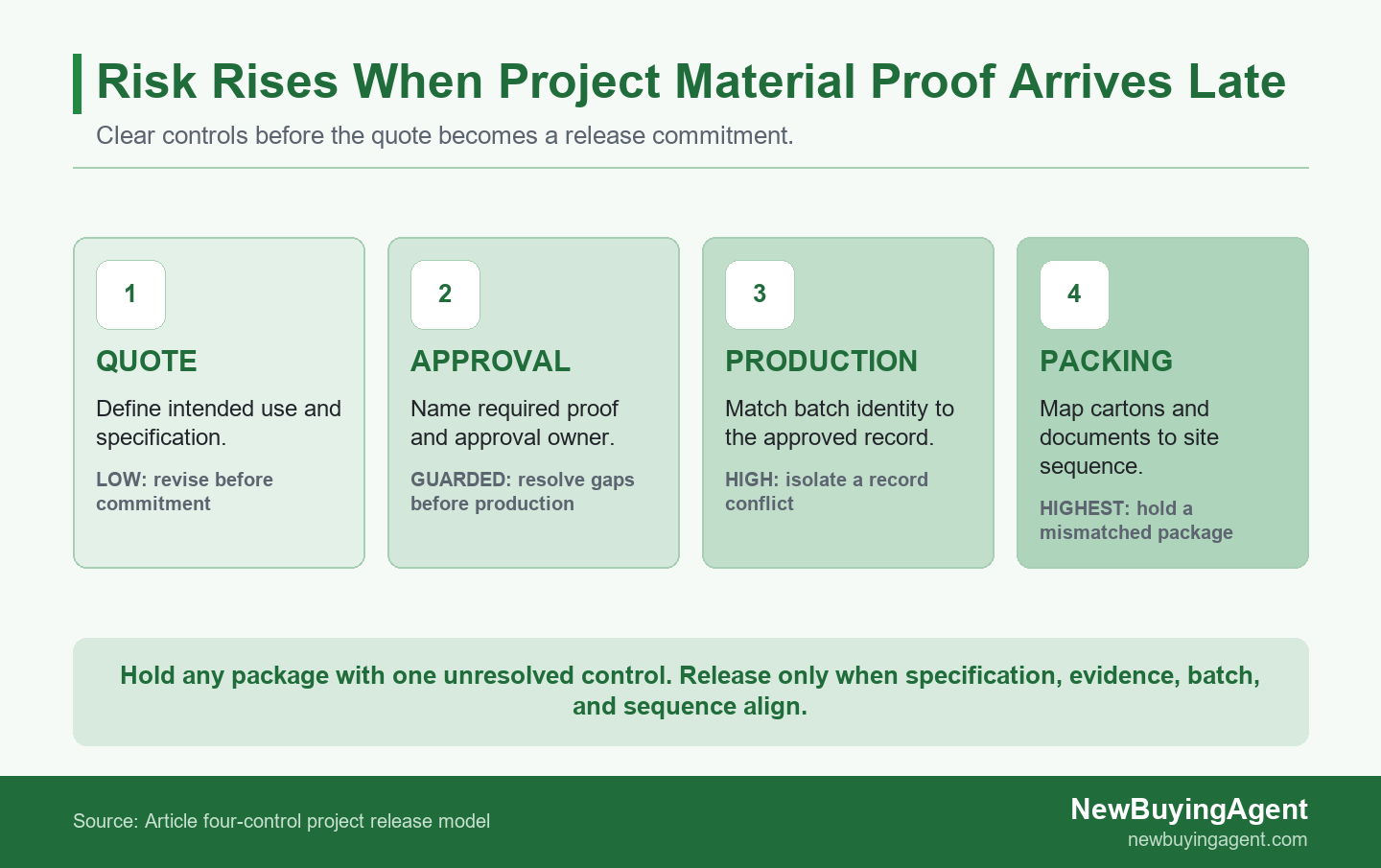
Risk ladder showing unresolved material controls becoming harder to correct from quote through packing release
Turn Each Bill of Quantities Line Into a Buyable Specification
A product name becomes quoteable only when its controlled physical, performance, packing, and revision fields are recorded. A bill of quantities (BoQ) is the project list of materials, quantities, and descriptions to be bought. It is a useful starting document, but “600 × 600 tile,” “timber panel,” or “door hardware set” is not a complete buying instruction.
For every line, add the drawing or schedule revision; dimensions and permitted tolerance; base material, grade, and finish; colour or approved sample reference; intended location and use; required standard, test, or performance criterion; quantity and approved overage; unit of packing; labelling language; and the party that may approve substitutions. Where a project references a technical standard, identify the actual requirement and edition rather than writing “good quality.” A standard is a specific technical reference, not a generic marketing phrase.
The practical test is simple: could a second reader distinguish the requested product from a visually similar alternative without asking the original designer what was meant? If not, the line needs more control fields before it goes into a quotation comparison.
Separate Product Compliance From Project Approval
EU CPR tools provide product performance information and the EOTA route centers intended use and performance. Under the relevant EU construction-product framework, a Declaration of Performance is a product document that states performance information; it is not a universal approval to install a material on every project. The European Commission’s CPR overview explains the performance-information role, while its EOTA-route guidance highlights intended use and performance.
Keep two columns separate in the control file: product evidence requested and project approval owner. The first may include a declaration, test report, material record, SDS, or label. The second names the buyer, architect, engineer, consultant, authority, broker, or other qualified specialist responsible for the decision. A buying agent can help keep the China-side product record current, but should never be presented as the party that grants technical, code, regulatory, or customs approval.
Build a Control File Before You Compare Quotes
A project control file is a working row or linked file that connects the specified product, its evidence, its release decision, and its delivery instruction. It is deliberately more useful than a loose supplier comparison because it records the condition under which the price is valid. Keep one row per material package or controlled variant; do not blend a tile body, trim profile, adhesive, hardware finish, and carton label into one vague “item.”
Covered composite wood products imported into the United States have TSCA Title VI requirements. The EPA’s composite-wood guidance describes the U.S. framework, including requirements for covered products. This is an example of why “wood panel for the U.S.” is not enough: the exact material category, destination, intended use, records requested, and responsible reviewer have to be named in the project file.
Hazard communication uses labels and safety data sheets for covered hazardous chemicals. A Safety Data Sheet (SDS) describes a hazardous chemical product, its hazards, and handling information. For a coating, sealant, adhesive, or cleaner, match the current SDS and product label to the ordered formulation rather than accepting an old file attached to a sales quotation. OSHA’s Hazard Communication resource identifies labels and SDSs as core tools in the U.S. framework; destination rules and product scope still need qualified review.
Quality-management and technical-standard references are useful only when the order records identify the exact controlled requirement. ASTM’s standards and publications information is a useful reminder that the cited requirement and edition must be identifiable. Record the source file name, issue date or revision, issuer, product identifier, and approval status. This does not certify the material or decide its suitability. It prevents a document belonging to another model, batch, or earlier design revision from being treated as proof for the package now being packed.
| Control-file field | What to record | Release question | Owner |
|---|---|---|---|
| Specified product | Drawing, revision, material, finish, use, quantity | Is this the exact quoted variant? | Buyer / design owner |
| Evidence | Sample, declaration, test record, SDS, label, photo | Does it identify this product and intended use? | Qualified approval owner |
| Batch and inspection | Lot code, date, inspection plan, nonconformance record | Does the lot match the approved reference? | Buyer / China-side quality contact |
| Packing and handoff | Carton mark, pallet, zone, sequence, damage protection | Can the site receive and identify it correctly? | Logistics / site team |
Once the control file makes the material package, evidence request, delivery instruction, and commercial assumptions clear, buyers can ask NewBuyingAgent to supply a defined project material package from China. The relevant handoff is a defined package and commercial brief—not a request for NewBuyingAgent to replace the project’s technical or regulatory approval path.
Price the Order as Delivered Work, Not Factory Pieces
An 8% affected portion of an illustrative USD 180,000 order equals USD 14,400 before rework and delay. This is simple arithmetic, not a forecast: USD 180,000 × 0.08 = USD 14,400. It shows why the factory price is only one part of a project decision. The affected amount may be small in the purchase order yet expensive once replacement freight, access restrictions, labour, programme disruption, or mismatched packing are involved.
Compare quotations as delivered work. Put the following assumptions on the same sheet: included product revision and finish; sample or submittal status; evidence requested; unit packing and protection; export packing; lot or inspection condition; consolidated-shipment timing; carton marks; excluded accessories; Incoterms; and payment or change-control assumptions. A supplier may offer a lower piece price by omitting an item that another quote has already included. The control file makes that difference visible before it becomes a claim at the site.
Set Release Gates for Samples, Batches, and Packing
Sample approval, batch identity, records, and packing readiness should be cleared as linked release gates before a package moves forward. A useful order flow has four checkpoints: approve the controlled reference; confirm the production lot against that reference; reconcile the evidence and any inspection result; then verify carton identity and delivery sequence. A green light at an early stage is not a waiver for the next one.
Define what happens when a gate is red. The affected package may be held, relabelled, reworked, re-documented, re-inspected, or separated from independently documented packages. Record who can accept the correction. This is where a simple approval log becomes a release system rather than a folder of attachments. Buyers retaining their own China factories can ask NewBuyingAgent to manage their China-factory follow-up.
Use Sampling to Govern Lots, Not to Replace a Specification
Acceptance sampling uses a defined lot, sampling scheme, and decision rules to accept or reject that lot. In plain language, acceptance sampling is a planned check of samples from a defined lot against agreed criteria. NIST’s lot-acceptance sampling guidance describes a plan as both a sampling scheme and a set of decision rules.
That boundary matters. A sampling result cannot rescue an undefined finish, the wrong drawing revision, an unapproved substitution, or a document that does not identify the lot. Before inspection, state the lot, the controlled reference, the characteristics to check, how samples will be selected, the acceptance criteria, the escalation path, and who has release authority.
Hold the Package When Product and Records Diverge
A product-document-carton conflict can require a targeted hold and reverification. Consider an illustrative staged commercial fit-out buying tile, cabinet panels, door hardware, and coatings in an USD 180,000 China order. The planned release state is 2 of 4 material packages held pending record reconciliation, while all four packages are planned for one consolidated sequence.
Two panel pallets carry a newer material code than the approved sample file. At the same time, the coating carton label points to an earlier SDS revision than the order control file. Neither observation automatically proves the material is unsuitable. Together, they show that the physical product, the document set, and the shipping identity no longer demonstrate the same configuration.
The decision is to hold two of four material packages—the affected panels and coatings—not necessarily the whole order. Independently documented tile and hardware can continue through their own release path if their rows are complete. The buyer asks for the updated product identifiers, applicable evidence, corrected carton mapping, and lot-level confirmation. The goal is not to punish a factory for a paperwork discrepancy; it is to avoid consolidating a mixed record into a container that the site cannot later unwind.
Release the held packages only after the physical product, controlled documents, and carton identifiers agree with the approved project row and the named owner accepts the correction. This is an illustrative procurement-control scenario, not an engineering verdict, compliance decision, or legal import conclusion. For broader China-sourcing context, buyers can review NewBuyingAgent sourcing case experience.
Plan Container and Site Handoff as a Sequenced Delivery
Packing identity and sequence are part of an installable project delivery. A container can reach the port on time and still create delay if cartons cannot be matched to the correct floor, room type, trade package, or installation phase. The task is not merely to count cartons; it is to preserve the connection between the control-file row and the physical package through loading, receiving, and handoff.
For each package, agree the carton mark, internal item code, batch or lot reference where relevant, quantity per carton, pallet number, destination zone, handling requirement, and unload priority. Confirm whether partial shipments are acceptable and who may change the site sequence. Take final packing photos against the carton marks, not only wide warehouse images. A useful packing list should let a receiving team answer three questions quickly: what is this, where does it go, and is anything missing or held?
When a China-Side Buying Agent Adds Project Leverage
NewBuyingAgent can use local factory resources and product/QC capability to support a defined China-sourced project-material path. The most productive point to involve a China-side partner is after the buyer has made the material brief actionable: product and revision, quantity, destination, intended use, evidence request, approval owner, timing, packing requirement, and release rule. That gives the sourcing work a clear product and delivery target without overstating what a buying agent can approve.
When a current project brief is ready, send the product specification, quantity, destination, timing, packing need, and evidence requirements. The discussion can focus on China-sourced supply coordination while specialist project approvals remain with the right qualified parties. To begin that conversation, send the project brief to NewBuyingAgent.
Frequently Asked Questions
What should a construction materials buying agent handle?
A capable buying agent should turn an approved project brief into controlled product supply, evidence checks, and delivery coordination without replacing engineering or legal specialists. The practical scope can include quote comparison against the defined specification, product and record follow-up, batch and packing coordination, and a clear China-side handoff. The buyer and appointed specialists retain decisions about design suitability, project approval, local regulation, customs, and contract obligations.
Is an approved sample enough for a project order?
No, an approved sample alone cannot clear a project order because the supplied batch, records, labels, packing, and site sequence must still match. Treat the sample as one gate in the release system. If the material code, formula, document revision, or carton identity changes, record the change and obtain the responsible owner’s decision before release.
Who verifies compliance for imported building materials?
I-Codes are model codes used in the built environment, so the applicable local approval path must be named for the project and jurisdiction. The buyer remains responsible for confirming destination-market requirements with the appropriate qualified engineering, testing, regulatory, and customs advisers for the material and intended use. ICC’s I-Codes overview reinforces the point. A buying agent can organize product records; it does not replace that approval authority.
What belongs in a construction materials procurement brief?
A useful procurement brief names the product specification, quantity, destination, intended use, approval owner, target timing, packing needs, and the evidence required before release. Attach the current drawing or schedule revision, approved sample reference if one exists, required carton marks, intended delivery sequence, and unresolved questions. A brief with those fields allows the commercial, China-side, logistics, and site teams to check the same package against the same release condition.
NewBuyingAgent
Related Resources
Get Started Today
Let's Turn Your Sourcing Goals into RealityWeChat:+86 15157124615
WhatsApp:+86 15157124615
Address:Building 10 #39 Xiangyuan Road, Hangzhou, China
