

For a U.S.-bound product from China, the expensive mistake is rarely failing to find a tariff code. It is treating a search result as a final answer before the product specification, country-of-origin record, and producer facts have been tested against the written description of an actual order. That makes this a document-and-facts question, not a “made in China” label or a tariff-code-only exercise. The practical review organizes those facts while leaving customs classification, legal opinions, and duty-rate calculations to the appropriate professionals.
What Should a Buyer Verify Before Pricing a U.S.-Bound Order?
Before pricing a U.S.-bound order, compare the written order language, product facts, origin and production evidence, and producer or exporter details.
- Start with the written language of a specific order, not a broad product name or a country label.
- Use tariff-classification and product searches to find possible cases, then save the order text, exclusions, and case details for comparison.
- Compare four fields together: written order language, product facts, origin and production record, and producer or exporter details.
- When one field is missing or conflicts, hold the assumed duty treatment and seek the right professional review before a deposit, production release, or entry.
What Makes a Product an AD/CVD Target?
AD/CVD coverage begins with the scope of a specific order, not with a broad label such as made in China. AD/CVD means antidumping and countervailing duties: additional duties that can apply to merchandise covered by a specific order. Here, scope means the written description that identifies covered merchandise. A product is potentially covered only when its real characteristics and origin facts fit that description. The U.S. trade-remedy system involves distinct agency roles; the Commerce AD/CVD resource page provides the official starting point, and the Commerce scope guidance explains that importers use scope to understand coverage. For an importer, the operational point is simpler: do not price an item as clear merely because a product label, broker note, or competitor listing sounds outside the order.
“Targeted” is therefore not a useful yes-or-no label until a buyer can name the candidate order and compare it with a defined product. The comparison may turn on dimensions, composition, intended use, included components, exclusions, producer identity, or origin and production facts. Different orders use different language. A preliminary screen should narrow the question to a real record; it should never turn uncertainty into a duty promise. For buyers developing a China-sourced purchase, NewBuyingAgent can help keep the technical brief and factory-facing facts organized while the trade-compliance decision remains with qualified professionals.
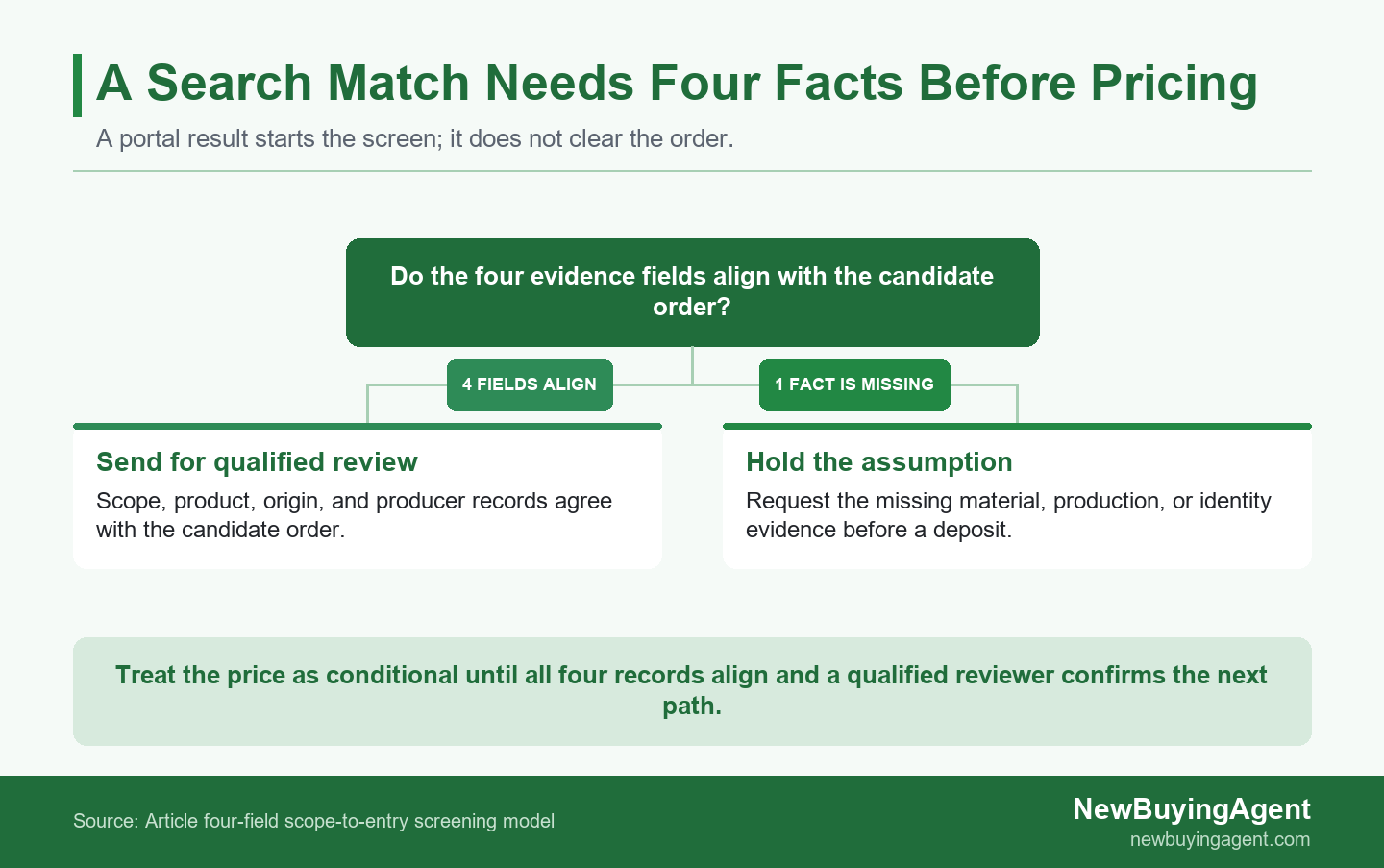
Two-branch AD/CVD screen showing four aligned evidence fields leading to qualified review and a missing field leading to a pricing hold
Build the Product-and-Scope File Before You Search
A useful AD/CVD screen starts with a product-and-scope file, not with a product nickname or a saved tariff code. Put the technical drawing, bill of materials, product photos, dimensions, use, producer and exporter names, origin statement, production sequence, proposed classification, and any candidate order in one review packet. This does not decide coverage. It gives a customs broker, trade counsel, or other qualified reviewer the same factual base that the commercial team used to evaluate the purchase.
Build the packet before a quote is treated as decision-ready. A quotation may include an item name, price, and delivery date without showing the material, component, or production detail needed for a scope comparison. Ask the factory to identify the document behind each key assertion. If an inclusion or exclusion cannot be matched to a document, label it as an open fact for review rather than allowing it to disappear inside a broad product description.
Read the Written Scope Before Treating HTSUS as an Answer
The written description of the scope controls AD/CVD coverage; an HTSUS reference is a screening clue, not a final answer. HTSUS is the United States tariff-classification system used to describe imported goods. Commerce’s AD/CVD FAQ states that the written scope description is dispositive, while listed HTS classifications are provided for convenience. Read inclusions and exclusions line by line. Then ask which words must be proved by drawings, material declarations, product samples, manufacturing records, or origin documentation. If a scope phrase names a technical feature, note the exact document that would prove it and whether that document is already in the packet.
Match Product Facts, Origin, and Producer Evidence to That Scope
A usable scope screen compares the written order with the product's physical facts, origin and production record, and producer or exporter details. “Country of origin” should be supported by a traceable production story, not inferred from a shipping route or final packaging location. Where the product is built, which party performs each material operation, and who actually produces or exports the merchandise may all matter to the review. If the supplier cannot document a fact that the scope appears to test, mark that field unresolved rather than filling the gap with a commercial assumption.
Use a short fact table for this comparison: what the order says, what the supplier says, which document supports it, and who must resolve any difference. This keeps a sales description from becoming the only evidence. It also makes the handoff more efficient when a broker or trade counsel needs to ask a focused follow-up question instead of reconstructing the product history from emails.
Use the Scope-to-Entry Check
Use the official search portal to find a candidate order, then compare that order against the complete product file before treating the match as actionable. CBP tells importers to review the scope of AD/CVD orders to determine whether merchandise falls within an order; its AD/CVD guidance also points to public search and agency resources. The Four-Field Scope-to-Entry Screen turns that instruction into a work sequence: discover the candidate, preserve the record, compare the facts, and escalate a material gap.
Search by Product, Country, Commodity, or HTSUS
Commerce's AD/CVD Search can be screened by country, product, case number, HTS number, or commodity. Search from more than one available fact because product marketing names are often too broad. If a result looks relevant, record the case number, country, scope text, exclusions, referenced HTS numbers, relevant dates, and any producer-specific information shown in the official material. A screenshot alone is fragile: it cannot show which wording was reviewed or whether the product file actually fits it. Use the same product wording in the packet so a reviewer can reproduce the search and understand why a case was retained or set aside.
Compare the Candidate Order Against the Product File
A candidate order becomes useful only after its scope, the product facts, the origin record, and the classification workpaper are compared together. In the Four-Field Scope-to-Entry Screen, each field answers a different question, so a positive result in one field cannot cancel a missing record in another. Classification research can clarify the tariff question, but it remains separate from determining whether a particular order’s scope covers the merchandise. A complete comparison records both answers and clearly marks the one that still needs professional review.
| Field | What to place in the packet | What not to assume | Screen result |
|---|---|---|---|
| Written scope | Order text, inclusions, exclusions, dates | An HTSUS reference decides coverage | Read and annotate |
| Product facts | Drawing, materials, dimensions, components, intended use | A catalog name proves a match | Match or flag a gap |
| Origin and production | Factory, process sequence, origin record | Shipping route establishes origin | Document or escalate |
| Producer and classification | Producer/exporter names and classification workpaper | A tentative code settles scope | Compare with a qualified reviewer |
When the product brief is complete, it also becomes a stronger commercial input. With a defined product file, NewBuyingAgent can use those factory-facing details to coordinate a China-sourcing conversation. Buyers preparing a China-sourced quotation can use a complete product brief for a China-sourced quote without representing that the sourcing discussion replaces a broker’s or counsel’s compliance determination.
An Illustrative Product Screen: When to Hold the Assumption
If any one of the four evidence fields is missing or conflicts with the order, hold the duty assumption and escalate the review. The Four-Field Scope-to-Entry Screen is deliberately conservative because it is an operating rule for commercial decisions, not a legal rule or a duty determination. It prevents an appealing search result from being converted into a purchase-price assumption before the evidence can support it. Where an existing factory must provide missing records, buyers can see how NewBuyingAgent manages existing China factories and review NewBuyingAgent sourcing case examples for the operational sourcing context.
A Cabinet-Hardware Order With Two Missing Facts
In this illustration, the buyer holds the pricing assumption because two of four evidence fields remain undocumented. This illustrative example concerns a U.S. retailer considering 6,000 units of China-sourced cabinet hardware for a planned USD 84,000 order with a 10-week delivery target. At this planned stage, the buyer is being asked for a deposit before the final product records are complete. A product-name search resembles a candidate case, and a tentative classification has been noted. Neither item is enough to release the pricing assumption.
Two observations keep the screen conditional. First, the technical drawing does not state the material composition that appears relevant to the candidate order’s product description. Second, the supplier names a factory in China and a finishing step elsewhere but has not documented the production sequence or the origin basis. The buyer has a possible match and a product record, but not the evidence needed to compare either point responsibly.
In this illustration, the buyer holds the pricing assumption because two of four evidence fields remain undocumented. The case result and tentative HTSUS classification do not settle the written-scope or origin questions. The commercial decision is to pause any duty-free assumption, preserve the search record, and ask a customs broker or trade counsel to review the product, origin, and scope facts before the deposit commits the timeline.
The corrective packet is concrete: an updated technical drawing, bill of materials, production sequence, producer identity, origin statement, proposed classification, and the specific order text. Release the next commercial step only after those records have been compared with the written scope and a qualified reviewer confirms the appropriate compliance path. This illustrative example is not a client case, named order, duty rate, or legal conclusion.
Know When a Search Is Not Enough
A search is not enough when scope wording is ambiguous, the product only partially resembles a candidate order, country-of-origin facts are incomplete, or the financial exposure would materially change the deal. Commerce issues binding scope rulings, while CBP's binding-ruling process addresses classification before importation. The CBP Binding Ruling Program explains the pre-entry classification route. Those are different questions: one concerns whether merchandise is covered by an existing order; the other concerns tariff classification. A broker or qualified trade counsel can help a buyer choose the appropriate route and assemble the facts for it.
A cash deposit is an estimated duty amount collected at entry when merchandise is subject to an AD/CVD order. Do not model a landed cost around “no cash deposit” unless the review path supports that assumption. The safest commercial handoff includes the candidate case, full written scope, annotated product file, production and origin records, proposed classification, supplier and producer identities, and the decision date. NewBuyingAgent can help organize sourcing-side product and factory information, but it does not issue scope rulings, act as a customs broker, or provide legal advice.
Put the Check Before the China-Sourcing Commitment
The same product and supplier packet can improve a sourcing conversation while remaining separate from the broker or counsel's compliance determination. Before inviting commercial commitments, consolidate five practical inputs: the current specification and images; material and component details; producer, exporter, and factory identities; production and origin records; and the relevant AD/CVD search or order materials. Add the unresolved questions in plain language. That lets a sourcing discussion focus on the product and supply facts while the qualified compliance reviewer handles the determination.
The key handoff rule is simple: a missing field means “conditional,” not “cleared.” It protects the buyer from treating a supplier statement as a legal conclusion and gives every reviewer the same source packet. If the product requirements and factory information are ready but the China-sourcing commitment is not, buyers may share the product requirements with NewBuyingAgent for sourcing-side coordination alongside their own broker or trade counsel.
Frequently Asked Questions
Does an HTSUS code prove that AD/CVD applies?
No, an HTSUS code does not prove that a product is covered by a specific AD/CVD order. It is useful for finding possible orders and preparing a classification workpaper, but it does not by itself decide coverage. Commerce treats the written scope description as controlling. Read the order’s inclusions and exclusions against the actual product record, then treat any unresolved product, origin, or producer fact as a reason for professional review rather than a clearance signal.
Can a product made outside China still raise AD/CVD questions?
Yes, a product made outside China can still raise questions when production and origin facts require order-specific review. The country listed on shipping documents or the location of final packing may not tell the whole production story. Review the particular order’s scope language and document where the relevant manufacturing steps occurred, which party performed them, and how the origin conclusion was reached. The right answer depends on the order and facts, so a buyer should avoid drawing one from a routing pattern alone.
Who issues a binding AD/CVD scope ruling?
Commerce issues binding scope rulings, while CBP issues binding classification rulings, and the processes answer different questions. CBP enforces scope decisions and can issue binding classification rulings for HTSUS treatment. Because those processes answer different questions, an importer with an ambiguous product record should identify whether the uncertainty is about classification, order coverage, or both before seeking advice. A broker or trade counsel can help determine the appropriate next step for the live facts.
What should be checked before paying a supplier deposit?
Before a supplier deposit, preserve the product specification, material details, supplier and producer identity, origin and production facts, proposed classification, and the relevant order or search result. If a possible AD/CVD match has appeared, add the full scope text and any exclusions to that file. When a material fact is missing, describe the price and timing assumption as conditional until the qualified reviewer completes the necessary compliance review.
NewBuyingAgent
Related Resources


Get Started Today
Let's Turn Your Sourcing Goals into RealityWeChat:+86 15157124615
WhatsApp:+86 15157124615
Address:Building 10 #39 Xiangyuan Road, Hangzhou, China
