


A weekly production report should let you answer a practical question: is the order still moving toward the agreed handoff, and what must change if it is not? A percentage-complete figure, a revised date, and several photos may look reassuring. They do not tell you whether the exact SKU, quantity, quality finding, or packing stage behind that update still supports the delivery plan.
For a buyer sourcing from China, distance makes a consistent record more valuable than a polished status email. The useful report is not the one with the most activity. It is the one that makes a fixed plan, the current evidence, and the next decision visible in the same place. That lets you accept a normal update, ask a focused question, or escalate before a vague recovery promise becomes a shipping problem.
The practical standard is to agree the evidence, escalation triggers, and reporting rhythm before production starts. It is an operating framework, not a substitute for the inspection, carrier, customs, testing, or destination-market records that may apply to a particular shipment.
A Weekly Report Is a Decision Tool, Not a Status Email
A weekly production report is useful only when it compares a fixed plan with current evidence and makes a variance actionable. The fixed plan is your baseline plan: the original agreed dates, quantities, SKU sequence, and handoff assumptions used for comparison. If the update cannot show what changed against that baseline, it is information about activity, not evidence that the order remains on course.
A decision-ready report should make four things easy to see without searching through message threads:
- what was planned for the current milestone;
- what has actually been completed, checked, packed, or held;
- which exception affects the plan, and who owns the response; and
- what dated evidence will verify the next claim.
This approach also protects the sourcing contact. A buyer who sees the baseline and the exception can ask for a specific correction instead of sending a broad request for “more updates.” For context, ISO implementation guidance describes documented information as a way to communicate what was planned and provide evidence of what was done; it also lists production schedules, inspection plans, and records of nonconformities among useful controlled information. Read ISO’s public ISO 9001 implementation guidance.
The short version is simple: a report earns acceptance when it tells you what is true now, what differs from the agreed plan, and when that difference will be checked again. “On track” can be the conclusion of that record. It should not be the record itself.
The Weekly Production Evidence Loop
A buyer can judge a weekly update through three linked records: plan versus actual, exception versus recovery proof, and reported status versus identifiable goods. NIST’s manufacturing planning and execution publication provides the production-control context behind that comparison. See the NIST publication record. Together, these links turn a routine update into a repeatable accept, clarify, or escalate decision.
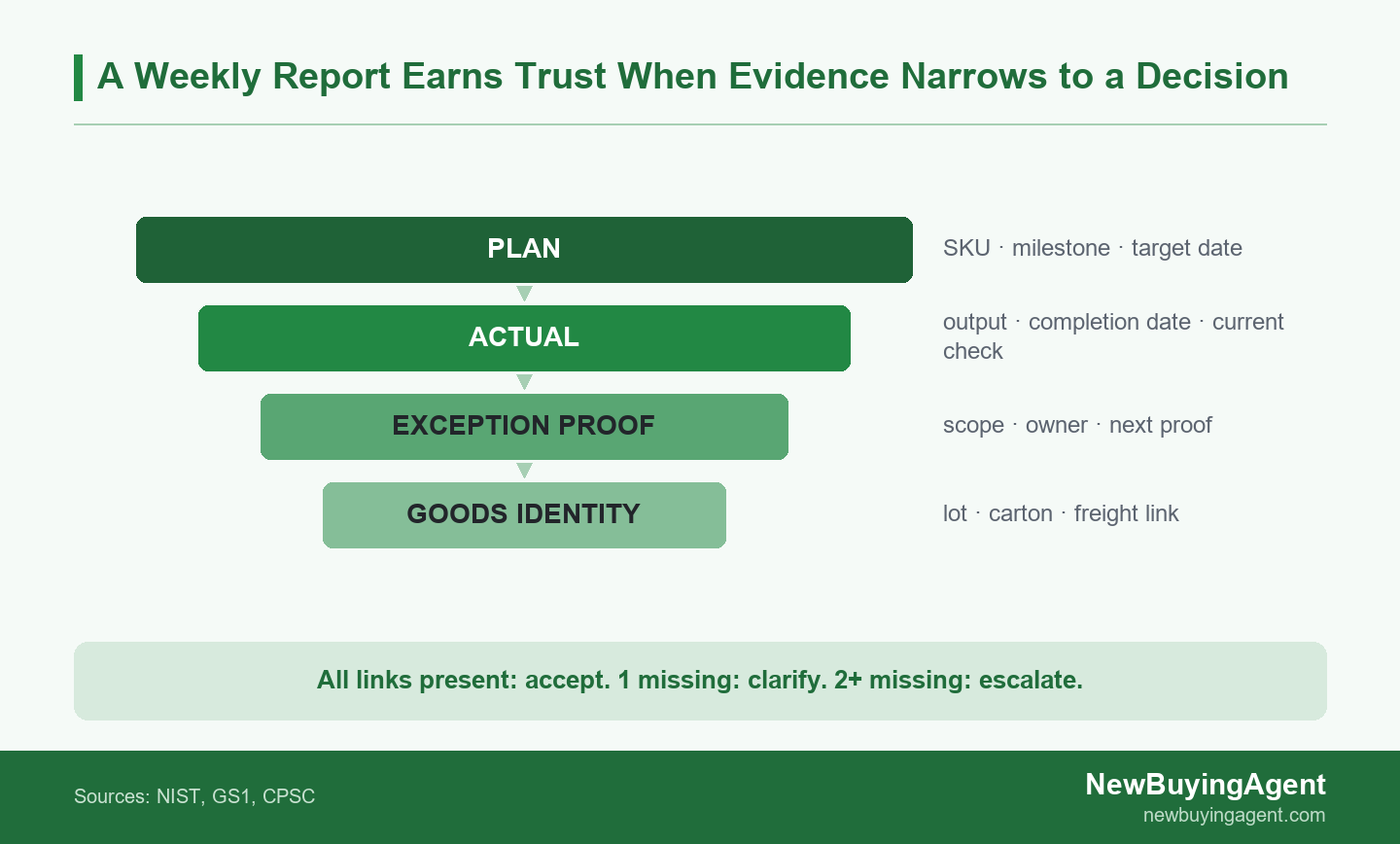
Evidence funnel linking weekly production plans, actual progress, exceptions, goods identity, and buyer action.
Think of the report as a loop, not a list. The first link shows whether production moved. The second shows what went wrong or changed and how the response will be tested. The third shows which goods, lots, cartons, or handoff records the update actually covers. If a link is missing, the right response is usually a precise clarification, not an automatic assumption that the order is late or safe.
| Evidence link | What the report should show | Buyer decision it supports |
|---|---|---|
| Plan versus actual | Baseline milestone, current SKU or workstream output, date variance, and remaining work | Accept progress or ask why the plan moved |
| Exception versus recovery proof | Affected scope, issue owner, containment, corrective action, and a dated next check | Clarify a forecast or escalate a repeated unproven recovery |
| Status versus identifiable goods | SKU, lot, carton, pallet, shipment, or document reference appropriate to the order | Confirm which goods the evidence and response apply to |
When the product brief, quantities, target price, destination, and timing are already defined, the same fields create a cleaner starting point for product supply. You can use NewBuyingAgent's product-supply service for a defined China purchase with a reporting expectation that follows the order from production through handoff, rather than treating weekly communication as a separate activity.
Start With Plan Versus Actual
NIST describes production status in terms that include quantity made, scrap and rework rates, and comparison with the production schedule. NIST’s publication record for its manufacturing planning and execution work is a useful reminder that a status line needs a schedule context.
In a buyer-facing weekly report, that does not mean every factory must use the same dashboard. It means the comparison should remain legible. For each SKU, production group, or critical workstream, show the planned milestone beside the actual status. If an order is due to enter packing this week, “80% complete” is weak evidence. “SKU A complete and awaiting inspection; SKU B has 2,000 of 3,000 units packed; SKU C is awaiting corrected material; revised packing check on Thursday” is something you can evaluate.
Ask the sourcing agent to keep the original planned date visible even when the forecast changes. Otherwise, each new date quietly replaces the last one and you lose the trend. Also ask what the percentage measures: pieces produced, pieces passed, pieces packed, or cartons ready for pickup. Those are different states, and mixing them can hide the work that still prevents shipment.
Then Record Exceptions and the Next Proof
Production monitoring becomes useful when problems are identified, corrective actions are named, and the result is reviewed with new evidence. A changed date is only a forecast until the report identifies the cause, the affected scope, the owner, the containment action, and the next proof point.
Use an exception log for this work. In plain terms, it is a short record of the issue, which goods or process step it affects, who is responsible, what is being done, and when the buyer will see confirmation. A complete entry may say that a colour mismatch affects cartons from one run, that the affected units are separated, that rework is assigned to a named owner, and that updated inspection photos and count results will be supplied on a stated date. It does not need dramatic language; it needs a testable next step.
ISO implementation material emphasizes documented information and records that show whether processes are carried out as planned, including records of nonconformities and actions taken. See the ISO committee’s public ISO 9001 implementation resources. For the buyer, the practical rule is narrower: do not accept a recovery date by itself. Ask what must happen before that date can be believed and what record will show that it happened.
Finish With Lot, Carton, and Handoff Links
Traceability records can link product status to lot, batch, supplier, carton, or logistic-unit identifiers. The appropriate level depends on the goods and the order, but unlabelled photos alone rarely establish which population of products was inspected, reworked, packed, or held.
For many orders, a SKU plus carton marks and dated packing photos may be enough to connect the update to the goods. Other supply chains need a lot or batch number. In logistics systems, the GS1 term Serial Shipping Container Code, or SSCC, identifies a logistic unit such as a case, pallet, or parcel. GS1’s identifier reference defines SSCC as the Serial Shipping Container Code. You do not need to impose SSCC on every purchase. You do need to agree an identifier that lets the agent, factory, inspection evidence, packing list, and handoff discussion refer to the same goods.
The boundary becomes especially important for products with product-specific traceability rules. For example, the CPSC’s U.S. apparel and household textiles guide discusses tracking information for children’s products, including production location and date, batch or run information, and the specific source. Review the CPSC guide for the U.S.-specific example. That is not a worldwide template. It is a reason to ask, before production starts, which product and destination records sit outside the weekly report.
What a Report Should Trigger When a Plan Slips
A second unproven recovery date should trigger a scope-specific escalation review rather than routine acceptance. That is an operating rule informed by the production-status concepts in NIST’s manufacturing execution publication, not a universal release rule. The goal is not to create an automatic hold. It is to stop a moving forecast from replacing evidence of remaining work, quality condition, and affected goods.
This distinction matters when an existing China factory is already producing. Local follow-up is most useful when the buyer’s reporting standard makes the next question clear: what moved, what is contained, and when will the recovery be checked? For that situation, you can use NewBuyingAgent's factory-management service for an existing China supplier with the current plan, open issues, and required evidence provided up front.
Run a Scope-Specific Evidence Review
When a second recovery date arrives without SKU-level scope, an owner, and a dated proof point, the buyer should review the affected population and containment before accepting the new window. This illustrative example is not a NewBuyingAgent client case or a universal shipment-release rule.
A buyer has four SKUs totaling 6,400 pieces on one China purchase and a retail launch that depends on a week-three packing milestone. Two SKUs with 1,900 pieces are not supported by the original packing milestone. Two SKUs have recorded output. For the other two, the weekly update provides no plan-versus-actual line, the photos do not show carton marks, and two quality findings remain open. The first report still says production is on track. That wording creates no usable comparison: the buyer cannot see the remaining output, which goods are tied to the findings, or whether the pack date still has support.
In the following update, the ship window moves again. The two findings still have no named owner or recheck date, and the completed-quantity photos cannot be tied to the affected SKUs. These are not three separate communication complaints. Together they break the evidence loop: the plan-versus-actual link is incomplete, the exception has no recovery proof, and the reported evidence does not identify the goods it covers.
The buyer should classify this as an escalation review, not because a delay is certain, but because the recovery cannot yet be tested. Ask for a SKU-by-SKU recovery sheet that states planned output, actual output, remaining units, bottleneck, and revised milestone. Ask for the scope of each quality finding, the containment action, the responsible owner, and the date and format of the next proof. Then ask for carton, lot, or other agreed identifiers on the evidence for the completed and affected quantity. This separates the two SKUs with unproven readiness from the work that may still be progressing normally.
At the next review, compare the actual output against the recovery sheet rather than comparing two assurances. Confirm that the named quality actions have a recorded disposition and that the photos or records identify the goods they describe. If the evidence matches, the buyer may accept the revised window for the documented scope while continuing to review the remaining risk. If it does not, the delivery promise remains under review. This illustrative example does not replace product-specific inspection, customs, carrier, test, or destination-market requirements; it gives the buyer a clearer basis for deciding what additional evidence is needed.
Set the Reporting Contract Before Production Starts
Agreeing report fields before production starts makes weekly updates comparable and limits unsupported schedule reassurance. ISO’s public implementation material provides the documented-information context for keeping planned work, records, and corrective actions accessible. Review the ISO committee’s implementation resources. Put the fields into the purchase brief, order timeline, or agreed reporting note so both sides know what “complete,” “delayed,” and “verified” mean before the first exception appears.
A practical reporting contract can be short. It should specify:
- the baseline milestones and the unit of progress for each critical SKU or workstream;
- the normal reporting cadence and the events that require an immediate update;
- the minimum evidence for output, quality findings, packing, and handoff;
- the identifier that connects photos, samples, cartons, lots, or shipment documents to the reported goods; and
- the escalation trigger, such as a second unproven date change, a material quality hold, or missing scope for a stated issue.
A weekly operating report does not replace destination-specific entry or product-verification records. For U.S.-bound orders, Customs and Border Protection describes commercial-invoice information for entry documentation and separately states that entry records must be retained for five years. Read CBP’s commercial-invoice guidance and its entry-record-keeping guidance. These are U.S. examples, not advice for every destination.
The same boundary applies to product categories. FDA states that applicable U.S. food importers maintain verification activities and records for each imported food and foreign supplier under the FSVP framework. Read the FDA’s FSVP records update. A production report can point to the relevant lot, issue, or check; it should not be presented as legal, customs, food-safety, or product-certification evidence.
Once you have a clear purchasing brief and a reporting contract, you can review NewBuyingAgent sourcing case examples for context on buyer requirements across the sourcing path. If you need product supply or local follow-up for a defined China purchase, send a production-ready purchasing brief to NewBuyingAgent with the product specification, quantities, destination, required timing, baseline milestones, and the evidence you expect to receive.
Frequently Asked Questions
How often should a sourcing agent send production reports?
Weekly reporting is a practical default for active production, but a material delay, quality hold, or date change should be reported when it occurs rather than saved for the next cycle. Residual buyer questions need concise timing and evidence boundaries. The right cadence depends on the order’s risk and milestone density. More frequent messages do not help if they repeat vague language. Agree the normal weekly record and define the exceptions that require an immediate, evidence-backed update.
Are factory photos enough evidence in a weekly update?
Factory photos are useful context, but they are not enough on their own because they rarely show the exact SKU, lot, quantity, condition, and milestone that a buyer needs to verify. Ask for a label, carton mark, lot reference, measured quantity, or other agreed identifier beside the photo when the evidence needs to support a shipping, quality, or recovery decision.
What should happen when the revised ship date changes again?
A second unproven date change should trigger a recovery review with the affected SKUs, remaining work, bottleneck, owner, and the next evidence checkpoint instead of another unsupported promise. Keep the original plan visible, separate the documented ready scope from the unproven scope, and decide whether the buyer needs more evidence, a revised handoff plan, or a formal escalation under the applicable commercial agreement.
Do regulated products need more than a weekly production report?
Yes, regulated or safety-sensitive products can require destination-specific verification records, testing, labels, or filings that a general production report cannot replace. Use the report to connect an issue or milestone to identifiable goods and to flag the next check. Confirm the exact product and destination obligations with the responsible compliance, customs, testing, or legal advisers for the shipment.
NewBuyingAgent
Related Resources



Get Started Today
Let's Turn Your Sourcing Goals into RealityWeChat:+86 15157124615
WhatsApp:+86 15157124615
Address:Building 10 #39 Xiangyuan Road, Hangzhou, China
