

For a China shipment, ICC A, B, and C are best read as three different starting points for a risk-and-document conversation. The buyer needs to know which loss event the cover addresses, what exclusions remain, and whether the certificate matches the sale term, cargo, and route. That comparison becomes far more useful before carrier handover than after a claim question appears.
NewBuyingAgent helps global buyers organize China-side product, packing, and supplier information; insurance placement and coverage advice remain with the buyer's insurer, broker, and qualified advisers. The resulting purchase brief gives those parties a more consistent set of transaction facts.
Cargo Insurance Is a Coverage-and-Document Decision, Not a Letter Choice
ICC-A, B, and C are starting points for a cargo-insurance comparison, not a substitute for the policy schedule, exclusions, deductible, transit scope, and endorsements. IUMI's marine cargo guide is a useful explanation of that distinction.
The Institute Cargo Clauses (ICC) are standard cargo-insurance clause forms. They help a buyer frame the question, but they do not by themselves show what a certificate actually covers on one China shipment. The controlling documents are the certificate or policy schedule, the clause wording, exclusions, deductible, endorsements, declared value, transit period, and the sale contract.
Practical definition: compare ICC A, B, and C as different starting points for covered events, then check the remaining exposure against the shipment file before cargo moves.
This is a general educational comparison, not legal, insurance, or claims advice. A buyer should ask its insurer, broker, or qualified adviser to confirm the actual policy and contract position for the transaction.
Three Clause Questions That Change the Shipment Decision
A cargo-insurance clause letter does not replace checking the policy gap that remains for the shipment.
- What event must be shown? ICC A is generally described as broader accidental-loss wording subject to exclusions; ICC B and C begin with listed events.
- What does the sale term actually require? A seller may meet an Incoterms insurance duty without creating the complete risk position a buyer wants.
- What document proves the intended scope? Match the certificate with the policy wording, declared value, route, deductible, exclusions, and any extension before carrier handover.
Those questions prevent a common mistake: treating a reassuring clause label as a complete answer to damage, delay, handling, or commercial-loss risk.
What ICC-A, B, and C Actually Compare
The central difference is the type of insured event the buyer may need to establish: ICC A is commonly described as all-risks subject to exclusions, while ICC B and C are named-perils forms. IUMI also notes that the assured still needs to establish the relevant covered circumstances.
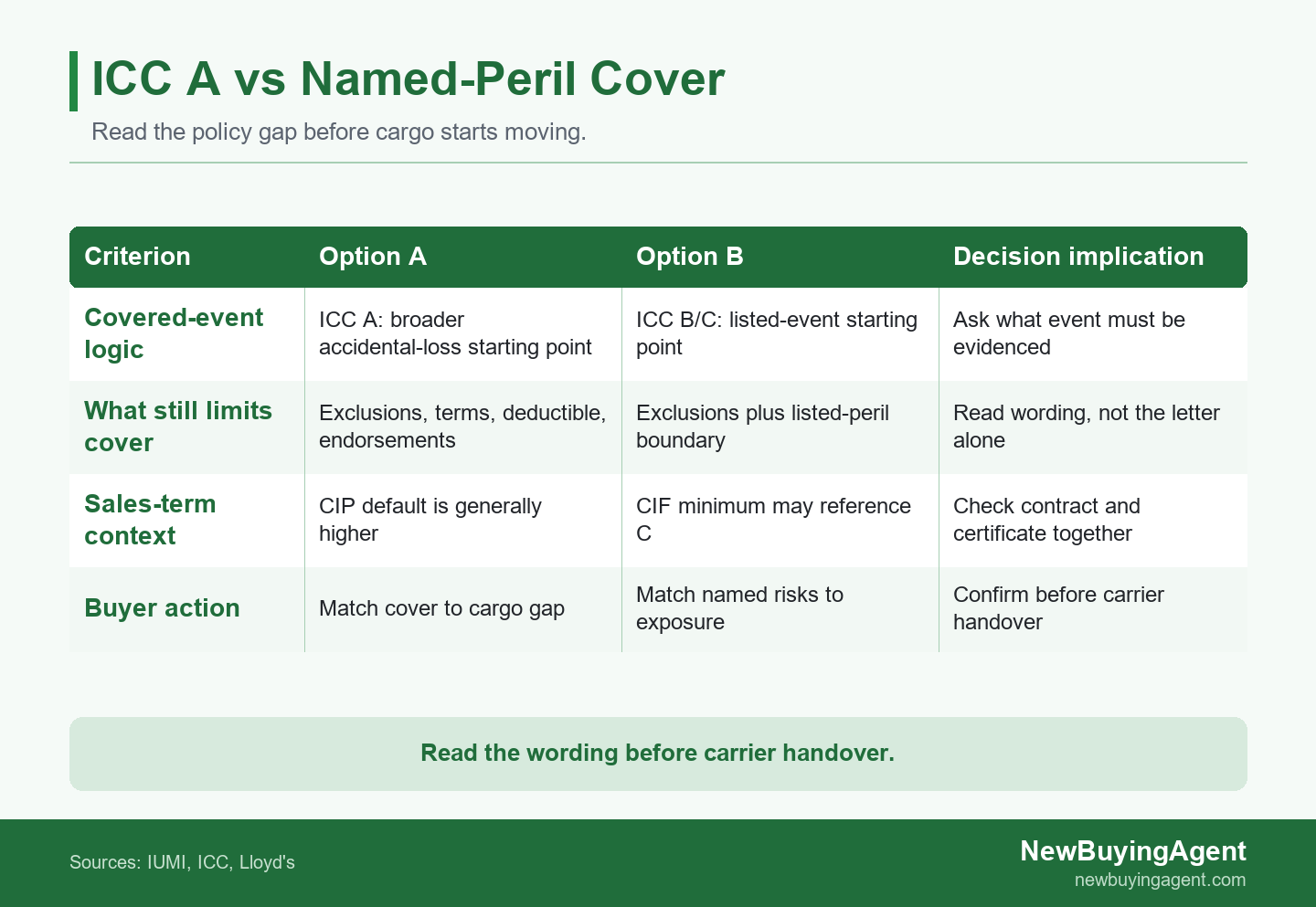
ICC A versus named-peril cargo cover: four checks before shipment
“All risks” is industry shorthand, not a promise that every adverse business outcome is insured. In plain language, it is broader accidental-loss wording subject to exclusions. “Named perils” means the policy starts from a list of events; the loss must fit that list and the other policy conditions. In both cases, the exact wording and evidence matter.
| Comparison point | ICC A | ICC B | ICC C | Buyer check |
|---|---|---|---|---|
| Starting logic | Broader accidental physical-loss wording, subject to exclusions | Named-perils wording | Named-perils wording with a narrower listed-event starting point | Ask what event and proof the policy requires. |
| What the letter does not settle | Exclusions, deductible, policy period, declared value, destination, packing conditions, and endorsements. | Read the schedule and wording together. | ||
| Commercial decision | Whether the buyer can accept the uninsured gap if a loss falls outside the actual cover. | Compare the gap with cargo and contract exposure. | ||
ICC A: Broader Accidental-Loss Starting Point, Still With Exclusions
ICC A can be broader for accidental physical loss or damage, but 'all risks' does not mean every commercial loss or every cause of damage is covered. Both the IUMI guide and the Lloyd's cargo claims manual point to the separate clause forms and exclusions.
For example, do not assume that delay, ordinary leakage or wear, inherent vice, inadequate packing, war, strikes, or a requested extension will be dealt with in the same way for every certificate. A buyer does not need to memorise every exclusion; it does need to identify the shipment conditions that could make a gap material and ask the insurer or broker about them.
ICC B and C: Named Perils Need a Closer Match to the Event
ICC B is a named-perils form that lists events such as fire or explosion, stranding, collision, water entry, and certain overboard losses in its standard wording. The published ICC B wording illustrates why the buyer should match a possible loss event to the actual list.
ICC C is commonly the more limited named-perils starting point. That does not make it automatically wrong; it can be the agreed contractual minimum for a transaction. The practical question is what physical-loss event, handling point, or transit exposure remains outside the intended scope, and who has deliberately agreed to retain that exposure.
CIF and CIP Can Set Different Minimum Insurance Expectations
A CIF price can meet a minimum insurance obligation based on ICC C or similar, while CIP's default insurance obligation is generally higher under ICC A or similar; neither label tells the buyer every detail of a particular certificate. The ICC comparison, ICC Academy's CIP guidance, and the ICC checklist describe the Incoterms 2020 default positions.
That distinction matters because an Incoterms rule allocates particular seller and buyer duties. It is not a complete description of the buyer's risk appetite. Under CIF, for example, a seller's minimum insurance obligation may be lower than a buyer's desired scope. Under CIP, a higher default insurance duty does not eliminate the need to read the certificate, any agreed variations, the transit period, or the policy conditions.
Risk transfer can also happen at a point that is different from the cargo's final destination. Put the named Incoterms rule and place in the purchase contract beside the insurance certificate. Then ask one simple question: when the buyer carries risk, does the document set show the intended protection?
Choose Coverage by the Gap You Cannot Absorb
The practical choice is driven by cargo vulnerability, packaging, route, storage and handling exposures, contract responsibility, and the cost of a gap—not by calling one clause universally best.
Start with the cargo, not the clause letter. Fragile, moisture-sensitive, high-value, seasonal, or tightly scheduled goods may make particular damage or delay consequences harder to absorb. Robust goods may have a different risk profile. The purchase price is only one input: replacement lead time, retail launch timing, destination handling, packing control, and the party carrying risk all belong in the discussion.
For an existing supplier program, accurate packing lists, product descriptions, loading details, and exception records make the insurance conversation more concrete. If those records need China-side coordination, ask NewBuyingAgent to manage your China factories around a shared purchase and shipment brief. That service does not place insurance or advise on coverage. The same records distinguish a factual packing revision from an assumption about what the certificate says.
Illustrative Scenario: Two Buyers, One USD 70,000 Shipment Value
An illustrative USD 70,000 China shipment shows why two buyers can make different clause decisions when cargo, contract term, and acceptable uninsured exposure differ.
Two Buyers Can See Different Coverage Gaps
The same shipment value can lead to different questions when cargo, contract term, and retained exposure differ.
A global buyer is importing a USD 70,000 mixed home-goods shipment from China. The teaching shipment includes boxed ceramic lamps and metal accessories, with a sale term and insurance certificate still under review. Goods are packed, but the buyer has not confirmed the clause wording, deductible, and whether the declared value and destination match the purchase terms. This illustrative example concerns 2 buyer decisions for 1 China-origin mixed shipment, not a NewBuyingAgent client case, premium quote, or instruction to select a particular policy.
Buyer One is purchasing under a term where the seller's minimum insurance obligation may be limited. Buyer Two has a more fragile cargo mix and a lower tolerance for an uninsured physical-damage gap. Neither buyer should jump from that fact to an automatic clause choice. Each should first establish what cover has actually been arranged, which exclusions and deductible apply, and whether the contract gives either party a further responsibility.
The cargo value alone does not choose the clause. The decision changes with how the cargo can be damaged, what loss must be evidenced, which exclusions apply, and whether the buyer accepts the remaining exposure. Treat the letter in the certificate as one input, then ask for the policy wording and compare it against the sales term, cargo, value, transit, and required extensions.
Before shipment, revise the insurance instruction or contract wording if the declared cover does not match the buyer's agreed risk position. Release only after the certificate/policy, declared value, clause, deductible, destination, and claim contact are coherent in the shipment file. This illustrative example is not a premium quote, binding recommendation, or customer case. The useful output is not “choose A” or “choose C”; it is a documented decision about the gap the buyer is willing or unwilling to retain.
Ask for the Certificate and Policy Details Before Cargo Moves
Before shipment, the buyer should compare the certificate and policy wording with the sale term, insured value, deductible, transit limits, exclusions, and documentation path because carrier liability and insurance responsibility are distinct questions. The U.S. International Trade Administration similarly cautions that international agreements can limit carrier liability and that insurance responsibility depends on the sale terms.
Use this as a transaction-review checklist, then ask the relevant insurer, broker, or adviser to confirm the answers:
- Clause and wording: Is the certificate tied to ICC A, B, C, or another wording version? Obtain the actual applicable clauses.
- Insured value and currency: Does the stated amount align with the commercial invoice, contract, and any agreed uplift? Do not assume a percentage used in one transaction applies to all others.
- Transit scope: Check the insured journey, origin, destination, warehousing, transshipment, and when cover attaches and ends.
- Exclusions, deductible, and endorsements: A deductible is the amount the insured retains before cover responds. An endorsement is a policy change or added condition; it may add or narrow a relevant point.
- Claim path: Keep the certificate or policy, invoice, packing list, transport document, photos, inspection evidence, and notification contacts together.
Make the check before cargo is handed to the carrier, when mismatched value, route, clause, or wording can still be clarified without reconstructing the decision after a loss.
Put the Insurance Questions Into the China Purchase Brief
For a new China purchase, a complete product and shipment brief helps align product, packing, destination, timing, and insurance assumptions before a quote-to-supply path is agreed. Buyers developing a new sourcing program can ask NewBuyingAgent to supply products from China with those facts available from the outset.
For an existing supplier program, shipment records, packing details, and exception evidence can be organized through China-side factory-management support, while insurance placement stays with the buyer's insurer or broker. That distinction keeps the sourcing brief factual: it supports an insurer conversation without implying that operational support decides the coverage.
NewBuyingAgent can help organize sourcing and supplier information, but it does not underwrite cargo insurance, issue a policy, decide a claim, or give legal advice. A purchase brief is most useful when it makes the product and handling facts usable by the parties who actually arrange cover.
Include the final product description, material or fragility notes, quantity, invoice value, packing list, destination, agreed Incoterms rule and place, expected departure window, and any unusual handling or storage point. If several suppliers contribute to one shipment, identify which factory supplied each lot and which packing record belongs to it. That does not determine insurance scope, but it reduces the chance that a certificate refers to a value, route, or cargo description that no longer matches the physical goods.
Keep the commercial and physical records version-controlled. A late packing-list revision, destination change, split shipment, or added warehouse leg should trigger a fresh document comparison. The goal is not to turn a sourcing team into an insurance desk. It is to make sure the broker, insurer, supplier, forwarder, and buyer are discussing the same shipment rather than separate versions of it.
When the product and shipment facts are ready, contact NewBuyingAgent with a complete China purchase brief.
Frequently Asked Questions
Is ICC A the same as insurance for every possible loss?
ICC A is not insurance for every possible loss because exclusions, policy conditions, deductibles, transit limits, and endorsements still shape the cover. The phrase “all risks” is a comparison shorthand for broader accidental-loss wording, not a guarantee that every business consequence or cause of damage will be paid. Read the policy schedule and clauses for the shipment, then ask the insurer or broker to interpret uncertain points.
Does CIF automatically give a buyer the right insurance cover?
CIF can satisfy a seller's minimum insurance obligation while still leaving the buyer to assess the stated scope, value, exclusions, and transit period. The Incoterms rule allocates duties; it does not replace a buyer's decision about acceptable retained exposure. Compare the named CIF place and contract wording with the actual certificate, then agree any needed insurance arrangement before the goods move.
When should a China buyer ask for the policy wording?
Ask for the policy wording before cargo is handed to the carrier, while value, route, clause, packing information, and responsibilities can still be clarified. Waiting until damage is reported can turn a simple document check into a dispute about assumptions. Keep the certificate, applicable clauses, commercial invoice, packing list, transport details, and claims contact in one transaction file.
Can a freight forwarder or carrier's liability replace cargo insurance?
For international shipments, carrier liability and cargo insurance are separate arrangements, and international agreements can limit carrier liability. Carrier liability and cargo insurance are separate arrangements, and international agreements can limit carrier liability. The International Trade Administration explains why an importer should not assume carrier liability is enough. The applicable transport contract, governing rules, and insurance wording determine the actual position, so confirm them with the responsible professional parties.
What should be in a cargo insurance claim file?
Keep the certificate or policy, commercial invoice, packing list, transport document, damage evidence, inspection records, correspondence, and insurer claim instructions together. The policy may set notification timing and document requirements, so follow its actual procedure promptly rather than relying on a generic checklist. A well-organized file does not guarantee a claim outcome, but it makes the shipment facts easier to establish.
NewBuyingAgent
Related Resources



Get Started Today
Let's Turn Your Sourcing Goals into RealityWeChat:+86 15157124615
WhatsApp:+86 15157124615
Address:Building 10 #39 Xiangyuan Road, Hangzhou, China
