
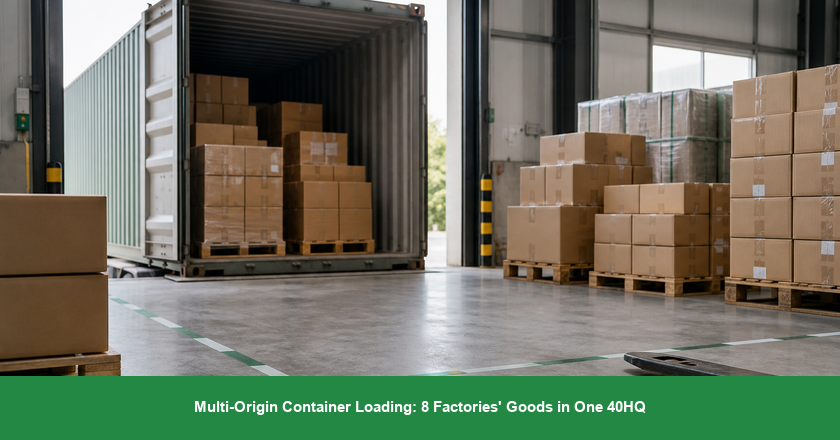
Putting eight factory lots into one 40HQ is not a question of how many supplier names fit on a booking. It is a controlled loading event: every included lot needs to agree with one carton-and-weight sheet, one arrival sequence, one floor plan, and one evidence handoff before the seal goes on.
A 40HQ means a 40-foot high-cube container. It can be a useful equipment choice for a multi-origin full-container load, but it is not a promise that every group of eight factories will fit or can be released together. Confirmed dimensions, gross cargo weight, packing pattern, route conditions, equipment details, and the responsible carrier or warehouse instructions still determine the shipment.
One 40HQ Is a Loading-Control Problem, Not an Eight-Factory Count
A published equipment figure is a starting reference, not a loading target. For example, Maersk lists 76.4 m³ capacity and 28,690 kg maximum payload for one 40-foot high-cube steel container type, and also says specific weight limits can vary by country. That is why a buyer should not turn a website figure into a blanket approval for a particular load.
The more useful question is: can the warehouse show how the actual factory lots will enter, sit, and leave the container as one documented plan? If a late factory, concentrated hardware lot, weak carton, or missing weight record changes that plan, the right response is a controlled hold or re-sequence—not a last-minute assumption that unused cubic volume solves the problem.
The Five Controls That Make a Multi-Origin 40HQ Loadable
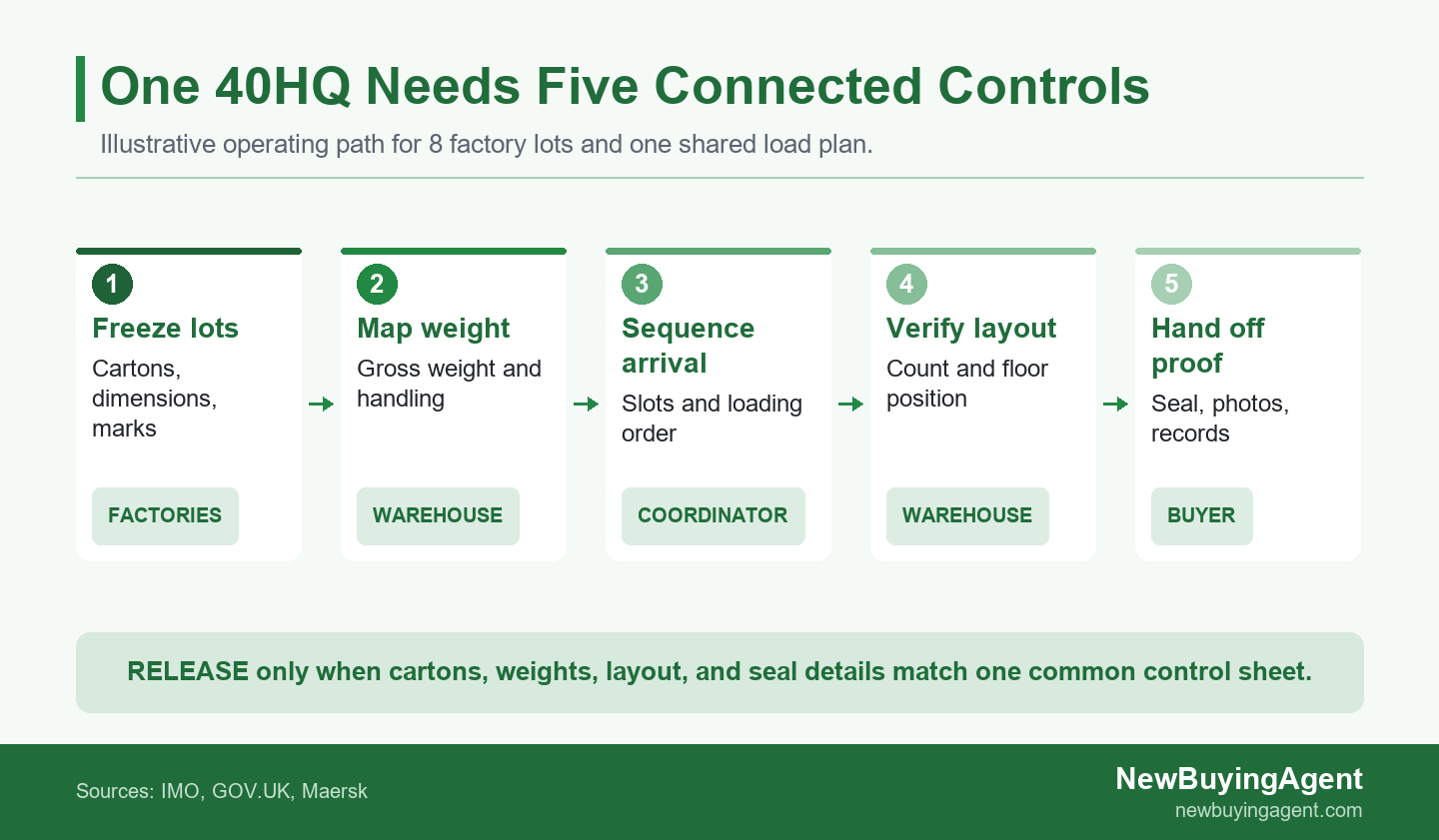
A practical multi origin container 40hq brief connects five controls. They work as a chain: a later control cannot rescue an earlier unknown.
- Freeze the factory inputs. Agree carton count, dimensions, gross weight, marks, handling restrictions, and arrival slot for each included lot.
- Read weight as well as volume. A container can look spacious while a concentrated lot creates an unsuitable floor position or stacking problem.
- Sequence arrivals and loading. The first truck at the warehouse is not automatically the first cargo that should enter the container.
- Verify against the floor plan. Compare actual cartons and positions with the agreed plan while loading, not after the doors close.
- Hand off evidence with the seal. Give the buyer a small, traceable record of what was loaded, how it was checked, and which seal was recorded.
This sequence is deliberately stricter than asking each factory whether its goods are “ready.” Ready for a multi-origin load means ready for this shared plan. A finished lot with an unconfirmed count or a different weight basis is not yet a reliable input.
Use a Container Control Sheet Before Cargo Reaches the Warehouse
Start with one control sheet that has a row for every factory lot. It is not a freight quote or a substitute for carrier instructions. Its job is to expose the facts that otherwise live in separate supplier chats, packing lists, and last-minute warehouse calls.
Five-step multi-origin 40HQ loading path from carton freeze through evidence handoff
| Control field | Factory confirms | Warehouse checks | Release evidence |
|---|---|---|---|
| Carton identity | Final count, marks, carton dimensions | Count received against the shared row | Final count sheet and receiving record |
| Weight basis | Gross weight by lot and any concentrated items | Whether the floor plan still supports the actual distribution | Recorded weight input and exception note |
| Arrival and sequence | Arrival slot and handling restriction | Loading order against the floor plan | Updated plan if sequence changes |
| Final handoff | Agreed documents and contact person | Seal, photos, final access check | Seal record linked to the final load |
Freeze Cartons, Weights, and Arrival Slots
Give the sheet a defined freeze point. Before that point, a factory can change carton count, packing pattern, or arrival timing through the agreed channel. After it, an unconfirmed field is a hold condition. That avoids quietly loading a revised lot against an old plan simply because the truck is already waiting.
Use the same discipline for mass information. Maersk describes verified gross mass (VGM) as cargo, dunnage and bracing plus the container tare, and describes methods based on weighing the packed container or summing the contents with tare. Here, dunnage means material used to support or secure cargo. Your actual VGM method and submission requirement should follow the applicable shipment process, but the buyer's planning sheet should make the underlying weight inputs visible early.
The arrival slot deserves the same status as a carton count. State the earliest and latest acceptable arrival, whether a lot needs floor-level placement, whether cartons can bear stacking, and who must approve an exception. A spreadsheet without these operational notes is only a supplier list.
Buyers with established factories can ask NewBuyingAgent to manage their China factory coordination around one shared load brief. Ask NewBuyingAgent to manage your China factories so factory follow-up and shipment preparation do not depend on disconnected updates.
Design the Load by Weight and Sequence, Not by Factory Order
UK government load-securing guidance advises spreading weight over the floor area, keeping the centre of gravity low, and placing heavier items lower in a stack. In the maritime context, IMO also identifies stowage and securing as part of the container-safety context. These are useful principles for planning; they do not replace the warehouse's responsibility to apply the right handling and securing method for the actual cargo.
Build the floor plan from the cargo characteristics, not supplier seniority or arrival order. Put the lots that need a particular floor position into the plan first. Then reserve positions for light cartons, access to the doors, and any material needed to keep the final arrangement stable. If a heavy lot arrives late, it may need to replace a planned central position rather than occupy the first open space by the door.
Illustrative Scenario: Eight Factories, One 40HQ, One Loading Plan
The following teaching case is not a customer shipment, a carrier limit, or a loading authorization. It shows how an eight-factory plan can change when the final lot has a different weight profile.
Buyers with a new product program can ask NewBuyingAgent to source products from China before several factory lots need to converge. Ask NewBuyingAgent to source products from China after product specifications and packing expectations are clear enough to support a shared plan.
Correct the Door-End Imbalance Before the Seal
A global buyer is consolidating finished goods from eight China factories into one 40HQ. The teaching load has 760 cartons and an illustrative total gross cargo weight of 17.4 tonnes. One concentrated hardware lot is the final scheduled arrival. Seven lots have confirmed carton and weight records; the eighth lot is confirmed but its original door-end position conflicts with the intended floor distribution.
Seven factory lots agree with the shared carton and weight sheet before loading starts. The late-arriving concentrated hardware lot would place too much planned mass at the door end if loaded into the first available space. The initial map left door-end space because the team planned around cubic volume, but that choice would concentrate too much of the teaching load at one end and remove the intended access. The total listed weight has not changed, but the correct decision has: re-sequence the concentrated lot into the planned central zone before further loading.
The correction is not to force the final lot into the first open space. Update the floor map, recount the affected lots, and photograph the corrected layout before the final seal handoff. Release only when final carton counts, planned positions, documented mass inputs, and seal record agree with the control sheet. This illustrative example concerns 1 late concentrated lot and 1 planned door-end zone; it uses teaching inputs, not a carrier quote, legal limit, or real customer shipment.
This is why “eight factories in one 40HQ” should not be sold internally as a volume exercise. The useful result is a planned sequence that still makes sense after actual cartons and actual weights arrive.
Release Only When the Last Pallet Matches the Plan
A final pallet is not a release signal by itself. The release question is whether the actual shipment still agrees with the plan that justified using one container in the first place.
- Match the final received carton count to every factory row; isolate any unmatched or substituted cartons.
- Compare the loaded positions to the current floor map, including the heavy or concentrated lots that drove the sequence.
- Confirm that the agreed weight-record process, shipment documents, and responsible contacts point to the same container event.
- Record the seal and final photographs only after the count and layout checks are complete.
If a late lot breaks the floor plan, do not hide the exception inside a general “loaded” update. Re-plan it, move it to a controlled alternative, or wait for a revised instruction. The answer depends on the current cargo and booking conditions, but the decision should remain visible to the buyer.
Make the Seal Handoff an Evidence Handoff
A useful final handoff is compact: the final factory-lot count, the current floor-map reference, the relevant weight record, a small photo sequence, the seal identifier, and the matching shipment-document details. That is enough to make a later question traceable without turning the loading day into a document dump.
The IMO/ILO/UNECE CTU Code is described by IMO as a global, non-mandatory code of practice for handling and packing cargo transport units across sea and land transport. That context is a useful reminder that the evidence pack should support real packing and handoff work; it should not be treated as a generic compliance badge.
UK VGM guidance describes a documented method that can sum cargo, pallets, dunnage, securing material, and container tare. Keep the factory-side inputs needed for the applicable method in the same project record as the final load evidence, then follow the specific submission process required for the shipment.
Give China-Side Coordination a Single Load Brief
One shared brief gives factory teams, warehouse staff, and the buyer a common version of carton, weight, sequence, and release information.
Early product and packing decisions determine whether later shipment inputs can be compared cleanly.
A practical first message includes the factory list, product categories, estimated cartons and weights, target loading week, destination, and any handling restrictions. If those inputs already exist, prepare them as one attachment and contact NewBuyingAgent with a multi-factory loading brief.
Frequently Asked Questions
Can eight factories always fit in one 40HQ?
No. The number of factories does not establish that a 40HQ is suitable. Actual cargo dimensions, gross weight, carton strength, packing pattern, route conditions, confirmed equipment, and the applicable loading instructions control the decision. Treat the factory count as a coordination fact, not a capacity calculation. A clear control sheet lets the buyer see which missing input prevents a release decision before a truck arrives at the warehouse.
Should I use the carrier's published 40HQ payload as my loading target?
No. Treat a published payload as an equipment reference for the stated container type. Confirm the booking, container, route, road, port, carrier, and warehouse conditions for the specific shipment before deciding what may be loaded and how it should be arranged. The applicable limit is a shipment-specific confirmation, not a planning shortcut copied from a generic specification page.
What should each factory confirm before a multi-origin loading day?
Each factory should confirm its final carton count, gross weight, outer dimensions, packing condition, marks, arrival slot, and handling restrictions against the shared load brief. If a value changes after the freeze point, update the plan openly rather than treating the old row as still valid. The buyer should be able to see who approved the revision, when it was made, and whether it changed the loading order or final evidence list.
What should happen if one factory is late?
Recheck the real floor plan and release window. Do not insert the late lot simply because there is visible space. If it changes the planned weight distribution, carton count, handling sequence, or evidence standard, hold it for a controlled alternative or obtain a revised plan before the container is sealed. This makes the exception a buyer decision with a documented consequence rather than an informal warehouse workaround.
Is a loading photo sequence enough evidence?
No. Pair a useful photo sequence with the final count, current load-plan reference, relevant weight record, seal identifier, and shipment-document details. The point is not to collect more images; it is to let the buyer trace what was loaded and which version of the plan governed the handoff. Keep the records with the shipment file so the buyer can answer a later count, seal, or receiving question without reconstructing the event from separate chat messages.
NewBuyingAgent
Related Resources



Get Started Today
Let's Turn Your Sourcing Goals into RealityWeChat:+86 15157124615
WhatsApp:+86 15157124615
Address:Building 10 #39 Xiangyuan Road, Hangzhou, China