

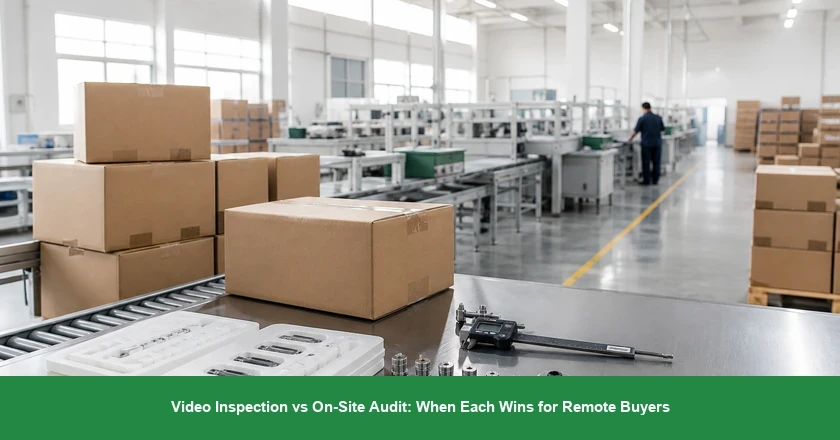
Remote buyers do not need to choose one verification method for every supplier question. They need to decide what proof would make the next commercial decision safe enough. A live video inspection can resolve a visible, time-sensitive point. An on-site audit can test evidence that is difficult to select, follow, or verify through a supplier-controlled camera route.
The useful distinction is not “remote versus physical” in the abstract. It is whether the method can independently reach the critical proof item: current carton markings, a production-stage condition, corrective-action records, traceability, process discipline, or the state of the factory itself. That distinction lets a buyer move quickly without treating a fast call as blanket supplier qualification.
Video Inspection Wins When the Question Is Narrow, Time-Bound, and Visible
A live video inspection is useful when the buyer has a narrow, visible question and can direct the evidence request in real time. The International Accreditation Forum’s guidance recognizes video, remote records access, and recorded information as possible ICT tools, while requiring the risks to audit effectiveness to be considered and documented. That makes live video a practical evidence method when the buyer knows precisely what must be seen, compared, or captured—not a substitute for defining the decision first. IAF MD 4 is useful here because it treats the technology as part of a controlled evidence process.
Good video candidates are bounded questions: Does the current lot carry the approved carton mark? Is the stated production stage active today? Can the supplier show a specific test record while the relevant item is visible? Is a packing method being applied before a booking deadline? The buyer can write the route in advance, request a live view of identifiers, and keep screenshots or a recording as part of the order file.
Video becomes weak when the request is “show us your factory” or “prove you are reliable.” Those are conclusions, not proof items. A polished walk-through can show clean floors and busy machines while leaving the buyer unable to connect a record to a lot, test a claimed process, or see what was outside the route. The question is therefore not whether the picture looks convincing; it is whether the picture, records, and follow-up can close a named decision.
An On-Site Audit Wins When the Decision Needs Independent Physical Evidence
An on-site audit is the stronger choice when a supplier decision depends on independent physical evidence that a camera route cannot adequately reach. ISO/IAF remote-audit guidance frames feasibility around the audit objective, available resources, and effective communication arrangements; it also allows remote and on-site activity to be combined. In other words, the method follows the evidence need, rather than a default preference for travel or video. ISO/IAF remote-audit guidance supports that objective-led boundary.
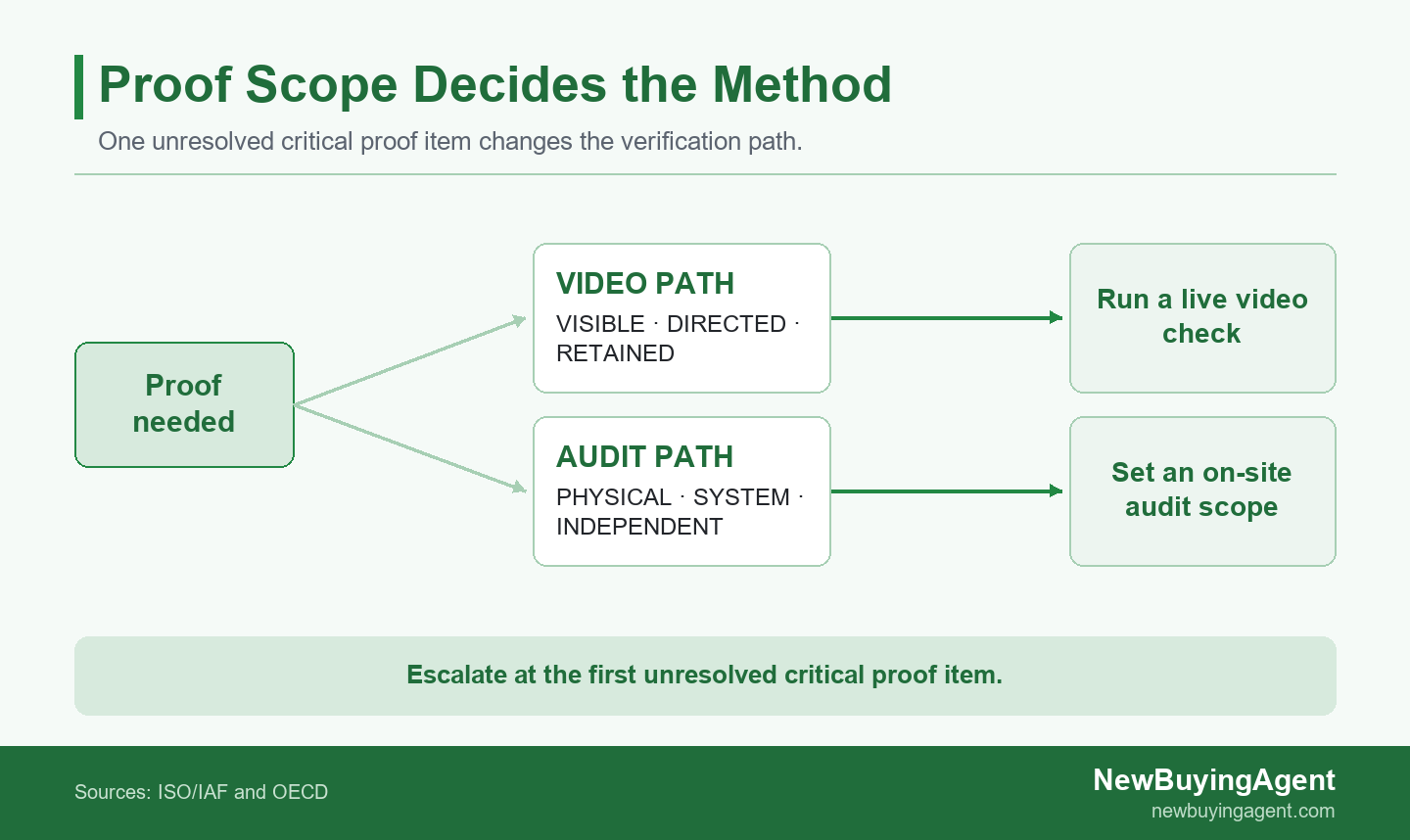
Split path showing when video proof is sufficient or an on-site audit is required
An on-site visit earns its cost when the result will determine supplier approval, a major production commitment, a response to a serious recurring issue, or a high-consequence claim about process control. The auditor can choose observations as conditions change, trace records back to the line, compare physical handling with written procedures, and test whether answers remain consistent across people and areas. That independence matters because the supplier does not control every next view.
An OECD report on international food-safety audits notes concerns that remote evidence may be selectively presented and that camera-based observations can miss cues. Its research scope is food safety, so it is not a universal statistic for commercial sourcing. It is still a useful reminder: when the consequence of being wrong is high, a buyer should not treat a supplier’s chosen visual route as independent proof.
NewBuyingAgent can provide China-side factory-management support for buyers who need local supplier communication, production follow-up, quality management, and logistics coordination. For an existing supplier relationship, that local execution can help turn a finding into a clear follow-up path instead of leaving the buyer to chase evidence across time zones. If the gap is ongoing supplier visibility rather than a one-off pre-purchase question, ask NewBuyingAgent to manage your China factories with the specific order stage and evidence still unresolved.
The Difference Is Evidence Reach, Not Camera Quality
Evidence reach means how far a verification method can independently access the proof needed for a specific buyer decision. It is an article-defined decision concept, not an ISO term. A high-resolution camera does not increase reach if the supplier chooses every location, record, person, and sample. Conversely, a well-run live call can have meaningful reach when the buyer has a limited question, can direct the sequence, and can compare what is shown with documents, identifiers, and earlier evidence.
- Use video for a defined visual question that a directed route can answer now.
- Escalate on site when an unresolved proof item needs independent physical observation or broader system checking.
- Use both methods when a quick operational question and a separate supplier-capability decision exist on the same order.
Start with the decision, then list the proof items that would justify it. A booking release may need current packing evidence. A new-supplier approval may need physical observation of process controls, traceability, equipment condition, and corrective-action practice. The first is often compatible with video; the second usually needs a broader, independent path. This keeps cost and speed in their proper place: as factors after the proof standard is clear.
| Decision condition | Video inspection is usually enough when | On-site audit is usually stronger when |
|---|---|---|
| Question scope | One visible condition, item, lot, or time-bound step | A supplier-system or approval decision |
| Evidence control | Buyer can direct live views and compare identifiers or records | Independent observation, interviews, or changing routes are needed |
| Consequence of error | The result closes a limited operational question | The result changes approval, production, compliance, or corrective-action decisions |
| Best next move | Run a directed live check and retain the evidence | Set an on-site scope and use video only for interim or supporting proof |
A Supplier-Guided Tour Is Not Yet a Directed Evidence Check
A remote check is more useful when the reviewer can direct live views, records, and follow-up requests rather than accept a scripted tour. The relevant standard is not hostility toward the supplier; it is whether the evidence can be tested. IAF guidance asks users of information and communication technology to identify risks that could affect effectiveness, while ISO/IAF guidance asks whether the resources and communication setup suit the objective. That makes feasibility part of planning, not an afterthought.
A directed video brief can specify a starting location, the order of areas to be shown, the lot or work-order identifiers to capture, the documents to open live, and the people who should be available for follow-up. Ask the supplier to move from a wide view to a specific item, then to the related record, rather than sending a pre-recorded clip. If the connection fails at the critical point, a document cannot be opened, or the route changes without explanation, record that as an evidence gap—not as proof that the factory is inadequate.
A Directed Video Check Still Cannot Qualify Every Factory-System Claim
A directed video check should escalate when the decision still requires physical observation, independent sampling, or broader system evidence. ISO/IAF guidance makes feasibility conditional on the audit objective; WHO/UNFPA remote-inspection guidance uses a risk-based approach that can combine video and document review with local support or follow-up. That is an institutional prequalification context, not a universal commercial rule. It nevertheless illustrates why mixed evidence is often more honest than a forced all-video answer. The WHO/UNFPA guidance is used here for the structure of the escalation, not to impose its sector rules on ordinary sourcing.
For example, video may confirm that cartons are being packed on a particular day. It may not establish whether the same controls operate across shifts, whether a corrective action was actually embedded in work practice, or whether traceability survives an unscripted walk from a finished carton back through the process. A buyer should state this limit up front: “Video can close the packing question; supplier approval remains conditional until the audit evidence is reviewed.”
Choose the Method With a Risk-to-Evidence Rule
The method choice should change at the first critical proof item that video cannot independently establish. This is a procurement decision rule, not a regulatory, certification, or legal standard. It prevents a common failure mode: setting up a video call because it is convenient, then quietly using its limited result to justify a much larger supplier or production decision.
- Name the decision that will be made after verification: release a packing change, accept a pre-shipment condition, start production, approve a supplier, or close a corrective action.
- List the proof items needed for that exact decision, including records, identifiers, physical conditions, and any independent observation.
- Mark which proof items a supplier can show live and which require the reviewer to choose the route, inspect broadly, sample, or test consistency.
- Choose video only if every critical proof item remains within directed video reach. Otherwise, use video for the bounded part and schedule an on-site audit for the unresolved part.
For a new China product purchase, verification expectations should be built into the product and supplier brief before sourcing commitments are made. This helps define what must be checked at sampling, production, packing, and shipment instead of improvising standards after a deadline is close. Buyers beginning a product program can ask NewBuyingAgent to supply products from China with product requirements, planned quantities, target timing, and the evidence they need at each stage.
Illustrative Scenario: One USD 80,000 Order, Two Evidence Gaps
Two Evidence Paths, Two Different Next Moves
One USD 80,000 illustrative order can contain both a bounded packing question and a separate supplier-system question. A UK home-goods buyer is preparing a first China production run with a new supplier. This is an illustrative USD 80000 order for 4000 units with a retailer launch date in six weeks. Packaging artwork is approved, but the buyer has not independently confirmed the supplier's process controls or the current packing condition.
The supplier can show carton marks and an active line on live video. The buyer still needs confidence that the factory, process records, and corrective actions are genuine and repeatable. Carton-mark and visible packing questions are bounded video checks; a supplier-system decision depends on broader evidence than a guided camera route can establish. The distinction is useful because both questions arrive on the same purchase order and feel urgent.
The buyer can close the visible packing question by video while holding supplier approval until an on-site audit closes the system evidence gap. Use a directed live video inspection for the immediate packaging proof and an on-site audit before treating the supplier as approved for the production program. Request a video route, current lot identifiers, document screens, and a separate audit scope for process, records, and corrective-action follow-up. The buyer proceeds only after the live evidence closes the packing question and the on-site findings close or clearly condition the supplier-capability question. The scenario is illustrative and does not predict defect rates or certify the factory.
Set a Remote Verification Brief That Can Trigger an On-Site Escalation
A remote verification brief should name the decision, proof items, live route, records, and escalation condition before the call is scheduled. FDA remote-assessment guidance explains that insufficient virtual interaction can lead to a different oversight route, and WHO/UNFPA guidance uses a risk-based mix of documents, video, and follow-up. Those are regulatory and institutional examples, not a buyer mandate; they are useful because both require the evidence plan to say what happens when the remote method cannot answer the question.
For a non-regulatory description of the method, FDA’s remote oversight tools explain that livestream video can work alongside records requests. A commercial buyer should still set its own evidence scope and escalation condition.
- Decision: State the exact outcome the evidence will support, such as releasing a packing change or deciding whether an on-site audit is required.
- Proof items: List the items, lot numbers, physical conditions, records, and people that must be shown or available live.
- Route and sequence: Define the starting point, areas, record screens, close-ups, and live comparisons; leave room for follow-up questions.
- Evidence record: Specify what will be retained: screenshots, meeting notes, document copies, timestamps, or a call recording where permitted.
- Escalation condition: Write the trigger in advance—for example, a missing traceability link, an unavailable record, an unexplained route change, or a supplier-approval question beyond video reach.
This brief is particularly valuable when travel is delayed but the buyer still needs a defensible interim answer. It tells the supplier what will be tested, gives the reviewer permission to stop at an unresolved gap, and prevents the status report from turning “we had a video call” into an unsupported conclusion.
Put the Evidence Gap Into Your China Supplier Plan
A useful China-side verification request identifies the supplier, product or PO, current stage, evidence gap, and timing. Add the decision that must be made and the proof that is still missing. That gives a China-side team enough context to separate a quick visible check from a broader factory-management or quality follow-up need.
For a new product purchase, this may mean attaching the product specification, sample status, packing requirement, and launch date. For an existing supplier, it may mean identifying the order stage, the process concern, the records expected, and the consequence if the evidence does not close. Keep the request focused on one next decision rather than a broad request for a factory review. When that brief is ready, contact NewBuyingAgent with the verification brief.
Frequently Asked Questions
Can a video inspection replace an on-site factory audit?
A video inspection can replace an on-site audit only for a narrow, low-consequence question whose needed evidence can be directed and retained live. It should not be treated as a replacement when the decision depends on independent observation, broader system evidence, sampling, or supplier approval. In those cases, use video as supporting proof and retain the physical review as the decision gate.
What should a live factory video inspection include?
A useful live video inspection should begin with the agreed decision and then show the requested areas, records, items, and test evidence in real time. Include identifiers that connect the physical item to its order or record, a planned route, a way to retain evidence, and an escalation condition if the requested proof cannot be shown.
When should a remote buyer pay for an on-site audit?
A remote buyer should fund an on-site audit when supplier selection, production risk, or compliance exposure cannot be resolved through supplier-controlled visual evidence alone. The decision is usually easier when framed as the cost of an unresolved critical proof item, rather than as a choice between a cheap and an expensive inspection method.
Is a video inspection the same as a pre-shipment inspection?
No, a video inspection is a method of gathering evidence, while a pre-shipment inspection is a defined check of the goods prepared for shipment. A pre-shipment inspection may use physical sampling and a stated acceptance scope; video can support a focused visual question before, during, or after that work, but it does not define the inspection scope by itself.
NewBuyingAgent
Related Resources
Get Started Today
Let's Turn Your Sourcing Goals into RealityWeChat:+86 15157124615
WhatsApp:+86 15157124615
Address:Building 10 #39 Xiangyuan Road, Hangzhou, China
