

Walmart packaging compliance is the alignment of a shipment's packaging, labels and related shipping information with the Walmart program and order requirements that apply to it.
A strong carton can still carry the wrong case code. Correct labels can still describe a different load. For an importer buying from China, preventing those mismatches means settling requirements before production and reconciling the actual shipment before dispatch. Public Walmart and GS1 materials establish general principles; account-specific instructions remain part of the shipment brief.
Make the shipment agree before it leaves China
A useful release decision connects the physical goods with their approved packaging and shipment records. It starts with the correct Walmart program, follows any change in case configuration through labels and quantities, and resolves discrepancies before dispatch. These controls help prevent avoidable errors; the applicable account instructions still determine the specific requirements and how any deduction is assessed.
- Decision: Identify the program, destination and controlling document version before approving packaging.
- Common mistake: Treating an unchanged product barcode as proof that a changed shipping case is correctly identified.
- Risk: A label, case count or electronic record can become obsolete after repacking.
- How it works: Compare the final load with the item data, labels, shipping notice and transport instructions.
Identify the Walmart program and the applicable instructions
Walmart packaging requirements need to be matched to the actual supply arrangement. Its public supplier requirements direct suppliers to examine case durability, markings, labels, palletization and trailer loading against the relevant specifications. For a China order, the practical starting point is to identify which party owns the Walmart relationship and which documents that party has authorized the factory to use.
A retail purchase order and a Marketplace seller's inventory shipment into Walmart Fulfillment Services (WFS) should not share an assumed universal packing rule. The WFS routing overview addresses its own fulfillment-center inventory flow, including packing, labeling and shipping guidance. Establish whether the order is retail supplier replenishment, WFS inventory or another arrangement before borrowing a size limit, label layout or appointment procedure.
Ask the supplier or selling-account owner for a controlled brief containing the program, receiving location, purchase order or shipment reference, applicable guides and revision dates. Include item-specific requirements, agreed case configuration and any written exception. A document without a known applicable version is an unresolved input, even when the factory has used something similar successfully before.
For an importer replenishing a kitchenware range, this work begins while product and pack specifications can still be priced together. NewBuyingAgent's local China factory network and product development and quality-control capability are relevant when the chosen pack must be reproducible across repeat orders. Put the retailer's requirements into the product brief so carton materials, packing labor and delivery needs are included in the supplied-product discussion.
Keep retailer authorization with the authorized account owner. A factory's agreement to follow a brief records what it will make; it does not grant an exception to Walmart's requirements. If two instructions appear inconsistent, obtain clarification for the affected order before committing the conflicting print run or loading arrangement.
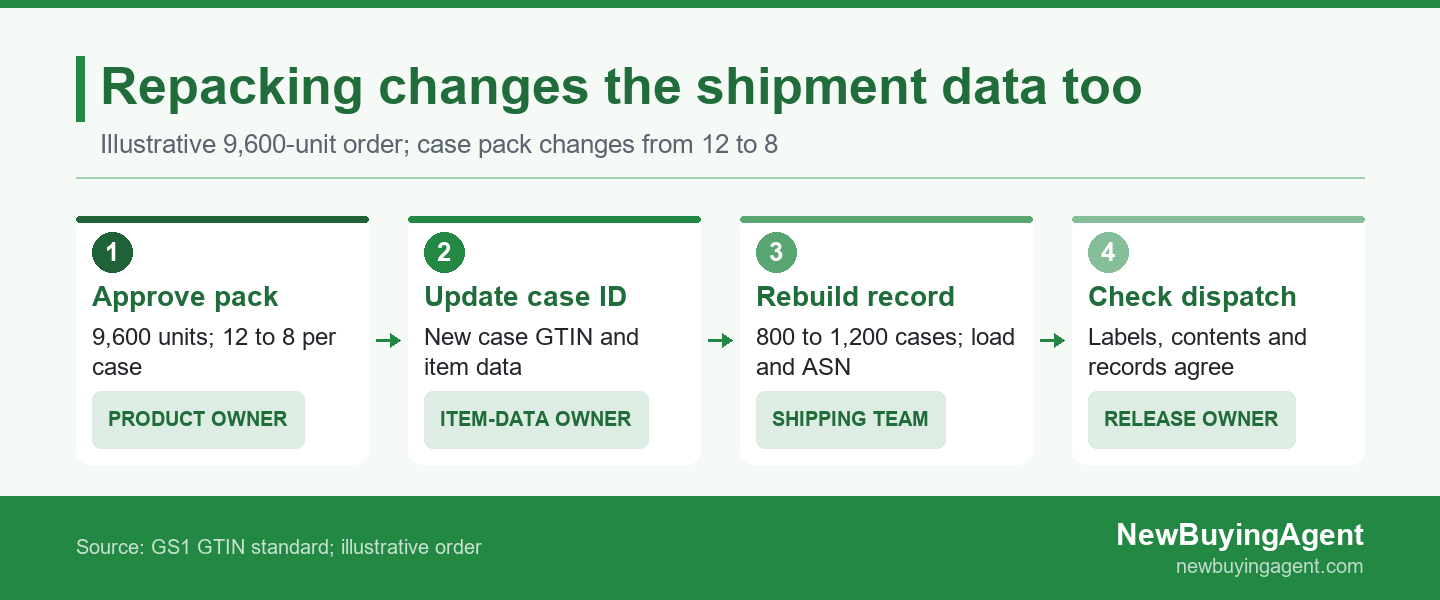
An illustrative case-pack change updates case identity, shipment quantities and release checks together.
Keep the product, case and pallet identities distinct
Product identity and shipment identity answer different questions. A Global Trade Item Number (GTIN) identifies a trade item configuration; a Serial Shipping Container Code (SSCC) identifies a particular logistics unit. GS1's logistics-unit guidance explains that the SSCC connects that unit to exchanged information. Knowing the consumer product therefore does not, by itself, identify the individual pallet or establish its contents.
Build a simple hierarchy for the order: sellable unit, inner pack if present, shipping case and logistics unit. Record the actual quantity relationships and the identifier required at each level. Then compare this hierarchy with approved item data and the labels used by the shipping team. Do not substitute a consumer UPC for a required logistics label just because both symbols can be scanned.
Repacking can change the case identity
Changing a case pack is a data change as well as a packing change. The GS1 GTIN Management Standard, section 2.8, requires a new GTIN when the number of trade items in a case changes, with new identifiers at the existing higher packaging levels. This rule does not automatically require a new consumer-unit GTIN when that retail item itself remains unchanged; review other applicable GTIN rules separately.
Consider an illustrative order of 9,600 identical kitchen utensils from a China factory. At 12 units per case, the order uses 800 cases. A proposed change to 8 units per case produces 1,200 cases, adding 400 cases while leaving the product-unit total unchanged. Suppose the packing team changes the cartons but the shipping file still says 800 cases and the labels retain the previous case identity. A readable label would preserve the mismatch rather than solve it.
The account and item-data owners should review the proposed configuration before the factory adopts it. Update the affected case identity and item records, confirm packaging suitability, then rebuild the packing and shipment records from the approved arrangement. Check a finished case against those records before extending the revision to the shipment. The example predicts neither a particular deduction nor a freight saving; it shows which records cease to describe the goods.
Verify the printed label, then verify its data
A phone scan establishes less than a print-quality verification. GS1 Greece's verification guidance calls for original printed labels and explains why a successful phone or point-of-sale scan does not guarantee broader readability. It also distinguishes production samples from labels printed on a different printer. Ask for evidence from the actual printing process and use the applicable barcode-quality criteria.
Check the decoded value against the approved identifier, not only the digits printed beneath the bars. Then compare that value with the item or shipment record it is meant to identify. Inspect the applied label for smudging, wrinkles, obstruction and placement after normal packing. A label that looked correct on screen may sit across a carton seam or behind stretch wrap in the finished load.
Keep a label specimen and its production reference with the inspection record. If the printer, substrate, artwork or packing method changes, identify which earlier result may no longer represent production. The buyer can then request the affected check rather than assume a previous label approval covers every later combination.
Check the package that will actually travel
A production packaging check should examine the configuration that will enter the distribution route. Compare finished carton dimensions, gross weight, pack count, materials and closure with the approved specification and the relevant order instructions. Photographs help identify the configuration, while measurements and test records establish details that a photograph cannot prove. A material description alone is insufficient evidence of the finished package's suitability.
For furniture hardware, a heavy component can move inside an apparently sound carton and damage an adjacent retail pack. For kitchen products, a revised divider can change protection, packing time and case dimensions together. Request photographs showing the internal arrangement and closed carton, together with the measured data and material identification. Include any pallet or loading configuration that the order actually uses.
- Check the actual packed quantity and arrangement against the approved pack drawing or sample.
- Confirm required markings and labels remain visible in the finished configuration.
- Compare case and pallet dimensions, weights and loading limits with the applicable instructions.
- Record damage, instability or unauthorized substitutions for disposition before loading.
Match protection testing to the distribution route
Protection evidence should fit the shipment's handling conditions and the decision being made. ISTA's procedure overview distinguishes early screening from simulations of shipment hazards and emphasizes selecting the procedure for the desired outcome. A generic test name does not establish that Walmart accepts that procedure for this product and route. Confirm any retailer-mandated method, report scope and acceptance criteria through the applicable instructions.
Compare the tested sample with production: product version, material, internal protection, case count, closure and loading arrangement. A report for a previous pack is useful only to the extent that its configuration and conditions still represent the proposed shipment. Ask a competent packaging specialist or the authorized requirement owner to resolve material differences; do not invent a drop height or pass threshold to fill the gap.
When a buyer retains its China factory but lacks local production and QC follow-up, NewBuyingAgent's factory-management service provides a relevant existing-supplier route. Agree how production checks, packaging observations and shipment progress will be reported within that scope. The account owner still confirms retailer requirements, and a packaging observation should not be described as Walmart certification or laboratory approval.
Reconcile the load with its electronic and transport records
Dispatch readiness requires the final physical load, electronic shipment information and transport instructions to describe the same movement. Confirm the receiving location, carrier arrangement, relevant shipping window and appointment responsibilities against the current order. Assign each task to a named party, especially when a China factory, consolidator and overseas account team handle different parts of the journey.
Match the ASN to the final logistics units
An Advance Ship Notice (ASN) is an electronic shipment record describing the goods before receipt. GS1 US explains how logistics identifiers work with retailers' electronic data and ASN systems to track goods and quantities. Confirm the required logistics-unit level and current transmission rules through the authorized Walmart account team. The standards explanation does not replace the program's detailed EDI or routing instructions.
Reconcile the shipment record with the final packing list, purchase order and logistics-unit contents. In the illustrative repack, the unchanged 9,600-unit total would not excuse the obsolete 800-case count. Check that the revised record describes 1,200 cases and the correct final hierarchy. Where a consolidator rebuilds pallets or changes shipment grouping, agree who updates identifiers and data before dispatch.
Retain the transmission outcome and resolve rejection or mismatch messages through the responsible account or EDI team. A saved file or a screenshot of a send button proves less than an accepted, correct record. Neither technical receipt nor a successful label scan, on its own, proves that every commercial requirement has been satisfied.
Use a shipment-specific release checklist
The checklist below is a working comparison record. Add the applicable requirement reference, actual result, checker and time for each row; keep supporting files under the shipment reference. Mark an unresolved item as held or awaiting clarification. A tick without its underlying comparison will not tell the next person whether the packed goods or an earlier design were checked.
| Check | Record the comparison | If it does not agree |
|---|---|---|
| Program and instructions | Account owner; order; destination; guide version; approved exceptions | Obtain the applicable instruction before releasing the affected work |
| Pack configuration | Actual units per case, case count, dimensions, weight and approved version | Resolve the changed configuration and its affected records |
| Identifiers and labels | Approved IDs; decoded values; production label and placement evidence | Correct data or print/application issue and recheck the actual pack |
| Protection and load | Applicable test evidence; carton condition; pallet and loading checks | Obtain disposition or corrective action against the specified requirement |
| ASN and shipment data | Final contents and hierarchy; transmission result; resolved errors | Correct the record with the authorized data owner before dispatch |
| Transport handoff | Receiving location; carrier; timing; booking and document responsibilities | Resolve the relevant routing or appointment gap |
The rows separate evidence that can fail independently. A stable pallet does not cure an incorrect identifier, and an accepted transmission does not cure damaged cartons. After correcting a discrepancy, check the affected physical units and records again. Retain the approved revision so the next repeat order starts from the accepted arrangement instead of an untracked factory workaround.
Resolve exceptions before they become deductions
A deduction needs to be understood within the program that generated it. Walmart's WFS Prep Services guidance distinguishes planned preparation from unplanned corrections for issues such as missing labels or incorrect packaging. That WFS fee context is different from assuming a universal retail-supplier routing charge. Check the specific program, reason, transaction and current account documentation before calculating exposure or contesting a charge.
Do not use a third-party article's percentage or deadline as the controlling rule for a live dispute. Request the relevant notice and requirement reference from the account owner, identify the shipment and affected quantity, and compare the allegation with the contemporaneous records. If information is missing, preserve that gap explicitly rather than estimate an assessment and present it as a Walmart rate.
Keep the shipment evidence usable after delivery
A useful evidence file joins the approved pack revision, inspection observations, label specimens, final packing list, shipment data and transport records under one shipment reference. Preserve timestamps and the account owner's written clarifications. If a deduction arises, these records help identify whether the issue concerns physical preparation, data, routing or a receiving discrepancy; they do not guarantee reversal.
Use the finding to change the relevant control. An incorrect case count needs a pack-to-data reconciliation; a damaged label needs a printing or application correction; a missed booking needs a clearer logistics responsibility. Closing every issue with “train the factory” leaves the specific failure mechanism untouched. Confirm the corrected arrangement before carrying it into replenishment.
For a continuing retail product line, prepare the product specification, quantity, destination, timing and current sourcing situation, together with the applicable packaging requirements. You can send the purchasing brief to NewBuyingAgent to discuss China-sourced product supply or an agreed existing-factory management scope. Its factory resources and product/QC capability are relevant to making the required pack repeatable, while retailer permissions and account decisions stay with their authorized owners.
Frequently Asked Questions
Does a factory certificate prove Walmart packaging compliance?
A factory certificate does not establish that a particular Walmart shipment meets its packaging, data, labeling and routing requirements. Check what the certificate actually covers, then assess the order's finished pack, identifiers, electronic records and shipment instructions separately. Retain any specifically required audit or test evidence, but do not use a general certificate as a substitute for those shipment-level comparisons.
Who should obtain the current instructions for a China factory?
The supplier or selling-account owner should obtain the current applicable Walmart instructions and provide controlled shipment requirements to the factory. A packaging or sourcing team can turn those instructions into measurable production checks within its agreed authority. Keep account access, permission to amend data and approval of exceptions with the authorized parties, and make those responsibilities explicit before production or dispatch.
Can an approved pack be reused for another Walmart route?
An approved pack can be reused only after checking whether the new product configuration, program and distribution route still fit that approval. Identify any change to handling, pack count, materials, dimensions or required labels. Carry forward evidence that remains applicable, and obtain the missing checks or clarification for changed conditions before treating the previous approval as sufficient.
Can a packaging check guarantee that no deduction follows?
A packaging check can reduce identifiable errors, but it cannot guarantee that a shipment will receive no deduction or disputed charge. Its value is to expose mismatches while the team can still correct them and retain evidence for later questions. Assess an actual deduction against its own reason and applicable requirements, rather than infer success from a checklist's completion alone.
NewBuyingAgent
Related Resources



Get Started Today
Let's Turn Your Sourcing Goals into RealityWeChat:+86 15157124615
WhatsApp:+86 15157124615
Address:Building 10 #39 Xiangyuan Road, Hangzhou, China
