

The Packaging and Packaging Waste Regulation (PPWR) is the EU regulation governing packaging design, composition, information and packaging-waste obligations for packaging placed on the EU market.
For a China sourcing order, the useful starting point is the actual packaging, its intended use and EU market date. A supplier’s broad compliance statement leaves important questions unanswered: which requirements apply now, who is responsible, and what evidence matches the packaging being purchased?
Build the order around applicable packaging requirements
A workable PPWR purchasing brief identifies the packaging layers, intended use, market date, responsible businesses and evidence needed for that order. The regulation introduces requirements in stages, so current conformity work and later design changes need separate decisions. Supplier information should support the responsible operator’s assessment, while the purchase record shows what has been accepted and which questions remain open.
- How it works: Identify the retail pack, protective components, grouped packaging and transport packaging actually supplied.
- Risk: A general application date does not establish the timing of every later requirement.
- Decision: Connect each applicable requirement with a packaging reference, evidence and responsible task owner.
- Common mistake: Treating a generic supplier certificate as a complete conformity file.
Map the packaging layers and market date
The supplier brief should describe every packaging layer relevant to the EU purchase and the intended placing-on-market date. A retail carton, protective insert, outer shipper and pallet wrapping can have different functions and requirements, even when they arrive in one consignment. Describe those functions before requesting documents so the evidence can be matched to the actual packaging rather than an undefined shipping box.
The European Commission’s packaging-waste overview explains that the PPWR covers packaging placed on the EU market regardless of material or origin. Imported packaging therefore belongs in the assessment, including packaging accompanying a product.
Record the material construction, revision, dimensions, component weights where relevant, supplier and intended use for each layer. Include coatings, liners, labels, adhesives and closures that could change the assessment. Identify the intended EU destination and selling route, and have the responsible reviewer confirm the relevant market event; a factory completion date or departure from China does not, by itself, settle that question.
For a home-and-kitchen brand buying a product and its packaging together, NewBuyingAgent’s local China factory network and product development and quality-control capability help connect the product brief with factory execution. Specify the approved carton, inserts and permitted material alternatives alongside the product, so a packaging substitution remains visible during sampling and production follow-up.
Keep the physical specification and the legal requirement review connected through the same packaging reference. That gives the supplier a concrete information request and gives purchasing a way to identify which part of the delivered configuration the evidence actually covers.
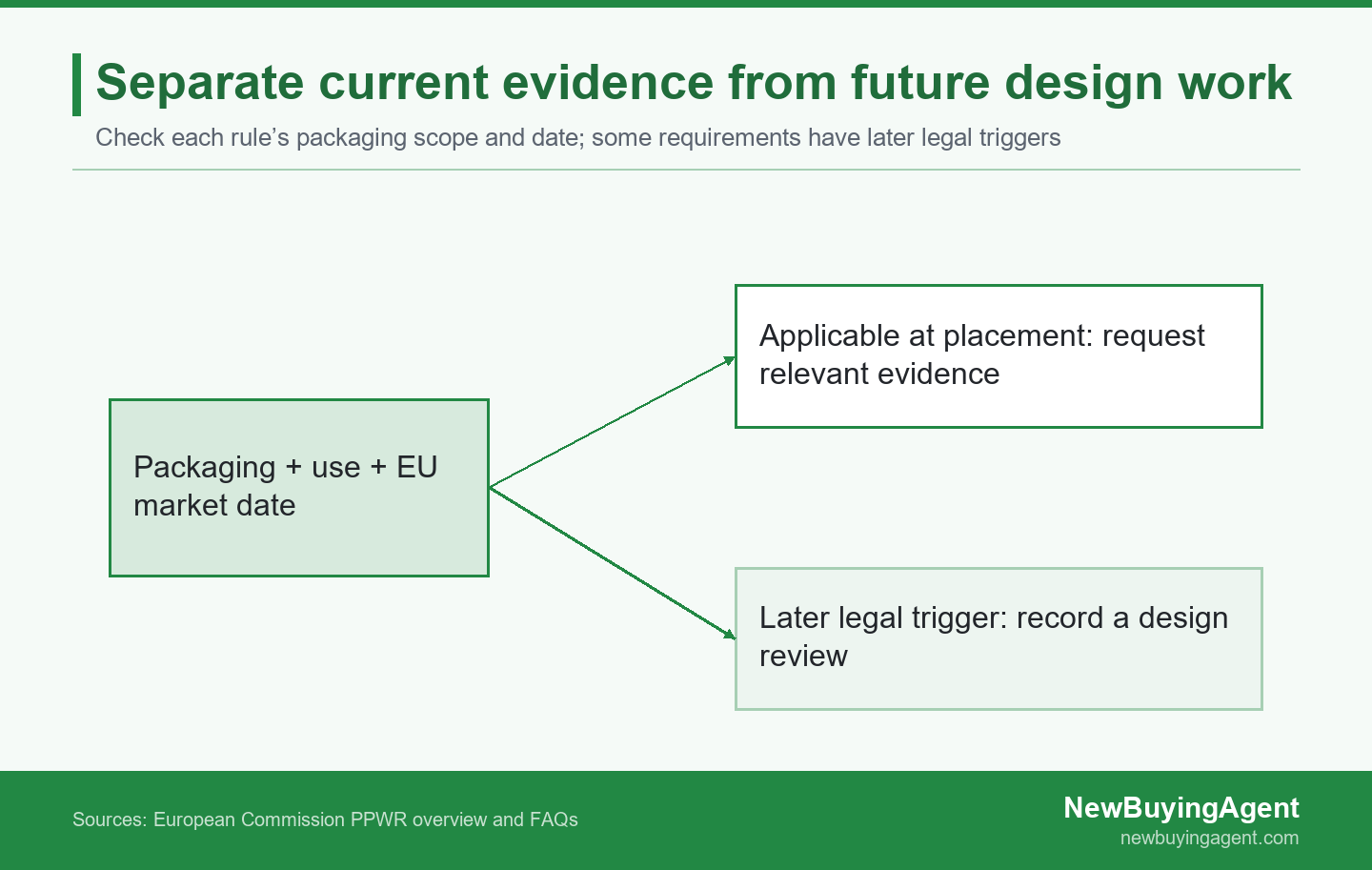
Packaging use and market date determine which evidence is due and which design checks come later.
Separate present obligations from later design changes
Apply each PPWR requirement according to its own packaging scope and legal trigger date. General application starts an important set of duties, but several sustainability measures depend on later dates or secondary legislation. A useful purchasing plan therefore separates evidence needed for the current market placement from design reviews that prepare a recurring product line for subsequent changes.
Identify the requirements applying to this order
The Commission’s application notice confirms the general start on August 12, 2026, including restrictions on PFAS in food-contact packaging. It identifies major waste-prevention and design measures applying from 2030, rather than presenting every requirement as immediately operative.
For the current order, ask the responsible reviewer to identify the relevant provisions and any conditions tied to implementing measures. Food-contact use changes the chemical and safety questions; it should not be assumed for every outer carton. Equally, a long-term redesign plan does not postpone evidence needed for requirements already applicable to the packaging being placed on the market. Keep the review date and the basis for the timing decision in the purchase file.
Check the precise scope of future transport requirements
The Commission’s delegated decision concerning pallet wrappings and straps illustrates why exact scope matters: it addresses specified complete-reuse requirements for those formats. It is not a general exemption for all transport packaging or all reuse obligations.
Before asking a factory to replace a transport format, identify the packaging type, logistics route, operator and applicable requirement. Request alternatives against that defined brief, with their protection, handling and cost implications. For a repeat order, set a future design-review milestone linked to the relevant rule or implementing act. Avoid locking an unsupported universal reuse instruction into a long-term supply contract simply because a headline mentions a future deadline.
Identify the responsible businesses before requesting documents
Supplier, manufacturer, importer and producer for extended producer responsibility are distinct roles that need to be determined for the actual packaging transaction. The business physically making a package is not automatically the only relevant legal actor, and a contractual task list cannot settle statutory responsibility. Identify the actors and intended market route before deciding who must provide information, maintain records or issue a declaration.
Distinguish the physical factory from the legal manufacturer
The Commission’s official PPWR FAQs distinguish suppliers providing technical information from the manufacturer bearing legal responsibility. That responsibility cannot be transferred simply through a contractual arrangement.
Determine the role using the actual packaging type, branding, design and supply arrangements, including relevant exceptions. A business having packaging designed or manufactured under its own name may have manufacturer obligations even when a Chinese factory performs the physical work. In another arrangement, the factory may supply packaging or material information to the responsible manufacturer. Record the confirmed role separately from practical tasks such as collecting material declarations, arranging an assessment or maintaining the approved artwork. Have uncertain cases checked against current official requirements and qualified specialist advice.
Confirm the importer’s access to the conformity file
The Swedish Environmental Protection Agency’s operator guidance explains that importers need to ensure the relevant manufacturer documentation is available and keep a copy of the declaration of conformity for authority access. The supporting file concerns applicable requirements; later requirements do not all need to be demonstrated prematurely.
Agree how the responsible operator can obtain the current records and connect them with the imported packaging. Access arrangements should remain workable after a supplier contact changes. This does not mean printing the full technical file inside every shipping carton; identify the records, retention arrangements and contact responsible for providing them when needed.
Keep destination producer responsibility in the buying plan
Germany’s Central Agency Packaging Register describes specific authorised-representative obligations for foreign businesses selling directly to German end consumers without a German branch. Registration with the LUCID Packaging Register remains the obligated company’s own responsibility.
That is a defined national selling scenario, not a rule assigning every Chinese exporter the same role throughout Europe. Confirm the producer, destination registrations, representation and reporting arrangements for the actual market route. Ask the supplier for the relevant packaging material and weight data so the responsible business can fulfil its obligations. An agreed commercial delivery term does not replace this role and destination review.
Turn the packaging specification into a usable evidence file
A useful packaging file connects the final construction and intended use with the applicable assessment, declaration and traceability information. Documents should identify the packaging they cover and explain their relevant scope. Review the file as a connected set, because a material datasheet, a test report and a declaration answer different questions and none should be accepted solely because it carries a reassuring title.
Review the declaration together with its supporting basis
The Netherlands Enterprise Agency’s PPWR guidance describes the EU declaration of conformity as a self-declaration. It should therefore be reviewed with its supporting basis and responsible issuer, rather than treated as a generic third-party certificate establishing every packaging property.
| Evidence | Question it answers | Connection to verify |
|---|---|---|
| Packaging specification | What is being supplied? | Components, revision, intended use and actual sample |
| Assessment and supporting records | Why does it meet applicable requirements? | Covered construction, method, conditions and conclusions |
| EU declaration of conformity | Who declares conformity for the identified packaging? | Responsible issuer, scope and relevant supporting file |
| Identification and production records | Which supplied packaging does the file cover? | Type or batch reference and controlled changes |
Ask the issuer to explain missing references or a report covering a different material. A copied template with an unrelated carton description does not resolve the order’s conformity question. Preserve the accepted file reference in the purchasing record so later substitutions can be reviewed against it.
Ask for material and process information that resolves uncertainty
Request the component specifications needed to understand the finished packaging, including relevant coatings, inks, adhesives and production processes. Where chemical evidence is needed, ask what construction was assessed, the method and scope, and how the result relates to the applicable requirement. “PFAS-free” or “recyclable” wording alone does not identify that basis.
Keep supplier declarations and analytical results in their proper roles. The appropriate evidence depends on the material, use and applicable rules; a universal test package should not be invented for every carton. If the supplied report covers a different coating or sample, identify that mismatch and request the information needed to resolve it.
Keep food-contact safety in the assessment
The Commission’s food-contact legislation overview explains the separate safety and inertness framework, including harmful migration and unacceptable changes to food. A PPWR packaging statement does not replace assessment of the relevant food-contact requirements.
For a takeaway container, define the intended food, contact time, temperature and relevant use conditions, and obtain the appropriate supporting evidence for that material and use. Distinguish the food-contact container from an outer transport carton that does not have the same function. Keep both assessments tied to the agreed construction so a coating change is not hidden behind an unchanged product name.
Use the supplier handoff to close specific purchase gaps
A supplier handoff should show what purchasing has accepted, what evidence remains missing and which decision the gap prevents. Give each request a packaging reference and a responsible task owner while keeping statutory roles explicit. The example and checklist below are recommended purchasing controls for organizing an order, rather than a replacement for the applicable conformity procedure or a legal appointment.
For an ecommerce product line with retail and transport packaging sourced together, NewBuyingAgent’s China product supply service connects local factory resources and product/QC capability with the buyer’s product requirements. Include the approved packaging construction and evidence requirements in the product brief, so sample review and production follow-up use the same physical specification. The agreed route should also identify the businesses responsible for declarations and destination obligations.
An illustrative coated-paper bowl order
Consider an illustrative purchase of 12,000 coated-paper takeaway bowls and matching lids from China, intended for first placement on the EU market in November 2026. The supplier quotes “all-paper, PPWR compliant,” but has not identified the coating and provides an older food-contact report for a different construction. This is a hypothetical procurement exercise, not a NewBuyingAgent customer case.
The buyer records the food-contact use, bowl and lid references, intended market date and outstanding legal-role determination. The immediate gaps are the actual material construction, the relevance of the report and the evidence for applicable requirements, including the food-contact PFAS restrictions. A future recyclability design plan does not answer those current questions.
The handoff therefore records “packaging evidence incomplete” and requests the coating and lid specifications, a reasoned assessment basis, relevant food-contact records and confirmation of the responsible declaration issuer. When the response arrives, the reviewer compares it with the agreed sample and specification, then records the supported decision or remaining gap. A report covering the wrong coating leaves the question open. A non-food-contact outer shipper follows its own applicable assessment; it should not automatically inherit the bowl’s entire evidence request.
Copy these fields into the purchasing brief
Use the fields below to turn a broad supplier statement into a request that can be answered and checked. Complete the packaging identity and intended use first, then connect requirements and evidence to that version. Where an input is unknown, record the missing information and the decision it prevents instead of filling the space with an assumed pass.
- Packaging: Product and packaging references, layers, construction, revision and sample.
- Use and market: Intended use, EU destination, selling route and relevant market date.
- Roles: Confirmed manufacturer, importer, supplier-information contacts and destination producer responsibilities.
- Requirements: Applicable provisions and dates; separate later design-review triggers.
- Evidence: Supporting files, declaration reference, scope, identification and version changes.
- Decision: Accepted requirement, missing information, request owner and next review action.
For a recurring EU-bound product purchase, prepare the product specifications, quantity, destination, timing, current sourcing situation and repeat-order needs, then send the purchasing brief to NewBuyingAgent. Add the packaging layers, intended use and buyer-approved requirements so product supply can be discussed against a clear physical specification and an explicit evidence request.
Frequently asked questions
Does a pre-August production date settle the applicable requirements?
A production date alone does not settle which PPWR requirements apply, because manufacture, stockholding and placing on the EU market are different events with their own relevant conditions. Check the actual market event, packaging and applicable transitional provisions before assuming that old stock is exempt. Keep the evidence of that review with the affected order rather than using a supplier’s undated stock statement as the entire basis.
Does every packaging component need its own serial number?
The Commission FAQ does not require every component of a packaging unit to carry a separate traceability mark; identification should connect the packaging with its relevant conformity records. Select an appropriate type, batch or equivalent reference under the applicable requirements and keep the component specification linked to it. Do not confuse identifying the packaging unit with inventing separate serial numbers for every lid, sleeve or label.
Can confidential material information simply be omitted from the file?
Confidentiality does not justify leaving the responsible manufacturer without information needed to demonstrate conformity; agree a controlled disclosure route for the relevant technical information. Clarify who needs access, which details establish the packaging assessment and how those records can be made available appropriately. A vague declaration that a formulation is secret should become a defined information-access question, rather than an assumed substitute for the missing evidence.
Should a long-term supply contract include later PPWR requirements now?
A long-term supply contract can include a dated review of later PPWR requirements, while keeping the current order’s applicable compliance obligations and evidence decisions explicit. State which rule, design assumption or implementing measure triggers that review and who will propose changes. This helps the parties prepare alternatives without presenting an unverified future design as already approved or postponing a duty that applies to the present packaging.
NewBuyingAgent
Related Resources

Get Started Today
Let's Turn Your Sourcing Goals into RealityWeChat:+86 15157124615
WhatsApp:+86 15157124615
Address:Building 10 #39 Xiangyuan Road, Hangzhou, China
