


California Proposition 65 is a law requiring businesses, subject to applicable exemptions, to provide clear and reasonable warnings before knowingly and intentionally exposing people in California to listed chemicals.
A packaging warning starts with a decision about exposure, not a printer’s choice of sticker. For a China sourcing order, establish the relevant product and packaging, obtain a supported warning determination, then carry the approved content into the physical pack and sales channels.
Make the warning decision before releasing artwork
A buyer workflow separates the warning determination, approved warning content and physical and online execution. These decisions belong to the same product and packaging revision, but they answer different questions. A supplier statement may contribute useful information, while an artwork proof shows what will be printed; neither should be accepted as evidence of a decision it does not actually establish.
- Decision: Identify the relevant California exposure and the basis for providing or not providing a warning.
- Timeline: Check the short-form transition against manufacture and labeling dates.
- How it works: Carry the approved content into packaging, retailer materials and the online purchase journey.
- Common mistake: Treating a generic “Prop 65 compliant” statement as a complete order approval.
Define the product, packaging and California exposure
Proposition 65 concerns warnings before relevant exposure to listed chemicals in California, subject to applicable exemptions. OEHHA’s business guidance connects the warning decision with the anticipated exposure and relevant risk criteria. Finding a chemical in a material therefore does not, by itself, settle whether a particular finished product needs a warning or establish the correct warning language.
Begin with the product reference, materials, packaging construction, intended use and California sales route. Ask whether the concern relates to handling the product, unpacking it, using it or another foreseeable exposure. Distinguish the source of the exposure from the surface carrying the message: a warning printed on a carton may concern the product inside, while a packaging component can also require its own exposure review.
For a home-storage brand sourcing a product and its retail pack together, NewBuyingAgent’s local China factory network and product development and quality-control capability help connect the buyer’s specifications with the supplied construction. Identify the approved resin, finish, inserts and labeling requirements in the product brief so factory alternatives can be checked against a defined configuration.
Keep the warning determination with the business responsible for making it, using qualified professional advice where needed. Purchasing can then translate the reviewed requirements into specific production instructions instead of asking the printer to resolve an exposure question through a standard warning sticker.
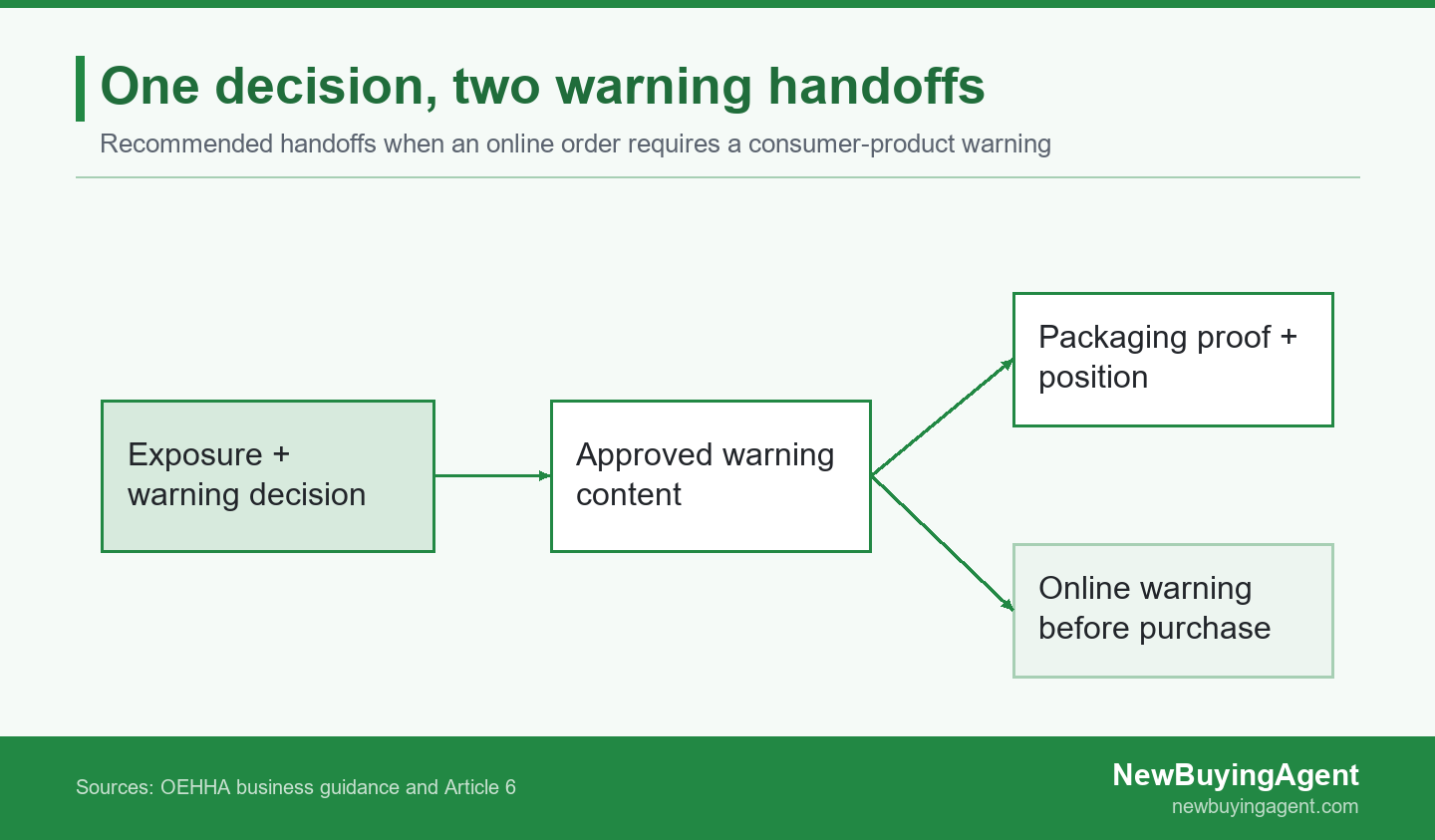
When a warning is needed, approved content feeds both packaging and online sales.
Build a file that supports the warning determination
Match component and packaging information to the finished specification and use before accepting a broad supplier statement. A useful file identifies what was reviewed, which evidence applies and what remains uncertain. Start with the physical construction and the anticipated exposure, then request the records needed to answer that question rather than collecting unrelated certificates because their titles sound reassuring.
Identify the chemical and listing endpoint
The current Proposition 65 list identifies chemicals listed for cancer or reproductive harm, or both. Use the actual chemical identity and relevant listing information when reviewing a supplier declaration or report.
A commercial material name such as “soft plastic” or “printed paper” does not identify the chemical being evaluated. Request the relevant component, formulation information and report scope without guessing the warning’s chemical name from the product category. If a declaration covers only the main body, ask whether handles, coatings, adhesives or accompanying packaging were included. Record the unanswered component question explicitly, so an apparent whole-product statement does not conceal a narrower assessment.
Separate material concentration from consumer exposure
OEHHA’s Proposition 65 safe harbor levels address exposure, including No Significant Risk Levels for cancer and Maximum Allowable Dose Levels for reproductive toxicity. A material concentration result and a daily exposure level describe different quantities; they cannot simply be compared as though they use the same units and assumptions.
Ask the reviewer how the result relates to the actual contact route, use conditions and amount of exposure. Check the tested sample and method against the supplied component before relying on the conclusion. If no applicable regulatory level exists, the absence does not mean the chemical is unrestricted for warning purposes; the assessment needs an appropriate basis under the applicable rules. Avoid inventing a universal concentration cutoff or test package for every imported product.
Review exposures from packaging as well as the product
OEHHA’s information letter on receipts and shipping labels explains that consumer product safe harbor warnings apply to exposures from items accompanying a consumer purchase, including packaging. Its discussion of Bisphenol S in receipts and shipping labels illustrates why the accompanying material can be relevant to Proposition 65.
This does not mean every carton or label needs a warning. Ask which material is the potential exposure source and when the consumer encounters it. A warning hidden inside a package cannot resolve an exposure that occurs while opening or handling the outside. Keep a specific packaging-material question separate from an assessment covering only the product, and have the reviewer determine the appropriate warning method for the actual exposure.
Record a supported outcome or a specific information gap
OEHHA’s business resources point businesses toward toxicology, laboratory or legal expertise appropriate to their situation. Use that expertise to resolve a defined product and exposure question, rather than requesting an unexplained approval stamp.
The order record should distinguish a supported no-warning determination, a decision to provide an identified warning, and an unresolved assessment. For the last outcome, name the missing information and the decision it prevents. A revised component specification, relevant report or clarified use condition may change the result. Printing a warning does not establish that an unrelated report covered the supplied construction or that the rest of the product requirements have been met.
Choose warning content against the current rule
OEHHA’s short-form warning amendments took effect on January 1, 2025 and introduced chemical-name content with a transition period. Safe harbor warning provisions specify content and delivery methods deemed clear and reasonable by regulation. They are a warning route, distinct from the exposure levels used when determining whether a warning is needed.
Use manufacture and labeling dates for the short-form transition
The approved regulatory text permits the prior short-form content on products manufactured and labeled before January 1, 2028, regardless of when they are sold to a consumer. The new short form identifies relevant chemicals. The transition concerns the applicable safe harbor content; it does not postpone an existing duty to provide a warning.
Record both manufacture and labeling information for any order relying on that provision. A purchase order date, arrival date or plan to use old cartons is not evidence that the finished products satisfy those conditions. For replenishment extending beyond the transition, agree the applicable warning version before committing to a large print run. Have the responsible reviewer check whether the general or a tailored warning route applies; a short form is not an automatic substitute wherever a specific warning provision exists.
Check the actual printed warning and packaging position
Compare the approved warning content with an actual-size proof and the consumer opening path. Review the full text, relevant chemical names and endpoints, symbol, language, contrast and position against the selected requirements. For a short-form safe harbor warning, the minimum is 6-point type, together with conspicuous presentation; reaching the minimum size alone does not establish readability.
Ask for a proof on the intended substrate or a representative finished sample. View it in the context of other graphics, folds, closures and stickers, including anything applied later by a warehouse or retailer. Check that the message remains visible at the relevant stage and is not covered by a barcode label. Preserve the accepted content and artwork revision separately, so a layout adjustment cannot silently change an approved chemical name or warning endpoint.
Carry the warning through the sales channels
OEHHA’s business FAQs explain warning responsibilities across manufacturers, packagers, importers, suppliers and retailers. For internet purchases using the safe harbor route, an applicable on-or-with-product warning method and an online warning before purchase are both needed. An approved physical label therefore does not complete the online implementation. Both checks should identify the same product.
For an ecommerce brand buying packaged household goods, NewBuyingAgent’s China product supply service brings factory resources and product/QC capability to the buyer’s agreed product requirements. Include the approved packaging revision and warning instructions in that supply brief so sampling and production follow-up use the same construction. Assign the warning determination and retail-page implementation to the businesses responsible for those decisions.
Name the handoff owners and keep receipt evidence
Make the commercial handoff identify the sending business, authorized recipient, affected products and current warning materials. Where the applicable route uses written notice and warning materials, follow its notice and acknowledgment requirements rather than treating an informal message to a salesperson as the entire handoff. The retailer’s placement and maintenance responsibilities also need to reach the team operating the actual sales channel.
For purchasing, keep the product reference, warning version, materials sent, recipient and receipt evidence together. Specify who communicates a change and how the factory, importer and retailer identify affected stock. A commercial task assignment helps the work happen; it should reflect the applicable responsibilities rather than assume that a printer or sourcing partner becomes the legal decision maker by receiving an artwork file.
Test the customer journey instead of only the artwork
Test product selection and checkout against the approved warning, recording the actual page and product variant checked. Confirm that the purchaser encounters the applicable warning before completing the purchase and does not have to search general website content to find it. Use the selected regulatory method, such as the product-page warning or an appropriately marked link, rather than assuming a packaging photograph is readable.
Check mobile as well as desktop layouts, variant changes and any channel-specific listings. Retain dated screenshots showing the message and its association with the product, then assign corrections to the channel owner. If the physical pack and page carry different versions, identify the affected stock and applicable transition provision before deciding which change is needed. Avoid treating every warning update as having the same grace period.
Connect the decision to China-side production
Connect the reviewed requirement to the physical product, packaging revision and channel implementation before purchasing releases the affected work. The useful handoff states what has been accepted and which unresolved issue prevents approval. Keep the assessment decision separate from checks that the factory printed or assembled the accepted configuration, because passing one check does not establish the other.
An illustrative household storage order
Consider an illustrative purchase of household storage boxes for an importer selling through California retail and online channels. The supplier provides a report for the rigid box body, but the supplied version includes a soft handle absent from the report. It also proposes an old generic warning layout. This is a hypothetical purchasing exercise, not a NewBuyingAgent customer case.
The buyer records the handle material and report coverage as an unresolved assessment input. The reviewer needs information relevant to that component and the intended exposure before accepting a no-warning conclusion or choosing warning content. Purchasing pauses approval of the affected warning artwork while requesting the missing specifications and assessment basis; it does not invent a chemical name to fill the layout.
Once the responsible reviewer documents the determination, purchasing records the approved construction and warning route. If a warning is to be provided, the factory receives the exact content and artwork revision, while the retailer receives the corresponding channel materials. The buyer checks the finished-pack proof and the online implementation against those approvals. A correct print proof closes the artwork discrepancy; it does not retrospectively make the original body-only report cover the handle.
Copy this approval record into the order file
Use this approval record to connect the product and packaging, warning determination, content version, artwork and channel evidence to a specific order. Enter a file reference or a defined missing input in each row. These are recommended purchasing controls, not a statutory form; the responsible business still needs an appropriate basis for its actual warning decision.
| Record field | Enter or attach | Approval check |
|---|---|---|
| Product and packaging | References, construction, revision, use and California sales route | The assessed configuration matches the supplied version. |
| Warning determination | Responsible reviewer, assessment basis and outcome | Missing inputs and their decision consequences are explicit. |
| Content and timing | Approved warning, applicable route, manufacture and labeling evidence where relevant | The chosen version fits the actual conditions. |
| Physical execution | Artwork revision, actual-size proof and finished-pack view | Text, symbol and placement match the accepted requirements. |
| Channel handoff | Recipient, materials, receipt evidence and online checks | The applicable warning reaches the purchaser through the chosen methods. |
| Changes | Material, supplier, artwork or sales-channel changes and review owner | Affected approvals are reconsidered before the changed version is accepted. |
For a recurring California-bound product purchase, gather the product specification, quantity, destination, timing, sourcing situation and repeat-order needs, then send the product brief to NewBuyingAgent. Include the buyer-approved packaging and warning requirements so the product supply discussion can address a defined configuration and its factory execution.
Frequently asked questions
Does every purchase require a Proposition 65 laboratory test?
The regulations do not impose a universal testing requirement, but a business still needs a defensible basis for its warning determination. Testing may be useful where it answers a relevant material or exposure question; existing knowledge and appropriate professional assessment may also contribute. Define the information gap first, so a laboratory scope addresses the supplied product instead of producing a generic certificate that leaves the decision unresolved.
Does a small factory’s exemption settle the importer’s obligations?
A factory’s employee-count exemption does not establish that a separate importer or retail seller is exempt from its own applicable responsibilities. OEHHA identifies an exemption for businesses with fewer than 10 employees, while noting that contractual obligations can still matter. Review each relevant business and its role rather than applying a supplier’s employee count to the entire chain of commerce.
Can a QR code replace the warning on a package?
A QR code that requires an optional scan to find the warning does not automatically provide a safe harbor warning before exposure. OEHHA distinguishes making consumers seek information from an electronic process that automatically presents the relevant warning. A code can lead to additional information, but the chosen warning method still needs to meet the applicable timing, content and transmission requirements.
Does non-English consumer information affect the warning language?
When the relevant label, labeling or sign includes consumer information in another language, the safe harbor warning must also appear in that language. Check the actual material carrying the consumer information under the applicable rule rather than assuming an English-only warning always suffices. Have the responsible reviewer confirm the required language set and preserve the accepted translations with the controlled artwork.
NewBuyingAgent
Related Resources


Get Started Today
Let's Turn Your Sourcing Goals into RealityWeChat:+86 15157124615
WhatsApp:+86 15157124615
Address:Building 10 #39 Xiangyuan Road, Hangzhou, China
