

Plastic packaging reduction means using less plastic for a defined packaging function while checking the cost and performance of the changed pack.
A lighter insert can lower material use yet increase packing time, setup charges or product losses. For an importer, the useful question is whether the redesigned pack delivers the required protection at an acceptable cost, with a reduction claim the evidence can support.
Judge the redesign on plastic, cost and protection
A useful redesign comparison keeps the product and delivery function constant, measures plastic reduction and separates first-order from recurring cost. Material savings belong beside packing labor, one-off charges, rated freight and expected product loss in that comparison. Approval should also depend on the required protective performance and market requirements, because a favorable spreadsheet cannot establish that the changed pack is suitable for shipment.
- Decision: Define the unchanged product, packaging function and delivery route before comparing alternatives.
- Cost comparison: Separate recurring costs from tooling, validation and other first-order charges.
- Risk: A small change in product-loss cost can erase a material saving.
- Common mistake: Treating less plastic as proof of lower freight, lower total cost or lower overall environmental impact.
Freeze the comparison before removing plastic
EPA describes source reduction as preventing waste at its source, including reducing packaging and redesigning products. For a buying decision, connect that aim to a defined unit: the same product, quantity, required protection and distribution route. Otherwise, a lower-plastic option can appear better simply because it performs a different job or omits a packaging layer from the comparison.
Record the current bill of packaging materials, component weights, outer dimensions, packed weight and assembly method. Include relevant bags, films, inserts, tape and an allocated share of transit packaging. Identify what each component does: preventing abrasion, restraining movement, protecting edges, containing parts or supporting a required barrier. This makes it possible to remove unnecessary material while keeping the required function visible.
For a home-and-kitchen importer sourcing ceramic tableware with fitted protection, NewBuyingAgent’s local China factory resources and product development and quality-control capability help connect the buyer’s physical specification with available product and packaging options. Put the approved product geometry, pack construction and permitted material alternatives into the sourcing brief so a cheaper quote can be assessed against the same configuration.
Use a baseline revision and a proposed revision, then record every cost or performance input that changes between them. The illustrative comparison below shows why a plastic reduction can raise first-order cost while lowering repeat-order cost; it does not report a tested packaging outcome.
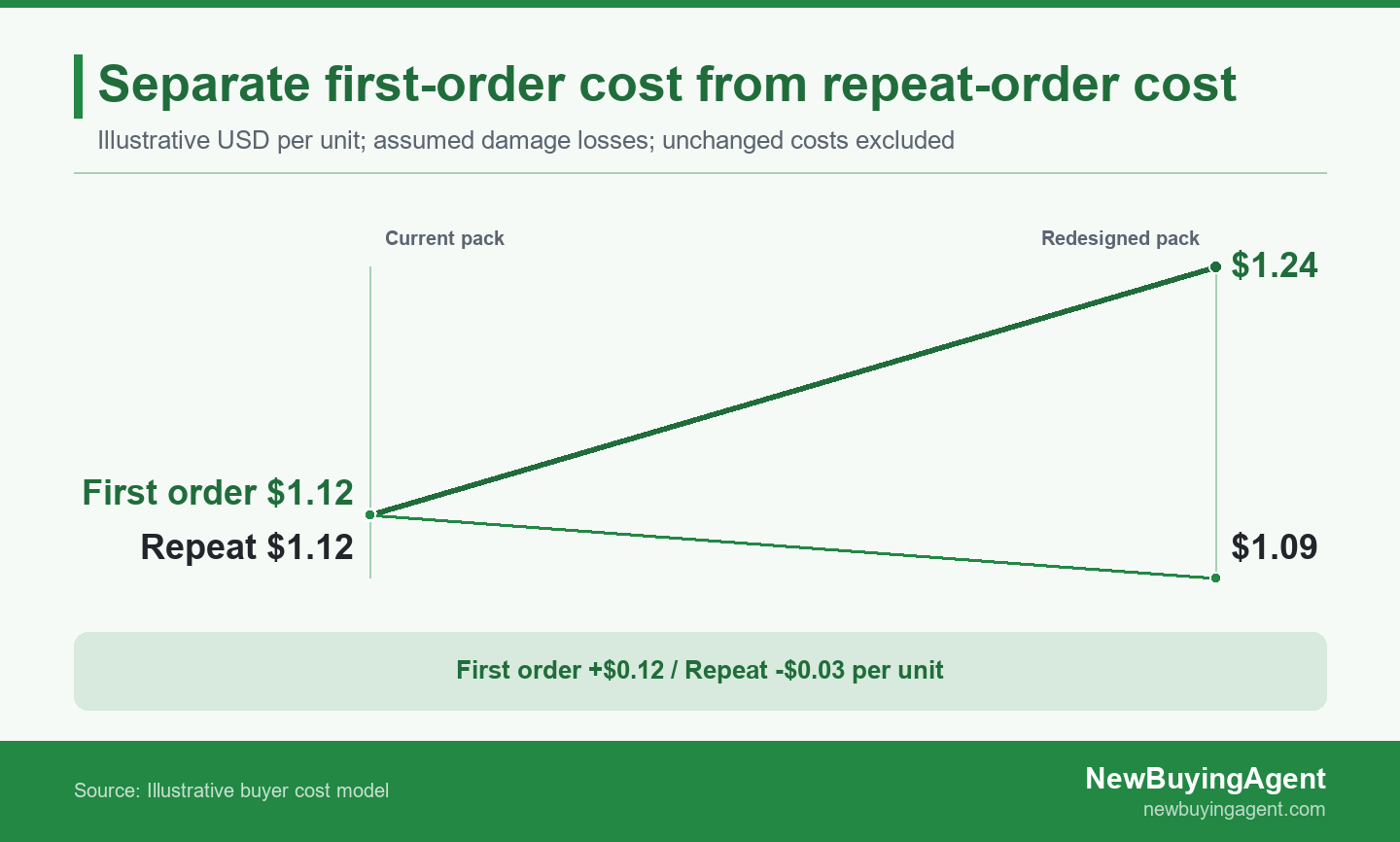
The illustrative redesign raises first-order cost but lowers repeat-order cost under the stated assumptions.
Build the cost bridge from the complete packed unit
Compare all packaging-related cost changes on the same order basis and leave unsupported amounts unresolved. Include materials, packing labor, affected freight or fees, one-off allocation and expected loss, while keeping common costs outside the comparison consistently. Expected loss is the estimated incident rate multiplied by the net incremental cost per incident. Record the source and status of each input so a quotation, assumption and measured result remain distinguishable.
Check rated freight instead of assuming a weight saving
UPS’s package measurement guidance explains that dimensional weight reflects the space a package occupies relative to actual weight and can affect shipping costs. Reducing plastic mass therefore does not automatically reduce the amount billed for a parcel.
Obtain a revised quote using the actual outer dimensions, gross weight, service and route. For consolidated or container shipments, check the relevant loading and charging basis instead of importing a parcel formula into the calculation. A thinner insert may leave the carton dimensions unchanged; a smaller carton may improve loading only when it changes the usable shipment configuration. Count a freight saving when the quote or loading analysis establishes it, with the applicable rounding and minimum charges included.
Keep destination reporting and fees in scope
The UK guidance for large-producer packaging reporting calls for material and weight information, with specific rules for components and material classification. That is a defined reporting context, rather than a universal fee formula for every importer.
Identify the destination, responsible business and applicable reporting or charging arrangements before assigning a saving to a material change. Ask for the component data needed to classify the redesigned pack correctly. If a coating, liner or composite construction remains, a material’s commercial name alone may not resolve the category. Keep the actual fee calculation and its current basis with the model; an unconfirmed fee change should remain open rather than silently becoming zero.
Work through an illustrative ceramic-set order
Consider an illustrative order of 10,000 ceramic sets with a redesigned protective insert. Every price, weight and incident rate below is a hypothetical input, not a NewBuyingAgent case, supplier quotation or measured trial result. Both options cover the same product and packaging function; the reduced-plastic design still needs technical validation.
| Input or cost component | Current pack | Redesigned pack |
|---|---|---|
| Plastic mass per packed unit, within the defined comparison | 40 g | 24 g |
| Packaging materials per unit | $0.80 | $0.66 |
| Packing labor per unit | $0.12 | $0.15 |
| Assumed damage incidence | 1.0% | 1.4% |
| Net incremental loss per incident | $20 | $20 |
| Expected loss per unit: incidence × net loss | $0.20 | $0.28 |
| New tooling and validation for this order | $0 | $1,200 + $300 = $1,500 |
| One-off allocation over the stated order | $0.00 per unit | $0.15 per unit |
The model assumes no change in billed freight or destination fees for this exercise. Common product price, unchanged freight and taxes, and other unchanged costs are excluded from both options; these figures are packaging-related comparison costs, not total landed costs. The incident-loss input is net of recoveries and excludes any amount already counted elsewhere in the model.
Under these illustrative assumptions, packaging-related cost is $1.12 per unit for the baseline, $1.24 for the redesigned first order and $1.09 for a redesigned repeat order.
The baseline is $0.80 + $0.12 + $0.20. The redesigned first order is $0.66 + $0.15 + $0.28 + $0.15; the repeat calculation excludes the one-off allocation only if the same tooling remains usable and no further validation charge is incurred. At the stated volume, the first-order increase is $1,200 and the repeat-order saving is $300.
The plastic reduction is 16 g per unit, or 40% of the baseline plastic mass, totaling 160 kg across the order. That material outcome can be valuable, but the first-order budget still needs to recognize its cost. A buyer might fund a controlled redesign for an explicit reduction objective without describing the first order as cheaper.
Find the assumption that can erase the saving
For this hypothetical model, an additional 0.55 percentage points of damage incidence removes the $0.11 recurring pre-damage saving when net loss per incident is $20.
The recurring saving before damage is $0.14 less material cost minus $0.03 additional labor. Dividing $0.11 by $20 gives an incident-rate increase of 0.0055, or 0.55 percentage points. Applied to the assumed baseline incidence, the redesigned pack reaches economic break-even at 1.55%, with the other inputs unchanged. The assumed 1.4% leaves only a small modeled recurring benefit.
This is an economic sensitivity boundary, not an acceptable defect rate or an engineering approval. The product’s quality requirements may rule out a design well before that point. Recalculate with the actual net cost of a damaged shipment, realistic order volume and any revised freight or packing labor. If a decisive input is unknown, request a quote or validation evidence rather than filling it with the value that makes the redesign win.
Validate the protective function before approving the cut
ISTA’s test-procedure guidance distinguishes early screening from simulations of shipment hazards and emphasizes selecting a test for the intended outcome. A convenient drop demonstration does not establish every aspect of distribution performance. Define the product, pack construction, route and acceptance criteria with the relevant technical reviewer or test provider before comparing the current and reduced-plastic designs.
For an ecommerce kitchenware brand arranging replenishment, NewBuyingAgent’s China product supply service connects factory resources and product/QC capability with the buyer’s agreed product requirements. Include the approved packaging construction and validation requirements in that brief so sample review and production follow-up refer to the same physical configuration. Keep specialized test selection and acceptance decisions with the parties qualified and responsible for them.
Retain required functions and market requirements
The European Commission explains that EU packaging rules cover packaging regardless of material or origin, including manufacturing and composition requirements. Replacing plastic with another material therefore does not remove the need to check the applicable packaging requirements.
Review the functions being changed: cushioning, edge protection, abrasion resistance, containment, moisture protection or another product-specific need. A thinner material can change fit or retention even when the outer carton looks identical. Identify relevant product-contact, labeling and destination conditions, and confirm their applicability and timing against current official requirements. A general reduction target should not become an instruction to remove a required barrier or conceal an unresolved product-protection issue.
Follow the new pack into a controlled shipment trial
Link an agreed validation plan and controlled shipment observations to the actual pack revision before extending the change. Record what was tested, the product and material construction, the relevant conditions and the acceptance outcome. Make any remaining limitation visible, particularly where a laboratory exercise does not cover the whole shipment or customer-use environment.
For the initial production run, check that the factory uses the accepted materials and assembly method. Compare damage and complaints using consistent definitions, routes and observation periods, and record the number of units observed. A small trial with no damage is useful evidence for its scope, not proof that future losses are zero. Revisit the cost assumptions when actual packing time, freight invoices or incident costs become available.
Keep the environmental claim as narrow as the evidence
UNEP describes a life-cycle approach that considers plastics from production through use and disposal. A measured reduction in plastic mass is one useful outcome within that broader view. It does not, by itself, establish a reduction in carbon emissions, total resource use or every other environmental impact of the redesigned product and packaging.
State the reduction and comparison basis precisely
The FTC’s published Green Guides on source-reduction claims call for clear qualification of the reduction amount and comparison basis. Match any wording to the actual measured scope rather than turning a component change into an unsupported whole-package claim.
In the illustrative model, the calculation concerns plastic mass within the defined pack comparison. Before making a real claim, verify the weights and revisions, identify what is included and confirm that the denominator remains comparable. Keep a record of the measurement method and approved wording. If only an insert has been assessed, state that limit rather than implying every layer of the delivered packaging has been reduced by the same proportion.
Check the trade-offs behind a broader green claim
The UK CMA’s environmental-claims guidance warns that a narrow positive attribute can mislead about overall environmental impact when relevant life-cycle trade-offs are ignored. A claim can be technically true about one feature yet create an unsupported broader impression.
Check additional material use, manufacturing, transport, product losses and relevant end-of-life conditions before making a wider claim. A replacement material or reusable format needs its own evidence; neither its appearance nor a supplier’s “eco” description settles that assessment. Use qualified technical or legal advice where the proposed claim requires it, and keep its limits clear in the final customer-facing wording.
Turn the approved redesign into a repeatable China order
Connect the approved product and pack specification, quote basis and validation evidence with the actual China product-supply order. The handoff should show the accepted revision, the costs that have been established and any conditions still limiting production release. Give material substitutions and assembly changes a defined review path so the next replenishment order does not quietly use a different design.
Retain a representative accepted sample, material references and the checks needed during production. Confirm how obsolete packaging will be handled and which inventory is affected by the change. Record savings after comparing actual results with the agreed baseline, including additional work or losses, rather than treating the initial material-price difference as a completed business result.
Copy this costed redesign checklist into the brief
A costed redesign checklist records the baseline, material change, cost bridge, technical evidence, claims and production handoff. Complete each item against the same product and pack revision, identifying an owner and evidence reference for an open input. Use the result to decide whether to request more information, run a bounded trial or approve a validated configuration within an explicit budget.
- Freeze the baseline: Record the product, packaging layers, component weights, dimensions, required functions, route and comparison quantity.
- Measure the material change: Enter current and proposed plastic mass on the same basis; calculate the absolute and percentage reduction.
- Price the complete change: Attach material and labor quotes, affected freight and fee calculations, one-off charges and the allocation volume. Separate confirmed amounts from assumptions and unknowns.
- Stress-test the economics: Record the incident-loss definition and sensitivity, showing first-order and recurring results without double counting costs.
- Close technical and claims evidence: Attach the agreed validation outcome and its limits, applicable requirement review and narrowly supported claim wording.
- Control the supply handoff: Identify the accepted sample and revision, production checks, change owner and the actual results to review after shipment.
For a recurring product purchase with a packaging reduction target, gather the product specification, quantity, target price, destination, timing and sourcing situation, then share the product brief with NewBuyingAgent. Include the baseline pack, repeat-order needs and buyer-approved cost and validation requirements so the supply discussion addresses a defined product and packaging configuration.
Frequently asked questions
Does replacing plastic with paper prove a better redesign?
Replacing plastic with paper can reduce plastic mass, but it does not by itself establish lower total cost, adequate protection or lower overall environmental impact. Compare the same packaging function and include any additional material, packing work or changed product losses. Check the destination and end-of-life conditions relevant to the claim instead of accepting a material name as the complete assessment.
Can an unknown fee or freight change be entered as zero?
An unconfirmed fee or freight change should remain an open input, because entering zero can create a saving the buyer has not established. Show the decision with that uncertainty visible and obtain the relevant quote or applicable fee calculation. A deliberately assumed unchanged amount is acceptable in a disclosed illustration, but it does not confirm the cost of a real order.
How should a reusable pack be compared with a single-use pack?
A reusable pack needs a per-use comparison based on supported reuse cycles, return logistics, cleaning, losses and the same required protective function. Divide its relevant lifetime costs and material use by realistic successful uses, with the assumptions and boundaries stated. An intended reuse count is not an observed recovery rate, so test whether the return system can actually deliver the modeled result.
When should a successful redesign be reviewed again?
Review the accepted design when product, packaging material, construction, supplier or distribution conditions change in a way that could affect its cost or protective performance. Identify which earlier quote, test or claim depends on the changed input. Refresh that evidence and the affected approval before extending the change, while retaining the still-valid records for parts of the configuration that remain unchanged.
NewBuyingAgent
Related Resources
Get Started Today
Let's Turn Your Sourcing Goals into RealityWeChat:+86 15157124615
WhatsApp:+86 15157124615
Address:Building 10 #39 Xiangyuan Road, Hangzhou, China
