

To diagnose vibration, drop, and compression failures, map where the damage occurs, compare the product with its packaging, and reconstruct the exposure before choosing a correction. Repeated scuffing, a crushed corner, or a buckled panel can suggest useful checks. None is a reliable stand-alone label for the event that caused it.
A packaging manager reviewing returns needs a defensible next action: inspect a contact point, request missing handling evidence, or ask a laboratory to investigate a specific mechanism. That decision should come before approving a more expensive carton or repeating the same test without learning why the original pack failed.
Transit damage: clues to collect before changing the pack
A damage pattern is evidence for a hypothesis, not a unique label for the event that caused it. The practical task is to connect a visible observation to an explanation that can be challenged. Preserve the returned system, ask what else could produce the same mark, and choose a check that would change the packaging or purchasing decision.
- Definition: Record the damage location and condition before naming a transport cause.
- Risk: A final photograph can combine damage from different events or from before shipment.
- Decision: Select an inspection or test that distinguishes competing explanations, rather than requesting a generic pass.
- Standard: Keep investigative opening separate from a complete performance or certification sequence when the selected protocol requires it.
1. Preserve the damage scene before choosing a cause
Preserve the product, internal protection, closure, and carton as a related set before repair or repacking changes their condition. Photograph the pack as received, then map damage to identified faces, edges, corners, and internal contact locations. These observations turn a general complaint into evidence for a hypothesis: a possible explanation that the next inspection can support or challenge.
ASTM D4169 distinguishes unopened performance testing from investigative work that may include intermediate inspection. This distinction matters when planning laboratory work: opening a package may help locate when damage begins, while also changing the system being evaluated. For an actual return, document each unpacking step and keep displaced inserts and loose parts, so later reviewers can reconstruct the arrangement.
Give each returned carton and product a linked identifier. Record the product model, packaging revision, units per carton, packed orientation, receipt date, and whether photographs preceded unpacking. Compare affected items with an undamaged item from the same packing configuration where available. Ask whether the mark was present in retained pre-shipment samples or factory photographs; transit is only one possible point of origin.
For a repeat China purchase, local product and QC knowledge can make that comparison more useful. NewBuyingAgent’s company background explains its sourcing context and factory resources. A buyer with packaging approval responsibility can include identifiable product and packing evidence in a sourcing discussion, helping connect the complaint to the actual supplied specification and the next order’s requirements.
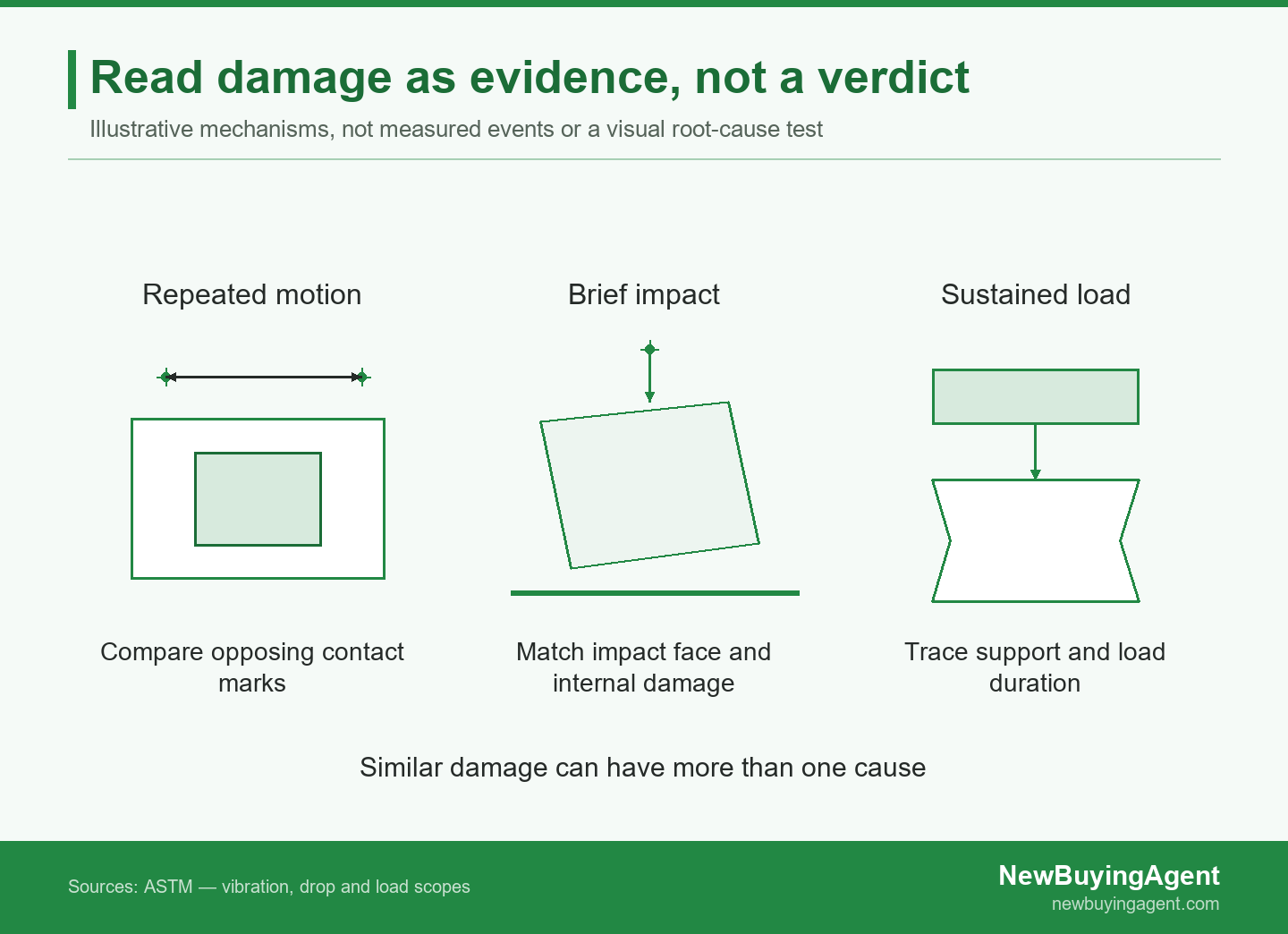
Illustrative forces show repeated motion, a brief impact and sustained loading as distinct packaging hypotheses.
2. Read vibration, drop, and compression clues together
Compare the location of damage, the internal contact points, and the exposure history before selecting a corrective change. The following patterns are starting points for investigation, not a visual classification test. Look for agreement between the external mark, the product’s damaged surface, and the way force or movement could reach that surface. A mismatch is useful: it may redirect attention to another exposure, an assembly issue, or damage that existed before dispatch.
Repeated rubbing or movement: examine vibration-related hypotheses
ASTM D4728 treats the container, interior packing, closure, and contents as interacting parts under random vibration. For a scuffing complaint, inspect both sides of a suspected contact: the product surface and the adjacent insert, neighboring product, accessory, or carton wall. Matching locations can make repeated relative movement a useful working explanation. A surface mark on only one item, without an identifiable opposing contact, needs a broader investigation.
Check whether the product can move in the actual assembled pack, whether separators shifted, and whether protective surfaces differ from the approved specification. Compare the same positions in several returns and retained unshipped products. Scuffs already present before dispatch would weaken a transit-only explanation. Powder from an insert, transferred coating, or polished contact areas may be worth documenting, but none independently identifies the transport vibration profile.
Ask a laboratory to investigate the relevant packed configuration and representative exposure, with a clear observation to reproduce. Record its selected method and conditions. A different vibration motion or test duration should not be treated as an equivalent result merely because both reports use the word “vibration.”
Localized crushing or breakage: reconstruct the impact path
ASTM D5276 evaluates the sudden shock of free-fall impact and the protection provided by the container and inner packing. When a corner or edge is crushed, compare that location with the product’s orientation and internal damage. The useful question is how the load could reach the failed feature: directly through an unprotected corner, through a displaced support, or through a neighboring component inside the box.
Look for a corresponding impact area, displaced cushioning, a fractured support, or a damaged feature aligned with the affected face. Preserve photographs of the outer package before unpacking and the internal arrangement afterward. A dented carton with undamaged contents tells a different story from an intact-looking carton containing a broken product feature.
Also consider alternatives. Localized contact from handling equipment, compression near an unsupported edge, or earlier product damage may produce a similar complaint. Request handling records and compare undamaged packs before assigning a drop as the cause. If a trial is needed, the laboratory should choose the appropriate orientation and method for the shipping unit; improvised drops are not a substitute for an agreed evaluation.
Panel buckling or load transfer: check compression exposure
ASTM D642 evaluates resistance to external compressive loads and can include contents that share the load. The load path is where force travels through the packed system. Examine whether the carton walls, inserts, or product carry the weight above them, and whether that support changes when boxes are misaligned or the actual contents differ from the tested configuration.
Panel buckling, reduced carton height, collapsed internal supports, or impressions on top-facing product surfaces can justify examining compressive loading. Map where those features appear in the stack and compare them with pallet support and carton alignment. Similar outer deformation across a tier may suggest a different investigation from one isolated damaged corner.
Request actual stacking arrangements and material specifications rather than relying on a carton’s appearance or a generic “heavy-duty” description. A product can share load intentionally or accidentally; changing its position or internal support may change the result. Keep any strength claim tied to the tested assembly and conditions, not just the paper grade printed on a quotation.
3. Reconstruct time, atmosphere, and handling conditions
Reconstruct how long the pack was loaded, how it was supported, and what atmosphere it experienced before comparing a laboratory result with field damage. Conditioning means holding samples in a controlled atmosphere before testing. A result obtained under one set of conditions answers a defined question; missing storage or handling information can leave an important difference between that test and the reported shipment.
ASTM D4332 explains that temperature and relative humidity can change packaging-material properties, especially those of cellulosic materials. Request the recorded conditioning and test atmosphere, together with any available storage and shipment history. Wet staining or a soft panel is a reason to investigate moisture exposure, not permission to infer an exact humidity or the point at which damage occurred.
ASTM D4577 evaluates resistance to a vertically applied constant load for a specified period or until failure. This makes duration an explicit input. A short compression-strength result cannot, by itself, establish performance under a long warehouse stack. Ask whether the supplied evidence addresses the actual load, support, time, and environment relevant to the complaint.
Build a simple timeline: packed at the factory, palletized, stored, transported, broken down, and delivered. Identify where the handling unit changed or a product was repacked. An inbound master carton and an individual parcel leaving a warehouse may have different protection. Record unknown stages honestly; a missing event record is an evidence gap, not proof that a particular party caused the damage.
4. Use a diagnostic record to choose the next check
Use a diagnostic record to pair each observation with a working hypothesis, evidence that could weaken it, and a specific next check. The best next check is the one that could change the explanation or correction. Assign an owner and an expected record for that check, so a request for “more photos” or “another test” has a clear purpose.
| Observed pattern | Working hypothesis | Evidence that changes it | Next distinguishing check |
|---|---|---|---|
| Repeated scuffs at contact points | Relative movement within the pack | Same marks on retained unshipped items; no matching contact | Map opposing surfaces and compare the actual assembled pack |
| Crushed corner with nearby product damage | Localized impact reaching the product | Damage away from the proposed impact path; handling contact elsewhere | Compare orientation, support displacement, and relevant handling records |
| Buckled panels or collapsed supports | Compressive loading through inadequate support | Different stack support, material condition, or packed contents | Review load, duration, environment, and the tested assembly |
| Several patterns in one return | Combined exposures or separate origins | Chronology or pre-shipment evidence contradicts a shared cause | Separate the observations and choose checks for each explanation |
Add the carton/product IDs, observation, hypothesis, alternative explanation, check owner, and required evidence to the record. Leave the cause unconfirmed when the available evidence cannot distinguish alternatives. That outcome is still useful if it identifies the next decision: inspect retained stock, obtain a packing comparison, or commission a defined investigation.
ISTA recommends separate investigative and complete certification tests when opening packages for intermediate inspection is needed. If intermediate opening is needed, agree that investigative purpose with the laboratory. After a relevant correction, use representative new packed products for the complete agreed verification, rather than treating a repeatedly opened diagnostic specimen as an untouched performance sample.
For buyers preparing a new or repeat product purchase, NewBuyingAgent’s We Supply Products To You service connects those findings to a complete China product-supply brief. Its local factory resources and product/QC capability are relevant to assessing the actual product and packing requirements. The purchasing discussion should address a workable supplied-product specification; specialist test interpretation and final packaging acceptance need their identified responsible owners.
5. Work through a report with more than one damage pattern
Different damage patterns in a return sample may call for separate explanations and checks. A buyer does not need to force every mark into one explanation before taking a useful next step. The illustrative report below shows how a packaging manager can narrow the investigation while preserving the distinction between returned items, the wider shipment, and a proposed change for replenishment. It contains no measured laboratory outcome.
An illustrative replenishment decision after six returned cartons
A regional wholesaler is preparing a repeat purchase of powder-coated metal brackets from China. Its packaging manager approves packing changes and advises the purchasing manager. In this illustrative shipment, 2,400 brackets were packed ten per carton in 240 cartons. The buyer has 6 returned cartons and delivery photographs, but incomplete handling records.
In this illustrative report, repeated coating scuffs and localized carton crushing do not establish a single shared cause. The brackets show coating scuffs on opposing contact faces. 2 of the 6 returned cartons also have crushed corners, while the other returns lack that external pattern. The supplier proposes a thicker carton without explaining how it would stop the contact scuffs.
The repeated contact locations justify checking movement and pre-shipment surface condition. The two crushed corners justify a separate impact or support investigation. The manager will not approve the proposed packaging change solely from these photographs. The 6 returned cartons cannot establish damage prevalence across all 240 cartons, so the wider shipment’s condition remains unknown.
The team should preserve the returns, map matching surfaces, compare retained unshipped brackets, and document the actual packing arrangement. It can then agree trials designed to reproduce the relevant damage locations and evaluate a corresponding correction. Approval of the final pack follows the agreed verification and acceptance criteria. These are proposed actions in an illustrative case, not evidence that a test has passed or that a carrier caused the loss.
What would support a stronger conclusion?
A stronger explanation predicts a repeatable damage location and survives comparison with a competing hypothesis. Suppose matching scuffs are already visible in dated pre-shipment photographs: the team should investigate coating handling and packing operations before treating transport vibration as the sole explanation. If retained surfaces are clean and a representative trial reproduces the contact pattern, the movement hypothesis gains support, while the corner-crushing question may still require separate evidence.
A correction should address the supported mechanism. Changing separation or restraint might address a verified contact problem; a different carton or support arrangement might address a demonstrated load weakness. These are conditional directions to investigate, not guaranteed fixes. Record what observation would count as success and check that the final assembled pack still meets the complete evaluation requirements.
6. Turn the findings into a product-supply decision
Turn the supported findings into a defined product and packaging change, with a verification decision before repeat procurement. The specification should identify the change, the product and packaging revision it applies to, and the evidence needed before acceptance. This gives purchasing a concrete basis for comparing the proposed supply arrangement, including material cost, packing consistency, and delivery requirements, instead of accepting an undefined promise of stronger packaging.
Keep confirmed observations separate from unresolved assumptions in the replenishment brief. A pack change can affect carton dimensions, units per carton, assembly instructions, and freight economics. Ask the relevant parties to confirm those consequences alongside the protection requirement. Later field feedback should retain the same product and pack identifiers, so repeated complaints can be compared meaningfully.
For a repeatable China product requirement, send NewBuyingAgent the purchasing brief, including the product specification, quantity, target price, destination, timing, and current sourcing situation. Add the relevant damage map and packing evidence to explain the desired improvement. This supports a product-supply discussion grounded in local factory resources and QC knowledge, with agreed responsibilities for specialist testing and buyer approval.
Frequently Asked Questions
Can vibration damage occur when the outer carton looks intact?
An intact outer carton does not by itself establish that the product and its internal supports escaped damage. Internal contact, shifted supports, or a vulnerable product feature may deserve inspection even when the exterior is presentable. Compare the packed arrangement and opposing surfaces, and keep the failure description separate from the transport explanation until the evidence supports it.
Does a crush mark prove that the carton was dropped?
A crush mark alone does not prove a drop, because compressive loading, handling contact, and earlier damage can also affect that location. Compare the damaged face with internal supports, product orientation, and available chronology. A defensible explanation should account for those relationships and the evidence that would contradict it, rather than rely on the mark alone.
Can a passed drop test rule out vibration damage?
A passed drop test does not establish resistance to a different vibration exposure, because the loading mechanisms and package responses are different. Check the method, packed configuration, conditions, and observations covered by each report. Ask the laboratory which additional investigation addresses the reported problem instead of assuming one successful test covers every distribution hazard.
How should buyers use a shock-indicator label in an investigation?
A shock-indicator label can be one piece of exposure evidence, but its response alone does not identify every product failure or settle responsibility. Record its identity, location, condition, and the manufacturer’s stated meaning alongside the damage evidence. Product inspection, packing configuration, chronology, and other applicable records are still needed to assess the actual loss.
NewBuyingAgent
Related Resources



Get Started Today
Let's Turn Your Sourcing Goals into RealityWeChat:+86 15157124615
WhatsApp:+86 15157124615
Address:Building 10 #39 Xiangyuan Road, Hangzhou, China
