

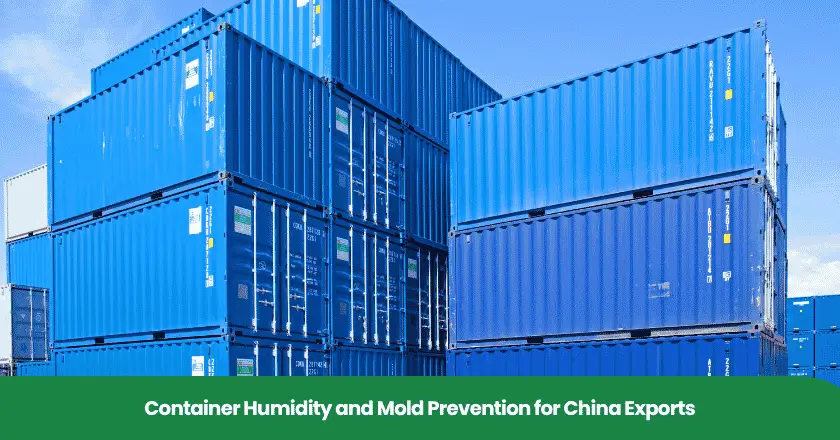
Container humidity and mold prevention begins before the doors close: qualify the moisture condition of the products, cartons and pallets, protect the loading operation from rain, and choose packaging that suits the journey. Desiccants, barriers and covers work under different conditions. A packaging or operations manager approving repeat China orders needs evidence for the materials and the protection system, followed by a clear loading decision.
The loading decisions that reduce moisture risk
- Risk: Water already inside products and packing materials can become a transit problem even when the container has no leak.
- Decision: Agree material-specific moisture criteria and the method of checking them before the loading date.
- Common mistake: Treating a single air-humidity reading or a routine desiccant bag count as proof of readiness.
- Bottom line: Record what was loaded, how it was protected and which unresolved items prevented approval.
Why dry-looking cargo can become wet in transit
A container can become wet from water carried inside the load, even when outside rain never enters it. The CTU Code’s condensation guidance identifies cargo, pallets, porous packing and moisture introduced during loading as potential sources; vapor can later condense at a cooler roof and drip onto cartons. For the buyer, this makes material readiness part of prevention, alongside checking that the unit is sound.
The dew point is the temperature at which air becomes saturated when cooled at constant pressure, as the US National Weather Service explains. A roof surface colder than the nearby air’s dew point can collect condensation. This is why the relationship between moisture and surface temperature matters more than describing the warehouse air as simply “dry.”
Keep two questions separate when reviewing wet cartons: did water enter through a defect, or did moisture condense inside? Photographing the roof, walls, floor and affected stack positions helps preserve those distinctions. A wet patch alone does not establish the cause, and an intact door seal does not establish the moisture condition of the loaded materials.
For an importer replenishing wooden homewares, packaging suitability belongs in the product brief alongside finish and carton construction. The local China factory network and product development and quality-control capability described in the NewBuyingAgent company background provide relevant sourcing context. The useful next step is to identify the actual product, packaging construction and approval responsibility before selecting the factory’s packing proposal.
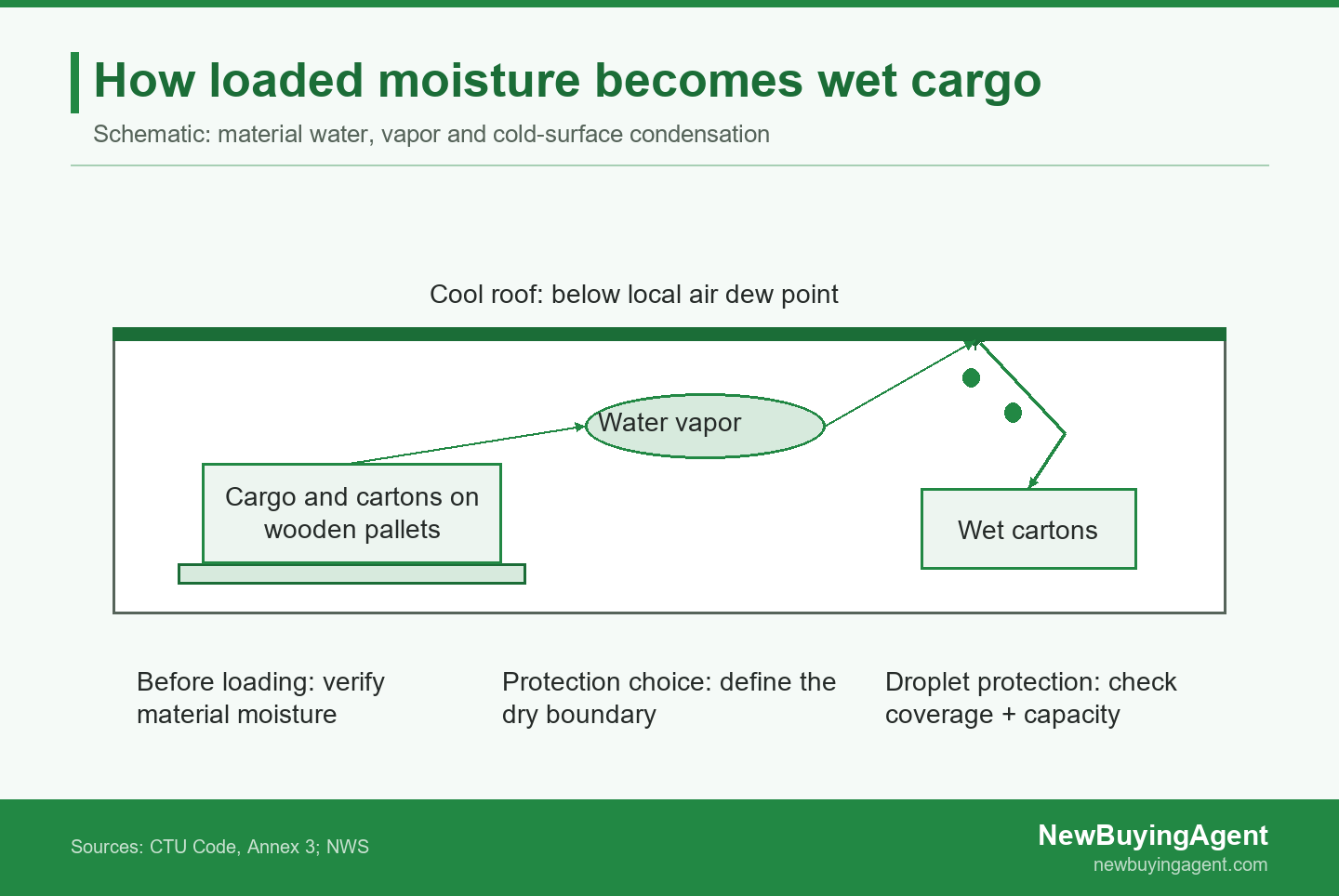
Moisture from loaded materials can condense on a cold roof and drip onto cartons.
Define material readiness before the loading date
Material readiness should be defined for the goods and every significant packing material that accompanies them, rather than judged from the outer carton alone. The GDV Container Handbook emphasizes loading the cargo, packaging, dunnage and accompanying materials in a container-dry condition. Translate that principle into an agreed specification for the particular product and route; a generic threshold copied from another commodity cannot qualify your shipment.
Moisture content describes water contained in a material. Relative humidity describes air moisture relative to saturation at the same temperature. These are different measurements: a shed air reading cannot replace a wood-moisture result, and a result for one wooden component cannot automatically qualify the corrugated cartons around it. Specify the material, measurement method, units, sampling locations and acceptance criteria together so the result has a clear meaning.
- For the product, identify moisture-sensitive parts, finishes and concealed areas, then ask the product or packaging specialist which readiness checks fit that construction.
- For cartons and paper components, record the material specification, storage conditions and any visible dampness, softening or staining that needs investigation.
- For pallets and timber dunnage, keep material identity and the agreed moisture checks separate from pest-treatment documentation.
- For the loading operation, record rain exposure, temporary outdoor staging and whether a recently washed unit has dried before use.
Assign someone to resolve missing criteria before loading day. If the supplier says “dry enough,” ask what method and material limit support that description. If the buyer has no established limit, obtain appropriate product and packaging advice rather than inventing one under time pressure. Retain the approved method with the purchase specification so later replenishment orders can be assessed on the same basis.
Choose a compatible moisture-protection system
Choose moisture protection as a system with an explicit boundary: the individual pack, a sealed pallet enclosure or the wider container load. Identify the moisture source, expected transport and storage duration, and the condition the product needs before selecting controls. This prevents a common purchasing error: combining a barrier, loose desiccant and ventilation instructions that each assume a different protected space.
Sealed barriers and desiccants need a defined boundary
A desiccant absorbs or adsorbs water vapor, but its useful capacity is finite. Virginia Tech’s packaging guidance describes sizing factors that include enclosed volume, moisture in hygroscopic packing materials, barrier permeability and transport time. Request the selected product’s sizing basis for the actual enclosure instead of treating bags as interchangeable units or extrapolating from an unrelated shipment.
For a sealed barrier proposal, ask what is enclosed, what condition those contents need at sealing, how seams and puncture-prone areas are protected, and how the seal is checked. The desiccant needs to act within the space it is intended to protect. A packet outside an intact barrier does not establish conditions inside it. Likewise, enclosing unverified damp material does not prove a dry starting condition.
Ask the packaging provider to state the arrangement, compatible materials, installation instructions and inspection points. Include protection against leakage or contact damage from the chosen moisture-control product where applicable. Approve a documented construction that can be repeated on the factory floor, then check actual production packs against that construction. A photograph of a bag beside the goods proves placement only, not sizing adequacy.
Covers and ventilation solve different parts of the problem
Do not assume a standard container ventilates the load effectively. Hapag-Lloyd’s container-packing brochure distinguishes small pressure-equalisation openings from suitable cargo ventilation. Its moisture guidance also ties protection to material state and climatic exposure, so the carrier and packaging provider should confirm whether the proposed unit and protection arrangement fit the cargo and route.
A covering intended to intercept roof droplets addresses contact with falling water; it does not establish dry products or remove all internal vapor. Ask how it is supported, how much water it can retain under the specified conditions, and whether its arrangement creates new contact or drainage problems. An arbitrary plastic sheet laid over cartons is not an adequately specified condensation-control system.
Ventilation requires a suitable unit, an effective airflow arrangement and outside conditions that make air exchange useful. Agree those details with the responsible carrier or specialist; do not modify or block container openings casually. Bulk-hold ventilation rules, ventilated agricultural cargo and sealed consumer-product packs have different operating conditions. Select the approach for the actual shipment rather than combining their instructions into one generic checklist.
Use a recorded pre-loading moisture check
Use a pre-loading record that pairs each checkpoint with identifiable evidence and an action when the evidence is missing or unsatisfactory. TT Club’s wet-damage guidance calls attention to holes, damage, repairs and water trails during unit checks. Add the material and protection checks below to the buyer’s agreed loading requirements, with a named person responsible for resolving each open item.
Copy this table into the order’s loading record. Fill in the shipment reference, product and pack revision, container ID, loading location and date, reviewer and decision owner above it. The blank entries are for actual results and agreed criteria; they are not suggested test limits. Keep photographs and measurement records referenced by filename or record number.
| Checkpoint | Evidence to enter | Response if unresolved |
|---|---|---|
| Product and packing materials | Material/lot: ____; method, units and criteria: ____; result/reference: ____ | Hold the unverified materials; obtain criteria or investigate a failed result. |
| Pallets and dunnage | IDs: ____; moisture-check record: ____; storage/exposure history: ____ | Identify affected units; replace or condition and recheck as agreed. |
| Container condition | Container ID: ____; roof/walls/floor/doors check: ____; photos: ____ | Resolve wetness, damage or suspected ingress with the responsible operator before use. |
| Protection construction | Approved pack revision: ____; protected space: ____; sizing/installation basis: ____ | Clarify incompatible or undocumented controls before packing approval. |
| Loading conditions | Time/weather: ____; staging cover: ____; exposure interruption/action: ____ | Pause affected loading and reassess any materials exposed to water. |
| Final loading approval | Open items closed: ____; evidence references: ____; decision/owner/time: ____ | Do not approve unresolved affected items; define any permitted separate preparation. Too little space? Use a linked record. |
An unresolved result calls for a decision about the identified material or operation. It does not automatically justify adding more desiccant, releasing the whole load or rejecting the whole order. Record the reason, affected IDs and who can close the item; this gives both buyer and packer a common basis for the next action.
A retailer introducing repeat kitchenware purchases can carry this record into We Supply Products To You as part of the complete product-supply brief. NewBuyingAgent’s factory resources and product/QC capability are relevant to selecting products and agreeing executable packing requirements. Define which packing checks, specialist input and logistics coordination are included in the particular order, so an attractive product quote is assessed alongside a usable protection proposal.
A replenishment order with unverified pallet moisture
Use the material identities to decide what is affected when only part of an order lacks readiness evidence. The illustrative example below separates preparation from loading approval: the buyer can continue work on traceable materials while withholding approval for the uncertain subset. That distinction is useful only if the two groups remain identifiable; otherwise, the hold needs to cover the scope that cannot be distinguished.
Hold the affected pallets while the evidence is completed
Illustrative example: an importer’s packaging manager approves packing and loading for a repeat order of 1,200 wooden kitchen organizers. The order contains 240 cartons of 5 organizers, arranged on 12 pallets with 20 cartons each. The factory has dry-storage and agreed moisture-check records for 6 pallets; 6 recently delivered pallets have damp patches and no material moisture record. This is an invented purchasing situation, not a NewBuyingAgent client shipment.
The packer offers a favorable shed air-humidity reading and proposes using the usual desiccant arrangement. Pallet IDs still separate the recently delivered group from the recorded group. Neither observation establishes the moisture content of the affected wood, but the identity record makes a targeted response possible. No product damage or dry-arrival result has been demonstrated.
The manager will not approve loading the 6 affected pallets until material readiness is verified. Preparation may continue on the traceable group, subject to the other agreed requirements. The favorable air reading does not close the missing wood evidence, and a routine desiccant arrangement does not justify accepting damp material. If the groups become mixed and cannot be distinguished, the scope of the hold expands accordingly.
The factory replaces the affected pallets or conditions them under an agreed method, protects them from further rain exposure and submits new material-check records. The manager closes the hold only after confirming the actual replacement IDs, method and results against the approved criteria. In this illustrative example, the decision qualifies the recorded loading condition; it does not claim that a voyage has occurred or that mold cannot develop.
Verify the replacement and preserve the loading record
Replacing a pallet closes nothing by itself if the replacement has no relevant evidence. Check that its identity appears in the new record, that the specified method was used and that the results meet the agreed criteria. Preserve the photographs or measurements that support the decision, rather than accepting a message that says only “replaced.”
Then confirm the replacement has not changed the approved pack arrangement, loading pattern or securing requirements. If it has, the relevant responsible person needs to review that change too. Keep material approval and final loading approval distinct in the record: an acceptable pallet can still be exposed to rain during staging, while an approved packing drawing can still be installed incorrectly. The final sign-off should identify what was actually loaded.
Monitor the shipment and improve the next order
Use shipment observations to test the assumptions behind the next packing specification, while keeping them tied to the locations and materials actually observed. A temperature-and-humidity logger can provide a record where it is placed; it does not certify every carton or surface. Agree the monitoring purpose, instrument suitability, placement, time basis and receiving checks before dispatch, then compare those records with the load and packing identities.
Packaging evaluation also needs a defined conditioning basis. ASTM’s packaging-conditioning guidance explains that temperature and relative humidity affect physical properties, especially in cellulosic materials, and that controlled conditioning makes measurements meaningful and reproducible. It also cautions that special laboratory conditions do not necessarily duplicate field conditions. Ask what exposure a packaging comparison represents before using its result to approve a route.
At receipt, relate any wetness, staining, softened cartons or visible mold to carton and pallet IDs, stack positions, packaging condition and the opening time. Preserve the original evidence and distinguish observations from an explanation of their cause. A dry sampled carton does not settle the condition of an unexamined stack, just as visible mold does not identify which loading decision caused it.
For the next replenishment, change the specific weak assumption: an unrecorded material condition, uncertain storage exposure, an inadequately defined barrier or a protection installation that was not checked. Give the supplier the revised requirement and identify what evidence will establish compliance. This turns an arrival complaint into a clearer purchasing decision without presenting a single favorable shipment as proof for every season or route.
For a recurring homewares or furniture purchase, submit the product and packaging requirements to discuss China product supply with NewBuyingAgent. Include the specification, quantity, destination, timing, current pack design and repeat-order plan. Its local factory access and product development/QC capability can inform the agreed supply scope; identify any specialist packaging work needed when defining that scope.
Frequently asked questions
Does a heat-treatment mark prove a pallet is dry?
A heat-treatment mark addresses the applicable pest-treatment process; it does not establish the pallet moisture content needed for your loading decision. The IPPC’s wood-packaging implementation resources cover phytosanitary treatment and marking under ISPM 15. Keep the treatment evidence and the material-readiness check as separate entries. Ask for the agreed moisture evidence for the actual pallet lot instead of treating the mark as a dry-loading certificate.
Is one low humidity reading enough to approve loading?
One favorable air-humidity reading cannot establish that wooden pallets, cartons and products are dry enough or that later condensation will be avoided. Keep the reading with its temperature, location, time and instrument details. It may help describe loading conditions, but the relevant product and packing-material checks remain necessary. Later exposure and temperature changes also remain outside what a single snapshot establishes.
How many desiccant bags should a container shipment use?
The appropriate desiccant quantity depends on the protected space, material moisture, barrier performance, expected conditions and duration, so there is no universal bag count. Ask the packaging provider to identify the protected enclosure, selected desiccant product and sizing assumptions. Confirm installation and inspection instructions for that construction. If those inputs are missing, resolve the design basis before purchasing an arbitrary quantity or copying another order’s arrangement.
What should the buyer do if mold appears at arrival?
Separate the affected goods from saleable inventory, document their condition and obtain product-specific handling and disposition advice before deciding whether they can be used. Retain photographs, carton and pallet identities, packaging records and any monitoring data. Notify the responsible supply-chain and quality parties promptly and preserve evidence relevant to the shipment. The appropriate response depends on the product and intended use; a generic cleaning instruction cannot establish that damaged goods are suitable for sale.
NewBuyingAgent
Related Resources
Get Started Today
Let's Turn Your Sourcing Goals into RealityWeChat:+86 15157124615
WhatsApp:+86 15157124615
Address:Building 10 #39 Xiangyuan Road, Hangzhou, China
