

Before a China factory prints packaging for a new product line or repeat order, the packaging or operations manager needs more than a barcode image. The buyer who controls product identity and purchasing release should approve what the code identifies, where it will be read and what production evidence is required. Treat those as separate decisions, then bring them together in the packaging brief. For general consumer products, keep the destination and receiving channel explicit; regulated products and individual trading partners can impose additional requirements.
Decide the identity before approving the printed code
Approve the correct identity before accepting a barcode, then confirm the carrier and production evidence. A readable symbol can still identify the wrong pack: scanning retrieves the encoded information without deciding whether that information matches the purchase. Keep approved product data and print-quality results together so neither becomes a substitute for the other.
- Definition: The identifier names the trade item or handling unit; the barcode is the machine-readable carrier used to communicate that identity.
- Common mistake: Reusing a retail code on an outer case without confirming what the receiving system expects the case to represent.
- Risk: Old artwork can remain perfectly readable after the physical case configuration has changed.
- Decision: Close identity, artwork and production checks against the same approved packaging version before authorizing use.
Start with the commercial object being ordered or handled, rather than the available space on the carton. This makes the factory brief more precise and gives the receiving team a clear reference when the shipment arrives. It also helps separate an artwork correction from a product-data change that needs the buyer's approval.
Keep numbering authority with the correct product owner
A Global Trade Item Number (GTIN) is an identifier for a trade item. Under GS1's allocation guidance, the brand owner normally assigns it, regardless of where or by whom the product is manufactured. For a private-label import, establish who owns the product specification and brand before asking the factory to print anything.
The manufacturing supplier may also be the brand owner, while an importer selling a private-label product may hold that role instead. The guidance also describes exceptions for non-branded and customer-specific items. Resolve the actual arrangement with the relevant GS1 member organization when responsibility is unclear. A factory's willingness to supply a number should prompt that ownership check, rather than settle it.
The GS1 Prefix does not identify the country of origin. Its allocation does not prove that a product was manufactured in a particular country. Keep the actual manufacturing country and any applicable origin marking in the product documentation; do not try to determine or correct them by choosing a different barcode prefix.
For purchasing control, retain a buyer-approved master record containing the product description, variant, pack configuration, assigned identifier and accountable owner. Give the factory an approved source file and a named contact for changes. Avoid a chain in which the designer copies numbers from an old image, the factory retypes them into another file and nobody checks the result against the master record.
For buyers coordinating recurring China product orders, NewBuyingAgent's local factory network and product-development and quality-control capability provide relevant procurement context. Review NewBuyingAgent’s company background when assessing that China-side support. The buyer's numbering authority still needs to be explicit in the packaging brief, alongside the factory's responsibility for producing the approved pack.
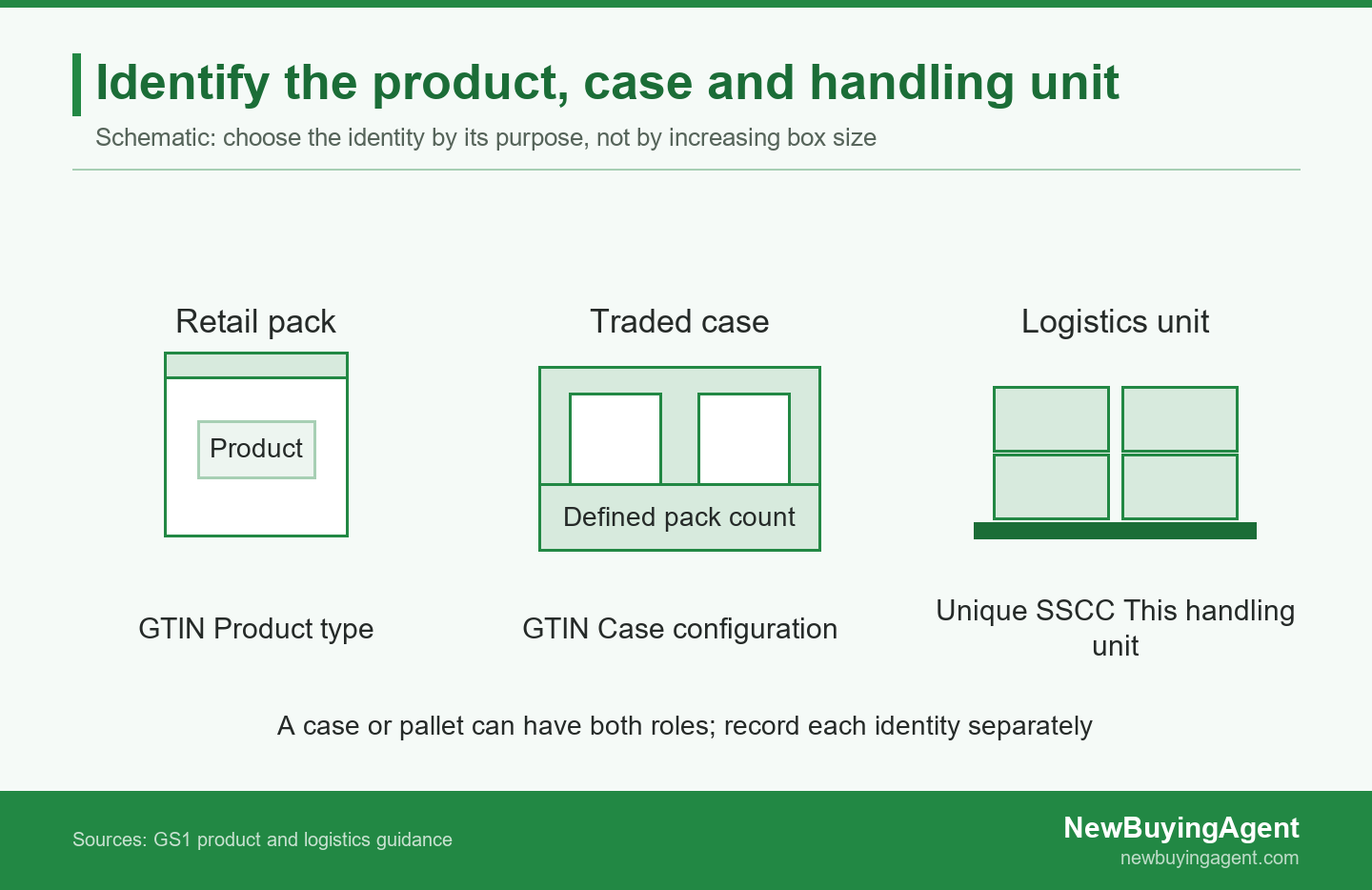
Retail packs, a traded case and a pallet use identities for different purposes.
Separate product types from individual shipping units
Distinguish the product type from the individual handling unit. A GTIN identifies a trade item; a Serial Shipping Container Code (SSCC) identifies an individual logistics unit. The same physical carton can have a role in trading and a role in transport. Its size alone does not tell the team which identity is needed.
Map the retail unit and the traded case
The GS1 explanation of product identity makes an essential distinction: the same GTIN can be repeated on identical units of the same product. It does not, by itself, give each physical unit a separate serial identity. A buyer should therefore describe the product configuration that a number represents before discussing the printed symbol.
Build the packaging map from the consumer unit upward. Record the individual product, any inner pack and the case that is actually traded. Where the outer case is a trade item, establish its own approved identity for that configuration instead of assuming the retail-unit number describes the case. Include the contained item and quantity so that the receiving record can distinguish a case purchase from a purchase of individual units.
Ask the warehouse or distributor what its system should do after reading the case: receive a defined case, break it into retail units or retrieve additional information. These are operational questions for the trading arrangement. A carton photograph and the words “same barcode as before” do not provide an adequate answer when the order format has changed. Keep the relationship visible in the purchase documentation.
Add a shipment identity when the handling unit needs one
Under GS1's logistics-unit guidance, combinations assembled in a case, on a pallet or otherwise for transport or warehousing are individually identified by an SSCC. This identifies the particular handling unit. It answers a different question from the GTIN used to describe the product type or traded case configuration.
Consider repeated cases assembled onto separate pallets. The cases may share a product-type identity, but the shipping team may need to tell the assembled pallets apart. Record who creates and applies the logistics identity, who maintains its association with the contents and what information the receiving partner needs. Keep this responsibility distinct from the approval of the retail artwork.
A case or pallet can be both a trade item and a logistics unit in an actual supply chain. Document both roles when relevant. Do not overwrite one identity with the other merely to simplify a label template, and do not assume that every outer carton needs exactly the same label content. Have the receiving party confirm the intended transaction and handling use before fixing the layout.
Choose the barcode for the receiving environment
According to GS1's barcode-carrier guidance, EAN and UPC barcodes are usually used at retail checkout. ITF-14 supports direct printing onto corrugated packaging, while GS1-128 can carry a GTIN together with attributes. Choose the carrier for its intended scanning environment and data needs, rather than treating all symbols as interchangeable pictures.
The following matrix is a briefing aid, not a universal specification. The receiving partner and applicable GS1 requirements determine the acceptable symbol and details. Where requirements have not been provided, mark them as unresolved rather than letting a graphic designer choose from the barcode generator's default settings.
| Packaging use | Identity question | Carrier discussion | Approval evidence |
|---|---|---|---|
| Consumer retail pack | Which exact product is sold? | Confirm checkout-compatible retail symbol | Product master, approved artwork and production sample |
| Defined traded case | Which contained item and case quantity are ordered? | Discuss corrugated print or label, plus any required attributes | Case mapping, receiver requirements and relevant print report |
| Individual handling unit | Which assembled case or pallet is being transported? | Confirm the logistics-label implementation with the partner | Unique logistics identity linked to actual contents |
Read the matrix across each row. An approval is incomplete when it specifies a symbol but leaves the represented object undefined. Conversely, a correct identifier does not settle whether the factory can print the required symbol reliably on the chosen material. Make both decisions visible before ordering labels or print tooling.
A retail brand launching a kitchen-product range may need the retail pack and wholesale case to work across different receiving processes. NewBuyingAgent's factory-resource access and product-development capability are relevant when matching the supplied product and packaging to that brief. Discuss product supply and packaging requirements with NewBuyingAgent, including the intended channel and case configuration, so those requirements can be considered within the product-supply scope.
Approve artwork and production print quality separately
Keep approval of the encoded identity separate from approval of the printed result. A correct file may produce a poor physical symbol, while a clear print may reproduce obsolete information. Use the artwork review to establish what should be printed, then use production evidence to establish what the factory actually produced.
Check the data and dimensions in the artwork
The check digit helps check the number's integrity through a calculation using its other digits, as explained by the GS1 US Check Digit Calculator. Passing that mathematical check does not establish that the number belongs to the approved product or case. Compare the encoded data against the authorized master record as a separate task.
Give the reviewer the final-size artwork, its revision and the packaging-level map. Check the complete human-readable number against the decoded value and the master record. Confirm which label or carton panel receives it. Treat screenshots as supporting references, not as substitutes for the controlled file from which production will be printed.
Ask the print supplier to identify the applicable symbol-size, height, quiet-zone and placement requirements. Quiet zones are the clear areas needed around a symbol; surrounding graphics should not be allowed to encroach on them. Agree how the printer will preserve these features when fitting artwork to the pack. Avoid approving a barcode that was resized merely because it looked proportionate beside the logo.
When revisions arrive, identify what changed rather than approving the filename alone. A move to another panel, a new label size or a change of print process can affect the physical result even if the identifier is unchanged. Retain the approved version and remove superseded production files from use. This gives later investigation a precise reference instead of several conflicting “final” artworks.
Verify the finished print under the relevant specification
The GS1 retail implementation guideline distinguishes barcode-quality assessment using ISO/IEC 15416 for linear symbols and ISO/IEC 15415 for two-dimensional symbols. Verification measures print characteristics; a successful read by a particular device is a narrower observation. Interpret a reported grade together with its measurement conditions and the requirements for the actual application.
Ask for the applicable minimum grade, measurement aperture and wavelength to be stated with the relevant specification. The aperture is the measurement opening used by the verifier; wavelength describes the measurement light. A bare result labelled “pass” leaves these conditions unclear. A single grade or barcode size cannot replace every application-specific requirement.
Specify which production samples the report covers. Useful records identify the product and packaging revision, print location, material, production date or lot, equipment used and the tested samples. Agree representative selection across the production conditions that matter to the order. A report for a clean development label should not silently become evidence for a different production material or printing process.
Look at the completed pack as well as the flat print. Review whether a seam, fold, overlabel or wrapping covers the symbol or its clear area. Check the result after the relevant packing steps, using the actual substrate and finish. This is a practical way to locate a problem that an artwork-only approval would miss; the agreed verification still needs to follow the applicable method.
If verification identifies a problem, request the parameter-level result and a corrected sample before approving another run. A low-contrast result calls for a different investigation from a data mismatch or an obstructed label. Keep optical quality, data accuracy and receiving-system readiness as separate entries in the approval record. Closing only one entry should not automatically close the others.
For a small trial run, the evidence plan may be relatively simple; repeat production across several print locations needs a clearer sample and change-control agreement. Match the plan to the actual risk and buying arrangement. A verifier report describes the tested samples and conditions, so retain that scope when deciding how confidently to extend approval to production.
Treat a case-count change as an identity decision
The GS1 GTIN Management Standard, pack/case quantity rule, requires a new GTIN when the number of trade items in a case changes. Its change applies at the affected higher packaging levels; a case-count change does not, by itself, change the retail item. Review other product or packaging changes separately against the relevant rules.
This matters when a factory proposes a different case quantity to suit a carton, a replenishment request or a customer's receiving arrangement. Discuss the identity and master-data impact before treating the proposal as a packing convenience. The new case may look familiar and scan successfully while representing a configuration the buyer's system has never approved.
An illustrative case-count change before replenishment
Consider an illustrative order of 2400 private-label kitchen accessories. The wholesaler keeps 1200 retail units in the existing case configuration, while the remaining 1200 move from 12-per-case to 10-per-case. The product itself is unchanged in this example, but the revised case identity has not yet been approved. These are hypothetical quantities, not a client shipment.
The factory sends a video showing a successful scan of the revised carton. However, the photograph shows the old case artwork, and the buyer's receiving record still describes the previous case quantity. The scan answers whether that device can read the symbol. It does not resolve whether the symbol and receiving data describe the contents now inside the carton.
The buyer holds the changed configuration and keeps its cartons and labels separate. The numbering owner approves the affected case identity; the team then updates artwork and receiving data together. The unchanged configuration can be assessed on its own evidence, rather than being automatically released or rejected because the other configuration has a problem.
Before releasing the changed cases, compare physical contents, decoded identity, approved master data and the relevant production print results. Retain the matching evidence with the change record. This illustrative example demonstrates a decision sequence, not a prescribed sampling plan or a claim that relabelling always resolves the issue. Other changes or channel requirements may call for further review.
Release the changed configuration only after reconciliation
Release the changed configuration when the approved identity, actual case quantity and receiving record agree, with the required print evidence complete. Write the approval against the specific version and affected stock. “Barcode corrected” is too vague if the old labels, cartons or electronic records can still enter the next production run.
Record how unused old labels and preprinted cartons will be controlled. Name the person who authorizes their disposition and the person who checks the change at the line. Where old and new configurations legitimately coexist, keep each mapping clear so the receiving team can distinguish them. Avoid solving the production problem by creating a later ambiguity in the warehouse.
On the next purchase order, carry forward the approved configuration and identify any proposed change early. A repeat order should refer to a controlled packaging specification, rather than rely on the factory remembering what happened last time. The retained record then becomes useful purchasing information: it tells both parties which version is approved and what evidence needs refreshing.
Use one approval record across the buying team and factory
Use a shared approval record to connect numbering authority, artwork revision, production samples and receiving readiness. The fields below are a practical buyer template, not a GS1-mandated form. Assign a named owner to each unresolved entry and distinguish “approved,” “pending” and “not applicable,” with a reason for the last status.
- Commercial scope: Product description and variant; destination and receiving channel; order and repeat-order scope; person authorized to approve product or packaging changes.
- Identity map: Numbering owner; retail and traded-case identifiers; contained item and quantity; logistics-unit identity responsibilities where relevant.
- Receiving requirements: Required carrier, data and label arrangement; partner specification and version; named contact who confirms system readiness.
- Artwork approval: Controlled file and revision; final-size review; comparison of human-readable and decoded data against the master; approved position and material.
- Production evidence: Actual print process and pack finish; sample identity and selection scope; applicable quality requirement; verifier report and measurement conditions; completed-pack observations.
- Release and change control: Affected stock, open issues, correction owner, recheck result, old-label disposition and the exact configuration authorized for use.
Use the record at the points where responsibility changes. The product owner confirms the identity, the packaging team controls the file, the production team follows the approved version and the receiving team confirms how the data will be used. One shared reference makes disagreements easier to locate: a changed case count belongs in the identity and configuration review, while damaged print belongs in the production-evidence review.
When a requirement is missing, retain the question and its owner rather than substitute an assumption. For example, the factory may know which print process it will use but have no authority to decide the customer's receiving-system mapping. Closing that gap before production gives the supplier a specific instruction and the buyer a defensible basis for acceptance.
For an importer replenishing several product lines, the practical challenge is keeping approved packaging requirements connected to the products being supplied. NewBuyingAgent's China-side factory resources and quality-control capability are relevant to that procurement task. Send NewBuyingAgent your product and packaging brief, including product specifications, quantity, destination, timing, current sourcing situation, case configuration and repeat-order needs, to discuss an appropriate product-supply scope.
Frequently asked questions about China-made product barcodes
Can our Chinese factory provide the barcode numbers for us?
The factory can print approved barcodes, but who allocates the product number depends on the brand-owner role and applicable GS1 exceptions. Establish that responsibility before using a supplier's existing artwork or purchasing identifiers. A private-label buyer should retain an approved product-to-number mapping and resolve unclear allocation arrangements with the relevant GS1 member organization.
Does a new carton supplier always require a new GTIN?
A change of carton supplier alone does not settle the GTIN decision; assess what changed in the trade item and packaging configuration. A new case quantity is a distinct trigger, while other changes need review under their applicable rules. Separately confirm the physical print result when the material or printing process changes, even if the approved identifier stays the same.
Is a phone scan enough to approve the production barcode?
A successful phone scan shows that one device decoded the symbol under those conditions; it does not establish a standardized print-quality grade. Compare the decoded identity with the approved master data and obtain the verification evidence required for the application. Keep the result tied to the actual production sample, material, artwork revision and measurement conditions.
Should we replace every existing retail barcode with a QR code?
Choose retail barcode changes with the receiving trading partner and applicable GS1 requirements; a promotional QR code alone is not a checkout plan. Confirm the required data, supported carrier and actual reading environment before changing production artwork. A consumer web link and a retail product-identification workflow serve different purposes, even when both appear on the same pack.
NewBuyingAgent
Related Resources



Get Started Today
Let's Turn Your Sourcing Goals into RealityWeChat:+86 15157124615
WhatsApp:+86 15157124615
Address:Building 10 #39 Xiangyuan Road, Hangzhou, China
