

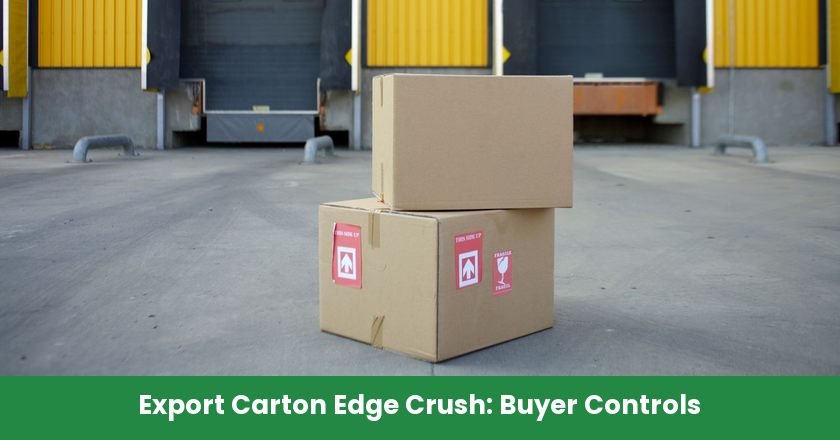
A crushed edge on an export carton is evidence of damage, not a diagnosis of weak board. Before ordering a higher edge-crush grade, establish what failed: a board specimen, a converted carton or a loaded stack. Then compare material identity, test conditions, carton construction and pallet support. For a packaging or operations manager approving repeat China purchases, the useful outcome is a verified correction that can be written into the next order.
Separate the strength result from the damaged pack
- Definition: A board-strength result and an assembled-carton result answer different questions.
- Common mistake: Treating every buckled corner as proof that the purchased board grade was inadequate.
- Risk: Converting changes, moisture exposure, unsupported corners and sustained stacking can escape a material-only check.
- Decision: Identify the changed condition, compare it fairly and verify the relevant packing configuration before approval.
Identify whether the failure is in the board or the carton
Start by identifying the specimen and the loading arrangement behind the reported result. A short board specimen can satisfy its agreed strength requirement while the finished carton performs poorly under a different construction or support condition. Conversely, a damaged edge in a shipment does not establish that the board failed its specified laboratory test; retain the damage observation and investigate the competing explanations.
The edge crush test, or ECT, evaluates a corrugated-board specimen. ISO 3037:2022 specifies a non-waxed edge method with force applied along the flute axis. It also permits samples taken from converted cases. A useful report therefore identifies the method, specimen source and condition; “the supplier has an ECT certificate” is too vague to connect the result to a particular carton order.
A box compression test, or BCT, evaluates the assembled box under a defined configuration. ASTM D642-25 covers compression of shipping containers, components and unit loads, with or without contents as appropriate. For buyer approval, the report should make clear whether the actual product, internal packing and closure were present, and which loading orientation was tested.
A retailer replenishing flat-packed household products needs the carton specification to match the product weight, geometry and intended handling. NewBuyingAgent’s local China factory network and product-development and quality-control capabilities support sourcing the product and its packaging against that brief. Record the agreed carton requirements alongside the product specification so proposed changes can be checked against the same basis.
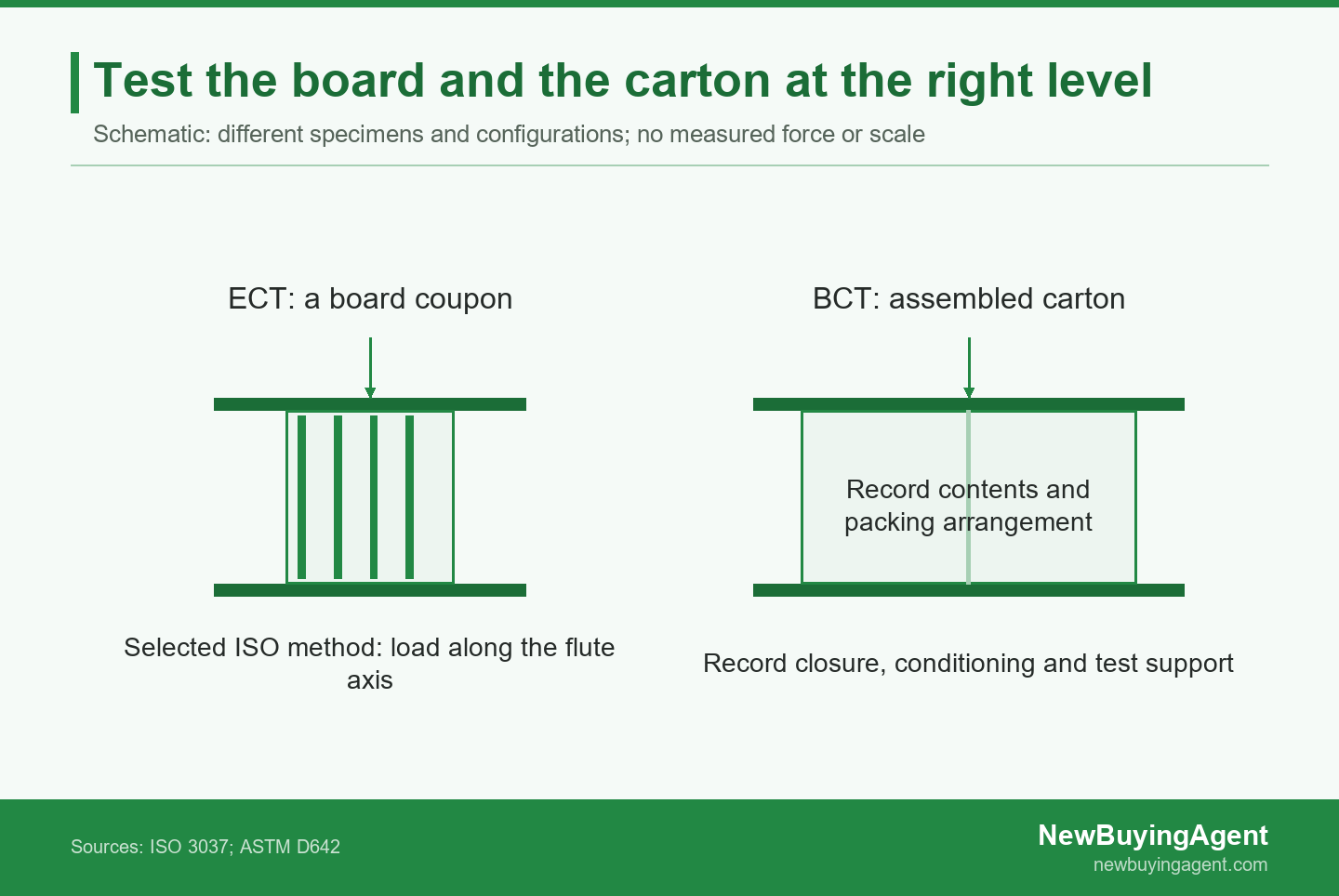
ECT tests board coupons; box compression evaluates the carton and its test configuration.
Separate board quality from converting changes
Trace the material and the finished carton separately before assigning a root cause. Compare a current, identifiable board sample with the approved reference under the same method and conditions, then check what happened during printing, scoring, cutting and assembly. This separates a change in the supplied material from a change introduced while making the box, instead of letting a shared grade name stand in for both.
Check specimen preparation and conditioning
Specimen preparation can complicate the interpretation of a low result. A Forest Products Laboratory comparison of edge-compression specimens reported a waxed sample with low strength because failure occurred at the loading edges. That older experiment is a reason to examine preparation and failure mode; it is not permission to dismiss an unfavorable current test or replace the selected method with a more convenient one.
Conditioning means holding specimens in a specified temperature and humidity atmosphere before testing. ASTM D4332 explains that these conditions affect packaging properties and that defined conditioning supports meaningful, reproducible measurements. The practice also distinguishes laboratory conditions from actual field exposure. Record the conditions and their duration rather than comparing a fresh dry-room sample with a shipment sample of unknown moisture history.
Ask for the lot identity, sampling location, method and version, specimen preparation, units, conditioning and individual results alongside the reported summary. The laboratory should explain any invalid specimens or departures from the method. If supplier reports use different methods, obtain a justified comparison rather than treating similarly named values as automatically interchangeable. Preserve both the original results and the explanation of what can be compared.
Inspect the converted carton against its approved design
Check the converted sheets and assembled cartons, not only untouched board. FEFCO’s converting-equipment specification treats scoring-depth variation as a measurable feature and describes its relationship to the die-tool and anvil setting. For a carton with deformation near a fold, this supports a focused request for score consistency and production-setting evidence, rather than a general claim that every visible crease is defective.
Compare the approved drawing with the actual carton: dimensions, flute orientation, score and slot positions, joints, openings and closure. Look for local crushing or tearing and identify where it first appears in the production sequence. Use retained material from before and after the suspected operation where possible. A sample cut from an undamaged area answers a different question from a sample deliberately taken through a damaged score; record that distinction.
The next action follows the evidence. A confirmed wrong material calls for material control; an isolated conversion change calls for investigation of that operation and affected scope. If both differ, a single replacement sample cannot show which correction mattered. Keep the compared constructions identifiable and ask the responsible packaging specialist to define a test arrangement that answers the actual question.
Recreate pallet support and time under load
Recreate where the carton transfers its load into the pallet, especially near corners and deck gaps. In their tested configurations, Baker and colleagues’ pallet-support study found lower box compression strength as deckboard gaps increased, with sensitivity affected by box size and gap proximity to corners. This makes actual support a diagnostic variable; the study does not supply a universal reduction percentage for every export pallet.
The load path is the route by which force passes through the stacked cartons into their support. Photograph the bottom layer and its contact with the pallet, not just the outside of the completed load. Record overhang, gaps beneath edges or corners, stack alignment, pallet identity and any change from the tested arrangement. A flat laboratory platen and a pallet with interrupted support are different configurations, even when the carton drawing and board grade match.
Time under load also needs its own evidence. ASTM D4577 evaluates resistance to a vertically applied constant load for a specified time or until failure, and can be used for palletized arrangements. A short compression-strength result therefore does not, by itself, establish performance through an extended stacking period. Agree the relevant load, duration, atmospheric conditions and acceptance criteria for the intended use.
For a support hypothesis, compare the actual carton and product pack on a defined reference support and the proposed support while keeping the other relevant conditions matched. If the results differ, investigate what that comparison isolates and what still varies. If the product, closure, humidity and pallet pattern all change together, the result can evaluate the combined proposal, but cannot identify one of those changes as the sole cause.
Arrange loaded-stack or machine testing through competent personnel and suitable equipment. The buyer’s role is to specify the question, configuration and evidence required for approval; an improvised loaded stack is not a substitute for a controlled test. Preserve any limitations when deciding whether the evidence represents warehouse storage, a palletized route or a different distribution condition.
Use a cause-to-evidence diagnostic record
Use a cause-to-evidence record to choose the next check without prematurely naming a root cause. Each row below pairs an observation with evidence that can discriminate between explanations and a conditional response. Add the actual carton revision, board lot, affected quantities, photographs and decision owner so that the investigation remains connected to the order rather than becoming a general discussion about stronger packaging.
| Observation | Evidence to obtain | Buyer response |
|---|---|---|
| Low or conflicting board result | Match lot, method, preparation, units and conditioning; review failure mode. | Retest or investigate the identified material under the agreed method; do not select the most favorable unmatched report. |
| Local damage near a score or joint | Compare approved geometry and converted samples; locate the production operation where damage appears. | Investigate the identified operation and affected scope; verify a corrected carton. |
| Bottom corners buckle on a pallet | Map corner/edge contact, deck gaps, overhang and stack alignment against the tested layout. | Compare support arrangements with the relevant pack and exposure held constant. |
| Damage appears after stacked storage | Record load, elapsed time, atmospheric history and where deformation occurs. | Evaluate sustained-load performance for the agreed conditions, not only a short strength result. |
| Board passes but the pack changes | Identify changes to dimensions, flaps, openings, closure, contents or pallet layout. | Review the changed configuration and define what evidence qualifies it. |
| Evidence cannot be traced to the order | Record carton revision: ____; board lot: ____; report: ____; affected IDs: ____. | Keep the unresolved scope unapproved until identity and relevant verification are established. |
Give each open item an owner and a closure condition: what will be checked, which configuration it represents and who can approve the result. “Use better board” is not a closure condition when the disputed feature is an unsupported corner. Equally, correcting pallet placement does not settle a genuine out-of-specification board result. Keep both issues open if the evidence supports both.
An importer purchasing a recurring household hardware range can use this record within We Supply Products To You. NewBuyingAgent’s factory resources and product/QC capability are relevant to selecting a product-and-pack proposal that can be repeated across orders. Bring the carton drawing and actual packing constraints into the complete supply brief, and agree who provides any specialist test work and which production evidence belongs in the order.
An illustrative order with an unvalidated pallet layout
An acceptable board result allows the buyer to use that result within its identified scope; it does not approve an untested pallet layout. The illustrative order below shows why the next decision can be a controlled packing comparison rather than an immediate grade increase. Keeping the material and configuration identities clear lets the manager define a correction without claiming that the visible damage has already proved its cause.
Compare the layout before changing the board grade
Illustrative example: a packaging manager approves repeat China purchases for an importer ordering 2,400 household hardware kits in 600 cartons of 4 kits. The shipment plan has 30 pallets carrying 20 cartons each. The current lot’s board report meets the agreed ECT requirement, but a new pallet layout proposed for 200 cartons on 10 pallets has not been qualified. These are invented inputs, not a verified client shipment.
A loading mock-up using the new layout shows lower-corner buckling, and a carton corner projects beyond its support. The carton IDs and board report remain traceable, while photographs show that support geometry differs from the previous arrangement. These observations make support a sensible hypothesis to investigate. They do not establish that the board is adequate for every use or that overhang is the only cause.
The manager will not approve the new layout for the affected 200 cartons on the strength of the board report alone. The board grade remains provisional while a matched configuration comparison is arranged. This avoids treating a material result as whole-pack approval and avoids paying for an unverified grade change that may leave the support problem in place.
The proposed correction removes the unsupported placement and identifies the revised pallet arrangement. The evaluation retains the relevant product, carton, closure, conditioning and exposure criteria, documenting the support change and the evidence needed for approval. In this illustrative example, the manager has selected a diagnostic and verification plan; no successful retest, dry arrival or permission to release the remaining shipment is being claimed.
Retest the corrected configuration before approving it
Verify the corrected configuration using the actual pack features relevant to the decision. Record the carton and material identities, contents, internal packing, closure, support and exposure conditions, together with the agreed acceptance criteria and results. If the corrected arrangement passes that evaluation, approval extends to the configuration and scope actually represented, rather than automatically to every other SKU or pallet.
Preserve the previous arrangement and failed observations in the change record. Issue the corrected packing drawing or loading instruction with a clear revision, and check that production uses it. If a different pallet, carton dimension or closure is later proposed, identify whether that change affects the verified load path. A corrected sample sitting in the office cannot establish that the factory packed the next replenishment the same way.
Approve a repeatable packing specification
Approve the defined packing construction, not only its board-grade description. In a study of shifted flap creases, the tested offset designs showed reduced static load capacity; geometry changed how the walls took load. The buyer lesson is to control dimensions, folds and other relevant revisions alongside the material requirement, without borrowing that study’s results as a universal allowance for a different carton.
Write the confirmed correction into the purchase specification: the board construction and required test evidence, approved carton drawing, conversion features, product and internal-pack arrangement, closure and pallet layout. Identify the conditioning and loading configuration represented by any acceptance test. Keep the report and its revision linked to the order, and state which changes require technical review before substitution.
- Before production, confirm that the quoted carton and packing revisions match the approved purchasing requirements.
- During carton conversion and packing, check the specific feature implicated in the diagnosis, such as score consistency or support placement.
- Before dispatch, reconcile actual carton lots and packing arrangements with the evidence used for approval; resolve unapproved substitutions.
Let the confirmed cause determine the control. Material variation calls for material evidence; conversion variation calls for process and finished-carton checks; a support change calls for an approved load arrangement. More than one can apply. Review later damage against those records so the next order improves the relevant requirement instead of repeatedly increasing a grade number without a demonstrated benefit.
For a recurring homewares or hardware purchase, include the product specification, quantity, destination, timing and repeat-order plan, plus the carton drawing and available test or loading records. These inputs support a complete China product-supply discussion using NewBuyingAgent’s factory access and product/QC capability, with any specialist packaging work defined in the agreed scope. Send the product and packing requirements to NewBuyingAgent.
Frequently asked questions
Can a higher ECT grade be used as a temporary fix?
A higher grade can be evaluated as a controlled change, but its label alone does not approve the revised carton or loading arrangement. Identify the intended scope and evaluate the actual pack before accepting the substitution. Keep the reason, changed construction and approval basis in the order record. A temporary purchasing decision should still identify which uncertainty remains and what evidence is needed to close it.
Can burst strength be substituted for the ECT requirement?
Burst strength and ECT describe different properties, so a burst value should not replace an agreed edge-compression requirement without a revised specification. FEFCO’s comparison of test families lists bursting strength and edgewise crush resistance separately. If a supplier proposes an alternative, ask the responsible packaging specialist to explain which requirement it addresses and how the revised pack will be evaluated. A different label or result does not establish equivalence.
Can a box-strength calculation replace testing the finished pack?
A calculation can support design screening within its assumptions, but it does not by itself verify a changed carton and actual pallet configuration. Check whether the model covers the box style, dimensions, board properties and support conditions in question. Use it to select sensible designs or test candidates, then verify the relevant construction. A prediction outside its validated range should remain an assumption, not a reported passing test.
Should every export carton use the same compression-test conditions?
Compression-test conditions should represent the product, packing construction and intended distribution exposure, rather than follow one universal grade or duration for all exports. Define whether the decision concerns an empty carton, the product-filled pack or a unit load, then identify the relevant support and exposure. Preserve method and version requirements where specified. Another supplier’s passing arrangement can inform questions, but it cannot qualify a different construction simply because both orders are exported from China.
NewBuyingAgent
Related Resources

Get Started Today
Let's Turn Your Sourcing Goals into RealityWeChat:+86 15157124615
WhatsApp:+86 15157124615
Address:Building 10 #39 Xiangyuan Road, Hangzhou, China
