

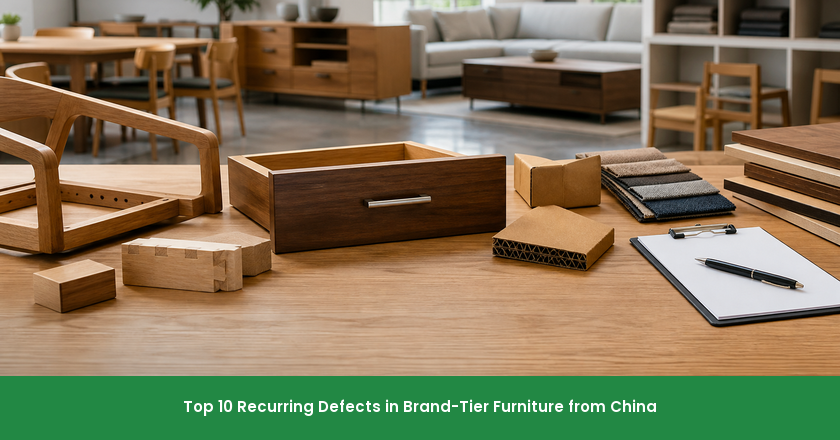
Recurring defects in brand-tier furniture from China usually come from weak version control, material changes, finishing variation, hardware mismatch, packaging shortcuts, or missing evidence before shipment release.
Brand-tier furniture is unforgiving because customers can see, touch, assemble, and review the product immediately. A slight color difference, weak drawer glide, missing screw bag, chipped corner, or unstable dresser can become a return, negative review, safety complaint, or retail chargeback. The buyer's goal is not to inspect every possible flaw. The goal is to identify the defects that repeat and build controls before mass production moves too far.
This is general sourcing and product-safety information, not legal or compliance advice. Furniture buyers should confirm final requirements with qualified compliance professionals, testing labs, or counsel when a product may be covered by a safety standard, chemical rule, warning requirement, or certification obligation.
NewBuyingAgent is relevant because furniture quality depends on a connected path from product brief to delivery. Buyers share specs, quantity, target price, destination, and timing; NewBuyingAgent prepares a quote and manages product selection, cost negotiation, quality management, production follow-up, logistics, and delivery.
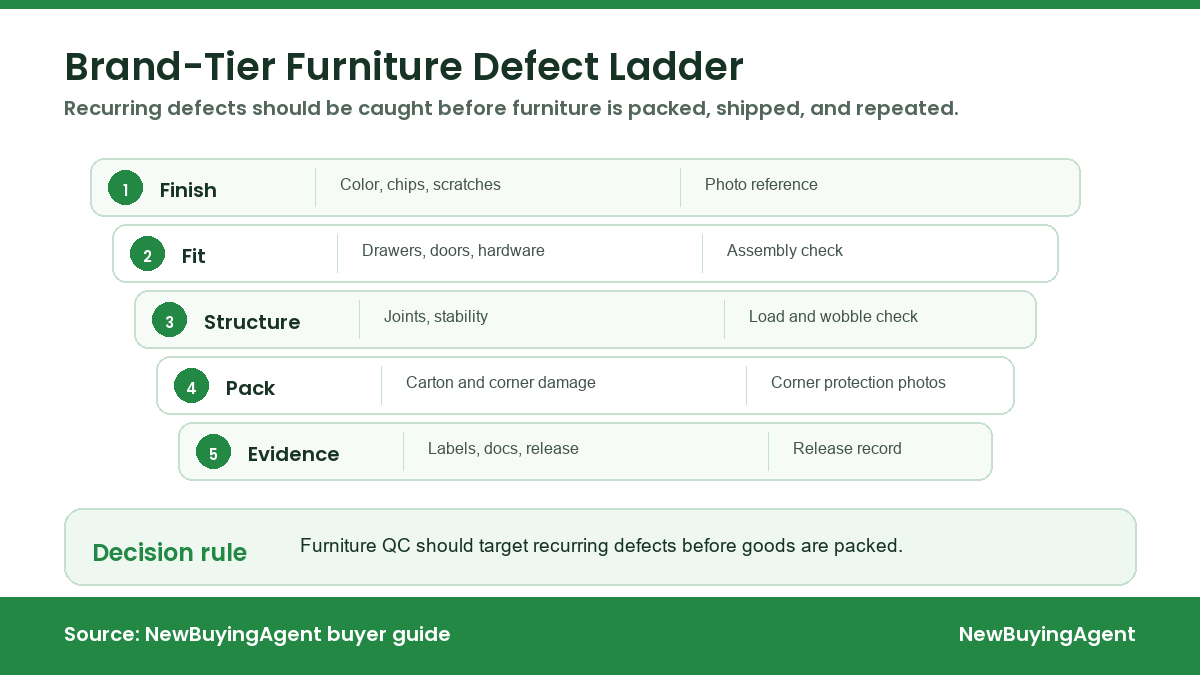
Recurring furniture defects move from visible finish issues to deeper risks in structure, packaging, documents, and safety evidence.
Why Furniture Defects Repeat
Furniture defects repeat because the product has many connected parts. A cabinet is not only panels. It is material, thickness, edge banding, surface finish, hardware, fasteners, drawer fit, packaging, labels, assembly instructions, and carton protection. If one detail is changed to save cost or speed production, the defect may not appear until the customer assembles or uses the product.
The second reason is that furniture samples can hide production risk. A showroom sample may look strong because it was built carefully. Mass production has different pressures: material batches, curing time, drilling accuracy, carton handling, container loading, and worker consistency. If the approved sample is not converted into measurable production and inspection requirements, the factory floor may create a weaker version of the same product.
The Return-Cost Estimate for a Small Defect Rate
Assume a furniture buyer imports 800 units with a landed cost of $85 and a retail price of $199. If 5% of units have visible finish damage, missing hardware, or drawer-fit problems, 40 units may require refunds, replacements, discount handling, or service tickets. At landed cost alone, the exposed inventory value is $3,400. If replacements must be shipped domestically and customer ratings fall during launch, the commercial impact can be much higher. This illustrative estimate is not a market average; it shows why a small recurring defect rate can damage a brand-tier furniture program.
The Top 10 Recurring Defects
#1 Finish and Color Variation
Finish variation is one of the most visible furniture problems. Wood tone, veneer pattern, laminate color, painted surface, powder coating, fabric shade, and gloss level can differ between sample and production. A buyer may approve one attractive sample, then receive goods that look inconsistent across units or across parts of the same set.
The control is not a general request for good finish. Buyers should define acceptable variation, keep approved reference photos, request batch photos, and treat finish as a release criterion. For multi-piece sets, the inspection should check whether pieces that ship together look like they belong together.
#2 Scratches, Dents, Chips, and Edge Damage
Surface damage often appears when furniture parts are stacked, moved, packed, or loaded without enough protection. Corners, edges, painted panels, metal frames, glass parts, and glossy surfaces are especially exposed. The product may leave production acceptable but arrive damaged because the handling and packaging plan was weak.
The buyer should request packaging photos before release, not only final product photos. Corner guards, inner separators, hardware bags, foam placement, moisture protection, and carton strength should match the product's fragility and shipping route.
#3 Dimension Drift and Poor Alignment
Dimension drift creates assembly problems, uneven gaps, rocking tables, misaligned cabinet doors, and drawers that do not close cleanly. It can come from cutting tolerance, drilling accuracy, material swelling, weak jigs, or rushed assembly checks.
Brand-tier furniture buyers should require key dimension checks and photo evidence for fit points. For items shipped flat-packed, the inspection should include an assembly check. A product that looks fine unassembled may fail when parts meet.
#4 Weak Joints and Structural Instability
Weak joints are harder to see than scratches but more serious. Loose screws, poor glue application, thin panels, weak brackets, or poor welding can reduce load capacity and customer trust. For storage furniture, seating, beds, and tables, structure is not a cosmetic issue.
Buyers should identify load-bearing points, ask for construction photos where practical, and align inspection with product use. Covered clothing storage units, bunk beds, and other regulated or safety-sensitive products require extra care because stability, guardrails, entrapment, labels, testing, and certification may matter.
#5 Hardware Mismatch or Missing Parts
Missing screws, wrong hinges, weak drawer slides, mismatched handles, unclear fastener bags, or missing wall anchors can turn an otherwise acceptable product into a customer-service problem. Hardware defects are common because small parts are easy to substitute or mispack.
The control is a parts list, labeled hardware bags, instruction review, and sample assembly. For ecommerce furniture, the buyer should assume that customers will judge the product harshly if assembly fails in the first hour.
#6 Drawer, Door, and Glide Problems
Drawers and doors create recurring problems because they combine dimensions, hardware, weight, and user feel. A drawer may pass a visual check but bind after installation. A cabinet door may close unevenly because hinges, holes, or panel flatness are inconsistent.
Inspection should include functional checks. Open, close, pull, align, and observe. The buyer should request close-up photos or short videos for the parts that customers will touch most often.
#7 Panel Warping, Moisture, and Odor
Wood, MDF, particleboard, plywood, veneer, and upholstered components can react to moisture, storage, adhesive, and curing conditions. Warping may not be obvious at first glance. Odor can create customer complaints even when the product looks acceptable.
For composite wood products and finished goods containing them, U.S. buyers should review TSCA Title VI expectations with qualified professionals. Even when the product is not legally complex, material and moisture control should be part of the purchasing brief.
#8 Upholstery, Stitching, and Foam Inconsistency
Upholstered furniture adds another layer of variation. Fabric shade, seam straightness, foam density, cushion feel, frame support, and wrinkle control all affect perceived quality. A product can match the photo but feel cheaper than the brand promise.
Buyers should preserve fabric references, foam expectations, approved sample photos, and close-up stitching details. The QC plan should check both visible finish and user feel where possible.
#9 Packaging Failure and Carton Damage
Furniture packaging is not a secondary detail. Bulky products move through export handling, container loading, unloading, warehouses, parcel networks, and customer homes. Weak packaging can convert good production into damaged inventory.
The buyer should require carton data, inner protection photos, corner protection, hardware placement, label placement, and carton-mark evidence. Packaging should be reviewed before production release if the product is heavy, fragile, painted, glass-based, or flat-packed.
#10 Label, Warning, Document, and Safety Evidence Gaps
Some furniture defects are not visible on the product surface. Missing warnings, weak instructions, incomplete certification evidence, wrong labels, or unclear documents can create retail, customs, or safety problems. CPSC guidance for clothing storage units and federal bunk bed requirements show that furniture categories can carry safety obligations beyond appearance.
The buyer should identify destination-market documentation needs before quote approval. If documentation is handled after production, the buyer may discover the issue when the order is already hard to change.
Recurring Defect Control Table
| Defect Type | Early Signal | Evidence to Request | Release Rule |
|---|---|---|---|
| Finish variation | Sample looks different from production photos | Reference sample, batch photos, close-ups | Hold if visible set mismatch appears |
| Poor fit | Uneven gaps, binding drawer, unstable assembly | Dimension checks and assembly proof | Rework before packing |
| Missing parts | Hardware bag not matched to parts list | Parts list, bag photos, instruction check | Do not release without full kit proof |
| Packaging damage | Thin cartons or unprotected corners | Packing photos, carton marks, pallet plan | Improve packaging before shipment |
What to Prepare Before a Furniture QC and Quote Review
Furniture buyers should prepare drawings or photos, dimensions, materials, finish references, hardware details, assembly method, packaging expectations, target quantity, target price, destination market, delivery timing, and known safety or documentation concerns. The clearer the brief, the easier it is to quote the right product and inspect the right risks.
Buyers with a furniture order can ask NewBuyingAgent to review the purchasing requirements , help you manage the suppliers' production process and product quality, and arrange door-to-door logistics before production decisions become hard to reverse. Buyers still defining the service scope can review NewBuyingAgent's product sourcing service.
Who Is NewBuyingAgent?
NewBuyingAgent is a one-stop China sourcing agent for global buyers. Buyers share product specs, volume, target price, destination, and timing. NewBuyingAgent prepares a quote and manages product selection, cost negotiation, quality management, production follow-up, logistics, and delivery.
Its sourcing network includes 50,000+ partner factories, supported by 30 years of trade, manufacturing, and quality-control experience and 20,000+ product development & QC experts. For furniture buyers, the value is turning product specs, sample standards, QC evidence, packaging, and delivery into one managed procurement path.
Controls That Should Happen Before Mass Production
The strongest furniture QC work happens before mass production, not only before shipment. Buyers should turn the approved sample into a production record: dimensions, finish reference, material notes, hardware list, packaging method, label requirements, instruction version, and known defect limits. If the record is weak, the production team may rely on memory, photos, or assumptions. That is how recurring defects begin.
Pre-production control also means deciding which details are brand-critical. For a premium dresser, drawer feel, surface finish, gap alignment, and stability may matter more than minor internal marks. For an outdoor chair, coating, rust resistance, fasteners, and load points may be more important. For flat-pack ecommerce furniture, missing parts, instruction clarity, and carton protection can decide customer reviews. The buyer should identify these priorities before inspection, because a generic checklist may miss the defect that actually hurts the business.
NewBuyingAgent can manage this work when the buyer provides furniture specs, volume, target price, destination, and timing. The service path should connect quote preparation, product selection, cost negotiation, quality management, production follow-up, logistics, and delivery. That connection matters because a furniture defect often starts as a cost or timing decision earlier in the order.
Production Timing Matters
Furniture inspection at the end of production is important, but it is not enough for high-risk products. Some problems should be checked while materials are being prepared, while finishes are being applied, while hardware is being fitted, or before cartons are sealed. If the buyer waits until everything is packed, the only choices may be delay, discount, rework, or acceptance.
A staged review does not need to be complicated. The buyer can ask for material confirmation before production, first finished-unit photos, assembly checks, hardware-kit photos, carton-protection photos, and final inspection results. The point is to catch repeating errors before they spread through the full order.
How to Turn Defect History Into a Better Next Order
Many brand buyers collect defect photos after delivery but fail to turn them into the next purchase brief. That loses the value of painful experience. If customers complain about chipped corners, the next order should include stronger corner protection and carton photos. If drawers bind, the next order should include fit checks. If color varies, the next order should include tighter finish references and batch photo review. If instructions confuse customers, the manual should be corrected before reorder.
The useful defect record has five fields: what failed, where it appeared, how often it appeared, what evidence proved it, and what must change before reorder. This turns quality control from complaint handling into product learning.
| Defect History | Likely Root Area | Next-Order Control | Buyer Decision |
|---|---|---|---|
| Chipped corners | Inner protection or handling | Corner guards and carton drop concern review | Do not reorder until pack is revised |
| Uneven drawers | Drilling, hardware, assembly tolerance | Fit check and close-up proof | Require correction before production scale |
| Strong odor | Material, adhesive, curing, storage | Material confirmation and ventilation timing | Check compliance and customer tolerance |
| Missing screws | Hardware packing and instructions | Parts list, labeled bags, assembly trial | Hold release if kit proof is incomplete |
Category-Specific Evidence Matters
Furniture buyers should not use the same evidence plan for every product. A clothing storage unit may need stability and warning attention. A bunk bed may need guardrail and entrapment review. A composite wood product may require formaldehyde-related documentation for the destination market. An upholstered chair may need fabric, foam, frame, and seam checks. An outdoor table may need coating and corrosion attention. The defect list should change with the product.
This is why official sources matter. CPSC business guidance for clothing storage units and federal bunk bed requirements show that some furniture categories carry safety expectations beyond appearance. EPA materials on composite wood products show why panel documentation can matter for U.S.-bound goods. These sources do not replace professional advice, but they tell buyers not to treat all furniture defects as cosmetic.
Buyers should ask two questions before each order. What defect would make this product unsafe, unsellable, or brand-damaging? What evidence would reveal that defect before shipment? The answer may be a test report, label photo, assembly video, close-up finish image, parts-list check, carton photo, or final inspection record. A useful QC plan follows the product's risk, not a generic template.
Release, Rework, or Hold
Before inspection, buyers should define what happens if a defect is found. Some defects can be accepted with a discount if they are hidden and do not affect use. Some require rework before release. Some should hold the shipment because they affect safety, assembly, customer experience, or retail acceptance. If this decision is made only after the report arrives, pressure may push the buyer into accepting goods that should have been corrected.
NewBuyingAgent can help by turning the buyer's furniture requirements into a managed quality path. The buyer still decides the commercial tolerance, but the production follow-up and quality evidence need to be organized before the order reaches the final release point.
Why Final Photos Are Not Enough
Final product photos can show finish, shape, color, and packing status, but they cannot prove every furniture risk. They may not reveal weak joints, missing inner hardware, poor instruction clarity, unstable assembly, odor, panel moisture, or whether cartons can survive handling. Photos are useful evidence, not the whole quality system.
For brand-tier furniture, buyers should request the type of evidence that matches the defect risk. A surface defect needs close-ups. A fit defect needs assembly or function proof. A packing risk needs carton and inner-protection photos. A documentation risk needs labels, warnings, certificates, or test records where applicable.
The evidence plan should be written into the order file so the same checks can be repeated on the next production run.
Frequently Asked Questions
What is the most common furniture defect from China?
The most common visible problems are finish variation, scratches, chips, poor alignment, and missing hardware. The most serious problems may be structural, packaging, or documentation related. Buyers should rank defects by customer impact, not only by how easy they are to see.
How can buyers reduce furniture defects before shipment?
Buyers can reduce defects by locking the approved sample, defining finish and dimension tolerances, checking hardware kits, reviewing packaging, and requiring inspection evidence before shipment release. For complex or safety-sensitive furniture, documentation and testing questions should be raised before production starts.
Do furniture buyers need product safety review?
Some furniture categories may need safety, labeling, testing, or certification review, especially clothing storage units, bunk beds, children's furniture, and products containing composite wood. Buyers should confirm requirements with qualified professionals for the destination market before approving production or shipment.
Why does packaging cause so many furniture returns?
Furniture is bulky, heavy, and vulnerable at corners, edges, panels, glass, and painted surfaces. Weak packaging can damage otherwise acceptable goods during transport. Packaging should be reviewed with the same seriousness as the product because customers judge the delivered item, not the factory photo.
NewBuyingAgent
Related Resources



Get Started Today
Let's Turn Your Sourcing Goals into RealityWeChat:+86 15157124615
WhatsApp:+86 15157124615
Address:Building 10 #39 Xiangyuan Road, Hangzhou, China
