


A beautiful home-decor mood board is not yet a sourcing brief. It may settle a palette and a feeling while leaving the substrate, finish variation, carton protection, product marking, and destination evidence unresolved. The useful test for a modern home decor sourcing agent in China is whether those decisions become one record that can be quoted, sampled, checked, and shipped.
What Turns a Decor Concept Into a Quote-Ready Range
A home decor sourcing agent is useful when it turns design direction into SKU evidence for Style, Structure, and Shipment. Style fixes what the buyer wants to see; Structure fixes what must be made; Shipment fixes how that approved item reaches the sales channel. When one of those layers is missing, two apparently similar quotes may refer to different products.
- Do not approve a mood board as a specification. Add a controlled visual reference, the material behind it, and the allowed variation for each SKU.
- Keep evidence at SKU level. A rug, a composite-wood side table, a cushion cover, and a wood accent do not inherit one generic approval file.
- Approve the packed product, not only the display sample. Carton identity, protection, labels, and handling conditions affect the product the buyer actually receives.
- Choose the service path by starting point. A new range needs a complete supply brief; an existing Chinese factory may need China-side management and follow-up.
What a Home Decor Sourcing Agent Should Actually Solve
The hard part of modern decor sourcing is translating a visual idea into product and packing decisions that can be checked. A factory photograph can show the right silhouette, yet leave open whether the ceramic glaze, mirror backing, cushion fill, hardware, protective corner, inner pack, and carton marking are the same as the buyer expects. The agent's practical role is to make those choices visible before a price is treated as comparable.
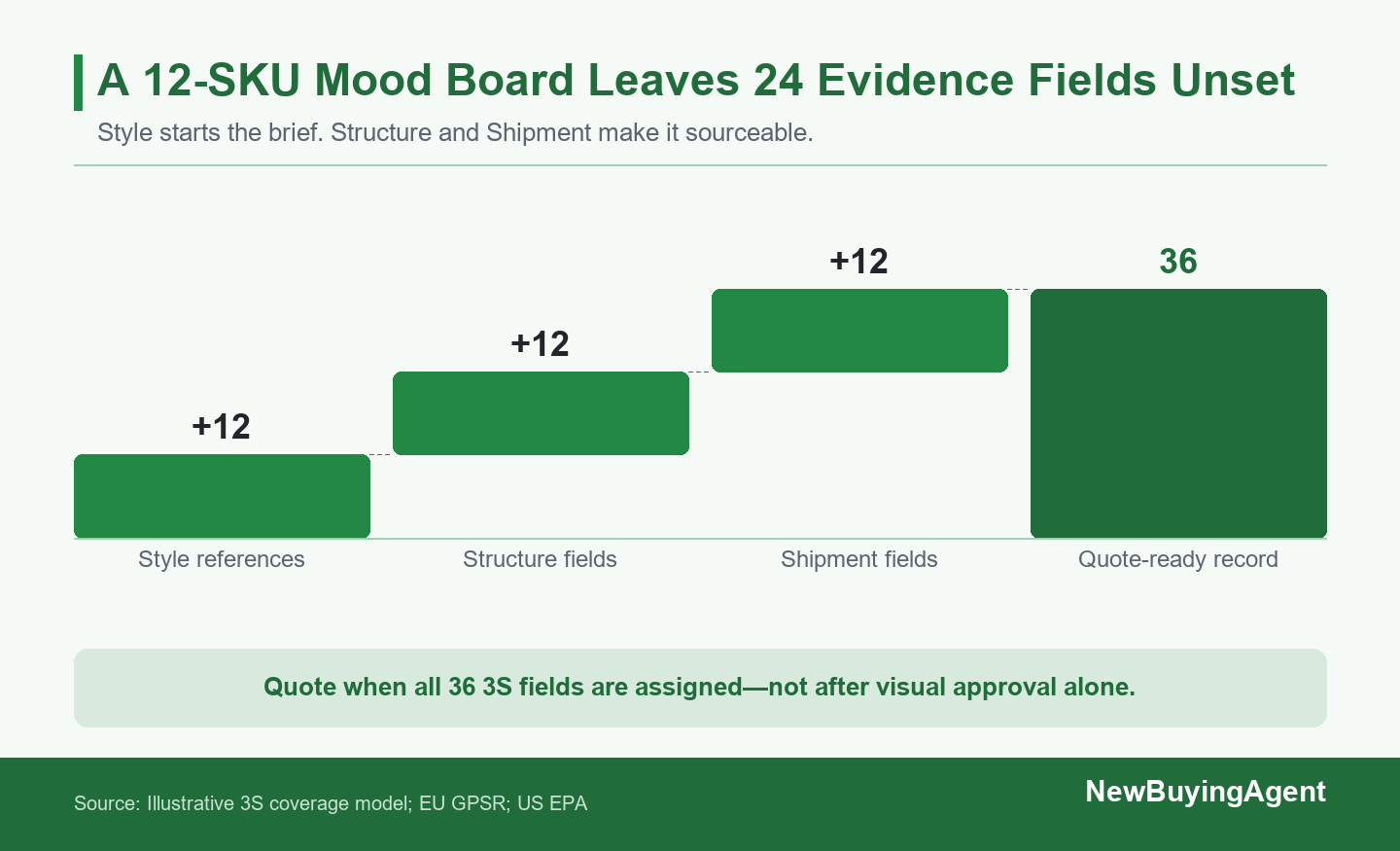
In this illustrative range, a mood board settles 12 style references; structure and shipment add 24 fields before the collection is quote-ready.
That matters most when a range mixes materials and factories. A buyer can ask for “warm stone,” “brushed gold,” or “soft bouclé,” but those are directions rather than measurable instructions. The working brief should tie each direction to a physical reference, a material, an approval point, and a packed configuration. It should also identify which details are range-wide and which belong to one SKU. This is how a sourcing discussion moves from attractive samples to controlled decisions.
Turn a Decor Idea Into a Quote-Ready Brief
The Decor Translation Framework uses Style, Structure, and Shipment to make every SKU quote-ready. It is a three-part briefing method: Style records the approved appearance, Structure records the physical build and relevant product evidence, and Shipment records the packed item, labels, and handling conditions. It is not a factory score or a promise of performance; it is a way for the buyer to see what is still undefined before asking for a quotation.
NewBuyingAgent fits when a buyer needs a new home decor range quoted and supplied from a complete product brief. Once the buyer has the 3S record, they can see how NewBuyingAgent supplies a new home decor range from China without mistaking the service for a buyer-facing supplier shortlist. The buyer supplies the commercial direction and product requirements; the China-side work converts that brief into sourcing, product follow-up, quality control, and delivery coordination.
For EU-bound consumer goods, product safety assessment can include packaging and instructions as well as the product itself. The EU summary of Regulation (EU) 2023/988 makes that boundary explicit. It is a reason to decide packing details and product information early for EU sales, while still confirming the specific product and market requirements for the SKU.
Style: Make Visual Intent Measurable
A color name is not a controlled finish until the buyer attaches a reference, substrate, and acceptable variation. For a ceramic vase, that might mean a signed glaze chip, matte-versus-gloss direction, viewing light, and location of intentional variation. For a mirror frame, it may mean a metal sample, sheen level, weld treatment, and the side of the frame used for approval. A picture alone cannot settle those choices.
Give each SKU one reference hierarchy. First, name the approved physical sample or color standard. Next, state the substrate and finish process that are expected to create it. Then note what variation is acceptable and what needs a new approval. This avoids the common trap of treating every sample comment as isolated. The Decor Translation Framework starts with Style because an undefined look cannot be protected by a precise carton or a clean test file.
Structure: Make the Look Buildable
For US-bound decor, composite wood and household textiles need product-specific material and labeling checks rather than one generic approval file. The EPA’s importer compliance guide for composite wood is relevant to covered engineered-wood products, while the FTC’s Textile Products Identification Act text includes household textile articles. In practical terms, a wood shelf and a cushion cover should keep separate material and labeling questions even when both belong to the same collection.
Structure also covers the information a product developer needs to reproduce the look: dimensions and tolerances, wall thickness or board type, glass or mirror details, hardware, fill, seam, attachment method, and expected use. A quote is clearer when it identifies the material grade and construction assumed by the supplier, rather than hiding those choices inside a single unit price. For destination-market requirements, confirm scope with the importer, product specialist, or qualified advisor before release.
Shipment: Make the Approved Product Deliverable
For US-bound decor, country-of-origin marking should be resolved before the final pack-out and label artwork are approved. US Customs and Border Protection guidance states that articles imported for US use generally need country-of-origin marking, subject to commodity-specific circumstances and exceptions. Treat pack-out as the product, protective materials, carton, labels, and quantity prepared together for shipment. Put the marking decision into that SKU record rather than adding it after printing.
Record packed dimensions, gross weight, drop-risk points, orientation, and any retailer or warehouse label requirement. The Shipment layer does not replace transit testing or market-specific rules; it makes clear which packed configuration needs review before a container booking locks it in.
Build a Destination-Specific Evidence Pack
A rug and a wood accent can need different evidence because flammability and timber-trade questions are product-specific. For US floor-covering products, 16 CFR Part 1630 sets a surface-flammability standard for carpets and rugs within its scope. For timber, the US Fish and Wildlife Service explains that a CITES listing annotation can determine whether a product needs permit or certificate checks. Those are different questions, so neither should be buried in an all-purpose “decor compliant” note.
Use one evidence row per SKU, then add a shared-range note only where it is genuinely shared. The following is a working screen, not a universal legal checklist. Its purpose is to surface the field that needs a destination-specific answer before sampling or packaging is signed off.
| SKU type | Style and structure record | Evidence question to assign | Shipment check |
|---|---|---|---|
| Ceramic vase | Glaze sample, clay body, dimensions, rim and base finish | Which destination requirements apply to the material and intended use? | Divider design, rim protection, packed weight, carton mark |
| Composite-wood accent | Board type, veneer or paint, hardware, assembly method | Is a US composite-wood evidence screen relevant to this covered construction? | Edge protection, moisture protection, origin-marking decision |
| Cushion cover or throw | Fiber content, fabric weight, trim, fill, seam and care details | Which fiber-content or product-category requirements apply in the sales market? | Fold method, polybag or insert, label location, carton quantity |
| Rug or timber accent | Pile or species, backing or finish, dimensions, product use | Does the product’s defined scope trigger a flammability or timber-trade review? | Rolled or flat packing, handling label, product-to-carton traceability |
Assign an owner and a decision date to each open field. If the buyer, importer, laboratory, factory, and sourcing team all assume another party owns the same question, the evidence pack is incomplete. The three-layer record makes the missing decision visible before it turns into a sampling or packing change.
Illustrative Example: When Finish Drift Becomes a Collection Problem
Factory management is the better NewBuyingAgent path when the decor factory already exists and needs China-side follow-up. In that situation, the buyer is not asking for a new supplier search; they need local communication, production tracking, quality checks, reports, and logistics coordination around a supplier relationship they already hold. A buyer in that position can use NewBuyingAgent factory management for an existing decor supplier while retaining the commercial factory relationship.
Escalate the Shared Finishing Scope, Not One SKU at a Time
Repeated finish drift across linked SKUs should trigger a master reference and reinspection decision. The following example is illustrative, not a client case or a universal release rule.
An omnichannel home retailer is developing a warm-stone autumn decor capsule with ceramic vases, framed wall mirrors, and cushion covers. The buyer has a coherent concept board and has already approved several neutral items.
The illustrative order covers 2,700 units across 12 SKUs. The affected scope is 7 warm-gold SKUs across two factories that use the same local finishing workshop for their accents, making that workshop the meaningful shared scope.
Initial samples exist, but the buyer has not approved one controlled reference that shows the intended cross-category finish under a defined light condition. The team is therefore comparing comments rather than comparing one agreed standard.
In round one, two vase SKUs arrived with a glossy amber glaze although the concept called for a muted stone finish.
In round two, the vase glaze improved, yet the mirror frames returned warmer and more reflective than the cushion trim under the retailer’s own lighting.
Because the drift recurs across different products tied to the same finishing scope, it is a collection-level reference problem, not three unrelated sample defects. More isolated comments could create a third variation without resolving what “warm gold” means for the range.
The buyer pauses approval only for the affected warm-gold finishes, establishes a master finish board under an agreed light condition, and lets unrelated neutral SKUs continue through their own Style, Structure, and Shipment checks.
The board records finish chips, gloss direction, substrate notes, viewing condition, and SKU mapping. New finish panels are then required before full product samples are reviewed again, so the correction starts at the shared cause rather than at the last visible item.
The team reviews the new panels and affected product samples together under the agreed light condition before the finishing workshop proceeds. The gate asks one clear question: do the linked SKUs now match the same approved reference closely enough for this collection?
The scenario is illustrative. The buyer must still confirm commercial timing, product standards, and destination-market requirements for the actual items. Its point is the decision pattern: repeated drift across a shared scope deserves a shared corrective record and a reinspection gate.
Turn the 3S Framework Into a Quote-Ready Brief
A complete 3S brief lets a buyer compare home decor quotes as product offers rather than as loose price indications. Use the Decor Translation Framework as the handoff record for every SKU: attach the visual reference and variation boundary, the material and construction record, the packed configuration, quantity, destination, target timing, and any open evidence question. Then mark which field is approved, under review, or still owned by the buyer.
- Start with the range map. Give every SKU a code, product name, quantity, destination, and planned launch or delivery window.
- Complete Style before debating price. Add the sample hierarchy, material appearance, finish, dimensions that affect the look, and allowable variation.
- Add Structure and destination evidence. Identify the physical build, product category, test or document question, and the person who must confirm the market scope.
- Freeze Shipment as a product decision. Add inner protection, carton configuration, labels, marking decision, and the packed sample or photo that proves the agreed configuration.
- Quote only from the same revision. If a supplier prices a different material, finish, packing configuration, or lead-time assumption, record the exception instead of comparing the number as if the offers match.
A buyer ready to source should bring the 3S brief, quantity, destination, and timing into the quote discussion. For a conversation about the actual product range rather than guesses that change after sampling, request a China home decor quote with a completed 3S brief.
Frequently Asked Questions
The right answer for a home decor SKU depends on its material, function, sales channel, and destination market. Treat the answers below as a way to frame the next evidence question, not as product-specific compliance advice.
What should a home decor sourcing brief include?
A home decor sourcing brief should identify the SKU, visual reference, material and construction, packed configuration, quantity, destination, and delivery timing. Add the buyer’s approval hierarchy, an acceptable-variation note, and the evidence question for the intended market. A range can share design direction, but each SKU needs its own record wherever material, dimensions, packing, or market scope changes.
Do I need a separate sample for every decor SKU?
Not every decor SKU needs the same sampling depth, but every SKU needs enough evidence to control its style, structure, and shipment risk. A shared finish board can guide related items, for example, while a fragile vase, a mirror, and a textile item may still need different physical and packing checks. Decide the sample plan from the product risk and shared process, not from a blanket rule.
Which home decor products need extra compliance checks?
Home decor products need extra compliance checks when their materials, electrical function, textile content, flammability exposure, timber species, or destination rules create a specific obligation. Start by naming the actual material, product function, and country of sale. Then ask the importer, appropriate product specialist, or qualified advisor to confirm which requirement and evidence apply before product release.
When is factory management better than new product sourcing?
Factory management is the better fit when the buyer already has a Chinese decor factory but needs local communication, production follow-up, QC reports, or logistics coordination. New product supply is the better path when the buyer needs a new range developed and supplied from a complete brief. The distinction is simple: existing supplier relationship versus a new product-supply requirement.
NewBuyingAgent
Related Resources


Get Started Today
Let's Turn Your Sourcing Goals into RealityWeChat:+86 15157124615
WhatsApp:+86 15157124615
Address:Building 10 #39 Xiangyuan Road, Hangzhou, China
