


China furniture sourcing is rarely a choice between a “good” city and a “bad” one. It is a choice between different manufacturing systems: a broad home-furniture cluster, a seating specialist, a solid-wood supply chain, a trade market, or an export-oriented production base. The most useful starting point is therefore not a national output ranking. It is a short list that matches the furniture family, required evidence, and delivery plan.
For an importer, the useful decision is whether one lead production area can carry the programme or whether a tightly bounded second location is justified. Geography can make supplier discovery more efficient, but approval still depends on the actual maker, materials, sample, documents, and shipment plan.
Choose a Furniture Cluster by Product Architecture, Not Popularity
A city list should organise a furniture search, not replace factory evaluation. A hospitality order that includes casegoods, dining chairs, and task seating contains several construction systems, not one generic purchase. The buyer is managing different materials, performance expectations, workshop processes, carton shapes, and destination requirements.
Product architecture, supplier depth, compliance evidence, and packing readiness should agree before a buyer selects a lead cluster. Product architecture asks what the item is made of and how it is used: upholstered sofa, panel cabinet, welded chair frame, or carved solid-wood table. Supplier depth asks whether an area has makers and component partners that can execute that exact construction at the required scale. Compliance evidence asks what material, performance, labelling, or safety proof the destination requires. Packing readiness asks whether the approved product can be protected, marked, consolidated, and loaded without creating a late logistics problem.
- Start with the product family: do not send a chair brief and a bedroom-casegoods brief through the same search without separating their critical specifications.
- Compare a lead cluster with a specialist exception: a second city earns its place only when it closes a real gap.
- Ask factories to prove fit: samples, construction details, capacity, material records, and packing data matter more than a city name.
- Keep the award controllable: each supplier needs a written SKU, approved-sample, carton, and pickup boundary.
A practical brief has enough detail for factories to respond to the right problem. That includes product drawings or reference photos, dimensions, materials, finishes, target quantity, destination market, sample requirements, performance criteria, packaging expectations, and requested ship window. NewBuyingAgent can help buyers who need those fields connected before supplier outreach align a furniture brief with China-side factory resources.
The four filters work in sequence. If one product family fails the supplier-depth or evidence test in the lead cluster, identify the exact failed line and consider a specialist exception. If all four filters agree, keep the award in one cluster and reduce coordination points.
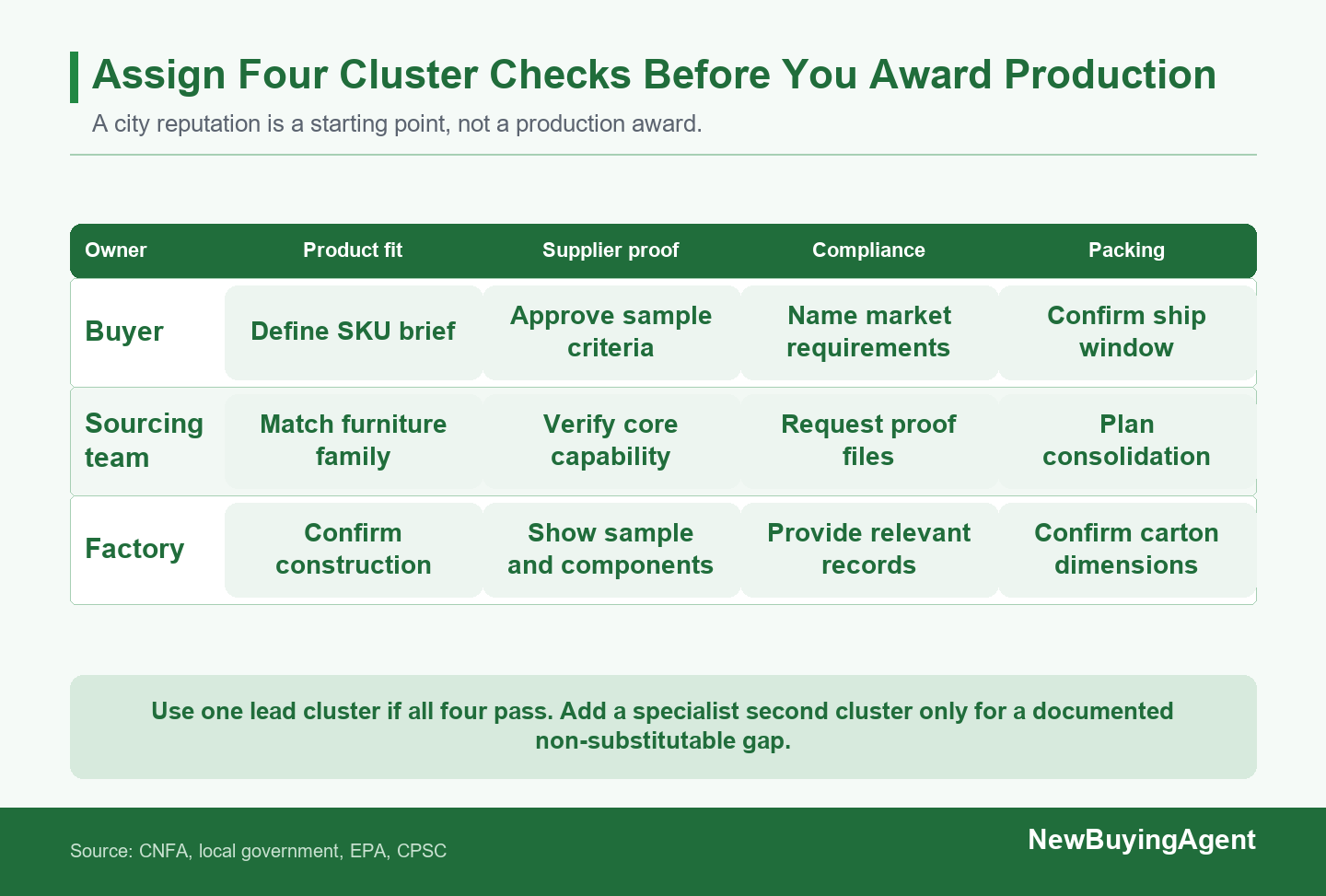
Assign product, supplier, compliance, and packing checks before approving a lead furniture cluster.
The 12 Furniture Manufacturing Cities and Clusters Buyers Should Compare
The China National Furniture Association’s cluster directory records specialised furniture locations across production, export, trade, office, and traditional-furniture roles. CNFA's cluster directory supports treating these locations as specialised buyer starting points. A buyer may visit Longjiang and Lecong within Foshan for a different reason than Daling Shan and Houjie within Dongguan, even though both are in South China.
Cluster relevance depends on the product family and the evidence the buyer needs. The table gives a first-search lens and an explicit poor-fit boundary for every location. It is not a supplier-quality scorecard, a substitute for quotations, or an endorsement of any factory.
| City / cluster | Best first-search fit | Buyer check before shortlisting | Poor fit when |
|---|---|---|---|
| Foshan Longjiang / Lecong | Broad home furniture, sofa, dining, showroom-led comparison | Separate maker from trading showroom; confirm construction and workshop location | A specialist performance need is more important than range breadth |
| Dongguan Houjie / Daling Shan | Export-facing upholstery, solid wood, trade and exhibition access | Identify whether the visit is to a producer, exhibitor, or trade contact | The product needs a chair, panel, or office specialist outside its core depth |
| Ganzhou Nankang | Solid wood, bedroom, dining, and wood-furniture component coordination | Trace wood species, moisture control, finish system, and component ownership | The brief needs a ready-made full-room export programme without validation |
| Huzhou Anji | Office chairs, task seating, mechanisms, bases, and seating components | Specify load, adjustment, upholstery, assembly, and requested test evidence | The main order is bedroom, dining, or upholstered living-room furniture |
| Chengdu Chongzhou / Xindu | Panel furniture, western-China supply diversification, domestic-market formats | Verify panel grade, hardware, flat-pack instructions, and export packing | The project assumes South China export routines without checking the route |
| Zhongshan Dayong / Xiaolan / Sanxiang | Traditional wood styles, mahogany, selected office furniture | Confirm species, joinery, carving tolerance, and finish approval sample | The buyer needs a price-only search for simple mass-market flat-pack goods |
| Bazhou Shengfang | Northern custom furniture, metal-and-upholstery search, regional supply | Request a specific bill of materials rather than relying on a category label | A detailed destination-compliance file has not yet been defined |
| Xuzhou Shaji | E-commerce-ready formats, modular or flat-pack product exploration | Test assembly instructions, drop protection, parcel dimensions, and returns logic | The brief requires premium finish matching without a controlled sample process |
| Zibo Zhoucun | Upholstered furniture and sofa comparison | Lock foam, fabric, frame, seam, and carton expectations before price comparison | Fabric hand-feel and comfort criteria are still only verbal |
| Jiaxing Haining | Export-oriented sofas and upholstered living-room programmes | Compare frame, suspension, cover, cushion, and container-loading assumptions | One supplier is expected to carry unrelated seating and casegoods families |
| Suzhou Likou / Haiyu | Classical wood styles, trade-market comparison, East-China buying visits | Trace the actual manufacturer and obtain a controlled construction sample | Showroom availability is mistaken for production ownership |
| Hangzhou | Office-furniture and commercial-space requirements | Define workstation, storage, seating, installation, and project-management scope | The buyer needs one commodity item rather than a commercial furnishing system |
For branded furniture, an OEM is a factory producing goods to the buyer specification or brand requirements. The city matters less than whether that factory can reproduce the agreed construction consistently. Before a factory visit, turn each row in the table into five questions: Which SKU family is in scope? Which material and component are critical? What evidence must be shown? What does the approved sample control? What packaging and pickup condition must be met before release?
Use the table to build a visit and quotation plan rather than a long, unfocused enquiry list. Select two or three relevant areas, assign each one a product family, and give every prospective maker the same specification pack. Then compare the returned construction, finish, component, sample lead time, minimum order, carton proposal, and evidence response. This approach makes a lower quotation meaningful only when it describes the same item and delivery condition. It also makes it easier to stop an unsuitable search early: if a supplier cannot identify its panel, upholstery, hardware, or pack-out method, a city-level reputation will not close that gap.
South China: Broad Range First, Then Export and Upholstery Depth
Furniture-industry reporting distinguishes Houjie’s production and exhibition/trade role from Daling Shan’s export-oriented furniture context. A buyer should distinguish Houjie production and exhibition/trade activity from Daling Shan export context. Use Foshan as a broad comparison base when the brief includes multiple home-furniture families and the buyer needs to see range and component options. Use Dongguan more deliberately when export experience, upholstery, solid-wood work, or a production-and-trade search is central. In either city, ask whether a showroom contact is the actual factory, where the factory is located, and which parts of the product are made in-house.
Specialist Clusters: Seating, Solid Wood, E-Commerce, and Office Furniture
Nankang’s local government describes a shared, digital furniture-manufacturing programme for the cluster. Nankang has a current shared-manufacturing signal relevant to buyers assessing collaborative production context. That does not mean every supplier offers the same capability, but it gives a buyer a useful question: which components, processes, or production records are actually controlled by this supplier, and which are shared or outsourced? For solid-wood casegoods, the answer should be tied to timber, panels, machining, sanding, finishing, assembly, and carton preparation—not only to a catalogue image.
The China National Furniture Association identifies Anji as China’s chair-industry cluster. Anji should be shortlisted first for office seating, not treated as a default source for all room furniture. It is therefore a sensible place to evaluate task seating, mechanisms, bases, casters, and related production knowledge. Similarly, Shaji can be a useful e-commerce and flat-pack exploration point, while Xindu and Chongzhou can diversify a panel-furniture search. The specialist should win only when it supplies evidence that the broad cluster cannot provide.
When One Furniture City Is Enough—and When a Split Award Is Safer
A city reputation cannot substitute for destination-specific evidence. The first decision is normally a single-cluster award: one lead area, one clear product scope, and as few coordination handoffs as the brief allows. It is usually the right choice when one factory group can meet the product, material, quality, packaging, and ship-window requirements without a meaningful gap.
Use a second cluster for a non-substitutable gap, not for generic variety. A split award means placing different product lines with different factories or clusters under one controlled plan. It makes sense when the second supplier owns a distinct requirement—for example, task-chair mechanism documentation, a solid-wood process, a commercial workspace system, or a construction method the lead factory cannot evidence. It does not make sense merely because another city has a lower preliminary quotation or a more attractive showroom.
Before approving a split, write down the economic and operating trade-off. The added factory must justify a second sample loop, second production calendar, second pickup point, extra carton coordination, potential consolidation work, and a new failure boundary. If the gain is only a broad category claim, stay with the lead cluster. If the gain is a documented product-family capability that cannot be substituted, isolate that SKU family and make the exception visible in the award sheet.
For a multi-city order, the control document should name the lead supplier, the specialist supplier, each SKU, product revision, approved sample reference, material code, test or document request, carton mark, pickup condition, and consolidation owner. Buyers can put China-side production management behind a multi-city furniture order when the issue is not finding a second quotation but keeping two production streams aligned to the same acceptance and handover record.
Use the same release logic in the supplier comparison. Give both makers a common purchase brief, then record what each one can prove without assumption. For the lead supplier, record the broad assortment it owns, the sample reference, the material schedule, the production calendar, and its planned handover. For the specialist, record the narrow SKU group that justifies its appointment, the required performance or construction proof, and any component or finish dependency that could affect the rest of the order. The comparison should show a buyer exactly what is gained by adding the second stream and what additional coordination it creates.
Next, choose one point of control for changes. A revised chair mechanism, replacement fabric, carton-size adjustment, or revised ship date should enter one current record before either maker acts. That record should identify the decision owner, the sample or document that changed, the affected SKU, the commercial impact if known, and the next confirmation required. This is especially important when different production calendars feed a shared container plan: a local delay can become a programme delay if nobody decides whether the balance should wait, move separately, or be reallocated.
Finally, schedule the handover backward from the confirmed shipment requirement. Allow time for sample confirmation, production checks, carton approval, document collection, pickup booking, and any consolidation work. Do not promise a second-city supplier the same loading date merely because its quotation was accepted on the same day as the lead supplier’s. A controlled split keeps its value only when the buyer sees the dependency chain early enough to make a deliberate choice.
Before appointing that second supplier, a buyer can also examine furniture and home-category sourcing examples to evaluate how sample control, scope definition, and China-side follow-up support a decision with more than one production stream.
Illustrative Hospitality Furniture Split-Award Scenario
The scenario is illustrative and not a client case. It is an example of a controlled specialist exception, not a prescription for every hospitality order.
An illustrative North American hospitality buyer is sourcing bedroom casegoods, dining chairs, and task seating for a 180-room project.
The 1260-piece order is for 180 rooms: 900 casegoods and dining pieces plus 360 task-seating units, with one target consolidation schedule.
The Foshan lead factory can support the broader range, but the buyer has not locked panel evidence, task-chair performance records, or final carton dimensions.
During the evidence review, the Foshan supplier cannot document the requested office-chair performance requirements for the task-seating line.
An Anji seating supplier can provide the requested seating documentation, but adds a pickup point and changes the container-loading plan.
The product-family gap is narrow and material: it affects only the 360 task-seating units. Moving the casegoods merely to use the second supplier would add complexity without solving a defined requirement.
The buyer keeps casegoods and dining pieces with the Foshan lead factory and awards task seating to Anji. Each factory receives a controlled SKU list, sample reference, evidence list, carton-mark format, and pickup sequence.
The sourcing team issues one split-award control sheet that records material references, requested documentation, carton dimensions, loading assumptions, and the party responsible for consolidation.
Before deposits are released, both factories acknowledge their SKU boundary, evidence list, packaging dimensions, and handover timing in writing.
This illustrative example does not prove that every hospitality order needs two cities. A second city is justified only when the product-family evidence gap is visible, specific, and controlled.
Verify Compliance and Packaging Before You Reward Cluster Depth
For US-bound products, EPA requirements apply to regulated composite wood panels and finished goods containing them under TSCA Title VI. US-bound furniture using regulated composite wood must be checked against TSCA Title VI requirements. Composite wood means engineered panels such as MDF, particleboard, or plywood made from wood pieces or fibres bonded with adhesives. A factory’s city or product display cannot prove the required material evidence. The buyer should identify which panel is used in each SKU, which documents apply to the finished-good route, and which revision of the bill of materials is approved.
CPSC furniture-tip-over guidance illustrates why stability is a product-level consideration for relevant furniture. Safety-sensitive furniture requires product-level evaluation beyond a city selection. That is a different question from whether the factory is in an established furniture area. For applicable designs and markets, assess the actual configuration, instructions, restraints or hardware where relevant, and product-specific requirements. Do not infer a safety outcome from geography.
Packaging deserves the same discipline. Wood packaging material means wood pallets, crates, or supports used to protect cargo during shipment. For every supplier, approve the carton drawing, internal protection, gross dimensions, marks, and loading assumptions against the purchase order. Where different factories feed one container, define who reconciles carton counts, what happens to an out-of-tolerance carton, and whether a late production line can enter the same consolidation release. These controls are practical even when no destination-specific regulation applies.
Make the sequence visible in the purchase record. First, freeze the approved sample and material schedule. Second, compare the quoted carton dimensions with the loading plan rather than adding a generic “export carton” note. Third, assign a date and owner for every missing document, carton test, or supplier acknowledgement. Finally, issue pickup instructions only when the release record matches the production revision. This protects the buyer from a common failure: a supplier ships a workable item from the right area but against an outdated construction, carton, or document request.
Build a Furniture Brief That Lets Factories Prove Fit
NewBuyingAgent can connect a furniture brief to China-side product supply and factory-management support. The value is in converting a category search into a controlled evidence path: identify factory options, clarify materials and construction, follow samples and production, carry out quality-control steps, and coordinate logistics where the project calls for it. The right service scope depends on the project, but the brief should make the decision testable before any supplier is treated as approved.
For a useful cluster-fit review, send these fields together rather than across separate messages:
- SKU list with product family, quantity, target price context, and priority ranking;
- drawings, reference images, dimensions, materials, finish targets, and approved-sample status;
- destination market, required testing or documents, product-use conditions, and labelling needs;
- carton, assembly, pallet, consolidation, and target ship-window expectations; and
- the decision to make: one lead cluster, a specialist second cluster, or a like-for-like factory comparison.
With that information, a sourcing conversation can ask better questions: Which cluster is the initial search base? Which factory can make the full line? Which SKU should stay with a specialist? What proof must arrive before the next deposit or pickup instruction? If you want an initial view of that decision, send a furniture sourcing brief for a cluster-fit review.
Frequently Asked Questions
A city answer changes when the product family or destination evidence changes. Use the same four filters whenever the assortment, target market, or delivery model changes.
Which Chinese city is best for sourcing furniture?
Foshan is often the broadest starting point, but no city is automatically best for every furniture order. Start with Foshan when you need a broad home-furniture comparison, Anji when task seating is central, Nankang when wood-furniture process depth is important, or a specialist cluster when a specific product family drives the risk. Then validate the actual factory, materials, sample, evidence, and packaging plan.
Is Foshan better than Dongguan for furniture sourcing?
Neither is universally better. Foshan is useful for broad range comparison and furniture-market access, while Dongguan can fit an export-oriented, upholstery, or production-and-trade search. The buyer should decide from the product architecture and factory role, not from city reputation. A quotation from either location is only comparable after the construction, material, sample, packing, and delivery assumptions are the same.
Where should buyers source office chairs in China?
Anji is a logical first cluster to evaluate for office seating because of its chair-industry concentration. Still, an office-chair purchase needs more than a city match: specify the user context, dimensions, adjustment functions, mechanism, base, caster, upholstery, assembly, and requested performance evidence. Hangzhou and Zhongshan may also be relevant when the programme includes broader office-furniture or commercial-space requirements.
Should a furniture order use one city or several?
Use one city when one cluster and supplier plan can meet the full product, evidence, and packing brief. Split the award only when a specialist second cluster closes a documented gap that the lead source cannot solve. Keep the split narrow, assign every SKU and carton to one owner, and confirm the sample, documentation, pickup, and consolidation boundaries before deposits or production release.
NewBuyingAgent
Related Resources


Get Started Today
Let's Turn Your Sourcing Goals into RealityWeChat:+86 15157124615
WhatsApp:+86 15157124615
Address:Building 10 #39 Xiangyuan Road, Hangzhou, China
