

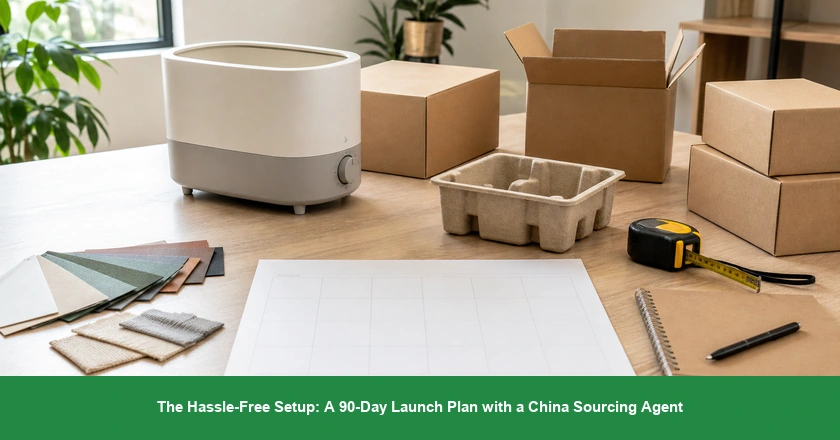
A workable 90-day launch plan puts five decisions in order: lock the brief, set the quote and sample path, match destination evidence, prepare the shipment file, and assign exceptions. The dates make responsibilities visible before a product, carton, or route detail becomes costly to unwind.
A 90-Day Plan Is a Decision Schedule, Not a Shipping Promise
A 90-day launch is a decision schedule, not a shipping promise. For a China product launch, it gives a buyer enough time to lock a product brief, compare a commercial path, connect the product to destination requirements, and hand over a shipment file. It does not mean every product can be sampled, tested, produced, cleared, and delivered within 90 days. Tooling, certification, seasonal capacity, material changes, and ocean schedules can all move the physical timeline.
The useful question is therefore not, “Can the factory finish by day 90?” It is, “Which decision must be complete by each date, who owns it, and what evidence proves it?” That framing keeps a late carton dimension, an unclear trade term, or an unassigned compliance record from becoming a last-week surprise. A capable China sourcing agent helps make those decisions visible; the buyer still sets the product, market, commercial boundary, and approval authority.
The Five Gates That Keep a Launch Moving
A launch gate is complete only when a named owner can show the matching evidence. That is the difference between a task list and a controlled launch. The five gates below are an editorial planning method, not a regulatory requirement. They work because they place the harder-to-reverse commitments—approving a version, committing to a route, or releasing cargo—after the information that should inform them.
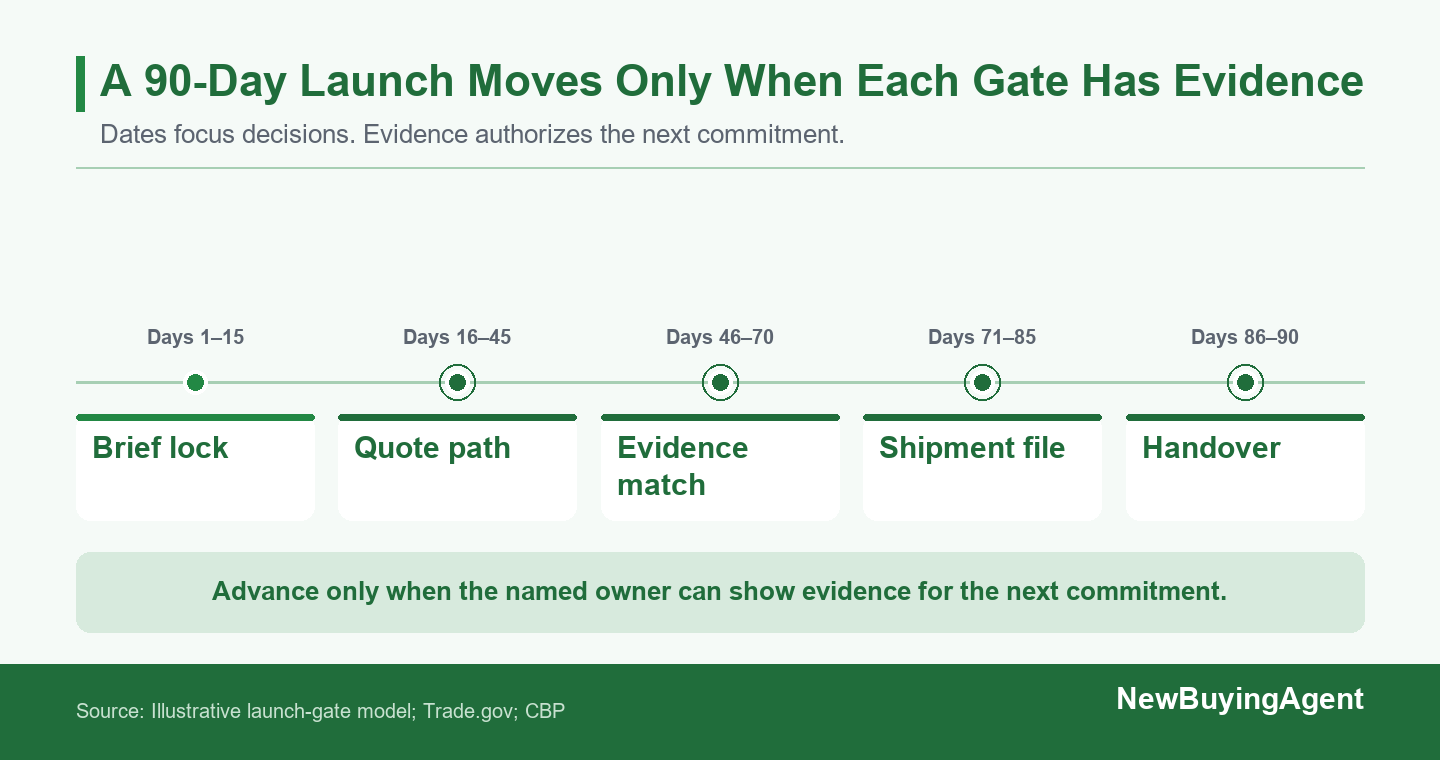
Use dates to focus decisions. Advance only when the owner can show the evidence named for that gate.
- Decision: Days 1–15 end with one controlled brief, not several changing chat threads.
- Commercial path: Days 16–45 end with comparable quotation assumptions and an identified sample decision.
- Risk: Days 46–70 end only when product, pack-out, and destination records describe the same intended sale.
- Handover: Days 71–90 end with a reconciled shipment file and an owner for any exception.
| Target window | Launch gate | Evidence to see | Decision to make |
|---|---|---|---|
| Days 1–15 | Brief lock | Product version, destination, quantity, target price, packaging, approval owner | Issue one controlled brief |
| Days 16–45 | Quote and sample path | Comparable scope, trade-term assumption, sample approval record | Select the next product decision |
| Days 46–70 | Evidence match | Production version, product records, carton and marking information | Hold or advance the affected scope |
| Days 71–90 | Shipment handover | Invoice, packing list, route data, exception log | Book, split, or delay the shipment |
Notice that “factory found” does not appear as a gate. A supplier conversation can begin early, but it is not a safe basis for a quote or shipment until the buyer and China-side team agree on what the product, package, destination, and commercial terms actually are.
Days 1–15: Lock the Brief Before You Compare Prices
Do not compare quotations built on different versions of the launch brief. A low unit price is not comparable when one supplier assumed a plain carton, another assumed retail-ready packaging, and a third assumed a different destination or delivery term. Start with a single document that records the product description and version, expected quantity, target price, intended market, desired arrival window, packaging expectation, must-have tests or records, and the person allowed to approve changes.
Incoterms clarify the tasks, costs, and risks borne by buyers and sellers. Give every open field one of three statuses: locked, proposed, or unknown. “Unknown” is not a failure. It is a useful signal that the quotation must state an assumption instead of silently filling the gap. For example, if the buyer does not yet know whether the offer should be FOB, CIF, or another term, the quote should make that visible. Trade.gov’s Incoterms overview is a useful reference for these trade rules, which belong in the first commercial conversation because they affect both the price comparison and the handover that follows.
Also assign an exception owner before the first quotation arrives. That person does not need to approve every color adjustment or carton measurement. They need authority to decide what happens when a product fact changes: pause the quote, update the brief, accept a documented assumption, or split a later shipment. Without this role, a launch can appear busy while decisions wait across email, chat, freight, and product teams.
Days 16–45: Turn the Brief Into a Quote and Sample Path
NewBuyingAgent can turn a locked launch brief into a China product supply quote. Once the brief is controlled, the next job is to turn it into a comparable product path. A quotation should state what it covers, what it assumes, what remains open, and what would change the price or timing. For a new product launch, buyers can turn a locked launch brief into a China product supply quote through NewBuyingAgent. The value is not a buyer-facing factory shortlist. It is a China-side path from buyer requirements to product selection, quotation, cost discussion, production follow-up, quality coordination, and logistics support.
Use the first sample conversation to distinguish a commercial sample from a production decision. A commercial sample may prove that a form, color direction, or material family is available. It does not automatically prove that the final component, retail carton, warning language, or production method is settled. Ask the team to write down which product version the sample represents, which elements are provisional, and what event would require another review. This avoids a common launch error: a buyer approves a product visually, then treats the approval as if it covered a later material, insert, or package change.
By day 45, a useful readout contains more than “sample approved.” It shows the approved version identifier, the decision it authorizes, remaining destination questions, expected production evidence, and the cost or timing impact if a field changes. If the destination or required packaging is still unknown, do not force a production date. Move the relevant decision back to the brief and show the dependency openly.
What an Approval Must Actually Identify
A sample is evidence only when the next production decision can be traced back to it. The approval record should identify the product version, dimensions or component set that matter, finish or performance reference, packaging assumption, destination-specific questions still open, and the person who approved the stated scope. A short approval note such as “looks good” can be useful feedback, but it should not be the only record authorizing production. When the product changes later, compare the proposed change with the approved scope instead of debating what someone may have intended weeks earlier.
Days 46–70: Make Product, Packaging, and Destination Evidence Agree
Destination requirements can change the product record and handover path. That is why compliance planning starts during the brief and sample stages rather than after cargo is ready. For U.S. imports, even duties and user fees can depend on the commodity and transport mode, as CBP notes in its guidance on duty, taxes, and other import fees. For covered U.S. consumer products, the certificate-data process must be considered in the import plan; CPSC’s eFiling Quick Start Guide is a current starting point for the importer’s data preparation. For products covered by the European Union General Product Safety Regulation (GPSR), the GPSR technical-documentation guidance shows why the record should be scoped early. These jurisdiction-specific examples do not apply to every product or destination.
The European guidance explains that covered products need technical documentation, with the content shaped by the product and its safety characteristics. Treat it as a reason to scope records early, not as a universal checklist for every market. The practical launch question is simple: does the product version in the file match the product, label, instructions, packaging, and destination path that the buyer intends to sell?
Use China-side factory management when an existing supplier stays in place. This is the appropriate service path when the buyer keeps the China factory but needs local production updates, quality evidence, and logistics coordination tied to the launch decisions. Buyers can use China-side factory management when an existing supplier stays in place through NewBuyingAgent. It supports the China-side communication and evidence flow around a supplier relationship the buyer already holds, rather than initiating a new product-supply path.
At this gate, build one small reconciliation sheet rather than collecting disconnected files: product version; model or variant; destination; applicable record or test question; carton dimensions and gross weight; carton mark; document owner; and status. The sheet does not create compliance by itself. It shows which product fact still lacks an owner or a matching record before booking turns the gap into a freight problem.
Illustrative Scenario: When a Missing Carton Record Expands the Hold
Hold the unmatched variant until the physical carton and shipment record agree. The following is an illustrative planning scenario, not a client case or a universal release rule.
An omnichannel retailer is preparing a new countertop-appliance line from China for a 90-day launch. The buyer needs the finished product, retail carton, freight data, and destination records to tell the same story before the booking file is released.
The illustrative order covers 2,400 units across three color variants. One variant represents 800 units, so it is meaningful to separate that scope rather than make a vague all-or-nothing decision.
Product function and commercial direction are approved. The open issue is not whether the product can work; it is whether the revised protective insert has changed the carton record that the forwarder and buyer will rely on.
On day 48, the factory changes the internal protective insert after a drop-test observation. The product remains functional, but the revised carton height is not reflected in the draft packing list.
On day 55, the forwarder receives weights and dimensions for only two variants, while the invoice draft uses one shared SKU description for all three. The team can no longer show that the third variant’s carton data matches the actual pack-out.
The gap is not a minor clerical issue. Booking data, carton marks, and product records describe a shipment population. If one variant is unverified, merging it into the same file hides the evidence gap and makes later correction harder.
The buyer holds the 800-unit variant and its carton record while the two fully matched variants continue through booking preparation. The decision is a full hold of the untraceable scope, not a judgment about the entire order or factory.
The China-side coordinator requests measured carton data, revised pack-out photos, a variant-level packing list, and a document comparison. The purpose is to identify the physical carton and the record it belongs to, not merely to obtain another email confirmation.
On day 62, the buyer checks that the held variant has matching dimensions, weight, marks, product description, and packing-list line. Only then does it re-enter the shipment file. The scenario shows why an evidence gate can preserve a launch while a calendar-only approach would simply push the uncertainty downstream.
This is an illustrative planning scenario. It does not replace destination-specific freight, customs, or product-safety advice.
Days 71–90: Hand Over a Shipment File, Not a Collection of Emails
A shipment handover is ready when the document fields and physical package facts describe the same cargo. Start with the commercial invoice and packing list, then compare them with the carton information, labels or marks, transport route, and any destination records required for the product. Trade.gov explains that a packing list identifies package contents, weights, marks, and dimensions, and that the invoice should reflect the same cargo information in its common export documents guide.
Ask one extra question when pallets, crates, or dunnage use regulated wood packaging material: does the route require an ISPM 15 check? The ISPM 15 standard covers wood packaging material in international trade. It does not mean every carton needs the same treatment; it means wood packaging should be an explicit pack-out question rather than an assumed freight detail.
U.S.-bound ocean ISF has a 24-hour pre-loading deadline. For this clearly labeled example, an Importer Security Filing (ISF) is a filing that requires specified shipment data before vessel loading. This timing is not a worldwide rule and does not apply to every transport mode, but it shows why a booking-stage data owner matters.
By day 90, the buyer should be able to open one handover folder and answer: which version is shipping, which cartons are included, who owns the commercial and destination records, which trade term governs the move, and what remains open. If an answer depends on searching old messages, it is an exception to log—not a reason to assume the shipment is ready.
Where a China Sourcing Agent Fits in the 90-Day Plan
Choose product supply for a new launch and factory management when the supplier is already in place. NewBuyingAgent is a one-stop China sourcing agent service provider for global buyers. For a new range, the useful input is a controlled product brief: specification, quantity, target price, destination, delivery window, packaging expectation, and known requirements. That gives its local factory resources and product-development and quality-control capability something concrete to work from.
For an existing China supplier, keep the same decision gates but route the work through local production communication, evidence collection, quality follow-up, and logistics coordination. In either case, the buyer should arrive with a target date and a clear decision owner instead of asking a partner to infer the launch from a photo and a deadline. When that brief is ready, send the 90-day launch brief for a China product quote.
Frequently Asked Questions
The 90-day plan remains conditional on the actual product and route facts. Use it to make dependencies visible early, not to erase them.
Can every China product launch fit a 90-day plan?
No, a 90-day plan is a decision schedule, not a promise that every product, test, production run, or shipment will finish within that period. It is most useful when it establishes when the buyer must lock the brief, authorize a sample decision, confirm destination records, and reconcile shipment data. If a product requires tooling, complex testing, a material revision, or a constrained transport route, extend the affected gate rather than pretending the date has not changed.
What should a buyer lock before requesting quotes?
Before requesting quotes, lock the product specification, target price, expected quantity, destination, delivery window, packaging expectations, and the person who can approve exceptions. Add product photos, drawings, material requirements, retail-channel needs, and known regulatory questions where available. The aim is not a perfect brief. It is a single current version that shows what is known, what is proposed, and what must be quoted as an assumption.
When should compliance and shipping planning begin?
Compliance and shipping planning should begin during the first brief review because destination rules, product records, carton details, and shipping terms can alter the quote and sample path. Start by identifying the destination market, intended product use, expected route, and whether the product, packaging, or materials raise a specific record question. Then assign the specialist, importer, supplier, or broker who will confirm the answer. Do not wait until booking to discover who owns the information.
When does factory management matter during launch?
Factory management matters when the buyer keeps an existing China supplier but needs local production updates, quality evidence, and logistics coordination tied to the launch decisions. It is especially useful when the buyer wants the supplier relationship to remain in place while someone in China follows the approved product version, pack-out information, timing changes, and release evidence. For a new product without an established supplier, the product-supply path is usually the clearer starting point.
NewBuyingAgent
Related Resources


Get Started Today
Let's Turn Your Sourcing Goals into RealityWeChat:+86 15157124615
WhatsApp:+86 15157124615
Address:Building 10 #39 Xiangyuan Road, Hangzhou, China
