

In China's manufacturing market, most overseas buyers can only directly reach around 5% of suppliers, while the remaining 95% of high-quality factories are difficult to contact. This creates the so-called 95% Factory Access Trap: many buyers mistakenly believe that the easily reachable factories are able to deliver the best overall procurement results.
Direct sourcing from Chinese factories seems appealing at first, as it cuts out middlemen to pursue lower unit prices. This model works well only for buyers with simple product demands, on-site teams in China, large order volumes, and mature capabilities to manage specifications, samples, quality control, documents and logistics. However, the trap emerges when buyers limit themselves to visible suppliers and confuse mere factory access with full operational control.
Industry data from NewBuyingAgent also confirms this trend: buyers usually connect with only a small portion of factories directly. Those less accessible suppliers often provide better cooperation terms, more competitive pricing and products that better match buyer requirements.
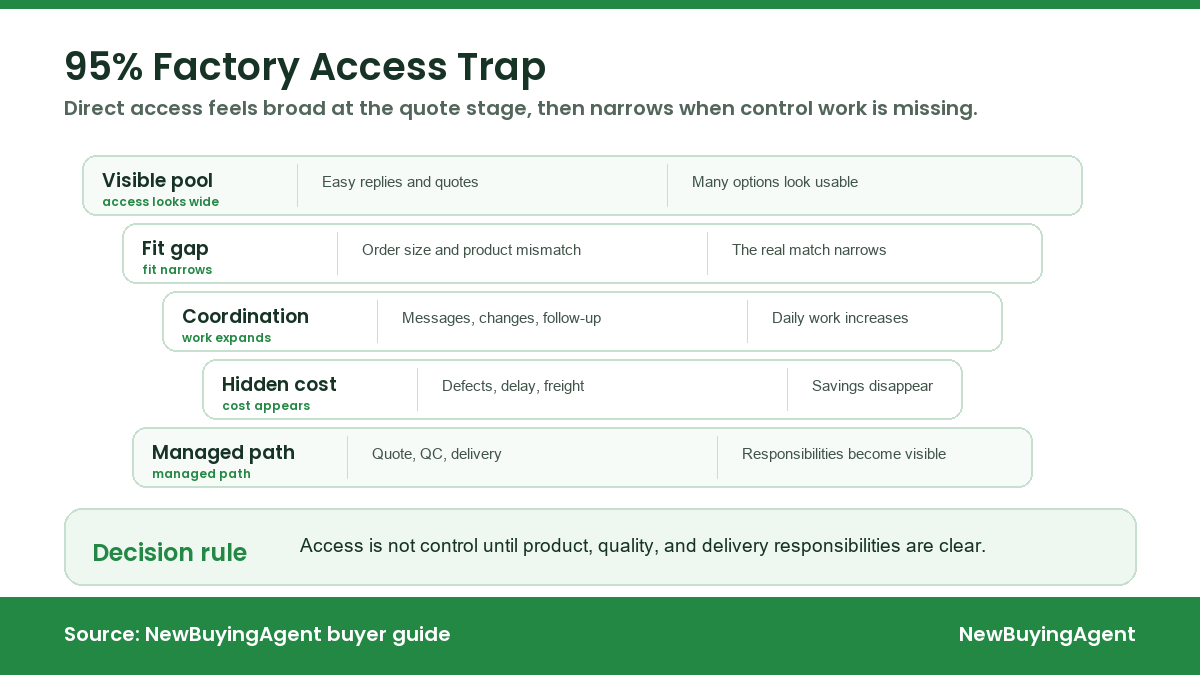
Direct sourcing can look cheaper at the quote stage while hidden cost appears through access limits, coordination time, quality risk, and delivery pressure.
Why Direct Factory Access Feels Cheaper
Direct factory sourcing feels cheaper because the buyer sees fewer layers in the conversation. There is a factory contact, a product quote, and a promise that the price is direct. If the buyer has procurement staff, category experience, and a mature quality process, direct work can be efficient. The problem is that many buyers compare only the first quote, not the full cost of getting the right product delivered.
The visible quote may exclude the time required to clarify specs, correct samples, follow production, review packaging, check documents, coordinate shipment, and handle defects. It may also reflect the factory's willingness to cooperate with the buyer's order size. A factory that quotes quickly is not always the factory that will protect the buyer's timeline or product standard.
Where the Extra Cost Actually Appears
The extra cost appears in places that do not look like unit price. It appears when the buyer spends weeks clarifying a specification that should have been defined before quoting. It appears when a sample is approved casually and production changes the material, finish, hardware, or packaging. It appears when the buyer learns late that carton size makes freight uneconomic. It appears when inspection finds defects after the factory has packed the goods. It appears when the buyer must choose between delaying launch and accepting weak goods.
Direct sourcing also creates hidden management cost. Someone must answer messages, track changes, interpret photos, chase dates, read documents, arrange logistics, and decide what to do when production is not perfect. For a buyer with a China office, that may be normal work. For a brand team, ecommerce seller, importer, or category manager without local execution capacity, that time competes with sales, marketing, product planning, and customer support.
The Direct-Sourcing Cost Estimate
Assume a buyer finds a direct quote that is 5% lower on a $20,000 order. The visible saving is $1,000. Now add 35 hours of internal coordination at an assumed loaded labor cost of $45 per hour, or $1,575. Add a 4% defect exposure on landed goods, or $800 before replacement handling. Add a two-week launch delay that forces discounting or lost ad momentum. This illustrative estimate does not mean direct sourcing always fails. It shows how a quote saving can disappear if the buyer does not price coordination, defects, and timing risk.
The strongest sourcing decision is therefore not "direct or agent" in the abstract. It is whether the buyer has the capability to control the full path. If the buyer can manage product version, cost, quality, documents, and logistics, direct sourcing may work. If not, the buyer may save on the quote and lose on the order.
Five Reasons the Visible Factory Pool Can Be Misleading
1. Easy Communication Does Not Prove Best Fit
Factories that respond quickly in English or on public platforms are easier to reach, but easy communication does not prove that the factory is the best fit for the product, price tier, order size, or quality requirement. Some factories are excellent at sales communication. Others are better at production but harder for foreign buyers to reach or manage.
The buyer should judge fit by product version, production capability, sample discipline, quality evidence, timing, and cooperation, not only by message speed. A fast quote can be useful, but it is not a full sourcing decision.
2. Low Price Can Hide Version Drift
A low direct quote may be based on a different material, lighter construction, simpler packaging, thinner coating, or weaker accessory set. If the buyer has not locked the product version, the price may look attractive because the quote is not for the product the buyer actually needs.
Version drift is especially dangerous for brand buyers. Customers judge the delivered product against the brand promise, not against the original quote spreadsheet. A buyer should ask what changed to reach the price before treating the saving as real.
3. Order Size Changes Cooperation
Factories respond differently to order size, season, category, and repeat potential. A direct buyer with a small or irregular order may receive limited attention, slower responses, or less flexibility. This does not mean the factory is bad. It means the buyer's order may not be operationally attractive.
A sourcing partner with managed procurement capability can sometimes make the order easier to handle by clarifying the brief, controlling communication, grouping work, and keeping production follow-up organized. The buyer's job is to define the commercial requirement; the execution path should make cooperation easier, not harder.
4. Quality Problems Are Easier to Prevent Than Repair
Direct sourcing often becomes expensive when quality control begins too late. Once goods are produced, packed, or loaded, the buyer has fewer options. Rework takes time, replacement parts cost money, and shipment delay can damage the selling plan.
ISO 2859-1 shows that AQL-indexed sampling is a recognized inspection approach, but inspection is only one part of the system. The buyer also needs approved sample records, defect definitions, packaging checks, production updates, and a decision rule for hold, rework, or release.
5. Logistics Can Change the Real Price
Incoterms define who handles shipment, insurance, documentation, customs clearance, and other logistics tasks. A direct quote can look lower while leaving the buyer with more responsibility than expected. Freight mode, carton dimensions, duties, insurance, storage, and delivery timing can all change the landed-cost result.
Buyers should ask for carton data, packing method, shipment terms, and delivery timing before approving the order. A product price without logistics context is not enough for a real sourcing decision.
When Direct China Sourcing Still Works
Direct sourcing can work when the buyer has strong category knowledge, clear specifications, internal quality staff, China-side coordination capacity, mature logistics partners, and enough order volume to earn factory attention. It can also work for repeat products where the buyer already has a stable relationship and a proven release process.
The trap is assuming direct is always cheaper because it removes an apparent intermediary. Direct can be cheaper when the buyer already owns the missing work. Direct can be more expensive when the buyer has to learn that work through mistakes.
What to Send Before Asking NewBuyingAgent to Take Over the Procurement Path
Buyers should prepare product photos or drawings, specs, materials, target quantity, target price, destination, delivery timing, packaging expectations, sample comments, and any known quality or compliance concerns. If the buyer already has a direct quote, include the quote assumptions and the problems encountered so far.
If direct sourcing is consuming too much time or creating quality uncertainty, buyers can ask NewBuyingAgent to review the purchasing requirements. Buyers that want to understand the service scope first can review NewBuyingAgent's product sourcing service and the broader What We Do overview.
Who Is NewBuyingAgent?
NewBuyingAgent is a one-stop China sourcing agent for global buyers. Buyers share product specs, volume, target price, destination, and timing. NewBuyingAgent prepares a quote and manages product selection, cost negotiation, quality management, production follow-up, logistics, and delivery.
Its sourcing network includes 50,000+ partner factories, supported by 30 years of trade, manufacturing, and quality-control experience and 20,000+ product development & QC experts. For buyers caught in the factory access trap, the value is not just a lower quote. It is a managed path that connects product requirements, cost, quality, production timing, and delivery.
Access Is Not the Same as Control
The factory access trap works because access feels like progress. A buyer receives replies, quotes, product photos, sample promises, and shipping estimates. The project feels direct and efficient. But control means something stricter: the buyer can define the product version, understand the cost basis, confirm sample changes, see production risk early, review QC evidence, and know who handles logistics responsibility.
A buyer can have access without control. The factory may reply quickly but interpret specs differently. The quote may be low but based on weaker packaging. The sample may look fine but not represent mass production. The shipment may be arranged, but the buyer may not understand who pays for customs clearance, insurance, or delivery changes. This is why direct access should be tested against the full order path.
NewBuyingAgent's role is not to make direct sourcing sound impossible. Direct sourcing can work for the right buyer. Its role is to manage the procurement path when the buyer has a clear purchasing need but does not want to absorb the hidden work. That path starts with specs, volume, target price, destination, and timing, then moves through product selection, cost negotiation, quality management, production follow-up, logistics, and delivery.
When the Direct Quote Saving Is Real
A direct quote saving is real when the product version is the same, the payment and delivery terms are clear, the buyer understands landed cost, the factory cooperation level is strong, QC evidence is planned, and the buyer has time to manage changes. If those conditions are not true, the saving may be only a quote-stage illusion.
Buyers can test the saving with four questions. First, is the direct quote based on the same material, finish, accessories, packaging, and inspection expectation? Second, does the buyer know the Incoterms and who handles freight, insurance, documents, and customs responsibilities? Third, can the buyer get useful production updates before final inspection? Fourth, what happens if the order needs rework? If the answers are vague, the buyer should not treat the price gap as guaranteed saving.
| Quote Saving Test | Pass Signal | Trap Signal | Buyer Action |
|---|---|---|---|
| Same product version | Specs, material, pack, and sample match | Price drops after vague changes | Lock version before cost approval |
| Clear landed cost | Freight, duty, carton data, terms known | Only unit price is discussed | Model delivered cost before deposit |
| Production visibility | Updates arrive before problems spread | Buyer hears only near shipment | Set update points and evidence needs |
| Rework path | Hold, fix, discount, or remake rules clear | Factory asks buyer to accept defects | Define release rules early |
The Handoff Point From Direct Work to Managed Procurement
The handoff point usually appears when the buyer has enough evidence that the direct path is consuming more value than it creates. Warning signs include repeated sample changes, unclear material substitutions, slow production updates, inspection disputes, carton damage, delivery-term confusion, or a buyer team spending too many hours on operational follow-up. These are not small annoyances. They are signs that the buying model and order risk no longer match.
At that point, the buyer should not hand over a vague problem. The buyer should organize the file: product photos, specs, current quote, sample comments, defect history, target price, destination, delivery deadline, packaging concerns, and open questions. A managed procurement partner can work faster when the evidence is clean. NewBuyingAgent can then evaluate the purchasing need, prepare a quote, and manage the path through product selection, cost negotiation, quality management, production follow-up, logistics, and delivery.
Run a Time Audit Before Calling Direct Sourcing Cheaper
Buyers often forget to price their own time. A direct quote may save money on paper, but someone must manage all the small decisions: clarifying the spec, checking sample photos, chasing production dates, reviewing packaging, asking for carton data, arranging inspection, confirming shipment terms, and solving disputes. If those tasks interrupt sales, product planning, marketing, or customer work, the real cost is higher than the spreadsheet shows.
A simple time audit helps. List every message, call, file review, sample correction, logistics question, and quality decision required for the order. Estimate the hours and multiply by the loaded cost of the people involved. Then add the cost of mistakes that a structured process might have prevented: wrong packaging, late shipment, missing labels, weak inspection, or unclear delivery terms. If the total is larger than the quote saving, direct sourcing has not reduced cost. It has moved cost into the buyer's own team.
A Decision Rule for Direct vs Managed Procurement
Direct sourcing is more attractive when the product is standard, the buyer has strong local execution, the order size earns factory cooperation, and the quality risk is manageable. Managed procurement is more attractive when the buyer needs product development, private-label control, multi-SKU coordination, category-specific QC, packaging review, landed-cost planning, or delivery reliability.
The decision should be made before the deposit. Once production starts, the buyer's options narrow. A buyer that is already struggling with unclear specs, changing samples, slow updates, or freight surprises should not wait for the final inspection to ask for help. It is easier to manage the procurement path while there is still time to correct the product, price, packaging, or schedule.
Do Not Confuse Factory Access With Factory Cooperation
Access means the buyer can reach a factory. Cooperation means the factory is willing and able to support the buyer's product, order size, quality expectations, timing, and documentation needs. A factory can be accessible but not cooperative enough for the order. This difference is one reason direct sourcing can become more expensive than expected.
Buyers should look for cooperation signals early: detailed questions about the product, realistic timing, willingness to document changes, clear packaging discussion, and useful responses to quality concerns. If the conversation stays at quote level only, the buyer may not have enough control for a serious order.
A cooperative factory relationship still needs structure; good intentions do not replace sample records, inspection rules, and delivery accountability.
If those controls are missing, the buyer is still carrying the real procurement risk.
Frequently Asked Questions
Is direct China sourcing always cheaper?
No, direct China sourcing is not always cheaper once coordination time, sample changes, defects, packaging, logistics, and delivery risk are counted. It can be cheaper for experienced buyers with local execution capacity, but it can cost more when the buyer only compares the first quote.
What does the 95% factory access trap mean?
The 95% factory access trap means buyers may mistake the factories they can easily find for the full market. The phrase is a practical warning: access, responsiveness, and a direct quote do not prove best product fit, cost control, quality management, or delivery reliability.
When should buyers stop managing factories directly?
Buyers should stop managing factories directly when coordination time, quality uncertainty, sample drift, packaging problems, or logistics confusion start to outweigh the quote saving. That point often arrives when a product becomes brand-critical, customized, multi-SKU, seasonal, or difficult to inspect remotely.
How can NewBuyingAgent help with direct sourcing problems?
NewBuyingAgent can help when the buyer has a clear purchasing need but does not want to manage the China-side process alone. Buyers provide specs, volume, price target, destination, and timing; NewBuyingAgent prepares a quote and manages product selection, cost negotiation, quality management, production follow-up, logistics, and delivery.
NewBuyingAgent
Related Resources
Get Started Today
Let's Turn Your Sourcing Goals into RealityWeChat:+86 15157124615
WhatsApp:+86 15157124615
Address:Building 10 #39 Xiangyuan Road, Hangzhou, China
