

SKU rationalization is the review of existing or proposed product variants to remove avoidable purchasing complexity while preserving the customer needs the range must serve. Before sourcing, it connects each proposed change with buying evidence, a commercial condition and the supply commitments that would remain.
Protect revenue by testing what customers would buy after the change and checking the actual remaining supply terms. A smaller assortment earns a wider rollout when it preserves important buyer needs, meets the agreed commercial conditions and produces a useful sourcing simplification. Start with a bounded, reversible change and keep the evidence that would stop or revise it.
Make every proposed cut pass a revenue and supply check
Use low sales or high handling effort to identify a candidate, then investigate the need it serves. Compare the commercial effect on a declared basis, including refunds and customer options. Ask the supplier to confirm what changes in the remaining order. Keep, consolidate, pause or exit according to the evidence, with a named owner and release condition for the next purchase.
- Definition. Rationalization changes the product commitments needed to serve the range.
- Risk. A low-selling variant can still protect a distinct need or customer commitment.
- How it works. Test the buyer effect and verify the proposed supply simplification.
- Decision. Hold a wider cut when a material condition fails or remains unknown.
Find avoidable complexity without removing a needed choice
Begin with the buying decision the proposed cut would change. Identify the actual variant, the customer need and the work or commitment it creates. Then state which part could be reduced, such as a redundant pack, a duplicative code or a separate color run. This separates an administrative cleanup from a change to the options customers can purchase.
For an importer reviewing a recurring range, NewBuyingAgent’s market-fit product analysis and free Bestseller Market Analysis Report can help investigate product hypotheses and relevant buyer needs. Use those inputs alongside actual sales, returns and customer commitments. They can inform a revised product-supply brief, while the buyer determines which choices the range still needs.
Identify the actual product and customer need
A stock-keeping unit, or SKU, identifies the product variant tracked in the buyer’s inventory and purchasing records. Match each candidate to its material, dimensions, color, pack, revision and destination offer. Check whether two codes represent the same physical product or genuinely different choices. Duplicate records may be consolidated while preserving customer ordering references. Removing a physical variant requires a separate customer-choice decision.
Record any specific use or commitment the candidate supports. A low-volume pouch may fit a particular device, complete a wholesale assortment or meet an existing customer’s agreed pack requirement. Identify the affected buyer and terms before proposing a substitute. A similar appearance alone leaves the functional or commercial equivalence unresolved.
Name the complexity precisely. Separate production runs, unique labels, extra sample approvals, slow-moving inventory and order-entry mistakes call for different remedies. An action should remove a real task or reduce a defined commitment. Changing the number of codes in a report may leave all the underlying work in place.
Use low sales to select a candidate for investigation
Review sales alongside availability, selling period, price, refunds, handling effort and the product’s buyer task. A variant that was unavailable or poorly described has a different evidence gap from one that received relevant exposure and still attracted little retained demand. Keep the cause of low sales open until the available records support an interpretation.
Shopify’s ABC inventory analysis grades products by revenue contribution and notes that item cost does not determine the grade. Use that view to locate sales concentration and possible review candidates. Add the costs, customer need and supply constraints that matter to this purchase. A revenue grade alone cannot determine whether a product can be removed without affecting the wider offer.
Choose a manageable candidate with a clear question and an observable next result. If the records are incomplete, identify what must be reconciled first. A review can conclude that the data needs correction, that a reorder should pause or that a customer-choice test is justified. Each outcome should lead to a specific action.
A proposed SKU cut needs both a commercial basis and a real supply benefit. Keep the protected customer need visible while deciding what the next purchase can change.
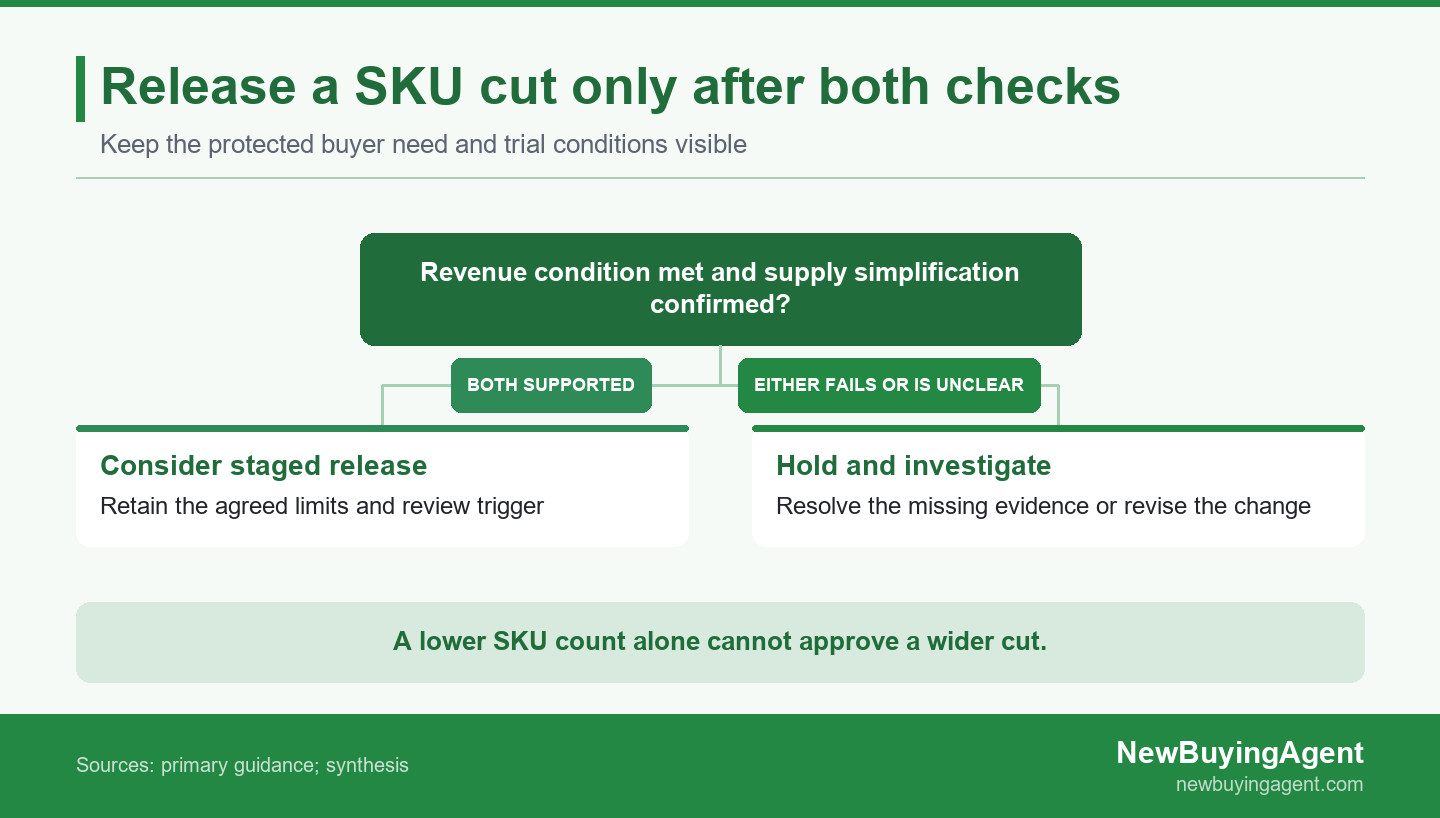
Consider a wider SKU cut when the revenue condition and supply simplification are supported, and hold when either fails or remains unclear.
Check what customers would buy after the change
The revenue question concerns the purchase options remaining after the change. Investigate whether customers would accept an alternative, leave the range, change their basket or return a product that no longer meets their expectations. Define the commercial measure and the conditions for another stage before running the trial. Use the result to decide whether the change can continue, needs revision or should be held.
Investigate substitution and the wider basket
Start with the proposed alternative and the need it must satisfy. Compare the relevant size, function, material, price, pack and delivery promise. Customer comments, order history and a bounded choice test can inform the question. Keep an assumed transfer of demand separate from an observed customer purchase. If an important group has no suitable alternative, retain the option or revise the proposed change.
The 2006 assortment-planning review by Kök, Fisher and Vaidyanathan discusses customer substitution as an important part of assortment decisions. The relevant question is whether buyers will accept another available option when their preferred product is absent. The research supplies that mechanism, while the actual range needs its own evidence about which customers substitute and under what conditions.
Look beyond the candidate’s own revenue where the purchase task requires it. A low-volume variant may be part of a wider customer order. Record changes in basket completion, qualified inquiries or canceled orders where they can be traced. Association in an order history helps select a question to test. It does not establish the extra revenue that one SKU caused.
Set the revenue measure and observation conditions
Choose a measure that matches the decision and define its components. A buyer might compare product sales less product refunds, excluding tax and shipping, per eligible session. Another channel may need retained wholesale-order value or customer-level revenue over an appropriate period. State the currency, unit, customer group, denominator and return-observation age. Include relevant margin and service measures separately where they control the purchase.
Google Analytics ecommerce guidance distinguishes product views, cart activity, purchases and refunds. Reconcile those observations with actual transactions and refund records. A missing refund or a duplicated purchase can change the apparent result. Keep the affected product version and cohort identifiable so the comparison reflects the intended assortment change.
NIST’s guidance on randomized block designs explains how a designed experiment accounts for other factors that may affect its measured result. Borrow that discipline when reviewing channel, season, price, promotion and stock availability. A matched retail before-and-after view remains an observational comparison unless the actual design supports a stronger conclusion. Use suitable analytical expertise when the release needs formal uncertainty or causal analysis.
Write a guardrail as the buyer’s condition for continuing, together with the trial limit and action on failure. Decide how missing records or a major selling interruption would affect interpretation. Keep the first change reversible where feasible. A favorable point estimate can support another bounded stage while leaving effects outside the observed group or period unresolved.
Choose consolidation, a pause or an exit deliberately
Choose the smallest change that addresses the verified complexity and preserves the needed buyer choice. Keeping a product, consolidating a redundant version, pausing a reorder and exiting an offer have different effects. Define the proposed action in the candidate record so the category, purchasing and supply teams understand what will happen to the next order and the customer-facing range.
Compare the four buying actions
The comparison below uses the same buyer check, supply effect and release basis for four actions. It is a qualitative decision guide for the identified candidate. Confirm the actual product, customer commitments and remaining quote before choosing a row. The matrix does not assign a universal cut percentage or promise a particular revenue outcome.
| Action | Buyer check | Supply effect | Release basis |
|---|---|---|---|
| Keep | Distinct need remains | Retain current variant | Need and terms supported |
| Consolidate | Alternative serves the need | Combine a redundant choice or code | Customer mapping and quote checked |
| Pause reorder | Current offer and stock reviewed | Delay new commitment | Stock and review trigger recorded |
| Exit | Choice change tested | Retire the defined future supply | Commercial and transition conditions met |
Based on this comparison, a pause can limit a new purchase while leaving a customer-facing option available from existing saleable stock. Consolidation can remove redundant work if the remaining product and records support the same need. An exit affects future availability and requires a transition decision. Record the chosen action and its limits so one team cannot interpret a purchasing pause as approval to delete the offer.
Work through a trial that raises gross sales but misses the guardrail
Consider a hypothetical importer testing a reduced adult travel-pouch assortment before its next China purchase. The candidate removes an orange variant while keeping the other defined pouch options available. Two observed groups each contain 10000 eligible product-page sessions under the intended USD20 product price. Every paid order contains one unit. The original assortment records 300 paid units and 10 full product refunds. The reduced assortment records 305 paid units and 20 full product refunds. Refunds are counted within each delivered order’s first 30 days. All values and the buyer’s descriptive guardrail are teaching assumptions, not actual client results or an industry benchmark.
The original assortment has USD6000 in product sales less USD200 in product refunds, leaving USD5800. The reduced assortment has USD6100 less USD400, leaving USD5700. Dividing by 10000 eligible sessions gives USD0.58 and USD0.57 per session. These buyer-defined product-revenue measures exclude tax and shipping. The reduced assortment misses the descriptive condition that its measure should at least match the original group.
The higher paid-unit count and gross product sales would therefore give an incomplete decision. Hold the wider removal and investigate the refunds, customer-choice findings and selling conditions. Keep the original option available or restore it where feasible while deciding the next bounded test. The observed difference supplies a reason to stop escalation. Its physical or commercial cause still needs investigation.
The groups are observational, and the arithmetic does not establish that the SKU removal caused the result. Confirm that each delivered order has completed the declared refund window and count refunds on the same age basis. Later refunds can still change the broader commercial outcome. If price, traffic or availability differed materially, record the difference and decide what further comparison is needed.
The supplier may meanwhile confirm a simpler order configuration. Keep that finding separate from the failed commercial condition. Procurement savings and product revenue answer different questions and may cover different periods. If transaction, refund-age or product-version records are missing, obtain them before relying on the comparison or authorizing the next exit stage.
Confirm that the change simplifies the China purchase
Ask what the proposed cut changes in the actual supply arrangement. Confirm the remaining variants, minimum quantities, setup or development charges, packing, quality checks and delivery assumptions. A reduction in codes earns a supply benefit only when it removes work, lowers a relevant commitment or improves a defined constraint. Record any new minimum, cost or limitation that offsets the proposed simplification.
Requote the remaining variants and release conditions
Get a current quote on the revised product basis. Identify which minimum applies to the material, color, pack or production run. Confirm whether variants can be combined under the quoted terms and whether the remaining quantities still fit the buyer’s limits. Preserve necessary sample and quality requirements when removing a variant. A smaller range does not resolve a changed specification by itself.
The International Trade Administration’s market-research guide connects the destination offer with pricing, distribution, landed costs and required product changes. Apply those questions to the revised assortment. Recheck the costs and product obligations relevant to the remaining variants. Use the actual project inputs for freight and import charges before deciding whether the sourcing simplification is worthwhile.
For a recurring range purchase, NewBuyingAgent’s complete China product supply draws on local factory resources and product/QC capability. These capabilities help connect the protected buyer need with feasible remaining variants, samples and agreed quality checks. Bring the candidate evidence into the complete product-supply discussion, then agree the relevant cost, quality and delivery responsibilities for the revised order.
If the remaining MOQ rises beyond the intended purchase, revisit the action. A quote that forces more inventory into the retained variants may change the cash or storage exposure. Confirm an alternative arrangement or hold the affected release while the buyer assesses the new terms. Keep the commercial trial result and revised supply finding visible together.
Preserve product history and customer commitments
A transition should identify existing purchase orders, saleable and held stock, customer orders, replacement promises and relevant service obligations. Assign responsibility for updating future availability and ordering references. Decide what happens to remaining stock and any proposed substitutes. A candidate’s removal from the next quote should not silently cancel a customer commitment or erase the record of previously supplied goods.
Status changes can preserve history. In GS1 US Data Hub’s product-status guidance, Archived is used for a product that is discontinued or not currently being sold, while its product details and GTIN remain recorded. That is a status within the GS1 US system. Apply the relevant status and record controls in the buyer’s own tools while retaining historical product identity and order mappings.
Keep a review or restoration trigger for a staged change. If the promised alternative is unavailable, an important customer need reappears or the revenue condition fails, the owner should know which decision can be reopened. Distinguish products temporarily absent from the next order from offers approved for a final exit.
Keep a copyable candidate and decision record
Use a short record that connects the proposed change to the affected customer choice and purchase. The category or product owner identifies the protected need and commercial interpretation. Sourcing confirms the revised product and quote. The purchasing decision maker authorizes the defined next stage with its limits. Unresolved information should name the evidence needed and the release it holds.
- Candidate and action. [SKU, variant, revision, destination, keep/consolidate/pause/exit]
- Complexity to remove. [Actual task, inventory commitment or supply constraint]
- Protected need. [Affected buyer, alternative and existing commitments]
- Commercial check. [Measure, inputs, period, refund age, result and guardrail]
- Supply check. [Revised variants, MOQ, costs, sample/quality and delivery conditions]
- Next decision. [Owner, stage limit, open evidence, review date and hold or restoration trigger]
Send the revised product brief with the unresolved conditions
Prepare the retained product specifications and variant quantities together with the candidate records. Show which customer needs must remain covered and which proposed changes are still conditional. Include the actual trial interpretation, updated quote assumptions and material transition items. This gives the sourcing discussion a defined product task and makes the next release decision traceable.
For a recurring range or replenishment opportunity, share the revised product brief with NewBuyingAgent. Include the product specifications, quantities, target cost, destination, timing and current sourcing situation, plus the proposed changes and important open conditions. NewBuyingAgent can discuss complete China product supply around the revised range and agreed product, quality and delivery scope. Confirm the feasible remaining variants and buyer-approved release conditions before extending a tested change.
Frequently Asked Questions
How many SKUs should a buyer remove?
The number should follow the buyer needs and purchasing complexity the evidence can support changing. Start with candidates whose task and commercial effect can be investigated clearly. Record the actual supply benefit and the conditions for another stage. A smaller product count is an outcome of those decisions. Review the retained range as well, because shifting too much commitment into the remaining variants can create a new problem.
Can a low-volume SKU still deserve a place in the range?
A low-volume SKU can remain important when it serves a distinct customer need or commitment. Check the relevant use, customer, pack, service requirement and place within a wider order. Compare the proposed alternative with those needs before assuming buyers will transfer. If the evidence remains unclear, retain the choice, run a bounded test or hold a new purchasing commitment while obtaining the missing information.
Is pausing a reorder the same as discontinuing a product?
Pausing a reorder and discontinuing a product are different decisions with different customer and inventory effects. A pause can defer new stock while existing saleable units remain available. Discontinuation changes the future offer and requires customer, stock and record decisions. State the action explicitly, including how availability will be communicated and which review trigger applies. Preserve any existing order or service obligation that remains in force.
What if the supplier’s MOQ rises after consolidation?
A higher MOQ requires the buyer to reassess the proposed consolidation against the actual remaining quantity and cost limits. Confirm which product, color, material or pack creates the minimum and whether another quoted arrangement is feasible. Update the candidate record with the changed terms. If the new commitment defeats the intended simplification or exceeds the limit, hold the affected purchase and reconsider the action.
NewBuyingAgent
Related Resources


Get Started Today
Let's Turn Your Sourcing Goals into RealityWeChat:+86 15157124615
WhatsApp:+86 15157124615
Address:Building 10 #39 Xiangyuan Road, Hangzhou, China
