

A Good-Better-Best product brief is a specification that connects three proposed value levels with shared requirements, explicit product differences and the evidence needed to check them. The tier name summarizes the buyer proposition, while the brief defines the goods a factory should quote and sample.
Begin with the intended buyer and use. State the requirements every relevant variant must meet, then describe what each upgrade adds and how it will be verified. Request quotes on that same basis. Use identified sample findings and current production evidence to decide which proposed tier can enter the purchase and which important condition remains open.
Specify a shared floor and a reason for every upgrade
A useful tier brief separates the buyer benefit, product requirement, quote assumption and verification result. The shared floor keeps essential outcomes visible across the range. Each upgrade earns its place through a defined use or benefit and a check that can be performed. Keep substitutions and failed checks attached to the affected version before approving its next purchasing stage.
- Definition. Good, Better and Best express proposed value levels within a defined product range.
- Risk. A tier adjective can leave the actual product and acceptance condition unclear.
- How it works. Specify the shared floor, useful differences, comparable quote and sample checks.
- Decision. Keep a failed shared requirement open even when the sample has extra features.
Define the buyer value before naming the tier
Define who will use the product, in which market and situation, before dividing the range into tiers. Good should perform the intended core task. Better should add a useful improvement, and Best should offer further value that the buyer can explain and verify. The choice of feature, material or design should follow that use and the economics of the actual offer.
For a recurring product-line opportunity, NewBuyingAgent’s market-fit product analysis and free Bestseller Market Analysis Report can help frame candidate products and buyer hypotheses. Connect those inputs with the intended use, selling channel and price position. The factory brief should then express the product differences the buyer wants to investigate, with the evidence needed before purchasing.
Give each tier a concrete use and benefit
Describe the customer outcome before choosing the upgrade. A desk organizer might offer a basic open compartment, an adjustable layout or a separate place for small accessories. Decide which buyer needs each arrangement serves. A more complex product may add handling, cleaning or storage tradeoffs, so the feature should have a reason that survives the actual use discussion.
Keep the difference specific enough to challenge. A removable divider may help separate objects of different sizes. Record the intended objects, layout and conditions so the sample can be tried against that need. If the buyer cannot explain the benefit, leave the proposed upgrade open until the use or demand evidence becomes clearer.
Avoid defining the levels only through a price target. A price-led Good tier still needs a usable product and clear requirements. A Best tier needs a reason for the additional commitment. The product team should identify the meaningful differences before asking a factory to fill the gap with an undefined promise of higher quality.
Keep shared requirements explicit across all tiers
Write the requirements that are genuinely shared for the defined use and destination. These may include the core function, important dimensions, agreed workmanship, relevant product rules, traceability and packing needs. Identify the actual requirement and its acceptance basis. A lower price target should be assessed against that floor when choosing the product design and supply terms.
A changed material, function or destination can also change the applicable requirements. Review each proposed variant where that happens, with the responsible product or market specialist. Separate the requirements common to the range from the additional obligations or checks created by an upgrade. This keeps the tier comparison on an explicit product basis.
Keep optional preferences separate from essential outcomes. If the buyer can trade a finish or accessory against cost, state that flexibility. If an essential dimension or use condition must change, obtain a deliberate revised decision and update the product brief. Preserve the reason and version so the factory can identify which specification governs the next sample.
Every tier keeps the shared requirements that apply to it. Each proposed upgrade adds a defined buyer benefit, a product change and a verification task.
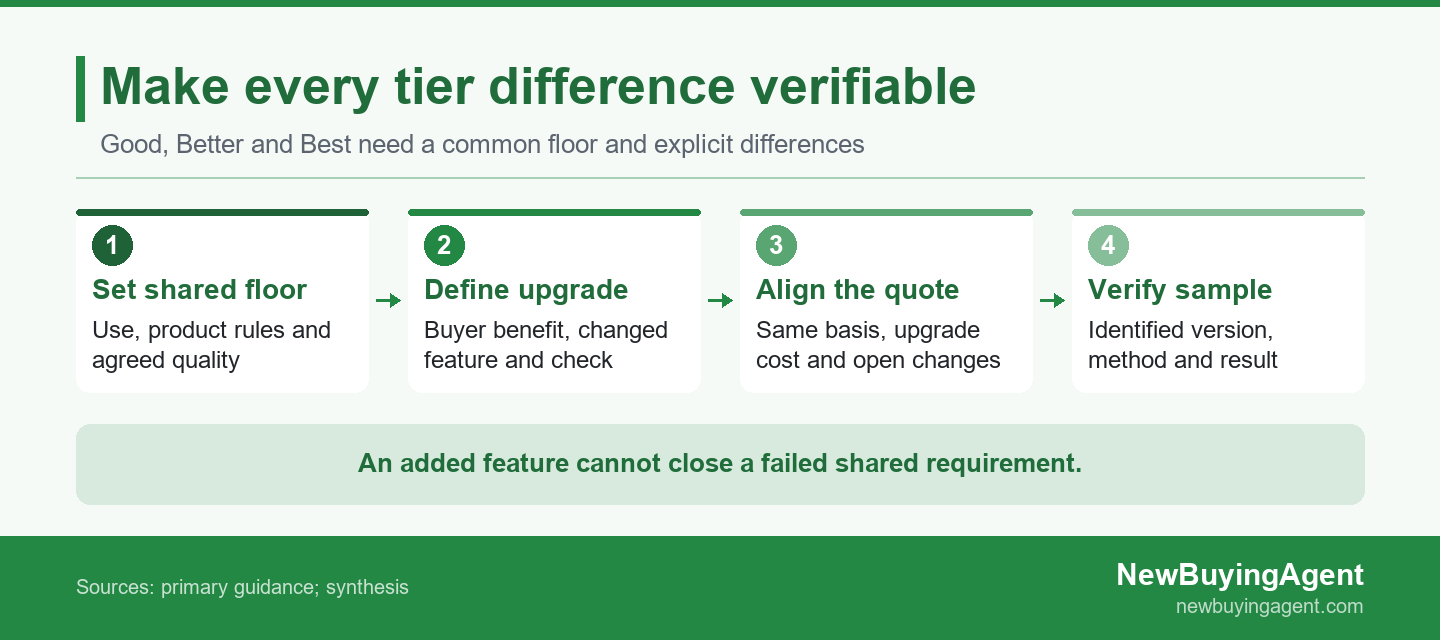
Define the shared floor, specify each useful upgrade, align the factory quote and verify the identified sample.
Translate the differences into verifiable requirements
Turn each important difference into a requirement with an observable outcome. Identify the product version, relevant condition, acceptance limit or feature, method and responsible decision owner. Separate what the product must achieve from a factory’s proposed way of achieving it. This allows the buyer to compare options while retaining a stable basis for quote and sample decisions.
Replace quality adjectives with outcomes and checks
Terms such as premium, durable and easy to use leave important questions unresolved. State the intended use and what would count as satisfactory performance. For a divider, specify the required layout and the way fit or retention will be checked. For an appearance requirement, identify the approved reference and inspection conditions. Record the result and the version to which it applies.
NASA’s requirement-writing checklist emphasizes precise, verifiable statements and criteria for checking satisfaction. Borrow that writing discipline for the product brief. The actual consumer-product conditions, limits and methods remain specific to the buyer’s use and destination. The checklist does not provide an aerospace qualification or a ready-made test limit for the proposed goods.
A requirement record can contain the buyer outcome, the measurable condition, the proposed method and an unresolved-field note. If the team lacks a method or acceptance limit that would change the decision, keep the requirement open and assign the missing work. A factory’s agreement to the word premium cannot resolve an undefined performance condition.
Compare the shared floor, Good, Better and Best
The matrix compares the shared floor and three proposed tiers by buyer benefit, specified requirement and check. It is a buyer-authored planning guide for the same defined product family. The tier differences and methods still need to be completed for the actual goods. Keep the shared-floor row visible when comparing a feature-rich proposal with the base product.
| Tier | Buyer benefit | Product spec | Check |
|---|---|---|---|
| Shared floor | Core use and agreed quality | Common outcomes and market rules | Approved methods and records |
| Good | Defined basic use | Core function and chosen finish | Shared floor and sample fit |
| Better | Useful added benefit | Specific upgrade documented | Baseline plus upgrade check |
| Best | Further justified value | Additional defined feature | Proof for each changed claim |
Based on this comparison, a tier name becomes useful when it points to a concrete difference and a verification basis. Keep the common requirements in every applicable version. Add only the feature and evidence changes that matter to the proposed buyer benefit. If two tiers have no meaningful difference after that work, revisit the range before asking for separate production commitments.
Ask factories to quote the same product basis
A comparable tier quote should identify the same destination, quantity basis, trade term, specification revision and delivery assumptions. Separate the base product from each proposed upgrade and show any change in MOQ, tooling, development, packing or lead time. Keep exclusions and alternatives visible. This allows the buyer to evaluate the cost of the intended difference rather than comparing incomplete tier labels.
Separate the base product from each upgrade cost
Ask for the base construction and a clear cost basis for the divider, tray, material or finish change. State whether a charge is per unit, per production run or a one-time project item. Confirm how the MOQ applies to each variant and whether a proposed combination is actually available. A range-level quantity should not hide a different minimum for one tier.
The International Trade Administration’s market-research guidance connects destination demand, price, distribution, landed cost and required product changes. Apply those questions to each tier’s actual offer. The buyer needs the product benefit and selling economics as well as the factory quote. Use current project inputs before deciding what price position and purchase quantity are workable.
For a recurring tiered range, NewBuyingAgent’s complete China product supply draws on local factory resources and product/QC capability. Those capabilities help connect the intended buyer benefit with feasible variants, samples and agreed quality checks. Bring the shared floor and explicit upgrade options into the complete product-supply discussion, then agree the relevant cost, quality and delivery responsibilities.
Keep proposals and substitutions visible
Allow the factory to propose a construction or material option, but record what changes from the brief. Ask which buyer outcome it supports, which requirement or method it affects and what happens to cost and timing. Keep an unapproved substitute out of the accepted specification. The product owner should be able to distinguish a suggestion from the version authorized for sampling or purchase.
Keep the physical variants traceable. GS1’s product-identity guidance describes distinct product and variation identifiers within the GS1 system. An internal SKU code and a standardized GTIN serve different record functions. Connect the relevant identifiers to the tier, specification revision and sample record so an approved finding cannot be applied casually to a different material, size or pack.
When a proposal changes an important use condition or requirement, revisit the affected comparison and checks. Update the quote and sample request together. This makes a cost-saving option reviewable while preserving the original reason for the tier.
Verify the proposed tier before approving its claim
Check the identified sample against the shared requirements and the changes that justify its tier. Record the method, conditions, result and open items. A successful feature demonstration covers the observed feature and conditions. Keep other product, market and production questions visible before deciding what the sample finding permits the buyer to release.
Marketing language needs evidence for the actual assertion. The FTC’s U.S. advertising-substantiation policy calls for a reasonable basis for objective advertising claims before dissemination. Match a measurable claim with appropriate product and use evidence. A supplier’s Best label alone does not substantiate a statement about longer life, greater capacity or another objective performance difference.
Work through a desk-organizer sample decision
Consider a hypothetical importer developing an adult desk-organizer range. Good has a main compartment, Better adds a removable divider, and Best also adds a removable accessory tray. A shared dimensional requirement specifies an unloaded usable interior width of 240 ± 2 mm and depth of 160 ± 2 mm, with removable inserts taken out. All tier features, dimensions, tolerances, methods and results are buyer-authored teaching assumptions, not an industry standard or an actual customer test.
For this teaching check, place the unloaded body on a flat bench and remove the divider and tray. Follow the approved drawing’s width and depth axes. At mid-height, measure the clear horizontal distance between the corresponding opposing interior faces. Use the agreed tool and decision rule, with measurement capability suitable for the stated tolerance. Record the identified sample and actual readings. The example assumes that method has been approved.
G1 measures 240 mm wide and 160 mm deep, B1 measures 241 mm wide and 161 mm deep, and P1 measures 237 mm wide and 160 mm deep. The permitted width interval is 238 to 242 mm and the depth interval is 158 to 162 mm. G1 and B1 meet only this dimensional check. P1 fails the shared width requirement, so the proposed Best sample remains on hold pending correction or an explicitly approved design change and recheck.
The added tray does not resolve that failed width condition. Ask for the relevant correction and an identified replacement sample, or make a deliberate product-definition decision before changing the requirement. Preserve the failed result and check the revised version against the approved basis. Keep Good and Better open for their remaining product and feature checks as well.
Measure the layout and intended-use benefit with the inserts installed separately. The unloaded body dimension does not establish whether the divider or tray works for the buyer’s objects. If the actual drawing, tool, method, acceptance rule or intended-use inputs are missing, obtain them before treating the sample as approved. These identified development samples supply no production-lot release decision.
Separate sample findings from repeat-production evidence
Carry the approved version into the proposed production conditions. Confirm the relevant materials, construction, manufacturing changes, checking responsibilities and packing basis. A good development sample is useful evidence for the requirements actually checked. Repeat supply needs evidence relevant to the current process and the intended purchase, with material changes assessed before the earlier approval is reused.
NIST’s acceptance-sampling guidance distinguishes a lot accept-or-reject decision from estimating lot quality. Keep the actual lot plan, its scope and its risks separate from the development-sample result. A few deliberately selected tier samples should not be treated as a production-lot acceptance plan. Agree the applicable checks and release responsibilities for the purchase.
NIST’s process-capability guidance compares an in-control process with specification limits. That is a different evidence question from checking one proposed product sample. Use suitable current production records and qualified methods where process capability must be assessed. A single dimension that falls within the limit cannot establish stable repeat production or a capability index.
Use a copyable tier brief for the China purchase
Keep the tier brief short enough to use in a quote and sample discussion while preserving the requirements that control the decision. The product owner defines the buyer benefit and shared floor, and sourcing confirms the current commercial and supply basis. The relevant technical or quality owner approves methods and interprets findings. Record the next purchasing stage and the open conditions that could hold it.
- Product and buyer. [Use, destination, channel, product version and intended benefit]
- Shared floor. [Common outcomes, applicable product rules, dimensions, quality and packing]
- Tier difference. [Good/Better/Best, added benefit, changed feature and requirement]
- Quote basis. [Quantity, trade term, base cost, upgrade charges, MOQ, tooling and timing]
- Verification. [Requirement ID, identified sample, method, limit or feature, result and responsible owner]
- Open decision. [Proposed substitute, missing evidence, correction, recheck and next release condition]
Keep the approved drawing, reference sample and verification findings connected to that record. Give proposed alternatives a clear status. When a material change affects the benefit, requirement or quote, update the affected version and decision before carrying the brief into the next order.
Send the range with its common floor and open decisions
Prepare the product specifications and proposed tier quantities together with the shared-floor and difference records. Include the sample findings and material open items. State which preferences can vary and which outcomes must be preserved. This gives the China product-supply discussion a clear buyer task and a workable basis for comparing the proposed goods.
For a recurring range or replenishment opportunity, share the tiered product brief with NewBuyingAgent. Include the specifications, quantities, target cost, destination, timing and current sourcing situation, plus the tier differences and important verification decisions. NewBuyingAgent can discuss complete China product supply around the buyer benefits and agreed product, quality and delivery scope. Confirm the current product basis and release conditions before committing around a disputed tier requirement.
Frequently Asked Questions
Should each tier use a different factory?
Factory choice should follow the actual product and supply capability needed for the proposed tiers. First define the shared requirements and useful differences, then assess the feasible supply options on that basis. A common manufacturing route may support several variants, while a material or construction change can require different capability evidence. Keep the product specification and commercial comparison consistent when assessing the proposed arrangement.
How large should the price gap between tiers be?
The price gap should follow the buyer benefit, actual upgrade cost and selling economics for the market. Identify which costs are recurring and which are one-time project charges. Check the relevant destination, channel and quantity assumptions. A meaningful product difference can still be unsuitable at the proposed selling price. Use the actual offer and evidence to decide the tier position and next purchase quantity.
Can a factory propose the tier upgrades?
A factory can propose options for the buyer to assess against the intended benefit and requirements. Ask for the physical difference, affected specification, cost basis and sample evidence. Record the proposal separately from the approved product version. If the option changes an important use or verification condition, update that part of the brief before requesting the next sample or agreeing the purchase.
Does a higher tier need a different inspection plan?
The verification and inspection scope should follow the product differences and risks that actually change. Retain checks for the shared floor and add the relevant checks for a new feature, material or performance claim. Agree the actual methods, sample or lot basis and release responsibilities. A higher tier label alone cannot select the plan or replace the evidence needed for the particular product and purchase.
NewBuyingAgent
Related Resources

Get Started Today
Let's Turn Your Sourcing Goals into RealityWeChat:+86 15157124615
WhatsApp:+86 15157124615
Address:Building 10 #39 Xiangyuan Road, Hangzhou, China
