

Assortment architecture is the way a buyer organizes a product range around customer needs, product roles and purchasing commitments. In the planning convention used here, a hero SKU expresses the range proposition, a core SKU serves established repeat demand, and a test SKU answers a defined product or market question within a limit.
Use these roles to decide what evidence each product needs and how much commitment it can carry. Record the actual variant, market and review period. A useful architecture connects the product’s job with the next buying action, so a prominent product, a reliable replenishment item and an experiment receive appropriate treatment.
Give every SKU a buying task and a commitment limit
Start with the customer need and the intended range. Give each SKU a primary role, the evidence supporting it and a limit for the next purchase. Check whether the quoted product and supply terms fit that limit. Review the role when demand, product economics or supply conditions change, keeping important unknowns visible to the person authorizing the order.
- Definition. Hero, core and test describe different jobs within a buyer’s range plan.
- Risk. A role label can hide weak evidence or excessive commitment if it has no decision rule.
- How it works. Link the variant, buyer task, evidence, purchase limit and next review.
- Decision. Release, revise or hold the purchase according to those conditions.
Define the customer need before assigning SKU roles
A coherent assortment begins with the customer and buying situation. Define the use, destination, channel, price position and range promise before classifying products. Then ask what each SKU adds to that promise. This gives the category and sourcing teams a basis for choosing the range’s breadth, variant depth and purchasing priorities without treating every attractive product as equally important.
For an importer developing a recurring product range, NewBuyingAgent’s market-fit product analysis and free Bestseller Market Analysis Report can help frame candidate products and buyer hypotheses. Connect those inputs to the actual channel, customer need and selling conditions. The role decision still needs buyer-specific evidence and a feasible product-supply commitment.
Decide the breadth and depth the range needs
Separate the number of customer needs the range covers from the number of variations offered for each need. An adult desk-accessory range might cover monitor positioning, cable organization and writing surfaces. Adding a new product type expands one part of the offer. Adding more colors of the same desk mat expands the choice within that product. Each addition should have a reason that can survive its inventory, display and sourcing costs.
The University of Tennessee’s on-farm retail assortment guide describes product breadth as variety and product depth as variations within a product. Borrow those basic terms from its farm-retail setting to define the imported range’s customer needs and variant choices.
Write the range boundary in plain language, such as adult desk accessories for a defined workspace and price position. Use it to question a proposed addition. If the product serves a different customer or introduces a new quality or delivery requirement, make that change explicit before allocating inventory to it.
Keep the role attached to the actual product variant
A SKU, or stock-keeping unit, is the internal product variant the buyer tracks for inventory and purchasing. Record the material, size, color, pack and revision that matter to the offer. A successful black cable-clip pack does not establish demand for every color or pack quantity. Keep the underlying identity stable when comparing periods, or record why an earlier result still applies to the revised item.
Within the GS1 identification system, products and variations such as sizes and colors receive distinct GTINs. A GTIN is a standardized trade-item identifier, while an internal SKU code supports the buyer’s own records. Link the appropriate identifiers in the product file. Adding a hero, core or test role to the planning record should preserve the identity of the goods being quoted, sold and replenished.
A role becomes useful when it changes the evidence required, the allowed purchase or the next review action. Keep those decisions attached to the identified SKU.
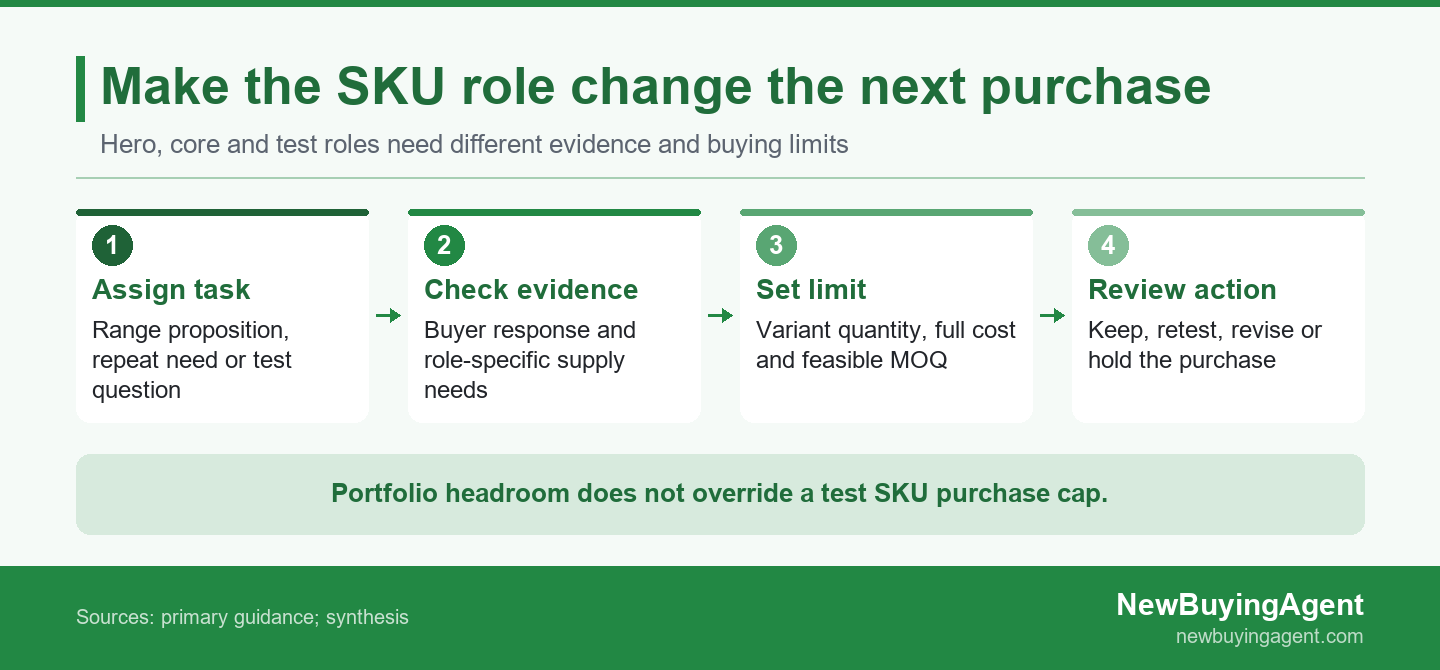
Assign the SKU task, check role-specific evidence, confirm the purchase limit and review the next action.
Use hero, core and test roles for different decisions
Use hero for the product that makes the range proposition clear, core for a product supported by established repeat demand, and test for a bounded question requiring more evidence. These are buyer-owned planning roles. Choose one primary role for the purchasing decision and record any secondary purpose. Keep the evidence and commitment limit visible so the label explains what the team should do next.
Use the hero SKU to make the range proposition clear
The hero SKU should make the intended offer easy to recognize. A monitor stand might express a desk range’s focus on a compact, coordinated workspace. Give that choice an observable task, such as attracting the intended customer to the range or demonstrating a product benefit. Decide which customer response would justify continued emphasis and which response would prompt a change.
Track the hero’s own buying evidence and any relevant relationship with the wider range. Product-page activity, qualified inquiries and purchases can inform different questions. Items frequently bought together show an association to investigate. They do not, by themselves, establish how many extra sales the hero caused. Preserve that distinction before assigning a large inventory commitment on the strength of a prominent campaign position.
The advertised specification, appearance and available quantity need to support the hero’s customer promise. If the featured variant cannot be supplied on the required terms, consider a revised launch or another suitable product. Record the change before releasing the purchase.
Support the core SKU with repeat demand and supply evidence
A core SKU carries an established buying need through successive selling periods or replenishment cycles. Look for relevant demand at workable selling conditions, product consistency and a feasible repeat-supply route. For a durable item, repeat demand can come from successive customer cohorts or channel replenishment. It need not mean that the same end customer buys another item immediately.
Shopify’s ABC inventory analysis groups products by revenue contribution, and item cost does not determine the grade. A core role should also consider retained demand, selling economics, customer need and the next supply conditions. Record the revenue grade and planning role separately if both are useful.
Review a core candidate’s availability and return history alongside its sales. A short period of heavy discounting may answer a different question from a full-price replenishment cycle. A variant can remain commercially important while a material substitution, quality issue or changed production schedule requires a purchasing hold. Keep the role and the release status as separate fields.
Give the test SKU a question, limit and exit rule
A test SKU needs a defined question. For a new desk-mat color, the question might be whether the intended customers keep buying at the planned price under the proposed channel conditions. Specify the product, audience, selling window, acquisition conditions, observation age for returns and evidence needed for the next decision. Set a purchase and spending limit before the trial begins.
Write the available actions in advance. A promising result may justify a second bounded observation or a core-candidate review. A weak result may lead to a product or offer revision, a smaller follow-up question or an end to the trial. Missing records should lead to a named evidence request. This keeps a test from continuing simply because inventory remains or the team has already invested in it.
A limited trial still needs the applicable product, market, packing and acceptance requirements. Agree those responsibilities for the actual product. The test role controls commitment and learning, while product requirements govern the goods supplied.
Compare the role before deciding the buying action
The matrix compares each role’s buyer task, evidence and sourcing action for a defined product range. The final row is an unassigned workflow state for a product whose role is unresolved. It preserves uncertainty before a buying decision. This is a qualitative planning comparison, with no universal role percentages or measured performance ranking.
| Role or state | Buyer task | Evidence | Sourcing action |
|---|---|---|---|
| Hero | Express the range promise | Relevant buyer response | Match featured offer and supply |
| Core | Serve repeat buying needs | Demand and repeat supply | Plan reliable repeat purchase |
| Test | Answer a defined question | Bounded trial result | Limit, review and retest or exit |
| Unassigned | Clarify the range task | Important facts missing | Hold role approval |
Based on this comparison, the buying action follows the product’s task and evidence. A test label needs a specific learning plan, a core label needs relevant repeat evidence, and a hero label needs a clear range proposition. Leave the role unassigned when those conditions are unresolved. This allows the next evidence request to be specific.
Consider the wider range as well as the individual SKU. The assortment-planning review by Kök, Fisher and Vaidyanathan, revised in 2006, discusses resource constraints and customer substitution. If two products serve the same need, examine whether customers switch between them and whether both choices earn their inventory commitment. A product’s own sales record alone may leave that range-level question unanswered.
Translate the role into a feasible China purchase
A role-based range plan should change the product brief and purchase conditions. Check the actual variant-level MOQ, full costs, production assumptions and delivery timing before confirming the next quantity. Keep the buyer’s SKU limit separate from overall range capacity. If a quote exceeds that limit, record the conflict and obtain a feasible option or hold the affected commitment.
Check MOQ, full costs and replenishment timing by SKU
Ask which minimum applies to the quoted product, color, material, pack or production run. Confirm any proposed combination in the actual quote. A supplier’s ability to combine variants is a project-specific commercial condition. It should not be assumed from the presence of several products in one range. Include sample, development, tooling or setup charges where they apply, with the basis of each charge clear.
The International Trade Administration’s market-research guidance connects the destination offer with price, distribution, landed costs and required product changes. Bring those questions into the SKU review. An attractive unit quote can still require more cash, space or time than the role allows. Use current project inputs for freight, import charges and other relevant costs, then check the selling economics at the intended price.
For buyers developing a recurring product range, NewBuyingAgent’s complete China product supply draws on local factory resources and product/QC capability. Those capabilities help connect the intended product benefit with feasible variants, samples and agreed quality requirements. Present the hero, core and test priorities as part of the complete product-supply brief, then agree the relevant cost, quality and delivery responsibilities.
Check when core replenishment would be saleable, whether the featured hero variant is available and whether the test purchase preserves its limit. Bring a material change back to the decision owner before increasing the order.
Work through an illustrative desk-accessory range
Consider a hypothetical importer planning an adult desk-accessory range with a next-purchase ceiling of 1500 sellable units. A cable-clip pack counts as one sales unit. H1, the monitor stand, is the hero candidate at 200 units. C1, the black cable-clip pack, is core at 800 packs. T1, the green desk mat, has a next-purchase cap of 120 units. All figures, role assignments and thresholds in this example are buyer-authored teaching assumptions.
T1’s earlier trial started with 120 saleable units and recorded 60 paid one-unit orders, all delivered. Each order has completed its first 30 days after delivery. Six units were returned within their respective 30-day observation windows, leaving 54 retained purchases at that matched age. The remaining 60 unsold units are confirmed saleable. Returned units stay outside that available-stock count until their disposition is resolved.
The buyer had set a threshold of 50 retained units for considering a further observation, so the first window meets that learning criterion. Later returns and different selling conditions can still change the commercial interpretation. Keep T1 as a test or core candidate while checking repeat demand. Where the product, season and selling conditions remain suitable, the existing 60 saleable units can support a second bounded window.
The factory quotes a next MOQ of 500 units for T1. Adding 200 hero units, 800 core packs and 500 test units would reach the overall ceiling of 1500. However, the 500-unit MOQ exceeds T1’s own 120-unit purchase cap. Hold that proposed test purchase. Ask whether a confirmed lower-quantity option is feasible, use the existing stock for the next observation where appropriate, or revise the plan through an explicit buyer decision.
Changing T1’s label to core would leave the MOQ conflict unresolved because the single trial has not established the repeat evidence or new exposure the purchase needs. Keep H1 and C1 subject to their own product and release checks. The total unit ceiling also leaves cost and space limits to be checked separately. If the variant, return or saleable-stock records are missing, obtain them before relying on the example’s calculations or approving another test commitment.
Review the role when evidence or conditions change
Review a role at a defined decision point and when a material condition changes. Compare the actual buyer response, retained demand, product economics and supply feasibility with the reason for the role. Then record whether to keep it, change it, request another observation or hold the purchase. Role changes should explain the new evidence and the commitment they permit.
Use the right calendar context. NIST’s time-series guidance describes seasonality as periodic fluctuations. A short seasonal peak may justify a timed range role while leaving year-round replenishment demand unresolved. Record the dates, channel, availability and selling conditions when comparing results. A product can earn a useful seasonal role without the buyer treating that peak as a permanent baseline.
Keep a copyable role and release record
Use a short record for each important SKU. The category or product owner explains the buyer task and demand interpretation. Sourcing and quality owners confirm the relevant product and supply evidence. The purchasing decision maker approves the next commitment. Keep role, evidence and release status separate so an attractive label cannot conceal a failed check or missing information.
- Product identity. [SKU, variant, revision, pack and relevant trade-item identifier]
- Buyer task and role. [Customer need, market, channel, primary role and reason]
- Evidence. [Selling conditions, period, demand, return age and product/supply findings]
- Next commitment limit. [Quantity, spending, space and current MOQ or timing constraints]
- Open items. [Missing evidence, affected purchase and responsible owner]
- Review and action. [Date or trigger, decision maker, keep/change/retest/hold and release conditions]
Give an unassigned product the specific evidence request needed to choose a role. For an approved role, name the event that would reopen it. A material change to the offer, product version or supply terms should be visible in the record before the team carries an old decision into a new purchase.
Send the product range with its buying priorities
Prepare the product list with the important role records, priorities and unresolved constraints. Include the variants that must remain consistent and the options that can change within the buyer’s intended offer. This gives the sourcing discussion a concrete range task and makes clear which quantities or requirements still need agreement.
For a recurring product-line or replenishment opportunity, share the range brief with NewBuyingAgent. Include the product specifications, SKU quantities, target cost, destination, timing and current sourcing situation, together with the role records and material open items. NewBuyingAgent can discuss complete China product supply around the range priorities and agreed product, quality and delivery scope. Confirm feasible variant quantities and release conditions before committing beyond a role’s evidence.
Frequently Asked Questions
How much of the range should be hero, core or test?
The allocation should follow the buyer’s demand evidence, range task and exposure limits. Record what each product contributes and what the proposed purchase would commit in quantity, cost and space. A range with established repeat demand may have different needs from a new category trial. Choose the allocation for the actual period and channel, then review it when the evidence or supply conditions change.
Can one SKU be both a hero and a core product?
A SKU can serve both roles, with one primary buying role and any secondary role recorded clearly. A prominent product may also have established replenishment demand. Explain which task controls the next quantity and which evidence supports that decision. Count its inventory commitment once in the range plan. Separate the role record from promotional placement so a campaign change does not automatically alter purchasing approval.
Should a low-selling product automatically become a test SKU?
A low-selling product needs a specific unresolved question and bounded trial before a test role is useful. First examine availability, product information, price, relevant traffic and the observation period. Some low sales may reflect an interruption or a completed seasonal opportunity. Define what another observation would resolve, the limit it must respect and the action that follows. If that question is missing, clarify the role before buying more.
When should a test SKU become core?
A test SKU becomes a core candidate when the relevant demand, product and repeat-supply evidence supports that role. Review the result under suitable selling conditions and a declared return-observation basis. Confirm that the next quantity and current MOQ fit the buyer’s limits. A promising first window can justify another observation while leaving a larger recurring commitment unresolved. Record the evidence that permits the actual role change.
NewBuyingAgent
Related Resources

Get Started Today
Let's Turn Your Sourcing Goals into RealityWeChat:+86 15157124615
WhatsApp:+86 15157124615
Address:Building 10 #39 Xiangyuan Road, Hangzhou, China