


A color and size curve allocates a defined buying quantity across product variants. The color curve sets each color’s share, and the size curve sets the size mix within that color. A usable order turns those shares into identified variant quantities, then checks stock, factory minimums and packing before release.
Start with the product, market and selling period the purchase must serve. Examine whether earlier sales reflect comparable availability, fit and selling conditions. Calculate the proposed color-size quantities and compare every cell with the factory’s offer. That sequence helps a buyer see where a seemingly correct total would still leave the wrong products on the shelf.
Build the purchase at color-and-size level
Plan the order at the level the customer actually chooses. A color total can conceal a shortage in a particular size, and a broad size average can conceal differences between colors. Keep the evidence, proposed quantities and factory packing basis connected so the buyer can make an explicit trade-off when they disagree.
- Definition. Record the product revision, size meaning, market and buying horizon.
- Risk. Read variant sales alongside availability, price exposure and physical-return reasons.
- How it works. Calculate size quantities within each color and reconcile the totals.
- Decision. Check usable stock, minimums and actual pack contents before release.
Define the curve for the actual product and market
A useful curve describes the proposed distribution for a defined product, market, channel and selling period. State whether the percentages represent observed unit sales, an adjusted demand estimate or a buyer-approved launch hypothesis, because those bases carry different uncertainty. Use the curve to generate a candidate order, then test that order against usable stock, arrival timing and the factory’s actual variant constraints.
When selecting a recurring range, NewBuyingAgent’s market-fit product analysis can inform the product and market hypothesis. Its AI-driven product analysis and free Bestseller Market Analysis Report provide inputs for that discussion. The buyer still needs relevant variant evidence and explicit assumptions to decide the color-size quantities. A broad product opportunity does not supply a measured curve for a particular fit or destination.
Record the intended arrival date and the demand period the stock must cover. Separate a first launch from replenishment of an established offer. For seasonal goods, a late arrival can change the useful selling window even when the size calculation remains arithmetically sound.
Separate color share from size share within each color
Choose the color quantities first, then apply the relevant size shares within each color. If the evidence supports a different size mix for each color, preserve that difference. Applying the same overall size curve to every color is an assumption about buyer behavior. Record the basis for pooling before it becomes a production commitment.
Oracle’s Size Profiles overview describes an estimated demand distribution across sizes at merchandise and location levels, down to style-color and store. That scope is a useful reminder to name the population behind a curve. A size share for one style-color and market can be a poor guide after a change in fit, customer mix or channel.
Use unit quantities for the allocation and define which transactions enter them. Revenue shares combine quantity with selling price, so a discounted color can look different depending on the measure. If the order is planned in units, keep the selected unit basis visible through the calculation and explain any deliberate commercial adjustment.
Match size labels to the approved physical product
Tie each size label to the approved product specification. For apparel, keep the size chart, points of measurement, tolerances, fit reference and relevant material or wash conditions connected to the variant. When a revised pattern changes fit, review how much earlier history remains comparable. A label can stay familiar while the physical product changes.
Google Merchant Center’s size guidance calls for a standard size value for the target country and separate apparel size variants under a common item group. Those rules describe product-data presentation. Physical fit still needs the approved measurements and product reference. Keep the destination size system and the factory’s size mapping explicit in the buying brief.
For bags, storage products and other consumer goods, define what size means for that family. It may describe dimensions, usable capacity or compatibility with another object. Preserve those distinctions when comparing demand. A capacity upgrade or changed external dimension can alter the customer task enough to require a separate buying assumption.
Carry the same identified variants through the evidence review, quantity matrix and factory pack check. This keeps the buying decision connected to the goods that will actually be produced and received.
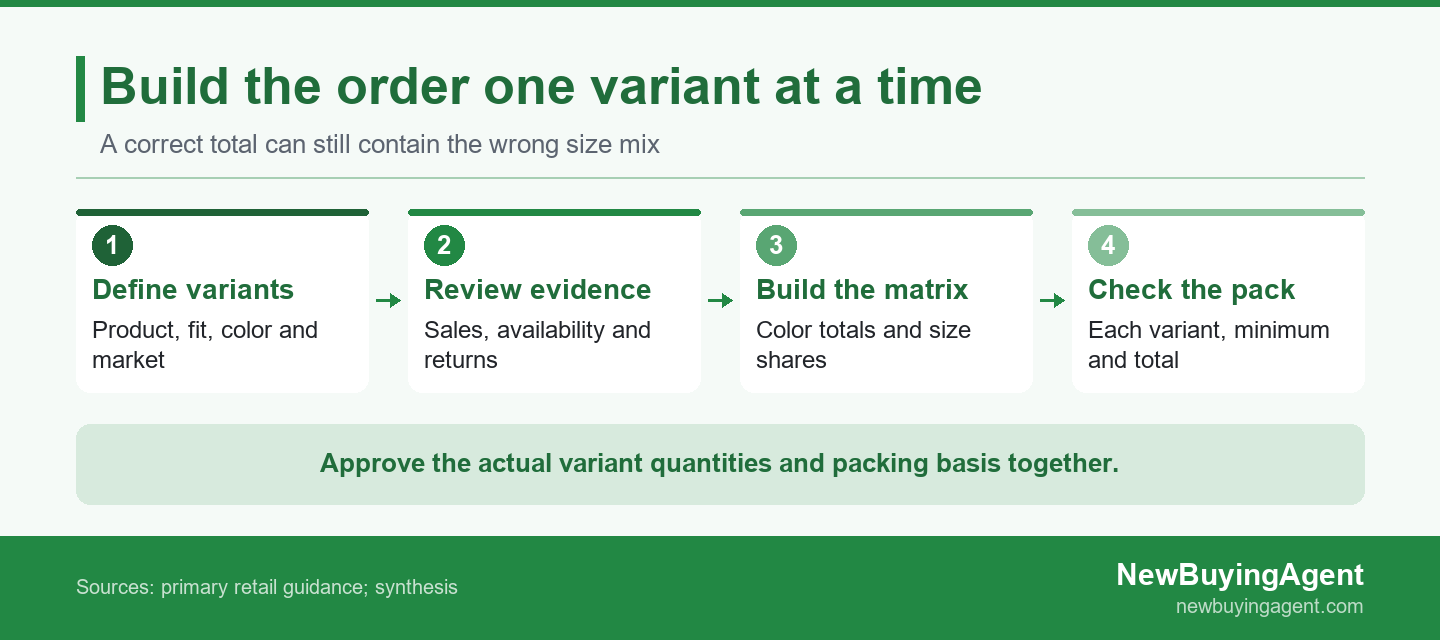
Define comparable variants, review sales and availability, allocate each color-size quantity and reconcile the factory pack.
Choose sales evidence that can support the next buy
Use evidence from comparable variants and selling conditions, with availability and transaction definitions visible beside the sales. Separate a supported observation from any adjustment for a new market, revised fit or incomplete history. Where the information cannot establish the next curve, label the proposed allocation as a buying hypothesis and bound the commitment through the buyer’s quantity, timing and replenishment options.
Read sales alongside availability and selling conditions
Build a variant history with units sold, the periods the variant was actually buyable, receipts, stockouts, price changes and material promotions. A size that disappeared early had less opportunity to sell. A heavily promoted color had different exposure. Compare suitable common periods or investigate those differences before carrying raw sales shares into the next purchase.
Letham and colleagues’ stockout-demand research models how customers can leave without purchasing or substitute another product when their preferred item sells out, using sales transactions and stock levels. Their empirical application concerns a bakery. For apparel order review, investigate possible substitution when interpreting another variant’s sales, while keeping any lost-demand estimate tied to an appropriate method and its assumptions.
Oracle’s documented size-profile data requirements use historical sales and inventory at SKU-store-week level for the Optimization method. Its Normalize method can run without inventory data. For a manual buying review, retain availability beside sales and explain the judgment made from them. The resulting matrix remains a buyer-owned allocation, with any lost-demand estimate requiring its own stated method and assumptions.
Check the actual inventory field definition in an export. Shopify’s inventory-report documentation states that from October 1, 2026 its inventory reports measure On hand rather than Available quantity. On hand includes committed and unavailable stock and excludes incoming units. Reconcile those states before treating an ending quantity as stock customers can buy or as stock available for the next selling period.
Keep unavailability visible even if the system has no lost-sales estimate. Dividing sales by in-stock days can be a diagnostic when selling conditions are comparable, but it cannot recover unknown demand without assumptions about timing and exposure. If the missing period contains the main promotion or season peak, obtain better evidence or retain a cautious hypothesis for that variant.
Check returns and exchanges before changing the curve
Investigate the reason a size comes back and the variant that replaces it. A fit issue, a damaged item and an order cancellation suggest different actions. Connect physical-return reasons and exchange destinations to the actual product version. A measurement or size-chart problem may need correction before a larger quantity of another label becomes a sensible response.
Shopify’s sales-report definitions distinguish reversed quantity, which includes refunds, returns, cancellations and edits, from the physical-return information needed to investigate fit. Select the relevant records and reasons before interpreting the pattern. Reconcile exchanges so the original sale and replacement do not become an unexplained duplicate in the buying dataset.
A size-recommendation study by Guigourès and colleagues jointly models purchased size and whether an item is kept, returned too small or returned too big. Keep those outcomes distinct when investigating a fit pattern. Use the actual product version, measurements and reliable return reasons to decide whether the next buy needs a different allocation, a product correction or better size information.
Allow a comparable return-observation window when assessing a recent launch against mature history. Record unresolved returns and the chosen cutoff. The buyer can then see whether a proposed curve reflects settled evidence or a recent period whose fit outcomes are still developing.
Turn the curve into a color-by-size quantity matrix
Calculate each cell from its color quantity and the size share approved for that color. Reconcile the size shares within the row, the row total and the overall buying quantity, then retain any rounding changes beside the original proposal. Before the matrix becomes a purchase order, confirm whether its values represent target stock or net quantities to buy, since usable stock and due inbound must be counted only once.
The working calculation is color quantity multiplied by size share within that color. Keep the unrounded result until the chosen integer or pack rule is applied. Where fractional units occur, use a documented allocation rule and reconcile the total after rounding. Let the buyer approve any change that materially shifts the intended mix or financial commitment.
Work through a two-color apparel order
Consider a hypothetical recurring adult T-shirt purchase with a net buying target of 240 units after usable stock and inbound commitments have already been reconciled. The buyer assigns 144 units to Navy and 96 units to Cream. Navy uses size shares S 25%, M 50% and L 25%. Cream uses S 50%, M 25% and L 25%. The resulting Navy quantities are 36, 72 and 36, and Cream quantities are 48, 24 and 24. These quantities, shares and product choices are teaching assumptions, not measured market demand.
The table compares the proposed unit quantities for the same approved adult T-shirt product and buying period. Size shares are conditional on color. The bottom row reconciles the size totals across the complete purchase, while each color row can be checked against the factory’s offer.
| Color | S units | M units | L units |
|---|---|---|---|
| Navy | 36 | 72 | 36 |
| Cream | 48 | 24 | 24 |
| Total | 84 | 96 | 60 |
Based on this comparison, the two colors need different size mixes under the stated assumptions. Navy’s largest quantity is M, while Cream’s is S. Retain the row-specific proposal through the quotation and packing discussion. An overall size total alone cannot tell the factory how to distribute those sizes between colors.
Test the factory pack against every matrix cell
Assume the factory offers a fixed 12-unit pack per color in an S:M:L ratio of 1:2:1. Each pack contains 3 S, 6 M and 3 L. Twelve Navy packs produce 36 S, 72 M and 36 L, matching the proposed Navy row. Eight Cream packs produce 24 S, 48 M and 24 L. Cream is short 24 S and over by 24 M against its proposed row, despite the correct 96-unit color total and 240-unit overall total.
Hold the proposed Cream packing basis and request a feasible alternative. Ask whether the factory can supply solid-size cartons or a different agreed assortment. Obtain the resulting cost, minimum and timing implications, then compare the revised cell quantities with the approved matrix. A carton count and a fixed size-ratio pack are different constraints and need separate confirmation.
If the factory cannot supply the proposed distribution, the buyer must deliberately revise the purchase or the supply arrangement. Compare the expected shortage, excess exposure, landed cost and replenishment timing of the available options. Preserve the original matrix and the approved change so a factory limitation does not quietly become a new demand forecast.
When pack contents or minimums are unknown, keep the matrix as a proposed buying plan. Request the actual constraints before release. A quote that shows only total units leaves the key color-size feasibility question unanswered.
Subtract usable stock before rounding the purchase
If the starting matrix represents target stock, calculate the net requirement by variant before applying pack rules. Begin with the quantity needed for the defined selling horizon and the explicitly chosen buffer. Subtract usable stock available for that horizon and confirmed inbound that will arrive in time and remains allocated to it. Keep the result at zero where the deduction exceeds the requirement.
Reconcile open customer commitments, held or damaged goods and transfers with the chosen stock definition so the same unit is counted once. Check that the demand input includes the intended commitments on the same basis. Then apply the actual purchase multiple or assortment rule and review the resulting excess, arrival timing and spend. The hypothetical apparel matrix above already represents the net buy, so those deductions have already been made.
Confirm the order the factory can actually supply
Confirm quantities and constraints for each actual variant before approving the purchase. Ask how minimums apply across style, color, fabric, size and packing, and require the quote to identify any substitution or quantity change. Link the accepted matrix to the specification revision, packing instructions and delivery basis so the buyer can check the goods received against the order that was deliberately authorized.
For a recurring range, NewBuyingAgent’s complete China product supply draws on local factory resources and product/QC capability. Those capabilities support discussion of feasible variants, product requirements, samples and agreed quality checks within the supply project. Bring the color-size matrix into that discussion alongside target cost and arrival needs, then confirm the actual product, packing and commercial basis.
Copy the variant order brief into the supply discussion
Use a compact record that keeps the buying logic and factory instructions together. The category owner approves the allocation, sourcing confirms feasible supply terms, and the relevant product or quality owner confirms specifications and checks. Give each unresolved input a responsible owner and a release condition. This keeps an attractive quote from closing a quantity question that remains open.
- Product and market. [Style, revision, destination, channel, arrival date and selling horizon]
- Variant identity. [Color reference, size system, approved dimensions, internal SKU and applicable product identifier]
- Evidence basis. [Period, unit definition, availability, price exposure, physical returns and launch assumptions]
- Quantity matrix. [Color total, size shares, target or net-buy status, rounding rule and approved cell quantities]
- Factory constraints. [Minimum by level, pack contents, carton multiple, cost, lead time and alternatives]
- Release and review. [Open input, owner, acceptance condition and next buying review]
Maintain a reliable mapping from the record to the actual goods. GS1’s color-and-size variation guidance calls for a unique GTIN for each product variation within the GS1 system, including each color-size combination. The buyer’s internal SKU and applicable GTIN serve distinct record functions. Keep them connected to the accepted variant, labels, packing list and order revision.
Review the next purchase against the original assumptions
Set the next review around meaningful buying evidence and the time needed to replenish. Compare actual variant sales, availability, physical returns and remaining usable stock with the assumptions recorded at release. Check that the goods received and listed correspond to the intended size mapping and color references before attributing a changed pattern to customer demand.
Update the affected assumptions when fit, channel, promotion, availability or supply conditions change. Preserve the earlier plan and the reason for the revision. Repeating a curve unchanged requires a reason just as changing it does. The useful output is an explained next order with an observable review point and a feasible route to supply.
Share the range and its unresolved buying decisions
Prepare a variant order brief with the product specifications, proposed quantities and evidence behind the mix. Include target cost, destination, arrival timing and the current sourcing situation, together with any unresolved pack or minimum constraint. Use that information to agree the feasible product-supply basis and the decisions still needed before purchase, while keeping the buyer’s demand assumptions visible for the next review.
For a recurring range or replenishment project, share the variant order brief with NewBuyingAgent. NewBuyingAgent can discuss complete China product supply around the variant matrix and agreed product, quality and delivery scope. Confirm the proposed quantities, available packing options and material open conditions before authorizing the order.
Frequently Asked Questions
Can the same size curve cover every country?
Use a shared curve only when the product, fit and buying evidence support pooling those markets. Compare size definitions, customer mix, channel and availability before combining the data. A small local dataset may justify borrowing a relevant analogue, but record that choice and its uncertainty. Retain local observations so the next purchase can separate a genuine market difference from temporary exposure or stock constraints.
How should a new color be ordered without sales history?
Treat a new color’s allocation as an explicit hypothesis informed by a relevant analogue and a bounded buying commitment. Record why the analogue is useful and which differences could change demand. Consider the current selling window, replenishment options and factory minimums together. A new color can warrant a different size mix when there is a defensible customer or fit reason, with the assumption reviewed after comparable evidence develops.
Should an unavailable size be recorded as zero demand?
Record the size’s availability status separately from sales so an unavailable offer is not mistaken for an observed lack of demand. Preserve periods when it was absent from the range, unlisted or out of stock. Decide whether the remaining evidence supports a comparable estimate or only a tentative allocation. Keep the uncertainty visible in the order record and identify what future availability or customer evidence would resolve it.
Does a size curve apply to bags and other consumer goods?
Use the same variant-allocation logic when the size has a clear product-specific meaning, such as capacity or physical dimensions. Define that meaning in the specification and product listing before pooling history. A bag offered in different capacities can serve different uses and customer groups. Keep the actual variant evidence and relevant product changes visible when deciding whether a common curve is useful.
NewBuyingAgent
Related Resources


Get Started Today
Let's Turn Your Sourcing Goals into RealityWeChat:+86 15157124615
WhatsApp:+86 15157124615
Address:Building 10 #39 Xiangyuan Road, Hangzhou, China
