

A short shipment contains fewer units than the agreed shipment quantity; an over shipment contains more. A mis-shipment contains the wrong product, variant or destination allocation, even when the total number of units matches.
Reconcile each exact product against the approved order and shipment scope, then compare what was recorded as dispatched, physically received and accepted for use. Preserve the evidence, identify where those records diverge and agree a remedy with the responsible parties. Close the case only after the replacement, credit, return or other agreed action has been verified in the relevant records.
Reconcile the product line before closing the exception
A shipment discrepancy needs a product-level record, not just a net shortage figure. Keep the original documents and the receiving result linked to the same purchase order, shipment and carton references. Assign someone to confirm the facts, someone to authorize the remedy and a clear next update time. Separate the investigation from any decision about liability or payment.
- How it works: compare the agreed shipment, dispatch record, physical receipt and accepted quantity.
- Risk: excess units of one SKU can conceal missing or wrong units of another.
- Cost: track goods, credits, extra handling and replacement transport separately.
- Decision: verify the agreed remedy before closing the outstanding quantity.
Define the discrepancy against the approved shipment
Establish what this particular shipment was authorized to contain before classifying a variance. Use the purchase order, approved amendments, exact product variants and any agreed split delivery. A balance intentionally scheduled for a later shipment is different from an unexplained shortage. Compare the same quantity unit and product identity throughout; a matching overall count does not establish that the right goods arrived.
Identify the SKU, or stock-keeping unit, for each product or variant. Check size, color, specification revision, pack configuration and destination allocation where relevant. Record short quantities and excess quantities separately, and give an unapproved substitute its own line instead of counting it as fulfillment of the requested SKU.
The U.S. International Trade Administration’s common export document guidance distinguishes the packing list, with quantities, packages, weights and marks, from the commercial invoice stating the goods sold and amount payable. Neither document alone verifies the physical receipt. Compare them with the approved shipment and actual count rather than treating one internally consistent set of paperwork as proof of correct delivery.
Product identity can be the difficult part when two variants look almost identical. NewBuyingAgent’s product development and quality-control capability, supported by local China factory resources, is relevant to checking those differences against the approved specification and origin records. Establishing the correct product gives the count a meaningful basis; it does not by itself determine who caused the discrepancy.
Keep four quantities visible for each product line: the approved shipment requirement, the quantity recorded as dispatched, the physical receipt and the quantity authorized for usable stock. A difference between two states identifies the next evidence question rather than automatically assigning fault.
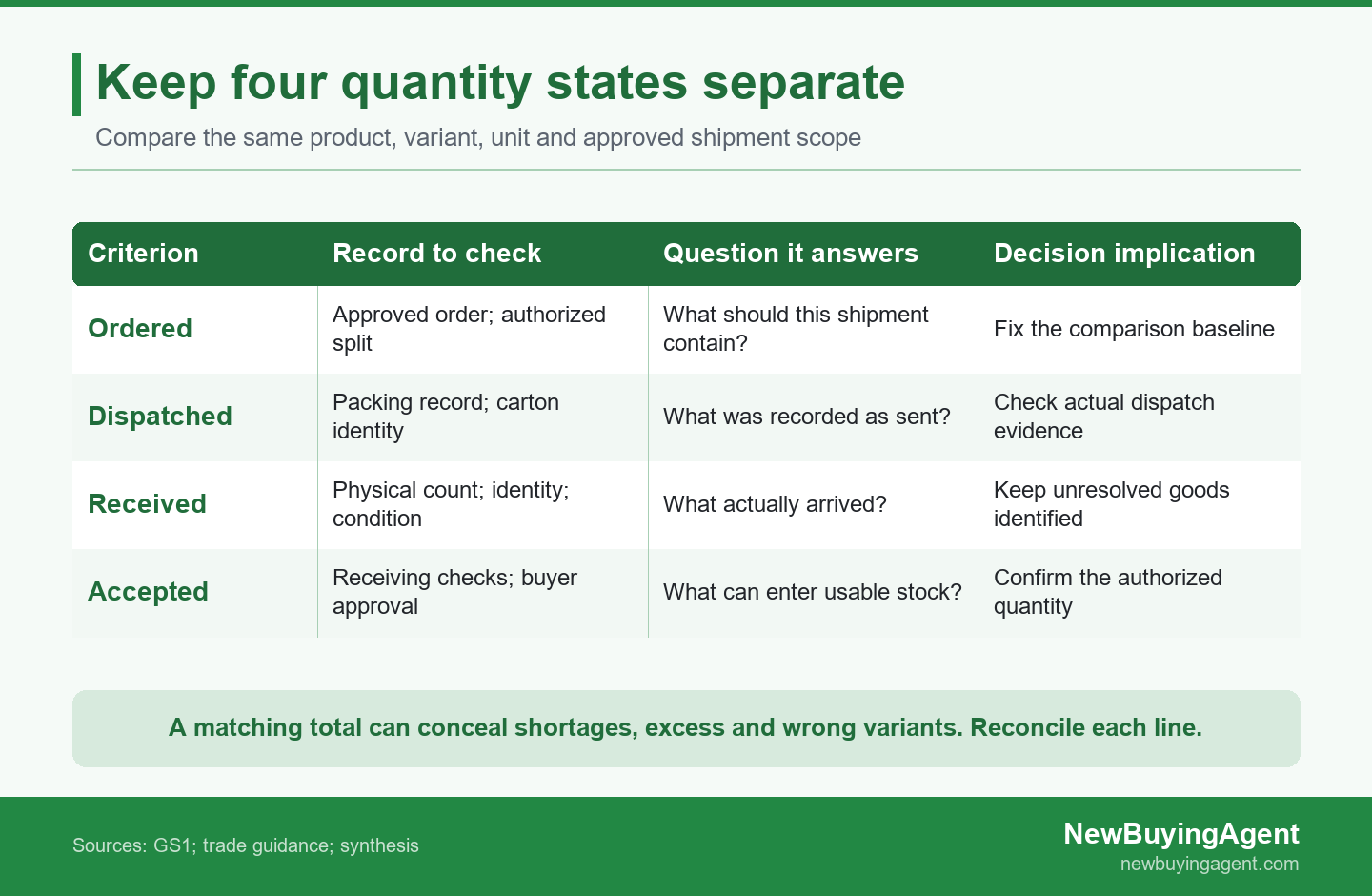
Reconcile ordered, dispatched, received and accepted quantities separately for each product line.
Build one discrepancy record from order to receipt
Create one case reference and attach a line record for every affected SKU and variant. Enter actual values, document references, the responsible person and the next confirmation time in the template below. Retain the original order and dispatch records alongside corrected versions. The purpose is to make the quantity, evidence gap and next action visible to purchasing, receiving, the supplier and the relevant logistics party.
Use the case reference in correspondence and inventory notes. Where multiple deliveries share one purchase order, identify which delivery each count belongs to. Record a verified fact separately from an explanation still being investigated so an early assumption does not become the basis for a credit or replacement request.
| Record field | Enter actual detail | Evidence / owner | Next action |
|---|---|---|---|
| Approved scope | SKU; variant; unit; split | Order / buyer | Confirm baseline |
| Sent quantity | Units; cartons; marks | Dispatch / supplier | Match origin file |
| Receipt | Count; identity; condition | Count / receiver | Verify variance |
| Stock status | Accepted; held; reason | Checks / approver | Control release |
| Open question | Missing fact; source | Case / investigator | Set next check |
| Agreed remedy | Units; credit; return | Agreement / buyer | Assign execution |
| Closure | Receipt; credit; update | Proof / case owner | Close each balance |
Normalize units, variants and authorized split quantities
Choose the comparison unit for each line and record the verified conversion where documents use different units. A carton count cannot be compared directly with a piece count, and a mixed carton cannot be converted using a single assumed pack size. Confirm the actual packing configuration for that shipment before calculating the variance.
The Canadian Trade Commissioner Service’s export documentation checklist specifically checks quantities, weights, units of measure and package counts across the invoice, packing list and transport record. This is a useful consistency check, not a universal destination-law instruction. Apply it alongside the approved order: matching document totals can still repeat an incorrect variant or pack quantity.
If an amendment or split delivery is cited as the explanation, obtain the approved version and identify its scope. Keep the original order balance visible, while comparing this receipt with the quantity actually authorized for this shipment.
Link the physical cartons to the dispatch record
Record pallet and carton marks, logistics labels and shipment references before mixing the goods with other receipts. Link photographs and count sheets to those identifiers. If labels are missing, duplicated or inconsistent, preserve that observation and explain how the receiver established which goods belonged to the delivery.
GS1 explains that an SSCC identifies an individual logistics unit and connects it to transaction information. SSCC means Serial Shipping Container Code; the unit may be a pallet, case or another transport grouping. Where that system is used, retain the identifier in the discrepancy record. Scanning it helps connect records to the same physical unit, but the scan does not independently verify its contents.
Open and count the affected goods using the agreed receiving method. Record the actual scope checked; counting selected cartons is not the same as verifying every piece in the shipment.
Keep received, held and accepted quantities separate
Use accepted quantity here to mean the quantity authorized for usable inventory after the agreed receiving checks. Physical receipt may also contain wrong variants, damaged goods or excess units awaiting a decision. Give those quantities an identified hold status so they cannot silently satisfy an outstanding demand. Internal stock approval is a separate record from any legal acceptance or waiver of rights.
The GS1 Logistics Interoperability Model describes receipt notification as a comparison of actual goods received with what was notified as sent, supporting inventory, discrepancy, order and invoice updates. Its receipt message is useful evidence of what arrived. The buyer still needs the applicable identity, condition and authorization checks before treating a quantity as available for use.
Record physical receipt in full, then identify which units are accepted and which remain held. Do not erase unwanted goods from the receipt count or add held goods to available stock merely to make a purchase-order balance look complete.
Locate where the shipment stopped matching the record
Investigate the first supported difference between the approved requirement, dispatch evidence and receiving result. Ask the supplier for origin records and the logistics party for the relevant handover information. A correct-looking invoice, intact seal or signed delivery record answers only part of the question. Preserve uncertainty where the evidence does not establish when or why the variance occurred.
A discrepancy can involve picking, packing, labeling, an authorized partial shipment, handling loss or an incorrect receiving count. Test the plausible explanation against the actual evidence. Recount affected lines where needed and record the result without altering the first count or discarding evidence that does not fit the initial explanation.
Preserve receiving evidence and notify the right parties
Keep the count sheet, product and label photographs, outer and inner packing condition, relevant seals, delivery record and time of discovery. Identify who observed the discrepancy and which cartons were opened. Send a factual notice through the required supplier, carrier or insurer channel as applicable, and obtain the actual notice and claim deadlines for the contract and route.
For example, the U.S. UPS claims supporting-document guidance asks for detailed merchandise descriptions and supporting records. For damage claims it requests photographs of the item and inner packing, shipping label and outer package, and notes that an inspection may be needed. This is a carrier-specific evidence example; it does not establish the notice period or liability for every ocean or air shipment.
Retain relevant packaging and goods until the required inspection or disposition is agreed. An internal discrepancy report is not necessarily the formal notice a carrier or insurer requires, so confirm the recipient, channel and acknowledgment instead of assuming that a supplier email preserves every claim.
Compare the receiving result with factory dispatch evidence
Request the actual picking or packing record, final carton list, product labels, release record and relevant loading evidence from the supplier. Match them to the receiving case by SKU and carton identity. Ask the factory to explain the specific difference, rather than accepting a general statement that the order was checked before departure.
For buyers using existing suppliers in China, agreed existing-factory management connects NewBuyingAgent’s supplier communication, production and quality follow-up, and logistics coordination to this origin-side evidence. The confirmed findings can support an agreed product remedy and the next order’s controls. Carrier responsibility, claim acceptance and any disputed legal obligation still require their own relevant evidence and authority.
Work through a shipment whose total count still matches
This hypothetical example assumes an approved shipment of 2,000 pieces, with no authorized substitution or overage. The dispatch record states the approved quantities. A complete receiving count finds the same total number of pieces, but different product-line quantities. Assume the correctly identified goods pass the agreed condition checks; excess and wrong-variant goods remain held pending an authorized decision.
The order calls for 1,000 units of A, 500 of B and 500 of C. The receiver finds 980 A, 520 B, 480 correct C and 20 of an unapproved C variant. A shipment-level total reports 2,000 pieces and a zero net variance. That conclusion misses both the product shortfalls and the goods that cannot yet enter usable stock.
Expose the shortage hidden by excess and wrong variants
A is short by 20 units and correct C is short by 20 units. B has 20 excess units, while another 20 pieces are the wrong C variant. Those two positive counts offset the shortages only at the aggregate level. They do not satisfy the outstanding demand for the correct A and C products.
| SKU | Agreed | Sent | Received | Usable |
|---|---|---|---|---|
| A | 1,000 | 1,000 | 980 | 980 |
| B | 500 | 500 | 520 | 500 |
| C | 500 | 500 | 480 | 480 |
| Wrong C | 0 | 0 | 20 | 0 |
| Total | 2,000 | 2,000 | 2,000 | 1,960 |
The usable column reflects this example’s authorized stock decision: 20 excess B units and 20 wrong-C units remain held. Thus 1,960 accepted units plus 40 held units equal the 2,000 physically received. The original product requirement still lacks 20 A plus 20 correct C, or 40 units. Keep the two shortages and the two held categories separate in the case record.
If a recount instead finds the missing correct items in another identified carton, update the line result with that evidence. The initial replacement need changes. Do not continue requesting 40 replacements after a verified recount has resolved some or all of the shortfall.
Choose a remedy for each affected quantity
If the buyer still needs the original quantities, one possible agreement is replacement of 20 A and 20 correct C, with a confirmed delivery plan. Decide separately what happens to the 20 excess B and 20 wrong-C units: return, approved purchase, another authorized use or a different documented disposition. None of those actions is assumed to be available without agreement.
For this example, receiving and approving the 40 correct replacement units would satisfy the original SKU quantities only after the receiving checks confirm their identity and count. The held goods still need their own disposition and commercial treatment. If the supplier instead grants a credit, the financial remedy may be complete while the buyer’s stock requirement remains open. Record which outcome the agreement is intended to achieve.
Close the physical, commercial and document records
Close each agreed obligation against observed evidence: goods received or returned, a credit posted, an authorized stock release or the relevant document correction confirmed. Keep the original case linked to those records. A supplier’s promise to replace goods is a pending action, not a completed receipt. Resolve any remaining purchase-order balance and demand requirement before marking the entire case closed.
Use separate statuses for physical resolution, commercial settlement and document updates when different people own them. Enter the confirming record and completion date for each. This avoids closing the investigation simply because finance has received a credit or receiving has found an additional carton.
Reconcile replacement goods, credits and remaining demand
Finance and purchasing should confirm the affected invoice line, approved credit or debit, payment treatment and any separately agreed replacement or handling cost. Keep disputed amounts distinguishable from amounts already agreed. Do not assume that receiving excess goods authorizes an additional invoice, or that recording a shortage permits an immediate unilateral deduction.
Link each replacement or later balance receipt to the original outstanding line so the same quantity is not credited and replenished twice by mistake. Where both a credit and replacement are deliberately agreed, record their distinct purpose. Confirm whether the buyer still needs goods after settlement: canceling an unneeded balance and obtaining usable replenishment are different commercial decisions. Retain the accepted agreement and the actual posting or receiving reference as closure evidence.
Check whether transport or customs records need correction
Send the verified discrepancy to the party responsible for the relevant transport and customs records. Identify what actually arrived, what was declared, the document status and whether a later shipment or return is planned. Ask which correction or new record is required for that destination and procedure. Preserve the original evidence and an authorized correction trail rather than silently rewriting the shipment history.
HMRC’s guidance on short shipments at UK temporary-storage locations uses the term for goods not unloaded on import as intended. Its processes depend on full or partial arrival and the declaration situation. That customs meaning differs from a warehouse count finding 20 missing pieces inside received cartons. Use the applicable procedure with the responsible declarant; a supplier credit alone does not establish the right customs action.
Carry the confirmed cause into the next purchase
Use the confirmed finding to improve the relevant control: variant identification, approved pack data, picking verification, carton marks, dispatch evidence or receiving count method. Assign the change to someone and specify what record will show it was used on the next order. Avoid imposing a generic inspection step when the actual problem was an uncommunicated split or an incorrect unit conversion.
For recurring China procurement, share your purchasing requirements with NewBuyingAgent. Include product and specification, quantities, target price, destination, timing, current supplier, variant list and relevant packing or receiving constraints. These inputs support a discussion of product supply or agreed existing-factory management, with supplier communication, production and quality follow-up, and logistics coordination aligned to the actual order requirements.
Frequently Asked Questions
Is there a standard over-shipment tolerance buyers must accept?
Do not assume a universal over-shipment tolerance; check the actual contract, authorized amendments and applicable rules for the purchase. A supplier’s routine packing practice does not establish the buyer’s agreed acceptance. Keep excess units identified while the authorized parties decide their stock, price and disposition treatment. If a tolerance was agreed, record its exact scope and calculate it against the correct product and shipment basis.
Can I deduct the disputed amount from the next invoice?
Do not assume a unilateral deduction is authorized; confirm the contract and obtain a documented settlement or appropriate advice for a dispute. Identify the original invoice, affected quantity, agreed amount and any separate replacement obligation. A deduction applied to an unrelated invoice can make the account harder to reconcile. Record the authorized credit or payment treatment and verify that it was actually posted.
What if a sealed container arrives with all carton numbers present?
An intact seal and complete carton identities do not independently verify the contents, product variants or unit counts inside those cartons. Preserve the seal and handover evidence, then apply the agreed receiving checks to the affected goods. Explain the scope counted and the observed difference. The condition of the seal can inform an investigation, but it does not by itself establish correct fulfillment or determine liability.
Should a later-delivered balance reopen the original discrepancy?
Link the later receipt to the original case and update its outstanding line quantity, while preserving the first delivery record. Whether the case remains open depends on the agreed remedy and any unresolved commercial or document action. Verify the later goods and avoid counting them twice as both a replacement and a separate order receipt. Close only the obligations that the new evidence actually resolves.
NewBuyingAgent
Related Resources



Get Started Today
Let's Turn Your Sourcing Goals into RealityWeChat:+86 15157124615
WhatsApp:+86 15157124615
Address:Building 10 #39 Xiangyuan Road, Hangzhou, China
