

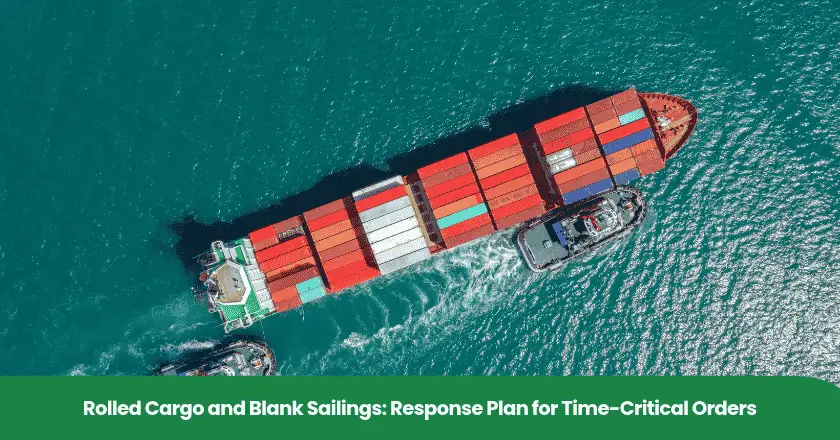
Rolled cargo is a shipment that misses its planned sailing and is reassigned to a later one. A blank sailing is a cancellation affecting scheduled service, potentially including a skipped port call.
When either threatens a time-critical order, confirm the cargo’s actual location and readiness, identify the products needed before stock runs out, and compare alternatives by when those goods can become usable at the receiving point. Approve the feasible route with named owners, costs and confirmation points. A revised vessel ETA alone is insufficient to rebuild the delivery commitment.
Protect the usable delivery date
A recovery plan should connect the transport exception to a specific product requirement. Establish what changed, what is ready to move and what quantity the business needs first. Then compare the complete route, including destination clearance and receiving, before authorizing changes. Keep uncertain capacity and timing visible so the purchasing team can act before another option closes.
- How it works: verify the disruption and cargo facts before selecting a recovery route.
- Risk: a replacement booking is different from confirmed loading.
- Timeline: measure the date goods become usable, including destination steps.
- Decision: expedite the critical released quantity only when the proposed route can meet the need.
Confirm what changed before choosing a recovery route
Start with the actual carrier notice and the shipment reference, not a forwarded message saying only “rolled.” Establish whether the problem concerns this shipment, the scheduled service, a port call or a missed connection. Confirm the container’s current location and revised assignment. These facts determine whether the practical response is rebooking, changing routing, retrieving goods or waiting for the existing movement.
Ask the logistics party to record the original vessel and voyage, affected leg, notice source, latest status and proposed replacement. Do not assume overbooking caused every roll or that a vessel delay means the entire service was canceled. A container still at the factory offers different options from one awaiting a connection overseas.
DHL’s blank-sailing glossary includes cancellation affecting certain ports or an entire route. Obtain the exact scope from the carrier: a skipped origin call and a canceled departure create different recovery questions. The term alone does not establish the next available departure, confirmed space or the effect on final delivery.
The transport comparison also needs reliable origin facts: the correct product, released quantity and packing status. NewBuyingAgent’s local China factory resources and product-development and quality-control capability are relevant to establishing those facts for recurring China orders. Use the confirmed product position to assess what can move; a transport offer cannot make unfinished or unreleased goods ready.
Before approving an option, check three things together: the required cargo is released, the complete route meets the usable delivery need, and the execution conditions have been accepted. Record what still needs confirmation rather than replacing an uncertain plan with another optimistic date.
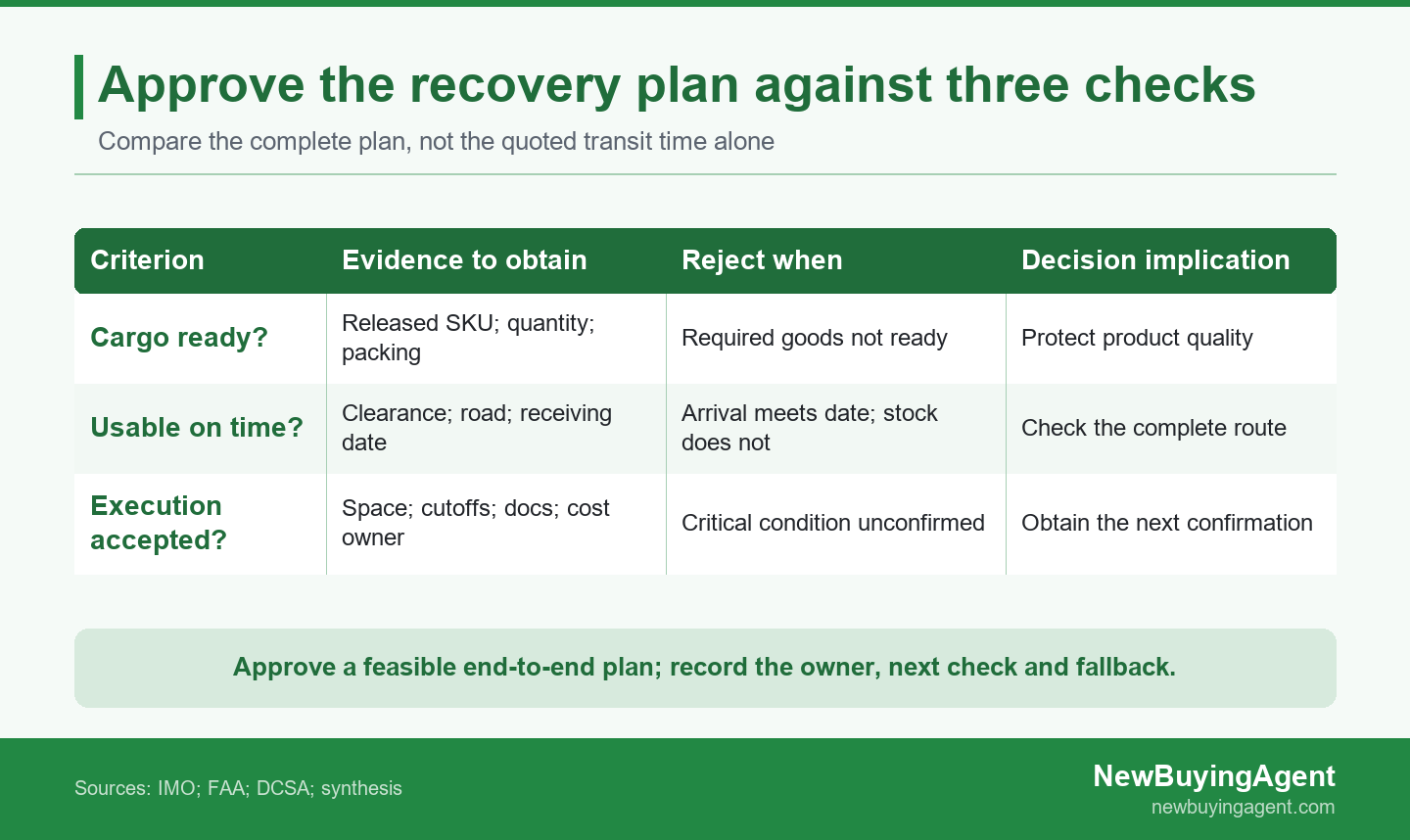
Check released cargo, usable delivery timing and confirmed execution before approving a recovery option.
Build a recovery plan around the critical products
Use one recovery record shared by purchasing, the supplier and the logistics party. Enter the actual value, evidence reference, responsible person and next confirmation time for every applicable row below. The plan is ready for approval when the critical products, end-to-end dates, execution conditions and incremental cost are clear enough to choose an option. Leave unresolved conditions explicit.
The matrix is a copyable working template. Add separate rows when products have different readiness dates or destinations, and preserve the original booking reference so revised instructions remain traceable. Assign a decision owner who can approve the extra cost and any change to the customer commitment.
| Plan field | Confirm and enter | Evidence / owner | Action if unresolved |
|---|---|---|---|
| Disruption | Affected leg; actual location | Notice / logistics | Clarify scope |
| Critical need | SKU; units; usable date | Stock / buyer | Prioritize demand |
| Cargo ready | Released units; packing | Release / supplier | Resolve readiness |
| New route | Space; cutoffs; acceptance | Booking / logistics | Keep conditional |
| Final delivery | Clearance; road; receiving | Route / receiver | Test usable date |
| Extra cost | Full change cost; exclusions | Quote / approver | Approve ceiling |
| Next check | Milestone; time; fallback | Plan / named owner | Escalate on trigger |
Set the need-by date and minimum bridge quantity
Define the usable delivery date as the point when the correct goods have completed the required steps and are available at the receiving location. A port ETA, airport arrival or truck booking is only part of that timeline. Confirm warehouse receiving hours, any required inspection and the quantity needed to sustain the next period of demand.
Calculate the gap by SKU, meaning the specific stock-keeping item or product variant. Start with usable stock, expected consumption and confirmed incoming quantities. Separate a production-stopping component from a slower-selling accessory, even if both are on the same purchase order. The minimum bridge quantity covers the shortfall until the remaining stock becomes usable; add any contingency quantity through an explicit buyer decision. Aggregated units are misleading when variants cannot substitute for each other.
Verify released cargo and the new cutoffs
Obtain the actual quality-release status, packed quantities, dimensions, weights and location. Distinguish finished goods awaiting approval from goods already released for shipment. Confirm pickup, shipping-instruction, documentation and terminal cutoffs for the proposed route, including local time zones. A quoted departure is unusable if the product cannot reach the required handover point on time.
For packed containers covered by SOLAS, IMO’s verified gross mass guidance requires the shipper’s verified weight sufficiently early for the stowage plan. VGM is a loading prerequisite, not an entitlement to loading. Reconfirm the operator’s actual submission arrangements and deadline for the changed movement; having a weight document does not prove that the container has been accepted aboard.
If repacking or removing a bridge quantity changes the shipment, reconcile the remaining package count and weights before issuing revised instructions. Keep quality requirements intact while changing the transport plan. Catching an earlier cutoff does not justify shipping an unapproved product variant or relying on obsolete packing information.
Resolve factory facts before committing to a route
Ask the supplier for a dated readiness response for each critical item: released units now, remaining completion date and packing work needed for a split. Obtain confirmation of who can prepare the revised shipment and when. A general statement that the order is “nearly finished” cannot support a departure decision or the size of an air bridge.
For buyers retaining suppliers in China, agreed existing-factory management connects NewBuyingAgent’s supplier communication, production and quality follow-up, and logistics coordination to this readiness assessment. Confirmed factory information helps purchasing choose quantities and transport timing together. The carrier or relevant logistics provider must still confirm the proposed movement’s capacity, acceptance and operating conditions.
Compare feasible end-to-end recovery options
Compare alternatives from the cargo’s actual location to the same receiving point and usable date. Include origin handling, cutoffs, main transport, connections, destination clearance and final delivery. An earlier departure or shorter main-leg transit may not improve usable availability. Exclude an option that cannot accept the goods or reach the deadline before comparing its price with the remaining choices.
Request written options with their assumptions and exclusions. Mark capacity as confirmed, conditional or unavailable, and identify the next fact that could change the recommendation. Compare the full order and a critical-quantity bridge separately; paying to accelerate every item may add cost without protecting additional demand.
Check the next sailing, routing and receiving port
For the next ocean departure, confirm space for the identified shipment, the actual routing and whether a connection is involved. Ask how the goods reach the new origin handover and whether existing equipment or documents can be used. Compare revised final availability with the stock gap rather than assuming the next scheduled vessel is available to your cargo.
A different discharge port may help only if customs arrangements, inland capacity and the receiving operation can support it. Ask for the extra handling, inland distance, local charges and revised document requirements. Where goods have already entered a terminal or moved overseas, first establish whether a change is physically and commercially available. Treat retrieval, rehandling and rebooking time as part of the option, not work that can automatically happen between two quoted dates.
Use partial air freight only when the goods qualify
Consider an air bridge for a released critical quantity when its complete usable date protects demand. Confirm actual air capacity, chargeable weight, origin handover, destination clearance and road delivery. Check whether separating the goods requires new packing, identification or approvals. An ocean shipment cannot simply be relabeled as air cargo without verifying the product and package requirements.
The U.S. FAA’s dangerous-goods shipping guidance stresses correct classification, packaging, marking and labeling, and notes that air carriers can impose additional restrictions. Batteries, battery-powered devices, aerosols and perfumery products need particular attention. Apply the actual route and carrier requirements: ocean acceptance or a familiar product description is not proof of air acceptance.
Have the appropriate trained party resolve classification and documentation before committing to the service. If the necessary acceptance or preparation cannot be completed before the cutoff, remove that air option from the executable plan. Do not present a flight quote as available inventory while a critical product restriction remains unanswered.
Compare the booking conditions and total extra cost
Read the actual service commitment behind each offer. Check amendment, cancellation and no-show charges, retained costs on the original movement, storage, rehandling, new transport and destination delivery. Confirm what is included and who approves the total incremental amount. Avoid comparing a port-to-port ocean price with an air quote that includes different origin or destination work.
As one specific example, Maersk’s Spot terms for the optional Rollable product permit cargo to move on a later sailing at the load port or during transshipment, and describe that option as typically more appropriate for non-time-sensitive cargo. This does not describe every Maersk booking. Check the product and terms applicable when the booking was made before treating a lower-priced offer as suitable for a critical deadline.
Approve the commercial decision against the business shortfall it addresses. If the option still misses the need, explain what it improves and what commitment must change; a higher transport bill alone does not make the recovery successful.
Test a bridge shipment against the inventory gap
The following hypothetical example uses elapsed days and steady demand for one interchangeable SKU. It is a planning exercise, not an actual shipment, forecast or standard transport time. Day 0 is the review point. Treat all proposed delivery dates as conditional until the relevant parties confirm their execution assumptions, and recalculate if demand, readiness or timing changes.
Assume the buyer has 600 usable units on Day 0 and consumes 100 units per day. The original purchase order contains 2,000 units, of which 800 are already quality-released and ready. Revised sea delivery would make the goods usable on Day 12. An air proposal could make a selected quantity usable on Day 5, subject to confirmed acceptance and the complete route.
Calculate the critical quantity from usable stock
The starting stock covers 600 ÷ 100 = 6 days, reaching exhaustion at Day 6 under this simplified continuous-demand assumption. From Day 6 to the revised sea availability on Day 12, the gap is 6 days × 100 units = 600 units. A 600-unit bridge delivered before exhaustion can cover that interval; it does not require expediting all 2,000 ordered units.
| Planning input | Assumption / calculation | Decision |
|---|---|---|
| Usable stock | 600 units ÷ 100/day | Coverage: 6 days |
| Sea stock usable | Day 12 | Gap: Day 6 to 12 |
| Minimum bridge | 6 days × 100/day | 600 units |
| Released now | 800 units of same SKU | 600 can be selected |
| Order split | 2,000 − 600 units | 1,400 remain for sea |
| Air stock usable | Day 5, conditional | Before Day 6 exhaustion |
Select the 600 bridge units from the 800 released units, then reconcile the remaining 1,400 units with the sea plan and their actual readiness. Do not count the bridge units again in the sea quantity. With usable air delivery on Day 5, the proposal arrives before stock exhaustion; the timing margin is still small and needs monitoring. If the buyer needs safety stock or consumption increases, calculate and approve the additional quantity explicitly.
Reject an arrival estimate that misses the usable date
Now change one assumption: the air quote means airport arrival on Day 5, followed by one day for clearance and one day for road delivery and receiving. The goods become usable on Day 7. That misses the Day 6 exhaustion point, so the same 600-unit quantity no longer prevents the interruption. The option may reduce the shortage duration, but it does not meet the original recovery objective.
Ask whether an executable earlier route, existing stock transfer or buyer-approved demand allocation can close the remaining gap. If no credible option protects Day 6, escalate the expected interruption and revise commitments rather than reporting that the order has been “saved by air.” Record the changed assumption and the decision owner so the next update tests the actual shortfall.
Approve the plan and follow the actual milestones
Release one approved instruction that identifies the shipment, selected route, quantities, cost authority, responsibilities and next confirmation. Keep the fallback available only to the extent its capacity and commercial conditions allow. Replace assumptions with actual events as the cargo moves, and reopen the decision when a critical milestone or usable delivery estimate no longer supports the agreed objective.
Assign an owner to every outstanding condition. State the next update time in a clear time zone and define an escalation trigger, such as no loading confirmation by the agreed check or a revised usable date beyond stock exhaustion. An update saying only “still following up” leaves the buyer unable to decide.
Assign responsibility and revise split-shipment documents
Before executing a split, identify who issues and checks the revised commercial and transport records. Reconcile the product description, quantities, package counts, weights, consignee and shipment references for each movement. Preserve a purchase-order reconciliation showing what went by air, what remains for sea and any quantity still at the supplier. Obtain approval before cancelling or changing the original movement.
The U.S. International Trade Administration’s common export document guidance distinguishes the packing list from the commercial invoice and describes air waybills separately from ocean bills of lading. Use the appropriate document set for each actual shipment with the relevant logistics party. Do not copy the original full-order quantities onto both legs; document and filing requirements must be confirmed for the actual route rather than generalized from U.S. export procedures.
Track loading, departure and delivery separately
Record the shipment reference, event, location, time and confirming source in the recovery record. Distinguish a new booking assignment from evidence that the specific container loaded. Likewise, a vessel’s departure or tracking position does not by itself identify every container aboard. Ask the logistics party for the confirmation relevant to your cargo and preserve any qualification.
DCSA’s Track & Trace standard describes distinct shipment, transport and equipment information alongside IoT and reefer events, including container loading, discharge, gate and transshipment milestones. These distinctions provide a useful way to organize updates; they do not mean every carrier supplies the same data. Track the facts available for this shipment and identify the next missing confirmation.
After arrival, continue through clearance, final delivery and the receiver’s usable-quantity confirmation. If those dates move beyond the approved need, escalate while a remaining fallback can still matter.
Connect the recovery lessons to the next purchase
Close the response with the actual quantity received, usable date, additional cost and unresolved balance. For the next order, preserve the readiness milestone, booking responsibilities and product data that proved difficult to confirm. Adjust the purchasing plan where repeated product-release or packing delays reduce the available transport choices. Do not treat an emergency freight decision as a substitute for reliable factory readiness.
For recurring China procurement, share your purchasing requirements with NewBuyingAgent, including product and specification, quantities, target price, destination, timing, current supplier, critical SKUs and receiving constraints. These inputs support a discussion of product supply or agreed existing-factory management, with supplier communication, production and quality follow-up, and logistics coordination aligned to the required delivery plan.
Frequently Asked Questions
Can a priority service guarantee that my cargo will load?
A priority label alone does not establish the loading commitment, and it is not evidence that the identified cargo actually loaded. Check the specific booking product, conditions, exclusions and any applicable remedy with the contracting party. Keep the written commitment separate from actual shipment milestones. Even a supported loading expectation must still fit the complete route and usable delivery need.
Should I cancel the old booking before confirming the alternative?
Do not cancel solely because an unconfirmed alternative appears earlier; first establish its capacity, acceptance, timing and the consequences of changing the original movement. The authorized party should approve the sequence and any cancellation or amendment cost. Record what capacity can actually be retained and until when, rather than assuming both options remain available indefinitely while the team decides.
What if the container is already at the terminal or a transshipment port?
Establish its actual location and restrictions first, because retrieval, rerouting or splitting may require approvals, handling arrangements and additional time. Ask the relevant carrier, terminal and logistics parties what changes are permitted and what they cost. Compare the resulting usable delivery date with leaving the goods on the revised route. Do not assume goods already in custody can be accessed like cartons still at the factory.
Does a blank sailing always add exactly one week?
No, the impact depends on the affected service or port call, actual alternative space, connections and destination handling. A weekly service pattern does not guarantee that your goods will move on the next scheduled departure. Obtain the revised assignment and complete delivery assumptions, then recalculate usable availability. Update the recovery plan again if the critical shipment misses the confirmation point on which the choice depended.
NewBuyingAgent
Related Resources


Get Started Today
Let's Turn Your Sourcing Goals into RealityWeChat:+86 15157124615
WhatsApp:+86 15157124615
Address:Building 10 #39 Xiangyuan Road, Hangzhou, China
