

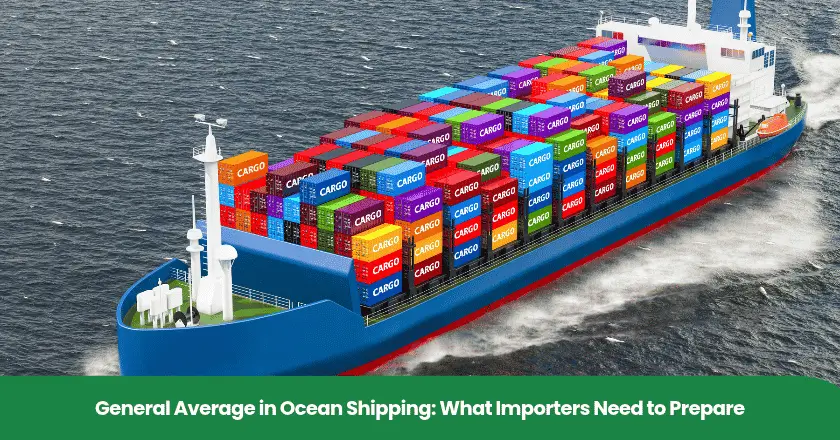
General average is a maritime system for sharing qualifying extraordinary sacrifices or expenditure intentionally and reasonably incurred for the common safety of property exposed to a shared peril.
If you receive a general average notice, verify the shipment and appointed contacts, notify the cargo insurer, assemble the requested commercial and transport records, and arrange the security specified for that casualty. Cargo can be affected even when it appears undamaged. Keep accepted security, final contribution and physical release separate: completing one does not establish the others.
Prepare for security before assuming the cargo can move
An importer needs a reliable shipment file, authorized document signers and a clear response from the insurer or adjuster. Work from the actual notice rather than a generic online form. Record what has been submitted, what has been accepted and which questions remain unresolved, including any separate salvage security and ordinary delivery requirements.
- How it works: the average adjuster assesses allowable amounts and allocates contributions under the applicable arrangements.
- Cost: an estimated deposit is security, not the final general average bill.
- Risk: insured cargo still needs the relevant policy and security response confirmed.
- Decision: obtain written acceptance before relying on general average clearance.
Separate general average from ordinary cargo damage
General average concerns qualifying measures taken for common safety, rather than every loss occurring during a voyage. Your own cargo need not be visibly damaged for a security request to matter. Start by identifying the casualty, shipment and applicable carriage terms. An average adjuster is the professional assessing allowable general average amounts and allocating contributions; the insurer and delivery parties have different responsibilities.
A vessel casualty can raise several separate questions: damage to your goods, general average contribution, salvage and delivery disruption. Do not combine them into one assumed insurance payment. Obtain the notice and relevant transport terms, including the incorporated rule edition, and route coverage or legal uncertainty to the appropriate insurer or adviser.
HMRC’s background explanation of general average illustrates the distinction with cargo jettisoned to save the ship and remaining cargo: the immediate loss falls on the sacrificed cargo, while the shared loss also involves the ship and surviving cargo interests. This UK tax-manual background is an explanatory example, not the governing law or contribution decision for every voyage.
Identifying the affected cargo requires accurate product descriptions and shipment-specific origin records. In recurring China procurement, NewBuyingAgent’s local China factory resources and product-development and quality-control capability are relevant to confirming those product facts. The records can support matching goods to the casualty file; the appointed adjuster and insurer determine their own valuation, security and coverage requirements.
Track three confirmations separately: acceptance of general average security, satisfaction of the remaining cargo-release requirements and the eventual financial adjustment. A sent form or transferred deposit is not evidence that all three have been completed.
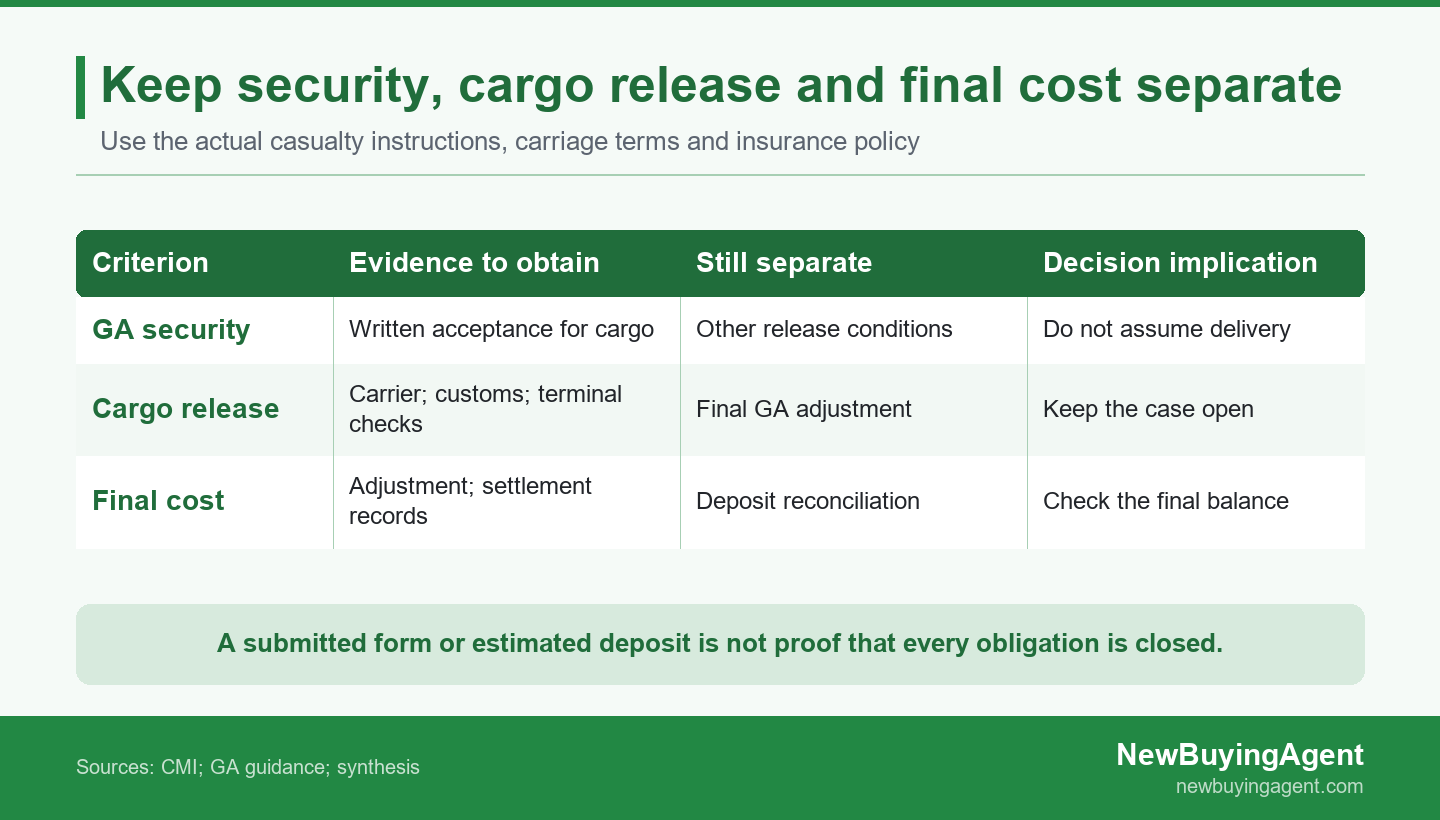
Confirm accepted GA security, operational cargo release and final financial adjustment separately.
Build a shipment file the adjuster and insurer can use
Create one response file indexed by the casualty reference and the affected shipment. Use the actual notice to confirm required documents, signers, recipients and submission channel. The matrix below is a recommended preparation tool, not a universal filing form. Add the current filename, responsible person, due date and submission or acceptance status beside each applicable row.
Resolve mismatched shipment references or company names before relying on a submission. Keep revised documents distinguishable from earlier versions and preserve correspondence explaining corrections. A complete-looking folder is less useful than records that identify the same goods and cargo interest consistently.
| Record | Match or confirm | Obtain from | Track |
|---|---|---|---|
| Casualty notice | Vessel; case; cargo | Carrier / adjuster | Verified contact |
| Transport record | Bill; container; shipment | Logistics party | Correct reference |
| Commercial invoice | Goods; price; currency | Seller / finance | Actual invoice |
| Packing list | Packages; product quantities | Supplier / logistics | Physical scope |
| Insurance record | Policy; insured interest | Insurer / broker | Response confirmed |
| Security forms | Required signer; wording | Adjuster / insurer | Accepted version |
| Damage evidence | Affected goods; condition | Receiver / surveyor | Sent to right parties |
| Release record | GA and other holds | Relevant release parties | Written status |
Verify the notice, contacts and shipment references
Confirm that the notice covers your vessel, voyage and transport-document references. Identify the appointed average adjuster and the actual contact for submitting security. If the notice reaches you through a forwarder or supplier, retain the original instructions and establish whether the intermediary is forwarding information or acting with authority for the cargo interest.
For consolidated shipments, ask which house-level goods and documents must be matched to the carrier-level movement. Do not assume that securing one buyer’s goods resolves the status of the entire container. Obtain the actual consolidation and release instructions instead of applying a generic groupage rule.
Match the commercial and transport records
Collect the actual commercial invoice, packing list and relevant bill of lading or other transport record. Match product descriptions, quantities, package marks, container references and the cargo owner or receiver details requested in the notice. Identify any split invoices or partial shipments so an unrelated part of the order is not assigned to this casualty.
The U.S. International Trade Administration’s common export-document guidance distinguishes the invoice recording the goods sold and amount payable from the packing list describing packages and physical quantities. The packing list does not replace the commercial invoice. That distinction helps build an accurate cargo file; it does not impose U.S. export-filing requirements on every shipment from China.
Keep the invoice currency and delivery-price basis visible. If the adjuster requests additional freight, insurance or value information, provide the supporting records and seek clarification rather than silently changing the invoice total to fit a requested field.
Confirm the actual insurance position and authority
Send the notice promptly to the cargo insurer or broker with the shipment references and policy or certificate. Ask whether the shipment and cargo interest fall within the policy and what the insurer will do about the requested security. Retain that response. A certificate on file, or a supplier’s statement that the goods are insured, does not establish that an acceptable guarantee has been issued.
Identify the person authorized to sign for the cargo owner or receiver and the person handling insurance correspondence. If coverage is disputed, documentation is missing or the insured value may not match the relevant exposure, explain the gap to the insurer and adjuster. Do not fill it with an assumption that the insurer will meet every amount or that the forwarder may sign every form.
Arrange the security requested for this casualty
Security gives the relevant parties assurance about a contribution that has not yet been finally determined. Obtain the current case-specific instructions and forms, then distinguish the cargo-owner undertaking from the insurer’s guarantee or any cash deposit. Ask who must sign, what wording is acceptable and how acceptance will be confirmed. Do not substitute a generic bank letter or a payment screenshot without that confirmation.
Create separate status entries for forms requested, forms signed, security submitted and security accepted. Record the cargo reference covered by each confirmation. This prevents an email acknowledging an attachment from being treated as permission to collect the goods.
Keep the bond and insurer guarantee distinct
An average bond is an undertaking by the cargo owner or receiver to pay the contribution legally and properly due for the cargo. An insurer’s general average guarantee is a separate security document. Use the actual required signers and wording; the buyer should not sign as the insurer merely because the shipment has insurance.
The CMI brief guidelines for cargo owners describe usual arrangements involving a bond and an accepted insurer guarantee or cash deposit. They also stress reading the actual notice: a bond may not be necessary in every case. The appointed adjuster should provide forms containing the relevant case information, and the response must follow those instructions rather than a fixed two-document rule.
Have unclear obligations reviewed before signature. Retain the completed version and the confirmation that it has been accepted for the specified cargo. Keep any subsequent request for corrected wording with the earlier submission so the file shows which version remains effective.
Confirm deposit instructions before releasing funds
If acceptable insurer security is unavailable, advise the adjuster and obtain the actual cash-security instructions. Confirm the requested amount, currency, value basis, payment reference, receiving account and deposit receipt arrangements. Establish who will retain the deposit record and follow its eventual reconciliation. A cash transfer should not be described as the final contribution merely because the money has left the buyer’s bank.
For payment-detail changes, the FBI’s IC3 business email compromise guidance recommends verification with the intended recipient through a secondary channel. Apply that control to a deposit request using independently established contacts, especially if account details change. This is a payment-verification precaution, not evidence that a particular casualty notice is fraudulent or a rule determining general average liability.
Ask whether separate salvage security is required
Ask explicitly whether the casualty requires salvage security in addition to general average security. Record each required undertaking, its recipient and acceptance status. If salvors have a separate security process, sending the general average forms alone may leave that requirement unresolved. Coordinate the question with the insurer and the appointed contacts rather than treating similar-sounding requests as duplicates.
The Hapag-Lloyd general average and salvage FAQ distinguishes security to salvors from general average security to ship interests and identifies different roles for cargo owners and insurers. It illustrates why two requests can arise from one casualty. Its particular release-list timetable and deposit-value instructions should not be treated as the procedure for every carrier or case.
Treat the security estimate separately from final cost
A security request addresses an estimated exposure before the final adjustment is complete. Confirm the requested calculation basis instead of assuming that one percentage applies to all casualties. Preserve both the instruction and the calculation, then keep that provisional amount separate from the eventual contribution, insurance response and any other costs. The numerical example below demonstrates that distinction, not a market-standard deposit rate.
The actual case may use a different amount, base, currency or security arrangement. Obtain a corrected instruction if a reference or value is wrong rather than paying a self-selected lower figure and assuming the cargo has been secured.
Test a disclosed deposit calculation and its limits
In this hypothetical example, verified case instructions request cash security of 20% on a stated deposit base of USD 50,000, and no acceptable insurer guarantee is available. Multiplying USD 50,000 by 20% gives USD 10,000 of requested security. The rate and base are assumed instructions for this example, not a typical rate, a rule for calculating contributory value or an actual customer demand.
| Example item | Assumed amount | Meaning |
|---|---|---|
| Deposit base | USD 50,000 | Confirmed only for this example |
| Requested percentage | 20% | Hypothetical instruction |
| Cash security | USD 10,000 | 50,000 × 20% |
| Final contribution | Not yet determined | Requires the adjustment |
| Other release conditions | Not yet confirmed | Separate operational checks |
The importer would retain the instruction, verified payment details, transfer evidence and deposit receipt, then obtain confirmation of acceptance for the relevant cargo. Payment alone does not prove acceptance or delivery. If the insurer later offers a guarantee, ask whether substitution is accepted and what happens to the deposit; do not arrange overlapping security on an assumption that the earlier payment will automatically be returned.
For planning purposes, distinguish cash tied up as security from a final cost estimate. Neither the example deposit nor an invoice percentage determines what the insurer will ultimately pay.
Retain values, damage evidence and the adjustment record
Retain value records, damage findings and correspondence requested by the adjuster and insurer. Report relevant cargo loss or damage promptly, with the supporting evidence, rather than assuming that undamaged invoice value remains the correct figure for every purpose. Keep security calculations, the final adjustment and deposit settlement records distinguishable.
Where incorporated and applicable, the York-Antwerp Rules 2016 address evidence and contributory values, including specific cargo-value provisions under Rule XVII. They also distinguish delay-related losses from allowable general average and preserve fault-related remedies or defenses. Check the actual incorporated edition and obtain advice on disputed values; these contract rules are not automatically the governing rules for every voyage.
Ask what additional evidence or response is required and record the actual deadlines and their source. Do not wait for physical delivery to organize the continuing file. Preserve any final demand, explanation of adjustments and deposit reconciliation, including a balance due or refund where applicable.
Confirm release and plan the next supply decision
Obtain written confirmation that the required security has been accepted for the identified cargo, then verify what still prevents collection. General average clearance is only one part of delivery readiness. The carrier, customs, terminal and inland transport arrangements can involve other requirements. Keep the financial file open for the adjustment even after the goods have been physically delivered to the receiver.
Use a status record with the confirming party, cargo reference, confirmation date and unresolved condition. This makes the next operational action visible without converting an adjuster’s limited confirmation into a promise about every delivery requirement.
Obtain written acceptance and check the remaining holds
Ask the relevant contacts to confirm what has been accepted and for which bill or cargo reference. Then have the logistics party establish the remaining carrier-document, customs, terminal and collection requirements for the route. Retain separate confirmations where different parties control them. An adjuster’s acknowledgment should not be relabeled as a terminal release order.
Confirm the goods’ actual availability and any current storage or handling arrangements before booking collection. If an instruction remains conditional, preserve that condition in the internal handover. Record who must obtain the missing confirmation and what action depends on it, rather than giving the purchasing team an unconditional “released” status.
Base replenishment decisions on confirmed product needs
If the disruption affects stock availability, separate the casualty response from the decision to replenish or replace goods. Confirm which products, quantities and delivery dates are still needed. Avoid duplicating the full order solely because a vessel was delayed; the actual cargo condition and availability may still be unknown.
For buyers retaining suppliers in China, agreed existing-factory management connects NewBuyingAgent’s supplier communication, production and quality follow-up, and logistics coordination to these repeat-order decisions. Confirmed production capacity and product requirements support a practical revised supply plan. The insurer, adjuster and relevant legal advisers retain their separate roles in the general average matter.
Include shipment responsibilities in the purchasing brief
For future orders, identify who keeps commercial and transport records, who holds the relevant insurance information and who receives casualty notices. Build shipment references into the order file so finance, procurement and logistics can locate the same goods quickly. This preparation supports the response without replacing the policy or the case-specific security instructions.
For recurring China procurement, share your purchasing requirements with NewBuyingAgent. Include the product and specification, quantities, target price, destination, timing, current supplier and any replenishment constraints. These inputs support a discussion of product supply or agreed existing-factory management with the required product, quality and logistics coordination for the next order.
Frequently Asked Questions
Can undamaged cargo still have to contribute to general average?
Yes, cargo that appears undamaged can still face general average security or contribution questions when it benefits from qualifying common-safety measures. A clean condition report does not resolve the security request. Verify that the notice covers the shipment and follow the applicable terms and requested process, while keeping any separate cargo-damage claim and insurance questions connected to their own evidence.
Does a CIF purchase mean the importer has nothing to prepare?
No, a trade term does not replace the actual insurer’s response or completion of the requested security process for the shipment. Locate the sales contract, insurance certificate or policy, notice and relevant cargo references. Confirm who is insured, who handles the matter and what the insurer will provide. Do not assume the seller’s involvement has already produced an accepted guarantee or removed the need for cargo-owner documents.
Does providing security admit the shipowner was free from fault?
Providing security and resolving fault-related rights are different questions, so have the actual wording and applicable rules reviewed when necessary. The CMI recommended arrangements and York-Antwerp provisions discussed above preserve relevant remedies or defenses; that does not justify signing any unfamiliar wording without checking it. Keep accepted security documents and any reservations or legal correspondence in the continuing case file.
Is general average security the same as customs or terminal release?
No, acceptance of general average security does not establish that all customs, carrier, terminal or collection requirements have been satisfied. Obtain the relevant operational confirmations and identify any remaining conditions before relying on a collection plan. Physical delivery also does not necessarily close the later general average adjustment or deposit reconciliation, so retain an owner for the financial file after receiving the goods.
NewBuyingAgent
Related Resources
Get Started Today
Let's Turn Your Sourcing Goals into RealityWeChat:+86 15157124615
WhatsApp:+86 15157124615
Address:Building 10 #39 Xiangyuan Road, Hangzhou, China
