

Section 301 tariffs on China are additional U.S. duties applied to covered products, and buyers should review HTS classification, list coverage, exclusions, landed cost, and sourcing timing before approving a China purchase.
Section 301 is not a generic "China tariff" line that buyers can safely estimate from memory. It is a product-specific import-cost issue. A product can be affected because of its HTS classification, list coverage, effective date, exclusion status, and shipment timing. A buyer that checks only the factory quote may approve an order that looks profitable in China but becomes weak after duty, freight, and compliance costs land in the destination market.
This is general trade and procurement information, not legal, customs, or financial advice. Buyers should confirm final classification, duty treatment, exclusions, and entry requirements with licensed customs brokers or qualified trade counsel. The buyer's practical job is to organize the product information early enough that those experts can review the right version before the purchase decision is locked.
NewBuyingAgent is relevant because tariff exposure changes sourcing decisions. Buyers share product specs, volume, target price, destination, and timing; NewBuyingAgent can prepare a quote and manage product selection, cost negotiation, quality management, production follow-up, and logistics. The buyer should bring tariff questions into that brief before price negotiation becomes detached from landed cost.
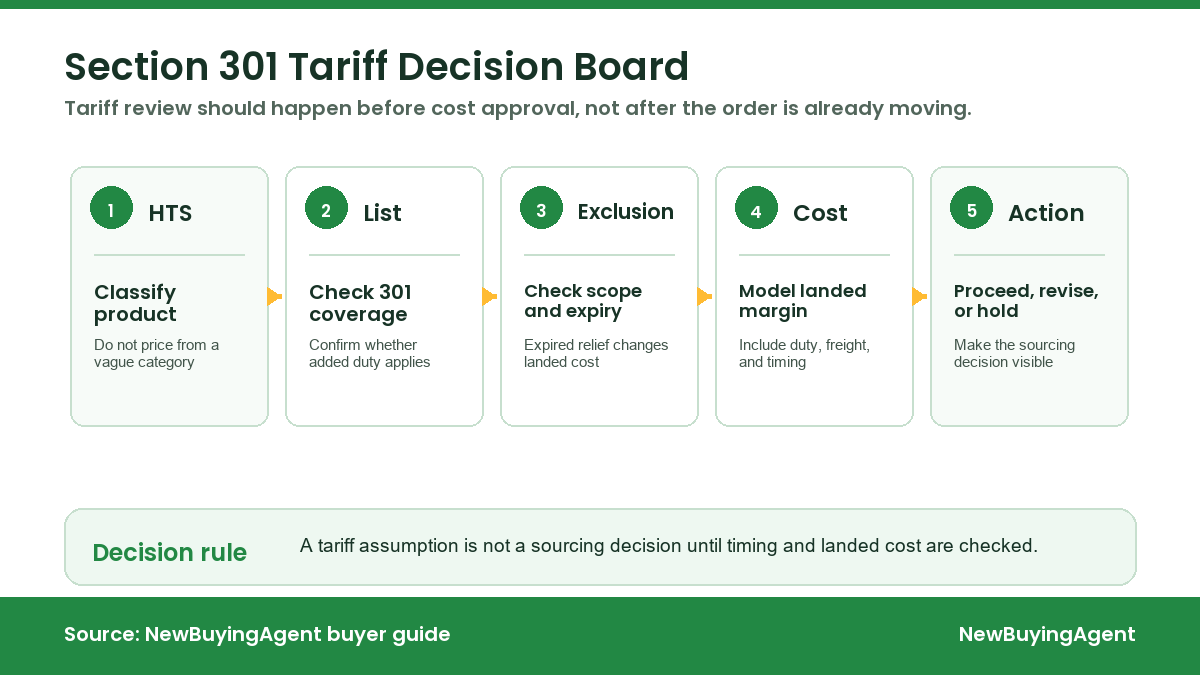
Section 301 tariff planning should move from HTS classification to list coverage, exclusions, landed-cost impact, and procurement action.
What Section 301 Means for China Buyers
Section 301 tariffs are trade remedy measures connected to U.S. policy actions, but for a buyer they become a purchasing-control problem. The buyer needs to know whether the product version being sourced from China may fall under an additional duty, whether a product-specific exclusion could apply, and whether the landed cost still supports the sales plan.
The USTR China Section 301 tariff actions page is the official starting point for tariff actions and exclusion process materials. USTR's Four-Year Review page organizes List 1, List 2, List 3, and List 4 action materials. These official pages matter because blog summaries and old spreadsheets can become outdated quickly.
The practical buyer method is simple: do not ask whether "China products" are covered. Ask whether this exact product version, under this HTS classification, at this shipment timing, has additional duty exposure or exclusion relief. That shift makes the question narrow enough for a customs broker or trade professional to answer.
List 1-4 Coverage: Why Buyers Should Not Guess
Lists 1-4 are shorthand for tariff-action groups, not a substitute for product classification. The same product family can contain SKUs with different materials, functions, or accessories, and those differences may affect the HTS code. A buyer should never assume that a previous product's Section 301 result automatically applies to a new version.
The USITC Harmonized Tariff Schedule is the official place buyers and brokers use for HTS research, while the World Customs Organization's HS overview explains why product nomenclature matters globally. The sourcing implication is clear: product specs, material, function, and intended use should be defined before tariff review. If the product description changes after the review, the duty conclusion may need to be revisited.
Buyers often make three mistakes. They use a competitor's HTS code without checking the product details. They quote a product before the material and function are final. They treat an exclusion summary as if it covers all similar products. Each mistake can turn into margin shock after the order is already in production.
A Five-Step Section 301 Review Workflow
The best workflow is not complicated, but it must happen in order. Buyers should treat tariff review as part of procurement planning rather than a final customs cleanup task.
Step 1. Define the Product Version
The product version should include material, function, dimensions, accessories, packaging, intended use, and destination market. A buyer asking for "metal hardware," "outdoor furniture," or "consumer electronics accessory" is not giving enough information for a reliable tariff review. The product version must be specific enough that a broker can discuss classification and a sourcing partner can quote the same item.
If a product has multiple variants, each variant should be reviewed separately when the differences could matter. A steel bracket and an aluminum bracket may not have the same classification logic. A finished good and a component may not have the same import treatment. A product with electronics may raise questions that the non-electronic version does not.
Step 2. Confirm the HTS Classification Path
HTS classification should be handled by qualified professionals, but buyers still need to supply the facts. The buyer should share drawings, material composition, product photos, function notes, packaging details, and previous import records if available. A sourcing decision based on an unreviewed HTS assumption is a weak decision.
The buyer should also ask whether any product changes after quote approval could affect classification. If the sourcing partner changes material, adds an accessory, changes the product's assembly level, or modifies the function, the HTS review may need a second look. This is one reason product changes should not be treated as small factory-side details.
Step 3. Check Section 301 Coverage and Exclusion Scope
After classification, the buyer can check whether the HTS code is tied to a Section 301 action and whether any exclusion may apply. Exclusions are not broad marketing discounts. They are narrow, time-limited, and tied to specific language. A buyer should confirm the exact exclusion scope, effective period, and entry requirements before assuming relief.
USTR announced that 178 exclusions were extended until November 10, 2026. The Federal Register also published the initiation of the second statutory four-year review in May 2026. Because these dates and scopes change, buyers should verify the current official status before placing orders.
Step 4. Model the Landed-Cost Impact
The landed-cost model should compare the quoted product cost with duty, Section 301 exposure, freight, insurance, customs fees, inland delivery, packaging, QC, and expected defect or rework risk. A product can be attractive at the factory gate and weak after all import costs are counted. Buyers should model landed cost before approving samples when the tariff exposure could change the commercial decision.
An illustrative scenario shows the effect. If a buyer sources a product at $20 per unit and an additional 25% duty applies to the customs value, the tariff adds $5 before freight and other import costs. On 5,000 units, that is $25,000 of additional cost. If the buyer's gross margin plan assumed only a $2 buffer, the tariff exposure is not a paperwork issue. It changes whether the product should be sourced, repriced, redesigned, or delayed.
Step 5. Choose the Procurement Response
The buyer's response may be to proceed, request a different product version, adjust target price, change timing, review exclusions, or pause until classification is confirmed. A sourcing partner should not decide the legal treatment for the buyer, but it can help manage the procurement implications after the buyer receives professional guidance.
NewBuyingAgent can use the buyer's tariff-aware brief to prepare a quote and manage product selection, cost negotiation, quality management, production follow-up, and logistics. The buyer remains responsible for confirming customs treatment with qualified professionals, but the sourcing process becomes more realistic because the target price and product version reflect import-cost risk.
Section 301 Buyer Checklist
The table below gives buyers a practical review sequence before they approve a China sourcing project with possible Section 301 exposure.
| Review Point | Buyer Should Prepare | Who Should Confirm | Decision Impact |
|---|---|---|---|
| Product version | Specs, material, function, photos, packaging | Buyer and sourcing partner | Quote matches the reviewed product |
| HTS path | Technical facts and prior entry records | Customs broker or qualified advisor | Classification basis is documented |
| List coverage | HTS code and product description | Trade professional using official sources | Additional duty exposure is understood |
| Exclusion scope | Exact exclusion language and timing | Broker or trade counsel | Relief is not assumed too broadly |
| Landed cost | Unit cost, duty, freight, fees, margin target | Buyer finance and procurement team | Proceed, reprice, redesign, or pause |
What to Send Before Asking NewBuyingAgent for a China Sourcing Quote
Buyers should send the product brief, destination market, target price, expected volume, timing, known HTS information, prior entry records if available, and any broker comments. If the product may be affected by Section 301, mark that concern clearly so quote preparation and product selection can reflect landed-cost risk.
Buyers should also state whether the product version is fixed or can be adjusted. If the buyer can change material, packaging, accessory count, or product configuration without hurting the market offer, NewBuyingAgent can account for those options during product selection and cost negotiation. If the product version is fixed, the sourcing path should focus on price, quality, production follow-up, and logistics around that approved version.
Buyers with a tariff-sensitive product can ask NewBuyingAgent to review the purchasing needs after they gather product facts for broker review. Buyers still defining the sourcing model can read what NewBuyingAgent does before preparing the quote package.
Who Is NewBuyingAgent?
NewBuyingAgent is a one-stop China sourcing agent for global buyers that want to source products from China without managing factory conversations, production follow-up, quality control, and logistics themselves.
Backed by 30 years of trade, manufacturing, and quality-control experience, NewBuyingAgent prepares quotes for products that match the buyer's purchasing needs. Buyers share product specs, volume, target price, destination, and timing; NewBuyingAgent manages product selection, cost negotiation, quality management, production follow-up, and logistics.
Its sourcing network includes 50,000+ partner factories and 20,000+ product development & QC experts. For tariff-sensitive China purchases, NewBuyingAgent helps buyers connect the purchasing brief, product quote, cost negotiation, quality management, and logistics plan to the commercial reality of landed cost.
Advanced Review Notes for 2026 Section 301 Planning
Section 301 planning in 2026 deserves more than a one-time duty lookup because the buyer is making a commercial decision while policy, exclusions, and tariff reviews are still moving. USTR's current public materials keep the List 1, List 2, List 3, and List 4A structure visible through the China Section 301 tariff actions pages. USTR also announced that 178 exclusions were extended until November 10, 2026, and the Federal Register notice published in May 2026 initiated the second statutory four-year review. Those two facts create a practical tension: a buyer may have a product that looks stable for today's quote, but the rule set still requires date discipline, entry discipline, and documentation discipline.
The biggest mistake is treating an exclusion as a general permission to ignore Section 301. Exclusions are usually tied to product descriptions, HTS language, and time windows. If the product version, material, power rating, use case, or technical description changes, the exclusion question may need to be reviewed again. A buyer ordering a slightly redesigned product should not assume that the old duty model still fits the new SKU. That is why the sourcing brief should preserve technical details that seem boring during price negotiation: material grade, dimensions, electrical function, component composition, intended use, and product photos can all matter when a broker reviews classification and exclusion fit.
Another issue is timing. A quote approved in June does not create tariff certainty for a shipment entering months later. Production delay, consolidation delay, document delay, port congestion, or a late balance payment can push entry into a different period. Buyers should therefore ask three separate questions: what duty model applies if goods enter on the planned date, what changes if entry moves by thirty to sixty days, and what margin remains if no exclusion applies. This does not make the buyer pessimistic. It makes the purchase approval realistic.
When a Product Has Multiple Plausible HTS Interpretations
Many Section 301 surprises start before List 1-4 review because the HTS code itself is uncertain. A product can sit near category boundaries when it combines materials, includes accessories, has electronic and non-electronic functions, or is sold as a kit. Two versions that look similar in a sales photo can land in different classification discussions once a customs professional reviews construction and principal use. The buyer should not ask a China sourcing agent to make a legal classification decision, but the buyer can ask the procurement team to keep the facts organized so the licensed broker receives a complete file.
A useful classification packet includes a product photo, exploded view if available, material breakdown, function description, user manual or instruction sheet, packaging description, and destination country. For custom products, buyers should also keep the approved sample record and any change log from development to mass production. If the product is assembled from several components, the file should show whether those components ship together, ship separately, or are packaged as a set. Small changes in shipped condition can change the broker's review path.
| Unclear point | Why it matters | Buyer evidence to prepare | Procurement action |
|---|---|---|---|
| Mixed materials | Classification may depend on composition or essential character | Material percentages, photos, bill of materials | Freeze material version before quote approval |
| Kits and sets | Shipment condition can affect classification review | Packing layout, included accessories, user instructions | Align packaging plan with broker review |
| Technical function | Function may separate similar-looking products | Specs, rating labels, manual, intended use | Do not change function after costing without review |
How to Use Exclusions Without Over-Relying on Them
An exclusion strategy should be treated as a documented assumption, not a hidden discount. If the buyer's landed-cost sheet assumes an exclusion, the sheet should show the exclusion reference, the product scope being relied upon, the expiry date, and the person or firm that reviewed the fit. A cleaner sheet also shows the alternate landed cost without the exclusion. That second number matters because it tells the buyer whether the product still works if shipment timing slips or if the product description does not fit as expected.
Buyers should also separate exclusion checking from price negotiation. If a factory quote is negotiated under a target cost that only works with an exclusion, the buyer may pressure the wrong part of the chain. A better sequence is to establish the desired product version, organize the HTS and exclusion review, model landed cost with and without the exclusion, and then negotiate product cost against the version that the buyer actually intends to import. This gives NewBuyingAgent a clearer commercial target: not simply a lower unit price, but a quote that survives the landed-cost model.
For repeat orders, create a small tariff review log. Record the SKU, HTS code used, duty assumption, exclusion assumption, review date, shipment date, and final entry note from the broker or customs team. When a new order repeats the SKU, the team can see what has changed instead of restarting from memory. This is especially useful when multiple people touch purchasing, finance, compliance, and logistics.
Buyer Decision Path When Tariff Exposure Is High
If Section 301 exposure materially changes the margin, the buyer still has several practical options. One option is product redesign, but redesign should not be treated as a casual tariff trick. A material or component change may affect performance, certification, packaging, and customer perception. Another option is order timing, especially when an exclusion expiry or review period is known. A third option is commercial repositioning: the product may still be viable if the buyer changes pack size, channel mix, or retail price. A fourth option is to pause the product and focus on a different item with a cleaner landed-cost path.
The key is to make the decision before production money is committed. Once molds, deposits, packaging, and production slots are locked, the buyer has less room to adjust. NewBuyingAgent can manage product selection, cost negotiation, production follow-up, quality management, and logistics, but the buyer should bring tariff exposure into the first purchasing brief. That allows the quote to be shaped around the real commercial constraint instead of discovering the constraint at customs entry.
Frequently Asked Questions
What are Section 301 tariffs on China?
Section 301 tariffs are additional U.S. duties applied to certain China-origin products under specific trade actions. Buyers should not estimate them from product category alone. The review should start with the exact product version, HTS classification, list coverage, exclusion status, and shipment timing, then be confirmed by a licensed customs broker or qualified trade advisor.
Do Section 301 exclusions apply to all similar products?
No, Section 301 exclusions are usually narrow and tied to exact product descriptions, HTS language, dates, and entry requirements. A similar-looking product may not qualify if the scope does not match. Buyers should verify exclusion language against the current official sources and professional customs advice before treating the tariff relief as part of landed cost.
When should tariff review happen in the sourcing process?
Tariff review should happen before quote approval or sample spending when the duty impact could change margin, target price, product version, or sourcing timing. Waiting until shipment can leave the buyer with limited choices. Early review helps the buyer decide whether to proceed, adjust specs, reprice, or pause.
Can a sourcing agent decide the correct HTS code?
A sourcing agent can help organize product facts, but final HTS classification should be confirmed by a licensed customs broker or qualified trade professional. The sourcing partner's role is to make sure the quote, product version, production plan, and logistics path reflect the buyer's confirmed import-cost assumptions.
NewBuyingAgent
Related Resources

Get Started Today
Let's Turn Your Sourcing Goals into RealityWeChat:+86 15157124615
WhatsApp:+86 15157124615
Address:Building 10 #39 Xiangyuan Road, Hangzhou, China
