Return reason codes become a sourcing tool when they lead to a verified change in the next order. Keep the customer's original reason, connect it to the right product and batch, investigate the physical evidence and give the responsible team a testable action. A code such as defective describes a reported symptom. It does not, by itself, prove a manufacturing cause or justify charging every return to the factory.
Treat the Return Code as a Signal, Not a Verdict
Useful return feedback links customer signals to product and batch evidence, routes the issue to the right owner, turns the confirmed problem into an action and checks later comparable orders. Preserve the difference between what the customer reported, what the team observed and what the investigation established. That distinction makes the next purchasing decision more defensible.
- Definition: A return reason is an input to investigation, while a confirmed deviation identifies what failed against the agreed requirement.
- Risk: Mixing refunds, returned units, product versions or unequal follow-up can create a misleading quality story.
- Decision: Correct the supported cause, retain unresolved cases and verify both production execution and later customer results.
Keep the Original Reason and Link It to the Product
An intact original return record provides the reference for separate analysis fields. Retain the source platform, original reason identifier and label, customer words, dates, product reference, variant and specification revision. Record whether the item was merely requested for return, physically received, inspected, refunded or exchanged. These are different events in the same customer case, not automatically separate failed products.
Reason libraries can change over time. Shopify's return-reason update introduced more detailed, category-specific definitions with identifiers, handles and names, replacing its previous reason enum. The practical lesson is to preserve the source definition and stable identifier used in each export, then maintain a dated mapping to the buyer's own categories. Do not overwrite historical customer selections with a new label that changes their meaning.
Link the reason to the goods actually supplied. GS1's guidance on batch and lot identifiers explains that a batch or lot number associates an item with manufacturer-relevant traceability information. A product identifier alone does not identify its production batch. Use available production, receipt and fulfillment records to establish the link; if stock was mixed and the batch cannot be recovered, mark it unknown rather than assigning the most recent factory lot.
Build a small working record that preserves original reason and customer words, mapping version, product revision, available lot evidence and event dates. Identify the affected unit or order-line quantity and its return event, then reconcile duplicate contacts, refunds and exchanges before counting failed units. Where individual identity cannot be established, state the quantity-level limitation. A refund and the related physical return should not become two incidents merely because they appear in different exports.
Keep photos, videos, measurements and inspection observations attached to the case, with access limited to what the investigation needs. A factory usually needs a product reference and defect evidence, not the customer's address or full account history. Separate personal information from the technical file before sharing it. Keep an explicit unknown or insufficient-evidence category so missing information does not quietly become a confirmed defect.
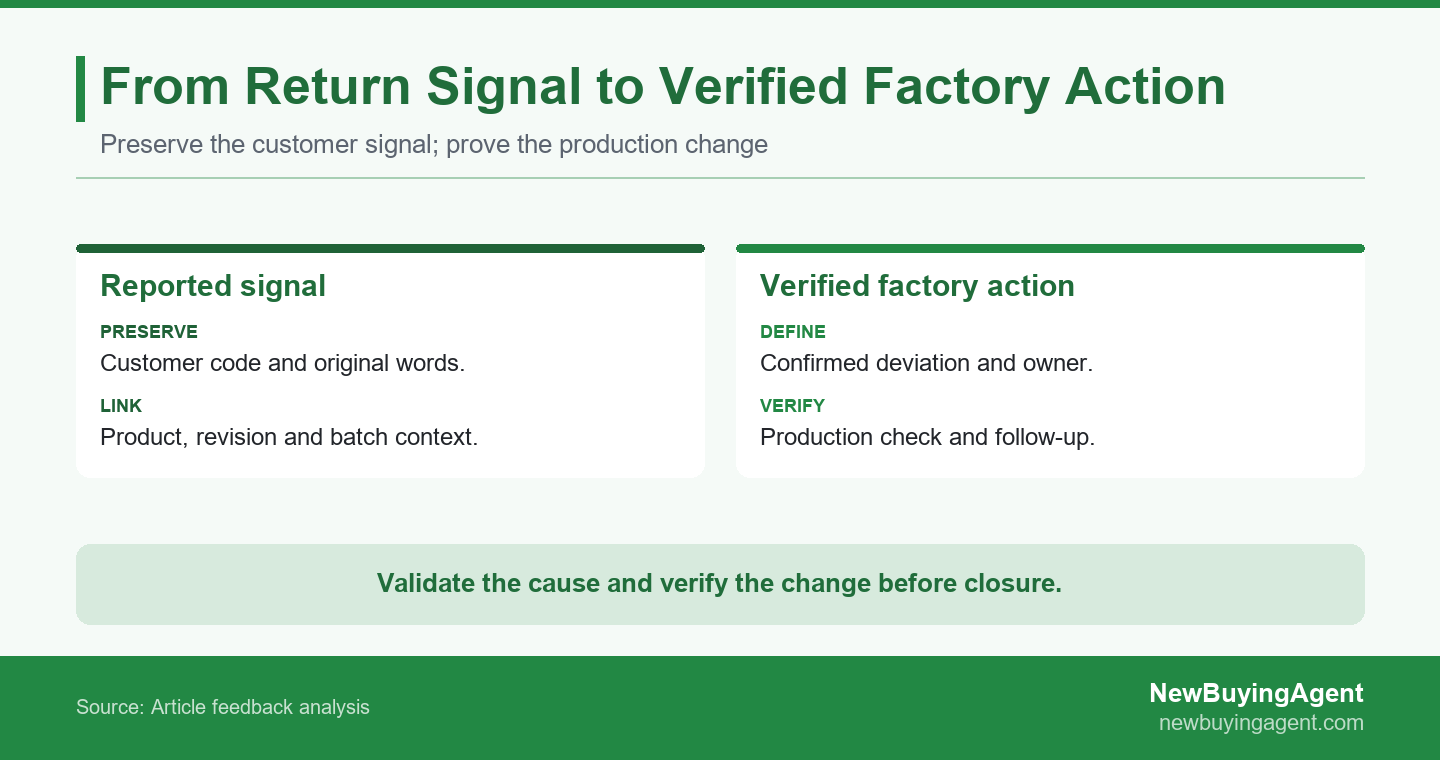
A return reason is a starting signal; confirm the product evidence before assigning factory action and verifying the change
Compare Like-for-Like Rates and Route the Problem
A valid ranking of reported problems compares like-for-like exposure: a cohort is a defined group of delivered orders or units followed over an equivalent period. For a product-level reported-code rate, compare unique affected units with delivered units from the same product version and delivery group. A reason's share of all returns answers a different question. A high-volume product can generate more complaints while having a lower reported rate.
Use the same follow-up opportunity when comparing delivery groups. A recently delivered order has had less time to generate a return than an older one. Record the observation cutoff and any changes in return policy, reason mapping, channel or customer mix. Split materially different revisions rather than averaging them together, and keep replacement shipments or failed deliveries consistent with the stated measure.
Minitab's Pareto guidance describes prioritization by frequency and explains how weighting by cost or severity can change the ranking. It also warns that categories and observation periods affect interpretation. Use a frequency view to locate recurring work, then add commercial exposure and severity. A large other category is a reason to improve classification, not proof that the remaining categories explain the whole problem.
Potential safety issues need immediate escalation through the responsible safety and compliance team. In the US, CPSC's duty-to-report guidance sets immediate reporting obligations for specified hazard and noncompliance information. Do not wait for a monthly ranking, repeated injuries or a completed routine factory investigation before addressing a potentially reportable issue. The applicable duty depends on the product, jurisdiction and business role.
The table compares four reported-signal groups using the evidence needed, initial investigation owner and next action as common dimensions. It is a routing comparison for the same product revision and delivery group, not a ranking of fault or legal liability. Rate comparisons additionally require the same event definition, denominator and follow-up window; a safety concern follows the immediate escalation path regardless of frequency.
| Reported signal | Evidence to obtain | Initial owner | Next action |
|---|---|---|---|
| Physical failure | Test and approved reference | Product/QC team | Confirm deviation |
| Transit damage | Pack and handling evidence | Pack/logistics team | Check delivery route |
| Fit or description | Measurements and listing | Product/content team | Check offer accuracy |
| Preference or unknown | Comments and missing facts | Category/service team | Clarify or retain open |
Based on this comparison, route each case by the evidence still needed. The initial owner investigates; it does not establish final liability. A size complaint can come from inaccurate production, a misleading listing or an unsuitable product choice. Measure the item and compare the information before deciding whether to change a factory instruction, the customer offer or both.
When the evidence points toward product-market fit, NewBuyingAgent's AI-assisted product analysis, free Bestseller Market Analysis Report and design or style optimization can inform the next assortment decision. That supports a different question from whether a seam met its approved specification. Use market insight for selection hypotheses and product evidence for manufacturing conclusions.
Separate Reported Defects From Confirmed Deviations
One broad reason code can require several different actions. Consider a hypothetical fabric storage-bag cohort: 1000 delivered units produce 30 units coded defective after the same follow-up window, a reported-code rate of 3%. This is a descriptive customer-report measure. It does not establish a factory defect rate, because the code has not yet been checked against the actual product and failure mechanism.
Of 20 returned bags examined, 8 fail the agreed handle-load check and lack specified reinforcement, 7 pass that check but have size-expectation comments, 3 show transit-cut evidence and 2 remain unresolved. The examined group is not a random sample of all delivered units. These observations belong to this hypothetical case, not to a client dataset or an industry benchmark.
| Examined cases | Observation | Action to develop |
|---|---|---|
| 8 bags | Load failure; reinforcement absent | Restore specified construction |
| 7 bags | Pass load check; size comments | Verify dimensions and listing |
| 3 bags | Transit-cut evidence | Investigate pack and handling |
| 2 bags | Insufficient evidence | Keep open and request facts |
The missing reinforcement supports a factory correction for the verified construction deviation. It does not explain every defective-coded return. Passing the handle test does not establish that the entire bag is conforming, either: check the dimensions and the customer's stated problem before clearing those cases. Transit evidence directs investigation toward the packaging and handling path without automatically proving carrier liability.
Keep the unexamined returns and unresolved cases visible. Request the missing goods or evidence where feasible, and consider how the examined cases were selected. The first useful factory instruction is specific: restore the approved reinforcement, identify the affected production scope and demonstrate the agreed handle test. A request to improve quality generally would neither resolve the known deviation nor explain how the buyer will verify the next order.
Give the Factory a Testable Correction Brief
A defined deviation and an agreed verification method connect the factory response to the next purchasing release. ASQ's root-cause guidance places analysis within a wider improvement process and makes clear that analysis alone does not produce the result. A plausible explanation therefore needs an implemented correction and evidence that the relevant control works, rather than a report that simply restates the complaint.
A usable correction brief states the product and batch scope, confirmed deviation, evidence and test, responsible owner, containment, permanent action, effective revision, production verification and post-sale check. Keep a suspected cause labeled as suspected until the investigation supports it. Ask what in the process allowed the deviation and what control will prevent or detect its recurrence.
| Brief field | Record before approval | Evidence to retain |
|---|---|---|
| Scope | Product, revision, batch and affected stock | Traceable records |
| Problem | Observed deviation from agreed requirement | Photos, sample and test |
| Immediate control | Stock hold or agreed disposition | Owner and affected quantity |
| Permanent action | Supported cause and changed control | Revised instruction and training |
| Verification | Method, criteria, sample plan and timing | Results on actual production |
| Follow-up | Comparable measure and reopen condition | Dated customer-data review |
Containment handles the current exposure; permanent action changes the process that produced it. For the bag example, identify affected stock, agree its disposition and restore the specified reinforcement. Check a corrected sample, then verify that the approved method reaches routine production. Choose the inspection or test plan for the product risk and order scope; a successful demonstration sample does not prove that every finished unit received the correction.
Keep product requirements, artwork, assembly information and packing changes under revision control. If the response proposes a different material or design rather than restoring an agreed feature, assess the resulting cost, performance and applicable product requirements before approval. Confirm who can release the change and which purchase orders it covers. Leave unaffected versions intact where the evidence supports that narrower scope.
For buyers retaining Chinese suppliers, NewBuyingAgent's factory management in China provides a local team for supplier communication, production progress and quality management, staged inspections and logistics coordination. Its product/QC capability is relevant when a confirmed return issue must become a controlled reorder instruction. This is part of NewBuyingAgent's one-stop China sourcing service for global buyers, with the existing-factory scope agreed for the purchasing need.
Verify the Change in Production and After Sale
Closing the issue requires evidence of the change at both production and customer levels. Confirm the effective revision, the first affected order and the actual production checks. Then monitor subsequent delivered groups using the same reason mapping, product scope, event definition and follow-up period. Keep confirmed deviations, reported symptoms and unresolved cases as separate measures so a coding change cannot masquerade as a product improvement.
Statistical inspection measures require their own conditions. NIST's proportion-control-chart guidance defines the sample proportion relative to the units in the sample and describes random-sample and process assumptions. Returned products are self-selected and can be selected again by which items reach the inspection team. Do not turn their failure share into a population factory-defect estimate or add control limits without checking the method's assumptions.
In a hypothetical matched follow-up cohort, 12 coded-defective reports among 1000 delivered units give 1.2%, compared with the earlier 3%. This descriptive change does not alone prove that the factory correction caused it. Check whether customer mix, delivery conditions, reason selection or the time available to return changed, and continue reviewing the specific reinforced-seam evidence rather than relying only on the broad code.
Agree closure and reopening conditions before the review. Closure should reference the verified action and its supporting production evidence, together with the agreed post-sale observation. Reopen when the same confirmed deviation recurs, the correction is missing from a new lot or important new evidence changes the diagnosis. A quiet period with little sales exposure is weaker evidence than a comparable, adequately observed delivery group.
Feed the result into the next specification, packing instruction, inspection plan or product-selection decision, as appropriate. Record which action belongs to the factory and which belongs to the brand, fulfillment provider or content team. This keeps a correct factory response from leaving an inaccurate listing or unsuitable pack untouched. Maintain a dated decision record so the next sourcing manager can see why the requirement changed.
To discuss China-side support for the next order, share the reorder requirements and confirmed issue with the product specification, current factory situation, order quantity, destination, timing and relevant batch evidence. Use the technical correction file as one input to an agreed factory-management arrangement. The objective is a controlled repeat order with the right product and execution conditions, not merely forwarding an unfiltered return spreadsheet.
Frequently Asked Questions
Should the factory receive every raw return reason?
The factory should receive the evidence relevant to its product and actions, with the original reason preserved and unnecessary customer personal data removed. Keep the mapped category, product revision, batch link and verified observation together. Include unresolved points as questions rather than accusations. The internal team can retain the fuller customer-service history while sharing a focused technical file that allows the source to investigate and respond.
How many returns are enough to start an investigation?
There is no universal minimum return count for investigation. Severity, pattern, evidence quality and commercial exposure determine the response; a potentially serious safety issue must not wait for a frequent-return pattern. For routine commercial issues, assess comparable exposure and the cost of repeating the problem. State what evidence would justify containment, further investigation or a changed reorder requirement instead of applying an arbitrary count threshold.
Can the team act without receiving the returned product?
A missing physical return does not make customer evidence worthless, but it limits what can be confirmed. Preserve relevant photos, videos, measurements and customer words, then request the evidence needed for the specific failure hypothesis. A retained factory sample may support a check but cannot necessarily reproduce the customer's item or handling history. Keep the cause provisional where the available material cannot distinguish the alternatives.
When should return data justify changing suppliers?
Return data can justify reviewing the supplier when a material problem is supported by evidence and the source cannot or will not deliver an effective correction. First distinguish manufacturing issues from transport, information and product-fit problems. Assess the response, implementation and recurrence against the agreed requirements. A supplier change still needs a controlled specification and validation; a different factory does not automatically fix an unresolved design or customer-expectation issue.
NewBuyingAgent
Related Resources



Get Started Today
Let's Turn Your Sourcing Goals into RealityWeChat:+86 15157124615
WhatsApp:+86 15157124615
Address:Building 10 #39 Xiangyuan Road, Hangzhou, China