

Retailer line review readiness means bringing a coherent product offer: the sample, wholesale price, retail pack and supply plan must describe the same version. Show the buyer what is confirmed, what remains conditional and when the remaining decisions can close. A polished presentation can open an assortment discussion, but it cannot substitute for a costed package or available production time when the conversation turns into an order.
Bring One Credible Offer to the Line Review
A line review is ready when samples, costing, packaging and supply timing describe the same product offer, with unresolved assumptions visible and owned. Use the meeting to secure a clear commercial next step, while keeping production release tied to the required confirmations. If the retailer changes the pack, quantity or delivery requirement, update the linked offer before repeating the original price or capacity promise.
- Best for: Category directors and sourcing teams preparing a new range, seasonal proposal or product-line extension.
- Risk: A sample can look ready while its cost, distribution pack or production slot remains unconfirmed.
- Decision: Present a defined offer, disclose its conditions and commit only after the changed requirements are reconciled.
Make Every Sample Represent a Defined Offer
A defined product offer gives the line-review presentation a consistent reference. Give each proposed item a product reference, sample revision, intended customer, selling unit and price basis. State whether the sample is a concept, development piece or approved production reference, and identify differences from the planned goods. The reviewer should be able to pick up the sample and find the matching specification, pack and quote without guessing which version each document describes.
Confirm the retailer's actual category, submission format, decision calendar and requested materials. A line review can involve physical shelves, online assortment or a mixed channel program, and those uses need different pack and fulfillment questions. Ask what decision the meeting is meant to produce: further development, a trial, a commercial negotiation or an approved purchase. Prepare the evidence for that decision rather than assuming every meeting is a launch authorization.
As a retailer-specific example, Walmart's supplier requirements cover product testing and supply-chain packaging, including case durability, size, markings and palletization. These published requirements show why a retail offer extends beyond product appearance. They are not a universal checklist for every retailer, so use the current requirements supplied by the actual account and category before treating an item as ready.
The table compares four readiness components of the same proposed item, sample revision, retail account, order quantity and receipt plan. Each component is assessed by the evidence available for review, the unresolved gap and the confirmation needed before commitment. This is a readiness comparison, not a score or a substitute for the retailer's own requirements.
| Readiness area | Review evidence | Visible gap | Before commitment |
|---|---|---|---|
| Sample | Identified version and specification | Development differences disclosed | Approve production reference |
| Costing | Price basis and full assumptions | Unpriced pack or allowance | Confirm revised economics |
| Packaging | Selling unit and distribution pack | Mockup or handling unverified | Approve relevant pack requirements |
| Capacity | Dated supply plan | Unreserved slots or materials | Confirm available supply and receipt |
Based on this comparison, readiness is a connected offer rather than four independent pass marks. A changed sample material can alter cost and timing; a new retail pack can alter handling and production preparation. Bring the line to discussion when the remaining gaps are explicit and useful decisions can be made. Keep the purchase conditional where a gap still changes the economics or delivery commitment.
Market-fit preparation also needs a reason for the proposed range to belong in the category. NewBuyingAgent offers AI-assisted product analysis, a free Bestseller Market Analysis Report and design or style optimization. Use that input alongside the retailer's assortment brief, customer evidence and price architecture. It can help refine product selection, but it does not guarantee a listing, shelf allocation or purchase order.
Identify each sample revision and its differences from planned production, then tie its material, dimensions, claims and pack configuration to the quoted offer. Keep a brief change list for anything the retailer sees that the factory has not yet reproduced. If a cosmetic prototype uses a different material, label that difference where it will be noticed instead of letting its appearance become an unintended production promise.
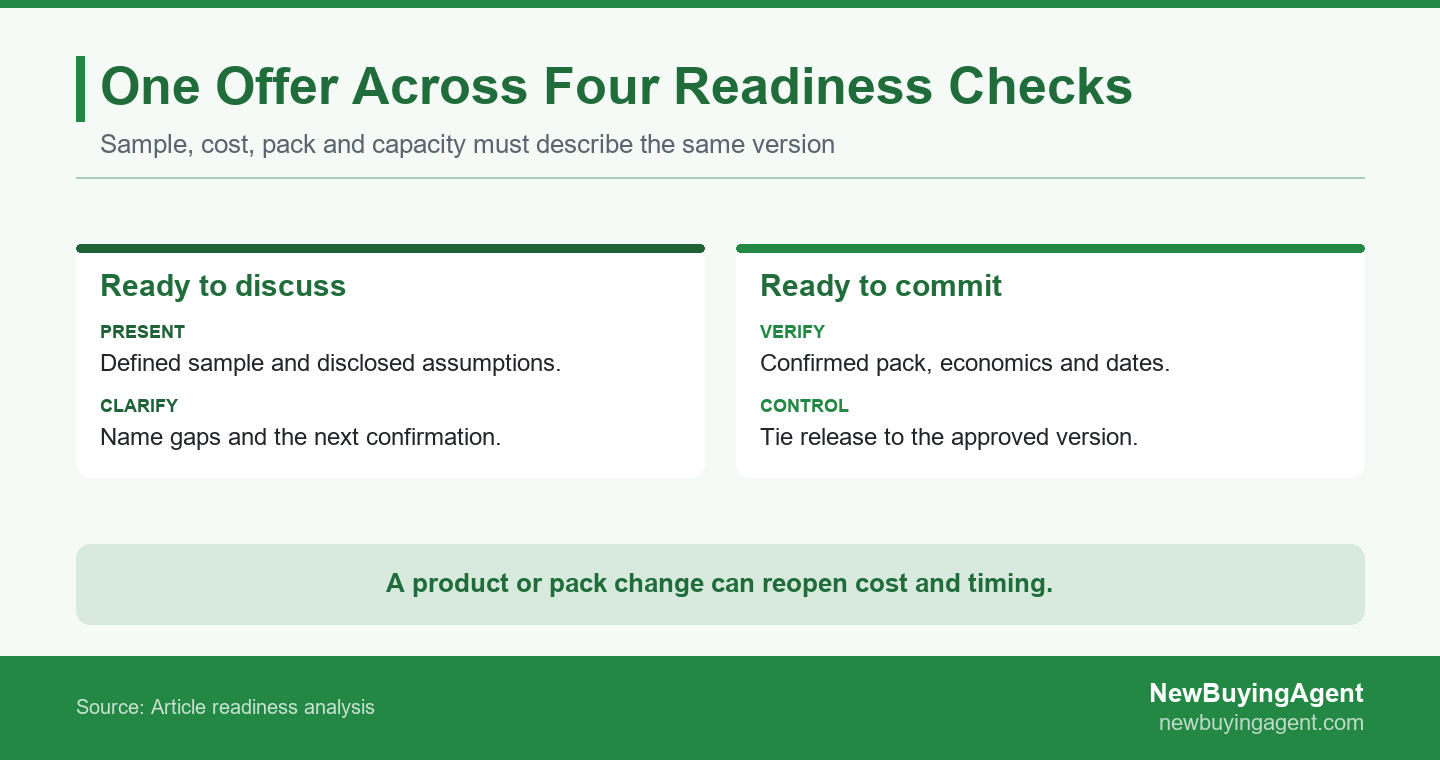
A line-review offer needs matching samples, costs, retail packaging and dated supply assumptions before commitments are made
Show a Cost Model That Survives the Retail Pack
A useful commercial model covers the product and pack being offered, with the same quantity, destination, currency and delivery basis throughout. Separate supplier economics from any retailer margin calculation. Identify freight, duties, handling, agreed allowances and one-time setup according to the actual commercial arrangement. An attractive factory unit price is an incomplete decision input if the retailer expects a different pack or delivered-price scope.
OpenStax's contribution-margin explanation starts from selling price less variable costs. The remaining contribution supports fixed costs and profit; it is not automatically net profit or the same measure as gross margin. For the supplier-side offer, define whose revenue is being counted and which costs change with each unit. That avoids presenting a factory markup as the retailer's margin or treating all sales revenue as available cash.
List retailer-specific terms as confirmed inputs or open questions. Promotions, returns, deductions, payment timing and logistics responsibilities can change the economics, but no standard percentage fits every account. Avoid adding a speculative allowance as if the retailer had agreed to it. Equally, do not omit a known cost because the final invoice has not arrived; use an explicit estimate or range and identify who will confirm it.
For a simple setup-recovery check, the SBA break-even calculator divides fixed costs by price minus variable cost. Its calculator uses a monthly fixed-cost period. For a one-time program setup, apply the formula over the defined program rather than silently treating that setup as a recurring monthly expense. A buyer must still assess demand, cash timing and costs excluded from the simplified calculation.
Attach a quote validity date and the assumptions behind it, including order mix, tooling, packaging revision and any conditions for repeat supply. If the buyer requests a lower price, show what would have to change rather than silently removing protection, material quality or a required control. A revised product option should return as a revised sample and costed specification, not remain an unrecorded concession made during the meeting.
Confirm the Selling Unit and Distribution Pack
A complete packaging specification distinguishes the consumer selling unit from the inner and master cases and confirms identifiers, dimensions, weights, protection, quantities and artwork at each applicable level. The retailer needs to understand what the customer buys and what its distribution operation receives. A visually attractive box can still be unsuitable for the chosen handling path, while a protective shipping carton can still lack the information needed for product setup.
GS1 US product-data guidance identifies specifications such as dimensions, weight and materials as important product-description data. Match those fields to the actual unit being described. Keep the product reference, identifier, image and pack quantity consistent so that the listing, purchase order and received goods do not refer to different configurations. A barcode image placed on a mockup is not evidence that the finished pack has been correctly identified.
Bring a representative pack or clearly labeled mockup, together with the expected case quantity, case dimensions and gross weight. Explain any display-ready format and how it changes shelf presentation or replenishment. Confirm the required handling and transit validation with the retailer for the actual route. Do not present a successful informal drop demonstration as proof of meeting an unspecified distribution requirement.
For a US destination, NIST's labeling and marking guidance explains that requirements depend on the product. Review required information, claims and responsible-party details for the actual category; a retail artwork approval is not a blanket compliance verdict. Resolve the relevant product and packaging requirements before freezing print files, and keep any unresolved content visible in the review pack.
Use a tableware range to make the distinction tangible. A plate sample may establish the proposed shape and finish for discussion, but the team still needs the applicable material and use evidence, protective pack and case data. A larger multipack changes both the consumer offer and the distribution unit. Recheck the quoted cost and data for that format rather than inheriting the single-item assumptions.
Turn Factory Capacity Into a Dated Supply Commitment
A capacity statement needs a dated plan for materials, available production slots, bottlenecks, quality release and arrival. Nominal output alone does not establish available supply. Ask what is already booked, which process constrains the order and what assumptions support the proposed dates. Keep the opening order separate from the repeat-order scenario so that a factory's ability to make a sample is not mistaken for a recurring supply commitment.
Request milestones for specification freeze, material availability, production start, pack availability, inspection or other release checks, dispatch and expected receipt. Use dates that fit the actual approval path. A production slot that depends on approving artwork before the retailer's review is a conflict to resolve, not a reliable slot. Identify the last practical approval date and what delay would do to the offer.
Maersk's transit-time guidance distinguishes time on water from door-to-door time, including documentation, customs and loading or unloading. Add production and the buyer's own receiving requirements when planning saleable availability. A vessel schedule is one part of the path; it does not establish when the retailer can receive, process and offer the product to customers.
Prepare a response to demand above the opening forecast: what repeat quantity could be supported, what materials would need advance commitment and when the next receipt would be useful. Distinguish a planning estimate from capacity actually reserved on agreed terms. If volume is uncertain, request conditional options and their expiration dates instead of paying for dedicated inventory simply to make the presentation look confident.
For a seasonal outdoor item, the useful receipt window can be less flexible than for a continuing storage range. The same manufacturing delay can therefore require a smaller launch, a different product or a later program. Discuss those alternatives with the category owner before promising recovery through faster shipping. Any revised delivery route needs its own cost, feasibility and product-handling check.
Decide What Is Ready to Present and What Remains Conditional
Changing one realistic review input tests whether the offer remains coherent through cost and release decisions. The following hypothetical model uses supplier-side revenue and variable costs for one sold unit, plus a one-time program setup cost. It assumes all relevant variable costs in that scope are included, while fixed overhead outside the setup remains excluded. These are illustrative inputs, not retailer terms or a forecast of sales.
In a hypothetical supplier-side model, unit wholesale revenue is USD 12, delivered variable cost is USD 8.40 and an agreed variable allowance is USD 0.60, leaving USD 3 contribution; USD 1800 setup requires 600 units to break even.
Suppose the retailer asks for an upgraded selling pack while the wholesale revenue stays unchanged. Treat that request as a new offer assumption and confirm the physical pack before using its estimated cost. The revised calculation below keeps the original revenue, existing variable cost, allowance and setup amount unchanged; only the extra variable packaging cost changes.
In the same hypothetical model, an extra USD 1.50 of variable packaging cost reduces contribution to USD 1.50 and raises break-even to 1200 units, assuming unchanged revenue, allowance and setup cost.
| Supplier-side input | Original pack | Revised pack | Interpretation |
|---|---|---|---|
| Revenue per unit | $12.00 | $12.00 | Unchanged assumption |
| Total variable cost and allowance | $9.00 | $10.50 | Includes extra pack cost |
| Contribution per unit | $3.00 | $1.50 | Before setup and other fixed costs |
| Setup recovery volume | 600 units | 1,200 units | Same $1,800 setup |
Based on this comparison, the upgraded pack halves unit contribution and doubles the volume needed to recover setup on the stated assumptions. The range can still be presented with a conditional offer, but the previous economics should not be repeated as if nothing changed. The next decision is to confirm the new pack cost and discuss price, quantity, setup treatment or another pack option.
An opening order below the revised break-even does not alone prove the whole program is unviable, but it cannot cover setup on that order alone under this model. Assess the credible repeat plan and cash exposure before relying on later orders. Keep the revised pack and economics conditional until cost and supply assumptions are confirmed; retailer interest is not evidence that those later purchases will occur.
If the buyer accepts a different price or pack, calculate that option using its own confirmed inputs. If the upgraded pack also changes case size or adds a preparation stage, review handling and capacity as well. Close the loop with an updated sample or proof, a dated quote and the revised receipt plan. Readiness improves when the documents agree, not when a spreadsheet cell turns positive.
Translate the Review Outcome Into a China Sourcing Brief
A production-purchase request needs the selected sample and pack revision, version quantities, price basis, remaining approvals, capacity reservations and receipt requirements. Give each unresolved item an owner and a closure date. This turns the review outcome into a clear buying decision and shows China-side execution which assumptions can be used for an offer, which require confirmation and which have already been rejected.
| Handoff item | What to record | Evidence of closure |
|---|---|---|
| Selected product | Reference, revision and permitted differences | Approved sample and specification |
| Commercial scope | Quantities, price basis and allowances | Accepted dated offer |
| Pack and data | Selling unit, cases, artwork and identifiers | Approved pack references |
| Supply timing | Materials, slots, release checks and receipt | Confirmed dated plan |
| Open conditions | Owner, deadline and effect if missed | Written decision or revised offer |
NewBuyingAgent is a one-stop China sourcing agent for global buyers. Its China product sourcing combines local factory resources, product development and quality-control capability with cost negotiation, production follow-up and delivery coordination. For line-review preparation, that matters because the attractive sample needs an executable supplied-product scope, including the agreed retail pack and timing, rather than a disconnected set of presentation materials.
To submit the line-review product brief, provide the specification, sample status, required selling and distribution packs, quantities, target price, destination and delivery timing. Add the retailer's confirmed requirements and the decisions still open. NewBuyingAgent can use its factory and product resources to prepare a scoped supply proposal, while the buyer retains the retailer relationship and the final commercial approval.
Frequently Asked Questions
Can a development sample be used in a line review?
A development sample can support a line review if its status and differences from planned production are disclosed and accepted for that discussion. Identify the material, finish or construction features that remain provisional and explain what the next sample will resolve. Do not let a concept piece become the production reference through silence. Before a purchase release, confirm which sample and specification govern the actual goods.
Should the buyer show retailer margin or supplier contribution?
Show retailer margin and supplier contribution separately when both are requested, with each price, cost scope and denominator clearly defined. Retailer gross margin usually starts from retail revenue and merchandise cost, while supplier contribution deducts the relevant variable costs from the supplier's revenue. Confirm the account's required calculation and treatment of taxes, allowances and other costs. Avoid using either figure as a substitute for the other.
Does an audit prove capacity is available for the launch?
A factory audit does not by itself reserve production capacity for a launch; obtain a current dated plan and confirm the relevant commitments. An audit can inform the assessment of capability, but existing bookings, materials and bottlenecks still affect availability. Ask which dates depend on buyer approvals and when any reserved option expires. Keep a contingency for a missed decision rather than assuming audited capacity is permanently open.
What if the retailer changes the pack after the review?
A retailer pack change should trigger review of sample representation, cost, identifiers, handling and timing before the purchase commitment is finalized. Establish whether the change affects the selling unit, shipping case or both. Obtain the revised pack proof and commercial assumptions, then update the connected product records. A small artwork correction may need a narrow review; a different pack format can require a broader supply decision.
NewBuyingAgent
Related Resources


Get Started Today
Let's Turn Your Sourcing Goals into RealityWeChat:+86 15157124615
WhatsApp:+86 15157124615
Address:Building 10 #39 Xiangyuan Road, Hangzhou, China
