


Market-specific pack sizes should follow the customer offer and channel economics, then become precise factory instructions. More pieces in a pack can increase revenue per sale while reducing the return on each piece of inventory. Before ordering a dedicated format, separate the consumer pack from the shipping case, compare costs on a common basis and identify what actually limits the opportunity: demand, product stock, handling capacity, cash or delivery readiness.
Approve a Pack Size Against the Constraint on the Order
A market-specific pack is worth sourcing when its customer offer, channel contribution, stock commitment and physical delivery requirements fit the actual order. A larger pack is not automatically more profitable. Choose the format against the constraint on the order, then confirm the finished pack, commercial assumptions and production requirements together.
- Definition: Consumer pack size describes what the shopper buys; case quantity describes how those saleable packs ship.
- Risk: A higher pack price can hide lower contribution per product piece and a larger stock commitment.
- Decision: Test the proposed count with actual channel inputs before locking artwork, packing materials and order quantities.
Define the Customer Offer Before Choosing the Count
The customer offer provides the basis for requesting a new pack count from the factory. Identify the destination, channel, customer task, acceptable cash outlay and expected replenishment pattern. A trial-sized offer, a household replenishment pack and a wholesale resale format can justify different quantities, but those are hypotheses to test. A country name alone is not evidence that shoppers prefer a particular pack size.
Separate pieces per consumer pack, consumer packs per master case and cases per shipment. Each level changes a different part of the sourcing brief. Increasing the consumer count changes what is sold; increasing the number of unchanged packs inside a shipping case changes the distribution unit. Choose the comparison basis before comparing prices, because a price per case can conceal a different number of saleable packs.
NIST's Unit Pricing Guide recommends consistent units of measure within a product category so different package sizes can be compared meaningfully. This is best-practice guidance with a US retail context, not a worldwide rule that every product uses the same price display. The useful purchasing principle is to keep both the pack price and an appropriate common-unit comparison visible, while checking the actual market's requirements.
The comparison below holds product quality constant and contrasts four buying situations by the limiting resource, the basis for comparing packs and the evidence needed. Each situation can favor a different count; the table does not assert a national preference or guaranteed demand. Revenue and costs must belong to the same business, channel and selling period, with format-specific setup considered separately.
| Buying situation | Comparison basis | Conditional choice | Evidence needed |
|---|---|---|---|
| Product stock limited | Contribution per piece | Smaller pack may use stock better | Attainable sales in same period |
| Order handling limited | Contribution per sale | Larger pack may earn more per order | Enough goods and actual handling cost |
| Cash or material limited | Cash committed by format | Lower count or later packing may help | Pack MOQ, setup and payment dates |
| Demand uncertain | Full contribution from test | Limit dedicated format commitment | Comparable buyers, returns and displacement |
Based on this comparison, the preferred count depends on the selling task and available resources. None of these situations establishes a quality grade or a national preference. Preserve the same product specification when testing count alone; otherwise a material, size or assortment change can explain the result instead of the pack quantity.
For an importer building a market-specific range, NewBuyingAgent's AI-assisted product analysis, free Bestseller Market Analysis Report and design or style optimization can inform product and offer selection. Use that input to refine which formats deserve a commercial test. It does not replace evidence about the particular pack's demand, net selling price or fulfillment cost.
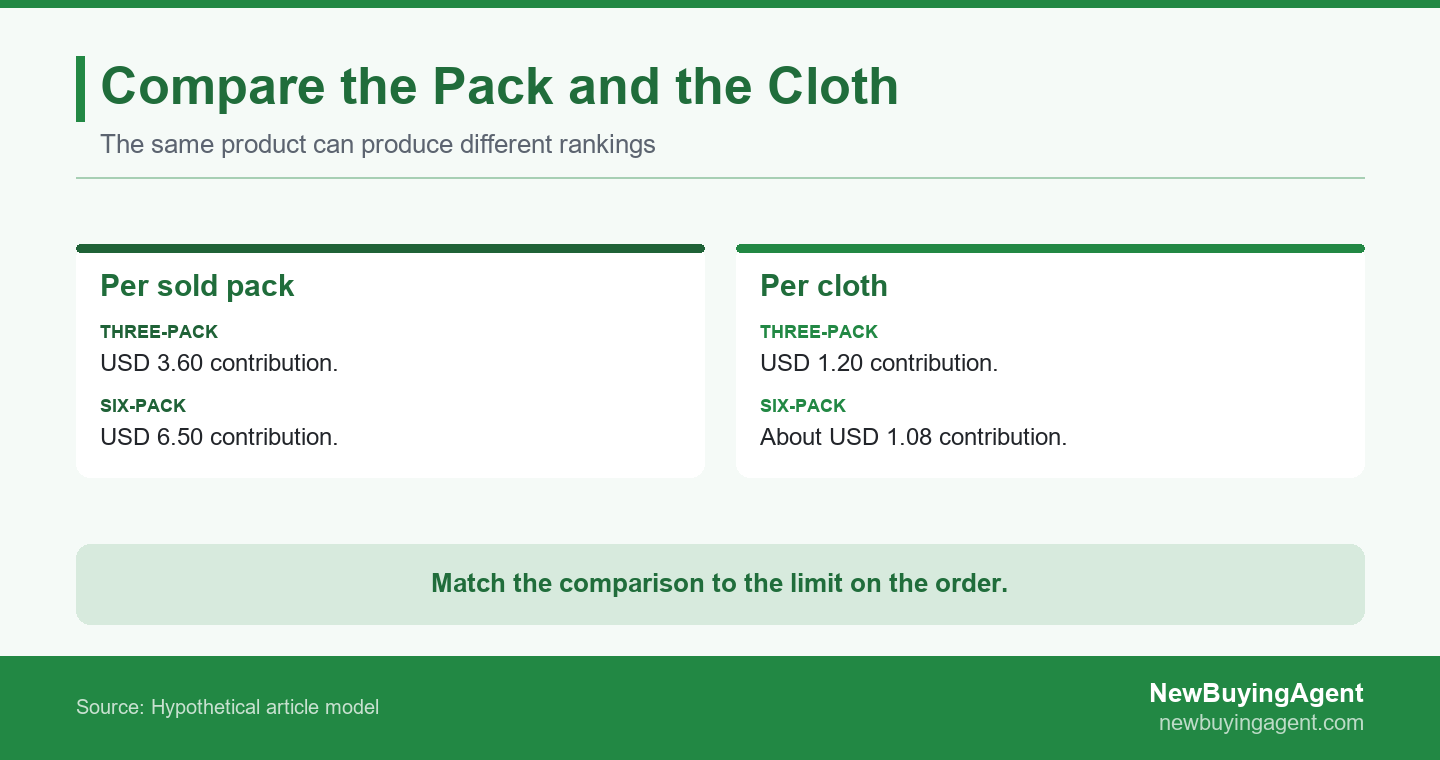
Larger packs can add more contribution per sale while returning less per cloth, so compare the constraint that limits the order
Compare Contribution per Pack and per Product Piece
Contribution per sold pack and per product piece reveal different aspects of how a format uses the order. OpenStax's contribution-margin explanation starts with sales revenue less variable costs. The balance contributes toward fixed costs and profit; it is not net profit. Count the purchasing business's own revenue and costs consistently, and keep retailer resale margins separate when the business sells wholesale.
Use a hypothetical cotton kitchen-cloth model with unchanged cloth quality. All figures below are USD per sold consumer pack. Net revenue is after assumed discounts and expected refunds. Other variable costs cover assumed selling expenses and return handling, without subtracting those refunds again. The model excludes fixed setup and overhead, and every input needs an actual quote or commercial estimate before a real commitment.
| Per sold pack | Three cloths | Six cloths |
|---|---|---|
| Net revenue | $12.00 | $20.00 |
| Cloths | $3.00 | $6.00 |
| Consumer pack | $0.60 | $0.90 |
| Allocated inbound | $0.90 | $1.50 |
| Fulfillment and delivery | $3.00 | $3.60 |
| Other variable cost | $0.90 | $1.50 |
| Total variable cost | $8.40 | $13.50 |
| Contribution | $3.60 | $6.50 |
In a hypothetical kitchen-cloth model, a three-pack has net revenue USD 12, variable cost USD 8.40 and contribution USD 3.60; a six-pack has net revenue USD 20, variable cost USD 13.50 and contribution USD 6.50. The larger pack earns more contribution per completed sale, but it also consumes more cloths. These are illustrative economics, not typical market prices or a client result.
Contribution per cloth is USD 1.20 for the three-pack and about USD 1.08 for the six-pack. If all 12000 available cloths sell in the same period, 4000 three-packs produce USD 14400 contribution, while 2000 six-packs produce USD 13000, before fixed costs. The full-sell-through condition is an assumption for comparing the use of the same goods; stock availability does not establish that demand.
Where cloth supply is the binding limit and the assumed sales are attainable, the smaller format uses that stock more profitably in this model. Where the team can process only a limited number of orders and enough goods are available, the higher contribution per sale may favor the larger format instead. Compare the resource that actually constrains the opportunity, with the same selling period and relevant fixed costs included.
Keep cash exposure visible alongside contribution. A dedicated printed pack can require a material purchase before the goods sell, while a larger consumer count ties more cloths to each finished unit. Record packaging setup, unused materials and payment timing separately. A format can appear attractive per sale yet absorb cash that the buyer needs for a better-selling part of the range.
Measure the Pack Before Assuming Freight Savings
Measurements of the finished consumer pack and shipping case are needed to establish whether more pieces reduce freight per piece. A larger pack can spread handling across more goods, but it can also require a different outer, consume more space or cross a service threshold. Request a quote for the actual route and shipment profile, with the relevant dimensions, gross weight and handling requirements.
FedEx's dimensional-weight guidance explains that a package is charged by dimensional or actual weight, whichever is greater. Dimensional weight reflects the space a parcel occupies. The applicable service, contract and rating rules still need confirmation; this is not a universal divisor or rate quotation for every carrier. Reducing unused space may help, but a package must still protect the goods and meet the chosen service conditions.
Use consistent measurement definitions at every packaging level. The GS1 Package and Product Measurement Standard covers nominal measurement attributes from consumer units through intermediary levels and pallets. It helps trading partners communicate dimensions consistently. Identify whether a measurement describes one finished consumer pack or the full shipping case; substituting the unwrapped product's dimensions can produce a misleading space and freight calculation.
Ask for a physical pack-out sample with the intended fold, band or bag, protective materials and closure. Record what was measured and which revision it represents. A compact hand-packed prototype is not proof that routine production will achieve the same dimensions. Confirm the packing method and any acceptable variation, then use the agreed finished configuration for the commercial quote.
Check the receiving side too. A wholesale customer may require fixed case contents or a particular presentation even when another arrangement looks cheaper. Establish whether the final consumer pack is assembled in China or at destination. Moving packing downstream can preserve flexibility, but its labor, materials, space and control costs belong in the same comparison.
Test Demand and Cost Conditions That Could Change the Choice
The first spreadsheet result remains provisional until the inputs most capable of changing the pack choice have been tested. Confirm net revenue, pack cost, route cost, expected sales and any format-specific setup. Use ranges where those inputs remain uncertain, and identify the estimate that would have to improve for the alternative to become worthwhile.
In the same hypothetical model, reducing six-pack fulfillment and delivery cost from USD 3.60 to USD 2.90 raises contribution from USD 6.50 to USD 7.20, with every other input unchanged. That matches the three-pack contribution of USD 1.20 per cloth. This is a sensitivity threshold for the stated assumptions, not evidence that a carrier or fulfillment provider will offer the saving.
Confirm whether such a saving is feasible before redesigning the pack around it. A revised fold may change packed dimensions, but a different shipping outer or packing step could absorb the benefit. Obtain the revised sample and quote, then recalculate the complete affected cost lines. If the saving cannot be supported, keep the original comparison instead of carrying an aspirational rate into the factory order.
Compare demand over the same selling period using actual sell-through, returns and full contribution. Equal stock availability is not proof of equal sales demand. When testing alternative offers, use comparable customers and selling conditions, record all sales affected by the offer and include any displacement of an existing pack. A higher conversion rate alone cannot establish the better outcome if the pack earns less after its relevant costs.
A limited test should answer a defined release question. Specify which formats are offered, how their actual costs will be captured, how long observations are commercially useful and what stock or spending limit applies. Where commercial conditions differ too much for a clean experiment, report those differences and use a conditional decision. Do not invent a universal sales threshold or present a short test as a guaranteed replenishment forecast.
If the evidence remains weak, reduce the irreversible commitment where practical: fewer printed variants, a smaller confirmed allocation or later final packing. Ask the actual source about the MOQ, price and lead-time consequences. These options preserve flexibility only when the supplier can support them; they do not imply that smaller quantities always retain the same unit cost.
Translate the Winning Pack Into a Controlled Factory Brief
A physical, versioned factory brief connects the selected economics to the goods being ordered. Identify the product piece, consumer count, assortment, case arrangement and finished-pack requirements together. A request for a cheaper large pack is incomplete if the factory cannot tell whether it may change the goods, presentation, material, quantity or packing location.
Identifiers must follow the trade item that changes. The GS1 GTIN Management Standard requires new identification when legally required declared net content changes, and separately addresses pack or case quantities at higher packaging levels. A consumer count change and a case-count change therefore need different identification checks. Confirm the applicable rule and assignment responsibility before artwork and item records are released.
Recheck the label against the actual product and destination. NIST's US labeling FAQ explains that applicable markings depend on the product, including relevant identity, responsibility and quantity declarations. This US example is not a worldwide label specification. Keep the declared contents, product record, artwork and actual pack aligned, and separately confirm any category or destination requirements.
| Factory-brief field | Fill before release | Confirmation |
|---|---|---|
| Product piece | Material, size, finish, criteria | Approved reference |
| Consumer pack | Count, mix, fold, pack material | Approved pack-out |
| Shipping case | Packs per case, size, weight | Measured case record |
| Identity and art | Identifiers, count, language, revision | Approved records |
| Order scope | Packs and pieces by format; price basis | Accepted quote |
| Timing and changes | Receipt date, approvals, revision owner | Dated release plan |
Write order quantities in both consumer packs and total product pieces, and state case rounding explicitly. Where a market has a mixed-color assortment, specify quantities of each color inside the consumer pack and each case. This prevents an apparently equivalent total quantity from becoming an unusable mix. Agree who approves changes to counts, packing materials and artwork before production substitutes a different configuration.
NewBuyingAgent's China product sourcing combines local factory resources with product development and quality-control capability. For an importer choosing market-specific counts, those strengths help connect the agreed pack to consistent supplied goods. As a one-stop China sourcing agent for global buyers, NewBuyingAgent brings product selection, cost negotiation, production follow-up, quality control and logistics coordination into the product-supply scope.
To discuss a defined supply offer, submit the pack-specific purchasing requirements with the product specification, proposed consumer counts, assortment, quantity, target price, destination and timing. Include the assumptions that still need a quote. Keep the first commitment tied to the supported format and order scope; revisit the economics when a later pack or delivery change alters those assumptions.
Frequently Asked Questions
Does each country need a different pack size?
A different country does not automatically need a different pack size. Change the offer when customer, channel or destination evidence supports it, such as a confirmed retail requirement or a tested difference in purchasing behavior. Keep unverified preferences as hypotheses. A shared format may remain suitable across markets even when language, labels or commercial terms differ, provided the applicable requirements and economics are confirmed.
Is changing the master-case count the same as changing pack size?
Changing master-case count is different from changing the consumer pack: one changes how saleable units ship, while the other changes what the customer buys. Record both quantities and their respective identifiers where applicable. An unchanged consumer offer can travel in a revised case, but the new case still needs accurate dimensions, weight and handling evidence. Do not change the declared consumer count merely to describe a shipping arrangement.
Does a new pack count require a new factory?
A new pack count does not automatically require a new factory. Confirm whether the current source can meet the required configuration, economics and quality evidence, including any packing equipment, materials and approval needs. A different pack-out may be feasible without changing the product process. If capability or commercial conditions are unsuitable, assess alternatives against the same controlled brief rather than comparing unrelated quotes.
Can a smaller pack be the better sourcing choice?
A smaller pack can be the better choice when its demand, contribution per scarce resource and stock flexibility outweigh the larger pack's handling savings. Check the actual customer cash outlay and complete route costs as well. More individual packs can increase packing and order-processing work. The useful choice depends on the order's real constraint and confirmed inputs, not a general rule that smaller or larger is better.
NewBuyingAgent
Related Resources



Get Started Today
Let's Turn Your Sourcing Goals into RealityWeChat:+86 15157124615
WhatsApp:+86 15157124615
Address:Building 10 #39 Xiangyuan Road, Hangzhou, China
