

DTC vs wholesale product specs differ mainly in how the same product is sold, packed, identified and delivered. DTC means direct-to-consumer sales; wholesale means supplying a business buyer for resale. Before sourcing, preserve the product requirements that serve the same intended use, then define the channel configurations separately. A channel label does not tell a factory the selling unit, protective packaging, case quantity or evidence needed to release an order.
Keep the Product Promise; Specify the Channel Differences
DTC and wholesale sourcing can share one product core while requiring different selling units, protective packs, identifiers, order quantities and release evidence. The actual customer, destination and fulfillment route determine those differences. Start with what the customer receives and trace backward to the factory pack-out, rather than copying an existing quote and changing only the selling price.
- Best for: Category directors, brand teams and importers extending a product into another sales channel.
- Risk: A good product sample can conceal an unsuitable delivery pack or incomplete account data.
- Decision: Share the unchanged product core, cost each configuration and approve the evidence needed for its actual route.
Separate the Shared Product Core From the Channel Version
The common product specification provides a baseline for the channel requirements that genuinely differ. Record intended use, target user, materials, dimensions, functional performance, finish and acceptance criteria. Give the baseline a revision and a reference sample. This lets the team distinguish a packing change from a product redesign when a wholesale customer requests a different presentation or price.
Keep intended use, materials, performance and acceptance criteria common where they describe the same product. A lower wholesale price does not authorize a silent downgrade in fabric weight, coating, component grade or workmanship. If the commercial offer needs a different material, create and approve that version explicitly. Otherwise the factory can meet the price while delivering something that no longer matches the listing, sample or customer expectation.
The US CPSC testing and certification guidance requires manufacturers and importers to address applicable requirements for covered consumer products; relevant certificates must accompany the product or shipment and be provided to retailers and distributors. The precise duties depend on the product and responsible role. Selling directly to consumers does not create a general exemption, while a wholesale purchase order does not transfer every obligation away from the importer.
The table compares four channel-and-route situations, using the selling unit, pack approval and release evidence as the same three dimensions. DTC parcel and wholesale drop-ship can share a route; bulky DTC freight and wholesale cases need their own handling assumptions. These are conditional sourcing situations, not four versions every product must offer. The product core stays unchanged only where intended use, user and performance requirements match.
| Channel and route | Selling unit | Pack to approve | Release evidence |
|---|---|---|---|
| DTC parcel | Consumer item or set | Individual shipping pack | Parcel pack-out and item data |
| DTC bulky freight | Large consumer item | Freight protection | Actual freight-route evidence |
| Wholesale cases | Retail unit within case | Account case configuration | Case data and receiving rules |
| Wholesale drop-ship | Consumer item or set | Individual shipping pack | Parcel pack-out and account rules |
Based on this comparison, the first sourcing decision is whether there is one product with two pack-outs or two materially different products. Keep shared requirements in one controlled baseline and put the differences in named configuration sheets. Avoid separate specifications that drift apart without anyone noticing which changes were intentional.
Product selection should also fit the customer and price point of the proposed channel. NewBuyingAgent offers AI-assisted analysis, a free Bestseller Market Analysis Report and design or style optimization. For a brand considering wholesale expansion, that input can help refine the assortment before committing to channel-specific packaging. Combine it with actual account demand and customer evidence; a product report is not a guaranteed sell-through forecast.
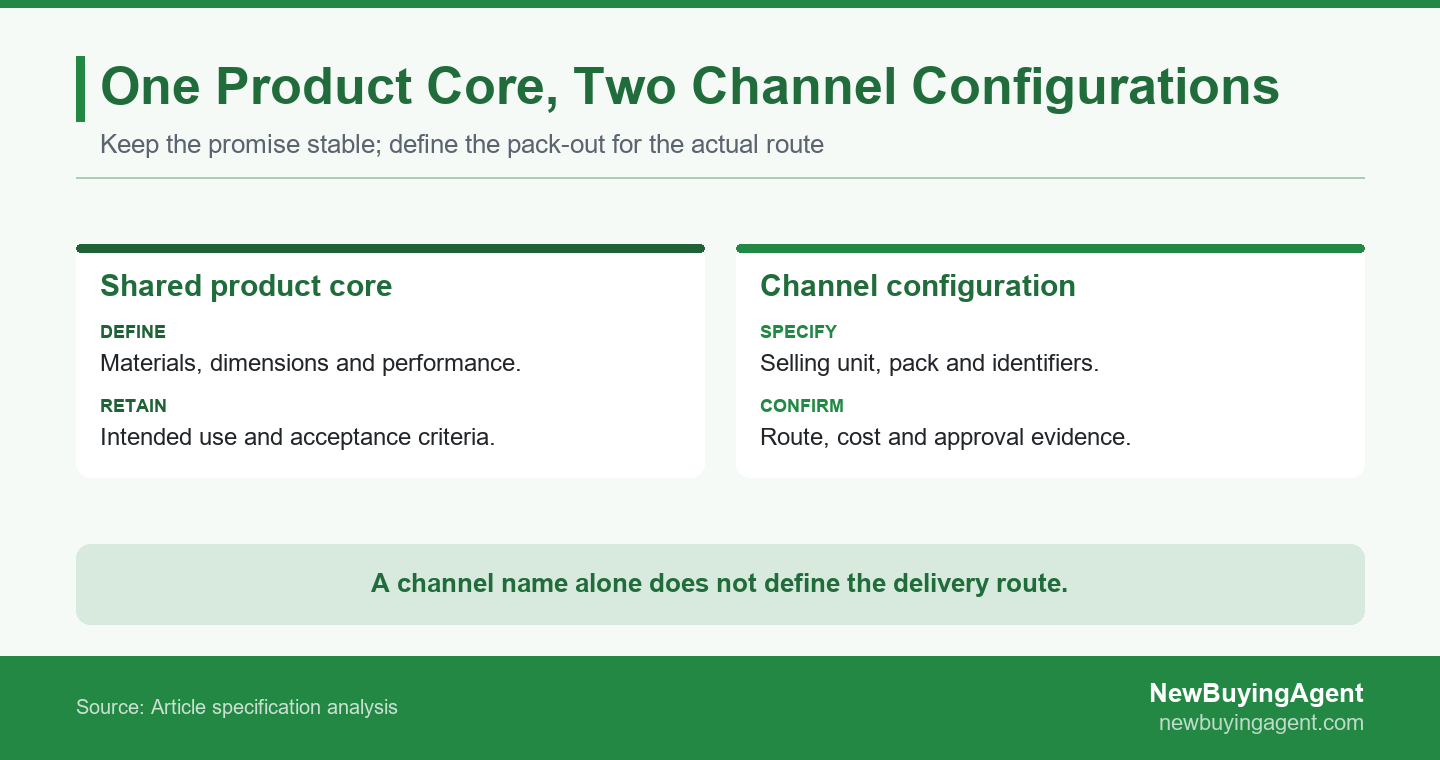
DTC and wholesale can share a product core while using different selling units, packs and delivery requirements
Specify the Selling Unit and the Actual Delivery Route
The actual delivery route determines the required selling unit and shipping configuration. A consumer may buy one item even when the retailer orders cases of six. Distinguish the retail pack, inner pack if used, master case and any consumer shipping outer. State quantities, dimensions, gross weights, protective materials, closure method and orientation requirements at the relevant levels.
For a direct order, establish whether the fulfillment team ships the factory pack unchanged or adds an outer, void fill and a shipping label. Record who performs those operations and which packaging the customer actually receives. For a wholesale account, obtain its current pack, receiving and routing requirements. Case quantities, assortment rules and labels should come from that account, not from a generic wholesale template.
ISTA's design and test-selection guidance distinguishes distribution environments and package types, including North American parcel delivery and less-than-truckload freight. That supports choosing protection evidence for the packaged product and its route. It does not mean every DTC item must use one particular procedure or every wholesale order another; confirm the appropriate protocol and acceptance criteria with the customer and qualified testing provider.
DTC does not always mean parcel, and wholesale does not always mean pallet freight. A wholesale drop-ship program can send individual items to consumers through the same parcel network as a direct order. Conversely, a large DTC furniture item may travel by freight. In either case, use the real handling sequence to decide what changes; the sales contract alone cannot establish the package hazards.
Check whether a presentation change also changes manufacturing or packing operations. A retail band can need artwork approval and an application step; a display carton can change case dimensions and storage space. Keep separately priced tooling, printing and packing preparation visible in the quote. A shared product does not guarantee shared packaging lead time, especially when the channel version depends on dedicated printed materials.
Keep Product Data, Identifiers and Compliance Aligned
An accurate product record describes the exact unit being offered and distinguishes consumer, case and shipping information. A product identifier connects records to a trade item; it does not replace the specification. Assign ownership for data entry and verification so a factory measurement, ecommerce listing and wholesale item form do not describe three different versions.
GS1 US product-data guidance identifies dimensions, weight and materials as useful product information and recommends the same GTIN online and in physical stores for the same product. A GTIN is a Global Trade Item Number. The channel name alone therefore does not justify changing it. First determine whether the trade item itself, its declared contents or another attribute covered by the identification rules has changed.
Under section 2.8 of the GS1 GTIN Management Standard, a change in pack or case quantity calls for new identification at the affected higher packaging levels. The unchanged consumer item does not need a new GTIN solely because its case quantity changes. Other product, brand, assortment or packaging changes may trigger other rules, so evaluate the full change rather than treating the case rule as a blanket permission.
Keep regulatory labels separate from optional presentation copy and account labels. NIST's US packaging and labeling FAQ explains that applicable label and marking requirements depend on the product, including relevant identity, responsibility and quantity declarations. That is US guidance, not a worldwide label template. For each destination, identify the applicable rules and responsible party before artwork approval; a successful barcode scan is not evidence that the regulatory label is complete.
Create a compact data list for each configuration: consumer item reference, identifiers where required, retail unit dimensions and weight, case contents, case dimensions and gross weight, artwork revision and language. Link photographs and measurements to the approved sample. If a channel receives only case data, still retain the consumer-unit record needed to reconcile the goods after the case is opened.
Cost the Version You Will Actually Sell
A valid cost comparison evaluates each channel configuration per sold consumer unit. DTC may receive a higher selling price while carrying individual packing, fulfillment, customer acquisition and return-handling costs. Wholesale can involve lower net revenue, account-specific packaging and commercial deductions. Use the actual agreement and a consistent cost boundary; neither channel has an automatic margin advantage.
OpenStax's contribution-margin explanation defines unit contribution as sales revenue less variable costs. That amount helps cover fixed costs and profit; it is not net profit. For this comparison, count the brand owner's revenue and costs, not the retailer's resale margin. Separate costs that vary with sold units from fixed setup and overhead so a lower factory price does not conceal a more expensive route to the customer.
Consider this hypothetical same-product model in USD per sold consumer unit. Assume net revenue already reflects discounts and expected refunds. The common goods and inbound cost is USD 8 in both channels. Other variable costs include assumed payment or sales expenses and expected return handling, without subtracting those refunds twice. These are disclosed planning inputs, not typical industry fees or margins.
| Per sold unit | DTC | Wholesale |
|---|---|---|
| Net revenue | $30.00 | $18.00 |
| Goods and inbound | $8.00 | $8.00 |
| Channel pack | $2.00 | $1.00 |
| Fulfillment and delivery | $9.00 | $1.00 |
| Other variable costs | $6.00 | $2.00 |
| Total variable cost | $25.00 | $12.00 |
| Contribution | $5.00 | $6.00 |
In this hypothetical same-product model, DTC net unit revenue of USD 30 minus USD 25 variable cost leaves USD 5 contribution; wholesale net unit revenue of USD 18 minus USD 12 variable cost leaves USD 6. A higher DTC price has not produced higher unit contribution in these assumptions. Neither result selects the better whole business: sales volume, channel-specific setup, payment timing, inventory commitment and fixed capacity costs still matter. Compare the expected orders over the same planning period before allocating the production budget.
If the DTC fulfillment and parcel cost falls from USD 9 to USD 7, total variable cost falls to USD 23 and contribution rises to USD 7, with every other input unchanged. The unit-contribution ranking reverses. Obtain the actual pack and fulfillment quote before choosing the channel configuration; an unknown cost should stay an estimate or range, not become zero to complete the spreadsheet.
Run One Product Through Both Specifications
Checking both proposed specifications against one physical product exposes gaps before either version is released. Consider a hypothetical adult cotton throw, 130 by 170 cm, with the same approved material, color, finish, workmanship and intended use. Plan 300 consumer units for direct sales and 300 for a wholesale customer. The common product and consumer label remain unchanged; the channel difference is how those units are presented and dispatched.
For the direct version, use the same approved retail band inside an individual protective mailing pack. For wholesale, place six identically banded throws in each master case, giving 50 cases for its 300 units. The band is not itself proof of transport protection. Specify the mailing pack and the six-unit case separately, then obtain evidence for the actual routes and the wholesale customer's receiving conditions.
| Decision input | Direct version | Wholesale version |
|---|---|---|
| Product core | Approved throw | Same approved throw |
| Consumer unit | One banded throw | One banded throw |
| Order pack | Individual mailing pack | Six units per case |
| Release evidence | Approved parcel pack-out | Approved case and route |
Suppose the original sample approval covers appearance and dimensions, while neither proposed transport pack has been confirmed. The team can retain that product approval, but it cannot honestly mark either shipping configuration ready on that basis. Request the missing pack proofs, confirm the suitable protection assessment and record the outcome against each configuration. Add the resulting packing costs to the relevant commercial model.
An unchanged product does not make an unverified shipping configuration ready. If the direct pack later has acceptable evidence while the wholesale case remains unresolved, hold the wholesale configuration and assess the direct allocation on its own confirmed conditions. Do not automatically reject the whole product or silently release both. If the wholesale customer switches to individual drop shipping, reopen its pack requirements because the assumed case route no longer describes the delivery.
This trial also exposes production dependencies. Confirm whether both versions can use the same goods batch, where final packing occurs and how the order split will be controlled. A revised allocation may be easy before dedicated packs are applied and expensive afterward. Agree the last date for changing the split, with the factory's actual material and packing commitments visible.
Turn Channel Choices Into a Production-Ready Sourcing Brief
A controlled common specification with clearly named channel configurations gives both price requests the same product baseline. Identify the approved reference and attach the relevant pack-out, artwork, quantity and data records. The handoff should let the sourcing team quote the goods that will actually be sold and identify which confirmation is still needed before commitment.
- Product: Intended use, material, dimensions, performance, finish, acceptance criteria and reference revision.
- Channel: Selling unit, account requirements, actual delivery route and where final packing occurs.
- Commercial scope: Quantity by configuration, price target, currency, delivery basis and separately identified setup.
- Release: Destination, required receipt date, pack and artwork approvals, data owner and unresolved conditions.
NewBuyingAgent's China product sourcing combines local factory resources with product development and quality-control capability. For a brand moving one range into two channels, that capability is relevant to keeping the product consistent while sourcing the agreed packs. As a one-stop China sourcing agent for global buyers, NewBuyingAgent connects product selection, cost negotiation, production follow-up, quality control and logistics coordination within the supplied-product scope.
When the common product and channel differences are clear, submit the channel-specific purchasing requirements with the planned order split, target price, destination and timing. Use the configuration records to discuss a defined product-supply offer. After agreement, make a material, pack quantity, route or artwork change a visible revision requiring the affected cost and approval checks, rather than an informal instruction that leaves the old quote in circulation.
Frequently Asked Questions
Does a DTC product need a different barcode for wholesale?
A channel change alone does not require a new GTIN for the same product; check the actual trade item and packaging hierarchy. The consumer item can keep its identity while a changed case quantity needs new identification at higher levels. If the product, declared content, brand or assortment also changes, assess the relevant rules. Keep internal channel references separate from the decision about the product's GTIN.
Can the wholesale version use lower quality to meet its price?
A lower wholesale price does not by itself justify lower quality; any changed material or performance must be specified and approved as a different offer. First examine packing, order economics and commercial scope. If a different product is necessary, update its specification, sample, claims and applicable evidence. Do not allow a cost target to become an undocumented instruction to reduce the agreed quality.
Can both channels share finished inventory?
Both channels can share finished inventory when the product core, identity and compliance scope match and each required pack-out can be completed before dispatch. Confirm where stock is held, who applies the final pack and how allocation is recorded. Dedicated printed packs or account-specific presentation can reduce that flexibility. Reserve the needed goods and packing materials separately so one channel does not consume the other's committed supply.
Does a small DTC trial remove the need for product checks?
A small DTC trial does not remove applicable product requirements. Reduce the commercial exposure through quantity, limited variants or reversible packing choices while retaining the checks needed for the actual product and destination. A trial can reveal customer response, fulfillment cost and packing problems, but it cannot substitute for mandatory conformity evidence. Decide which observations would justify a repeat order before committing to dedicated packaging.
NewBuyingAgent
Related Resources



Get Started Today
Let's Turn Your Sourcing Goals into RealityWeChat:+86 15157124615
WhatsApp:+86 15157124615
Address:Building 10 #39 Xiangyuan Road, Hangzhou, China