

Align marketplace listing claims with factory evidence by reviewing what the customer will understand, then checking whether current records support that meaning for the exact product and conditions. Approve the supported wording, narrow a promise that exceeds its evidence, and hold claims that remain unproven. A folder of certificates cannot replace this product-by-product decision for a merchandising or category team sourcing from China.
Approve the Claim That the Evidence Actually Supports
Listing wording is ready for approval only when current evidence supports the actual product, claim meaning, conditions and destination. Revise or hold unsupported promises before publication, and keep the approved wording tied to the supplied specification. Marketing, product and compliance reviewers need a shared record of what can be said, why it is supported and which changes would require another review.
- Best for: Buyers approving new product listings, revised claims or repeat-order substitutions.
- Risk: Genuine evidence can concern the wrong sample, property, use or market.
- Decision: Match each objective promise to suitable evidence and publish only the approved product version and message.
Write Down What the Listing Promises the Customer
The complete customer promise determines which supporting records are needed. Substantiation means evidence supporting what a claim communicates, including reasonable implications from the listing's words and images. Review the title, bullets, comparison graphics, packaging and instructions together. A product described cautiously in one paragraph can still promise a stronger result through its headline, demonstration video or photograph of an unintended use.
For US advertising, FTC advertising guidance requires a reasonable basis for objective claims before an ad runs and considers both express and implied messages. The necessary support depends on the claim and product. For buyers, the practical starting point is to write down the promised property or outcome before deciding whether a factory declaration, measurement or outside test could establish it.
Distinguish a visible feature from a performance outcome. A photograph may show a zipper, but it does not establish that a bag keeps contents dry in rain. A specification may name a material without proving that the finished assembly is safe for a particular use. Terms such as waterproof, non-toxic, certified and tested can therefore add evidence questions that a simple product description does not answer.
Google Merchant Center's misrepresentation policy prohibits inaccurate claims and statements presenting an improbable result as the likely customer outcome. This is an example of a channel rule, not a single policy governing every marketplace. Check the actual destination and selling platform alongside legal requirements; acceptance of a listing by an automated system does not establish that its promises are substantiated.
NewBuyingAgent's market-fit product analysis can help identify an assortment opportunity, with a free Bestseller Market Analysis Report and design or style optimization. Keep that commercial input separate from technical proof. Interest in a product feature can justify investigating it, but neither a trend report nor attractive competitor copy proves that the product being ordered delivers the feature.
Review the title, bullets, images, packaging and instructions together for the promises a reasonable customer would understand, including implied uses and results. Give each objective claim its own line in the approval record. Write any intended conditions beside it, then check whether the overall presentation communicates those limits clearly rather than relying on a distant footnote.
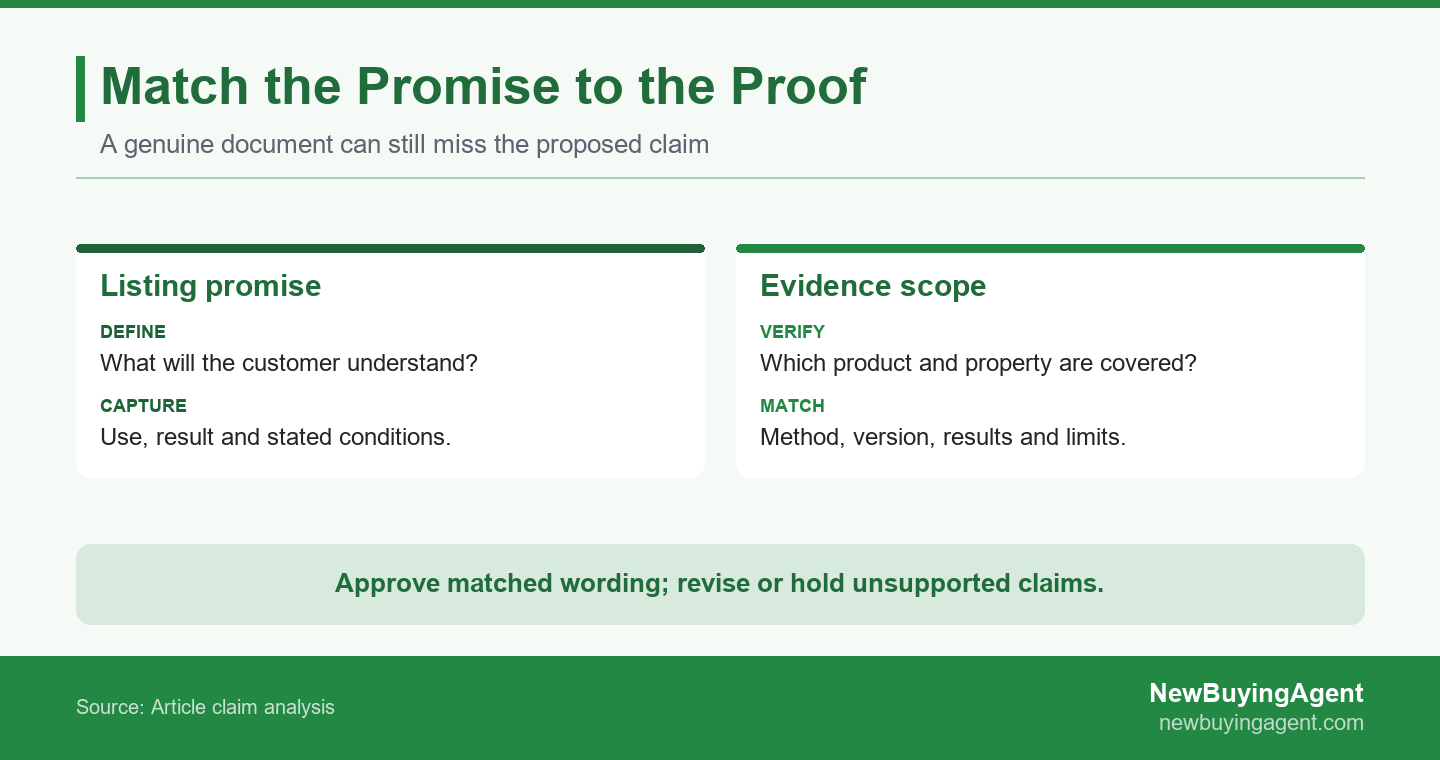
Listing wording needs evidence that matches the current product and claim conditions before publication
Separate Evidence Types Before Approving the Copy
A factory assertion, material document, test report and conformity record answer different questions and cannot automatically substitute for each other. Compare them against the same proposed claim and current product, rather than ranking documents by how official they look. The useful question is what each record establishes, what falls outside its scope and how the buyer can use it in a release decision.
| Evidence type | Can support | Does not establish | Approval use |
|---|---|---|---|
| Factory assertion | A stated specification or production fact | Independent proof of every promise | Verify records and current version |
| Material record | Covered material property or composition | Finished assembly performance | Check component and batch scope |
| Test report | Recorded sample results under stated conditions | Every use, variant or production lot | Match method, sample and wording |
| Conformity record | Specified applicable product requirements | All marketing performance claims | Confirm legal and product scope |
Based on this comparison, choose the evidence by the question the claim raises. Use controlled factory records where they adequately establish a straightforward fact, and obtain suitable testing or other support where the property demands it. A valid conformity record remains useful for its own purpose; it should not be stretched into an endorsement of every adjective on the product page.
For example, CPSC guidance on the General Certificate of Conformity concerns certain general-use products subject to applicable CPSC-enforced requirements and certification based on testing or a reasonable testing program. Children's products have different requirements. This product-safety scope is distinct from proving an advertised capacity, service life or environmental benefit. Determine the actual category and obligations before relying on the record.
The distinction also applies to the EU. Official CE-marking guidance limits the mark to products covered by rules requiring it. It is not a general performance award for every export product. Review the applicable conformity documentation where relevant, while separately assessing any claims about durability, water resistance or other benefits that the listing communicates.
Keep mandatory compliance and voluntary marketing claims as separate review questions. Removing an unsupported promotional promise does not remove the product's applicable safety, labeling or market-entry obligations. Equally, satisfying a mandatory requirement does not necessarily support a claim of superior performance. The approval record should identify both questions so that a copy edit cannot accidentally be treated as complete product clearance.
Match the Claim to the Actual Product and Test Conditions
Claim approval depends on matching product identity, materials and version, tested sample, method, conditions, results and limitations to the exact proposed wording. Read the underlying record, not just its cover or a photograph of a certificate. If an identifier differs, establish whether the tested sample is genuinely the product being supplied. If the relationship cannot be confirmed, keep the claim unapproved while the gap is resolved.
| Check | Evidence to read | Decision if unresolved |
|---|---|---|
| Product identity | Model, photos, revision and material details | Hold affected claim or version |
| Property and method | Test purpose, procedure and result | Obtain suitable support |
| Conditions | Use, exposure, preparation and limitations | Narrow wording or hold |
| Issuer and scope | Original record and relevant competence | Verify with the issuer |
| Current production | Approved specification and change history | Review affected evidence again |
| Final message | Copy, images, pack and instructions | Correct every affected surface |
ILAC's accreditation guidance explains that accredited laboratories undertake activities within their scope and that recognition does not guarantee acceptance by every party in a destination market. Check the relevant activity and applicable method, rather than treating an accreditation symbol as unlimited competence or universal market approval. The actual report still needs to match the product and the proposed claim.
Authenticate questionable records through a contact independently obtained from the issuer's official directory or website. Ask for the complete record, including annexes and qualifications, and record how the model was linked to the current product. A redacted customer name may be understandable, but missing information essential to product identity cannot simply be assumed. Keep the question open until a reviewer can establish the required relationship.
Environmental wording needs the same discipline. The US FTC Green Guides advise against unqualified general environmental benefit claims and call for clear, prominent language limiting qualified claims to specific benefits. A statement about a carton's recycled content does not establish that the entire packaged product has broad environmental advantages. Identify the precise product or packaging attribute and the support for it.
Assign the technical reviewer the meaning of the result and the marketing reviewer the meaning of the presentation. The technical reviewer may accept a limited water-repellency result while the proposed photograph still suggests complete immersion protection. Resolve that mismatch in the whole message. Do not add a narrow qualifier to one bullet while leaving an unsupported headline and image unchanged.
Work Through an Unsupported Product Listing
A hypothetical fabric organizer illustrates the claim-review decision, with all quantities and observations below treated as illustrative inputs rather than actual test results. The team has a draft listing, a fabric-only water-repellency record, a recycled-carton statement and a measurement of the current sample. Its task is to decide what wording can proceed and what evidence or product confirmation remains missing.
In a hypothetical fabric organizer listing, waterproof and eco-friendly are unsupported by a fabric-only water-repellency record and a recycled-carton statement; measured width of the current sample is 40 cm while the draft lists 45 cm.
| Draft claim | Available evidence | Gap | Action |
|---|---|---|---|
| Waterproof organizer | Fabric-only repellency record | Finished seams and use unproven | Remove unsupported promise |
| Eco-friendly product | Recycled-carton statement | Whole-product benefit unproven | Remove broad wording |
| Width: 45 cm | Current sample measures 40 cm | Draft and product disagree | Confirm version, then correct |
Based on this comparison, the team cannot publish the draft unchanged. The water-repellency record has a narrower object and purpose than the finished-organizer promise, while the carton statement concerns packaging rather than the product as a whole. The width conflict also needs a product-version check. These are different gaps, so adding one more certificate would not automatically resolve them all.
For that hypothetical organizer, remove unsupported waterproof and eco-friendly wording. Correct the width only after verifying the specification and current product scope, then review final images and packaging before release. If the sample represents the wrong version, pause the affected product approval instead of editing the listing to match an item the buyer did not intend to purchase.
A defensible next draft can describe verified construction and intended storage use without making the unsupported performance or environmental promises. Do not automatically replace waterproof with water-resistant: that is still a performance claim and needs an adequate basis for the finished item and communicated conditions. Similarly, approve any specific recycled-packaging statement only after checking its material scope, evidence and presentation.
Now change the evidence. If suitable finished-product testing becomes available, the reviewer can reconsider wording that accurately reflects the tested use and limitations. That does not turn a restricted result into protection under every exposure. If production later changes the coating or seam construction, reopen the affected evidence assessment. The reusable approval is the matched product-and-claim decision, not a permanent permission attached to a PDF.
Close the exercise by checking the actual title, bullets, graphics, feed fields and packaging proof against the approved wording. Record which surfaces changed and who checked them. If the listing was already live, correct or pause the affected claim promptly, assess the extent of prior exposure and obtain the appropriate compliance review. Do not wait for a future repeat order to repair a current unsupported promise.
Connect Approved Copy to China Product Supply
An approved claim record links the supplied product specification, evidence references, publication surfaces and change triggers, with named product and marketing approval owners. Include the destination and channel so that the decision remains usable when copy is translated or reused. Purchasing should know which features must stay controlled; marketing should know which wording remains conditional or prohibited.
The record can be short: exact approved wording, current model and revision, evidence reference, conditions, reviewer, approval date and events requiring review. Trigger another assessment when a material, component, manufacturing process, intended use or advertised result changes in a way that could affect support. A change in pack language or product imagery also deserves review when it alters the message customers receive.
NewBuyingAgent is a one-stop China sourcing agent for global buyers. Its China product sourcing is relevant when the promise depends on what is actually supplied. Its local China factory resources, product development and quality-control capability support product definition, cost negotiation, production follow-up and delivery coordination. Buyers can build the required product features and evidence needs into a supplied-product request, rather than relying on an unqualified catalog description.
For an apparel or bag range, that may mean controlling material composition, finished dimensions and construction behind the approved copy. For a powered household product, performance promises may depend on a particular component and operating condition, alongside separate mandatory requirements. In both applications, the sourcing objective is a consistent product at the required price, quality and receipt time, with evidence appropriate to the agreed scope.
Marketing remains responsible for using the approved message, and the buyer assigns qualified reviewers for the relevant technical and legal questions. Product inspection can show whether defined production features were followed; it cannot be assumed to establish every long-term performance or safety claim. Specify which checks belong in production and which need a separate assessment before making the promise.
To submit the product and claim brief, provide the product specification, intended uses, proposed claims, quantities, target price, destination, channel and delivery timing. Include existing evidence and identify unresolved properties. NewBuyingAgent can use its factory and product resources to prepare a scoped product-supply proposal, while the buyer retains the named approval process for final wording and applicable market obligations.
Frequently Asked Questions
Does a component report prove the finished-product claim?
A component report supports only the property and conditions it actually tests; finished-product performance may require different evidence. Check whether assembly, seams, adhesives, coatings or use conditions change the result that matters to the customer. If the listing promises an outcome for the finished product, the reviewer must establish that outcome for the relevant configuration. Keep the narrower component result available without presenting it as proof of an untested whole-product promise.
Does every listing statement need an outside laboratory test?
The evidence needed depends on the claim, product, risk and applicable requirements; an outside laboratory test is not automatically required for every statement. A controlled measurement may support a simple dimension, while a technical safety or performance promise can demand more specialized support. Have a qualified reviewer identify the appropriate evidence rather than using cost or document availability to choose the claim. Keep mandatory certification and testing obligations separate from that marketing decision.
Can a disclaimer fix an unsupported headline?
A disclaimer cannot be assumed to fix an unsupported headline; review the overall message and whether a qualification is clear, prominent and consistent. If the headline promises an outcome the evidence cannot establish, revise or remove the promise. Do not rely on small print that customers may miss or that contradicts the dominant message. Recheck images and demonstrations too, because they can preserve the same implication after a sentence changes.
Can approved claims be reused on a repeat order?
Approved claims can be reused only while the supplied product, evidence scope, wording and applicable requirements remain valid for that repeat order. Confirm relevant material and construction changes before copying the previous approval. A stable model number does not prove that every component stayed the same. Review the affected claim when the product or its advertised use changes, and retain the reason when existing support is judged still applicable.
NewBuyingAgent
Related Resources
Get Started Today
Let's Turn Your Sourcing Goals into RealityWeChat:+86 15157124615
WhatsApp:+86 15157124615
Address:Building 10 #39 Xiangyuan Road, Hangzhou, China
