


Peak season rarely makes an entire China order costlier by one fixed percentage; it changes which cost line carries the pressure. An earlier production slot may lower the product and freight inputs, then tie up cash for longer. A later slot may protect inventory cash, then add schedule exposure or a wider booking allowance. The useful comparison is therefore one order, one specification, one destination, and two dated release windows—not a calendar label attached to a quote.
For a buyer sourcing from China, the practical question is whether the expected savings from one release window still exceed the extra cost of holding stock and protecting the delivery date. The answer emerges only after the same order is priced across all four cost lines and tested against its required arrival date.
What Seasonal Timing Changes for a China Order
Use these four conclusions before asking whether a peak or off-season release is cheaper:
- Match the product specification, payment terms, Incoterm, destination, and required arrival date before comparing any two prices.
- Treat a factory-ready date and a vessel departure as separate commitments; one can move without the other.
- Add inventory carrying cost and a delivery-risk reserve to product and freight inputs, even when the early quote looks attractive.
- Approve the timing window only after the total-cost difference remains positive under a realistic demand and delay assumption.
A seasonal decision becomes defensible when every line has a date, scope, and owner. It becomes fragile when a buyer compares an undated FOB number with an all-in freight estimate and assumes the gap is a saving.
The Calendar Is a Capacity Signal, Not a Discount Table
A public holiday date is a capacity signal that needs supplier-specific cutoff and restart dates before it can inform a cost comparison. The calendar tells a buyer when to begin asking, not the price that a factory or carrier must offer. A useful working file records the last material-arrival date, last production day, expected restart date, inspection date, cargo-ready date, and booking cutoff for the exact order.
Use the Holiday Date to Ask Better Factory Questions
China's official 2026 Spring Festival runs from February 15 to 23, while National Day runs from October 1 to 7. The published public-holiday schedule confirms those dates, but they are not a factory production plan. Ask each factory for the last day it can accept changes, its restart date, and the first date the finished order can be released for pickup. The answer should be a dated record, not a verbal estimate.
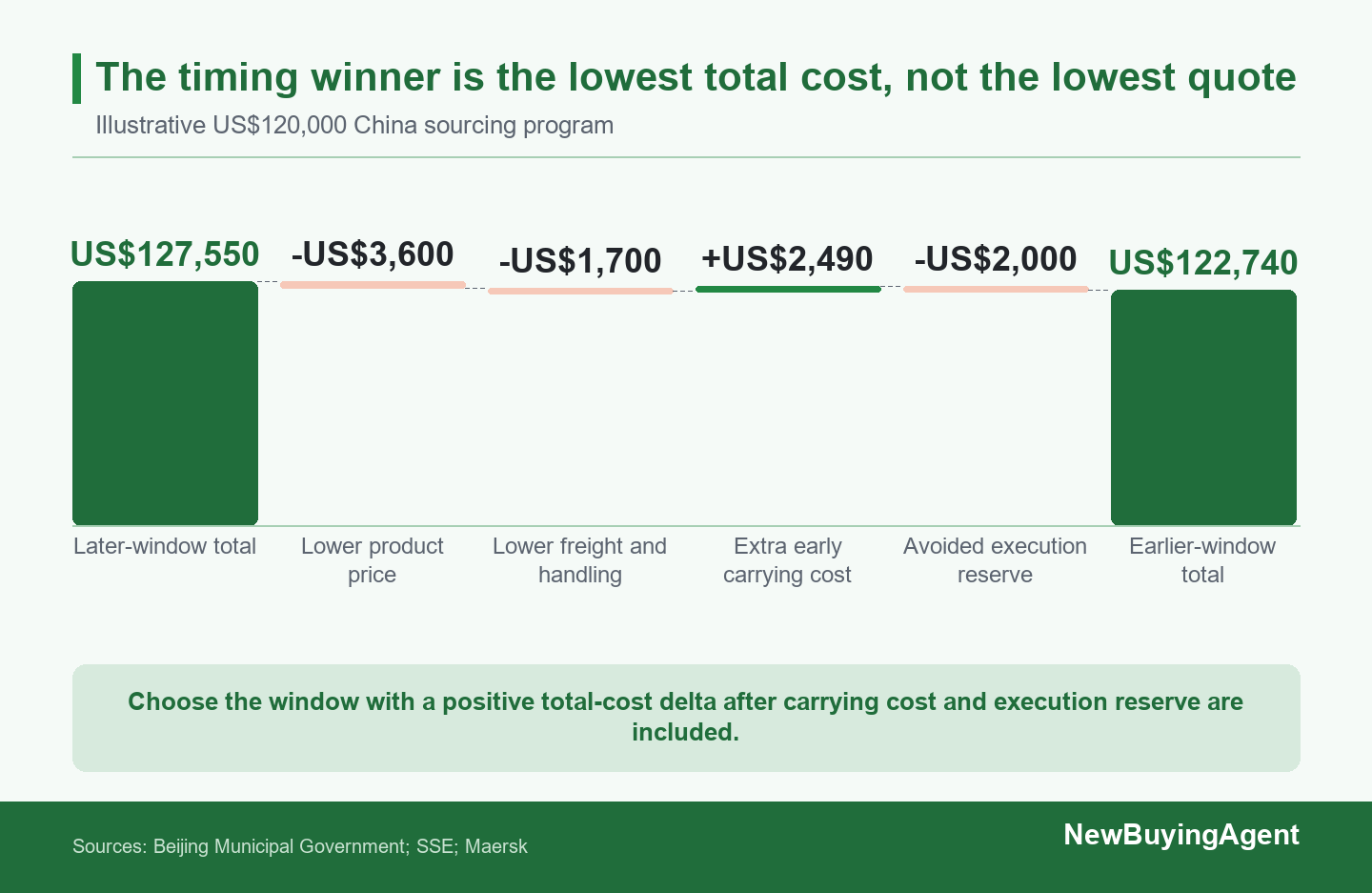
Illustrative Seasonal Cost Stack: lower product and freight inputs can be offset by earlier inventory time, so the timing decision depends on the net total.
A dated factory restart confirmation and a dated vessel departure confirmation are separate records after a holiday window. That distinction matters because a carrier can adjust service patterns while the factory is still working through its own return-to-output sequence. The correct response is to hold a release decision until both records are current, rather than building a safety buffer from a holiday name alone.
Treat Freight Demand as a Separate Seasonal Clock
A May 19, 2026 Freightos market update described an early start to Asia-Europe ocean peak season. Its 2026 market update gives the buyer a demand signal, not a lane quote. Separately, Maersk's Chinese New Year notice shows how blank sailings and alternative routings can change the transport plan. Ask for the lane, equipment, rate-date rule, validity window, and listed charges; an order can be cargo-ready while its transport economics still change. That is why an annual sourcing calendar and a lane-specific booking calendar should sit beside each other rather than being merged into one generic peak-season label for planning purposes.
Use the Seasonal Cost Stack Before Comparing FOB
The Seasonal Cost Stack compares four lines on the same order: factory price, freight and handling, inventory carrying cost, and execution reserve. Seasonal Cost Stack means comparing product price, freight, inventory time, and execution risk before a timing choice is approved. It is not a published NewBuyingAgent score or a forecast. If any one line has different scope between the two windows, the apparent seasonal saving is not ready for approval.
The starting formula is: Total timing cost = factory price + freight and handling + inventory carrying cost + execution reserve. A buyer can compare NewBuyingAgent's product-supply service for a complete purchasing brief when those inputs need to be evaluated together for a new China-sourced product program. The point is not to make a calendar choice look complicated; it is to stop one attractive line from concealing three material ones.
Factory Price Reflects Capacity Value, Not a Seasonal Promise
A seasonal factory quote is useful only when specification, readiness date, payment terms, and commercial scope are held constant. A factory may value an open production slot differently from a constrained slot, but no buyer should assume a standard off-season discount. Request two quotes against the same bill of materials and acceptance requirements, then record what changes: price validity, deposit timing, production lead time, packaging, and any minimum commitment.
If a lower early quote requires an earlier deposit or more finished-goods storage, it is not directly comparable with a later quote that keeps cash uncommitted. The comparison should expose that trade-off instead of burying it in a headline percentage.
Freight Is a Dated, Scoped Cost Line
SCFI is a weekly Shanghai export-container spot-rate signal, not an all-in invoice for a buyer's shipment. The Shanghai Shipping Exchange description makes that route and spot-market scope clear. The Shanghai Containerized Freight Index (SCFI) is therefore useful as a weekly Shanghai export freight index, not as a substitute for a booking quote. A price-calculation date is the carrier rate booking date used to decide which published rate applies. Use an index to notice movement, then obtain a quote that names the origin, destination, equipment, validity period, and charge inclusions.
Maersk's sample Shanghai-to-Los Angeles notice lists basic ocean freight, origin documentation, terminal handling, and peak-season surcharge as separate lines. A Peak Season Surcharge is a carrier charge that can apply to a particular route and validity window. Drewry's World Container Index fell 2% to US$4,547 per 40-foot container on July 16, 2026 in its dated weekly release, illustrating why a snapshot is not a permanent seasonal quote. In a separate example, Maersk separates freight, documentation, terminal handling, and surcharge lines. Compare each line under the same price-calculation rule before calling one window cheaper.
Inventory Time and Failure Cost Can Reverse the Saving
Earlier buying adds carrying cost because cash is tied in goods for more days before sale or deployment. Use the buyer's annual carrying-rate assumption, not a generic market rate: carrying cost = landed value × annual carrying rate × extra days ÷ 365. Add obsolescence, markdown, and storage exposure separately when the category makes them material.
Later buying has a different risk: the arrival buffer can shrink until a delay requires expedited freight, a split shipment, or a missed sales window. An execution reserve is a disclosed allowance for that exposure, not a prediction that a failure will occur. Keeping it visible prevents a later release from looking free simply because inventory is lower.
Peak, Off-Season, and Shoulder Windows Compared
Based on this comparison, neither peak nor off-season is automatically cheaper; the better window is the one with a positive total-cost delta and a defensible arrival buffer. A shoulder window often deserves its own comparison because it may balance capacity access with less inventory exposure than a much earlier release.
| Window | What can improve | What can worsen | Approval condition |
|---|---|---|---|
| Peak | Inventory cash stays available longer. | Capacity, booking, or recovery room can tighten. | Arrival buffer survives the dated production and freight plan. |
| Off-season | Factory or freight inputs may be lower. | Extra holding time and demand uncertainty rise. | Savings exceed carrying cost and markdown exposure. |
| Shoulder | Some timing flexibility without the longest hold. | Benefits may be smaller and less predictable. | Both sides use matched quote scope and dates. |
| Split release | Reduces one all-or-nothing timing bet. | Can add handling, booking, and coordination cost. | The added release cost is lower than the risk being reduced. |
A timing table is only as useful as the evidence behind it. Before turning a calculation into a supply commitment, buyers can review NewBuyingAgent sourcing case examples for the kind of operational proof that should accompany a decision: dated execution records, clear scope, and a defined response when the plan changes.
Worked Example: A US$120,000 Replenishment Has a US$4,810 Timing Spread
This illustrative US$120,000 program produces a US$4,810 earlier-window advantage after all four cost lines are included. It is a scenario estimate, not a market average, client case, or quotation. Its value is that every assumption is visible and can be replaced with the buyer's own data.
For an existing China factory relationship, the calculation should sit beside the production and booking calendar. A buyer that needs help confirming those records can use NewBuyingAgent's factory-management service for an existing China supplier; the decision still depends on the buyer's actual product, demand, and delivery path.
Calculate the Same Order on Two Dates
The illustrative timing spread comes from matching factory price, freight and handling, carrying cost, and execution reserve on the same order. The retailer has an existing China supplier and a US$120,000 replenishment program for one 40-foot-container equivalent, with the same specification, destination, and quality requirement under both options.
Situation: the retailer has a dated selling window but can either commit production earlier for a shoulder or off-season departure or preserve cash and ship in a high-demand window.
Order context: one 40-foot-container equivalent is planned for a dated selling window, with the same specification, destination, and quality requirement under both options.
The product specification is locked, yet the factory-ready date, carrier price-calculation date, and inventory assumption have not been aligned in one release file.
Observation one: the early option has a 3% lower product quote and US$1,700 lower freight-and-handling input, but it creates 90 additional inventory days.
Observation two: the later option avoids those inventory days but retains a US$2,000 execution reserve because a disrupted departure would threaten the selling window. On a matched-order basis, the early option is US$116,400 for product, US$2,800 for freight and handling, US$3,540 for carrying cost, and US$0 execution reserve, for a total of US$122,740; the later option is US$120,000, US$4,500, US$1,050, and US$2,000 respectively, for a total of US$127,550.
Analysis: the calculation uses a 12% annual carrying-rate assumption, so the early option's 90 additional days cost approximately US$3,540. The early option still wins in this illustration because lower product and freight inputs plus a reduced execution reserve exceed that inventory-time cost: US$127,550 minus US$122,740 equals US$4,810.
Decision: choose the early option only if the factory confirms the readiness date and the buyer accepts the inventory exposure. A lower factory quote by itself is not an approval rule.
Action: create a date-stamped quote matrix, confirm the factory restart and booking calendar, and keep any product revision outside the replenishment release unless its cost and timing are repriced.
Verification gate: reprice the same scope after the factory confirms capacity and the freight provider confirms the price-calculation date and surcharge scope.
Boundary: this illustrative example changes if demand is uncertain, the item has a short selling life, or early inventory could require markdown. Rerun the formula with the buyer's carrying and obsolescence allowances; the US$4,810 is not portable to another order.
Turn the Calculation Into a Seasonal Purchase Brief
For a new product program, NewBuyingAgent can use the complete timing brief to quote and supply China-sourced products around the required price, quality, and delivery path. The brief should name the destination and arrival date, product specification and quantity, factory-ready target, two release windows, required Incoterm, freight validity rule, and the buyer's carrying-cost assumption.
The non-obvious failure point is a quote that is technically complete but dated against a different booking or readiness assumption than the buyer's sell-in plan. Keep the brief open until both timing windows have comparable scope. When the inputs are ready, submit a complete seasonal sourcing brief to NewBuyingAgent to discuss a China-sourced product quotation tied to the actual decision path.
Frequently Asked Questions
There is no single best China sourcing season without the buyer's arrival date, cash cost, capacity evidence, and shipping lane. The right window is the one that remains viable after those conditions are compared on the same order.
Is off-season sourcing from China always cheaper?
Off-season sourcing is cheaper only when the product and freight savings exceed the added cost of holding inventory and buying before demand is certain. A lower factory quote can be outweighed by carrying cost, storage, markdown risk, or an early deposit. Compare the same order across all four cost lines before treating the price difference as a saving.
When should buyers plan around Chinese New Year?
Buyers should plan around Chinese New Year as soon as the required arrival date is known, then request the factory's last-change, restart, inspection, and cargo-ready dates. Confirm the freight provider's booking window separately. The public holiday date starts the conversation; the dated production and vessel records determine whether the release is safe, and they should be refreshed before a deposit or booking is confirmed.
Which freight numbers belong in a seasonal quote comparison?
Use the same origin, destination, equipment, Incoterm, price-calculation date, validity window, and listed surcharge scope. Separate basic ocean freight from documentation, terminal handling, and any other charge. An index may explain a market movement, but it cannot replace a quote with the correct route and booking scope. Ask the freight provider to state whether each line applies at booking, departure, or another defined date.
Can an existing supplier use the same timing model?
An existing supplier can use the same timing model when the buyer has a dated production plan, a shipping assumption, and an agreed response if the calendar slips. The model is especially useful when the relationship already has product history but the next release still has to balance price, inventory cash, delivery exposure, and the cost of holding finished goods earlier.
NewBuyingAgent
Related Resources



Get Started Today
Let's Turn Your Sourcing Goals into RealityWeChat:+86 15157124615
WhatsApp:+86 15157124615
Address:Building 10 #39 Xiangyuan Road, Hangzhou, China
