

Packing list reconciliation is the check that an identified shipment’s package contents, item quantities and stated units agree with the actual packed goods and the related shipment records.
Start with the physical packing evidence, not a copied order total. Rebuild quantities by item, separate full and partial cartons, and list mixed-carton contents explicitly. Then compare the packing list with the invoice and the information supplied for customs and transport, resolving differences before the documents are handed over.
Reconcile the packed goods before releasing the list
A useful packing list lets a reviewer connect an item quantity to identifiable packages. Check the current shipment, sales unit, actual contents and package count together. Arithmetic and matching document totals are necessary checks, but neither proves that the goods inside the cartons are the goods described. Release the list after discrepancies have been explained and the required corrections completed.
- How it works: reconstruct each item total from verified full, partial and mixed packs.
- Common mistake: a mixed carton appears against several items but remains one physical carton.
- Decision: distinguish a wrong document from missing goods before choosing a remedy.
- Timeline: communicate corrected packing facts before the declaration and carrier handoffs that use them.
Start with the actual shipment and a defined unit
Reconcile the shipment that is actually packed, using a clear product identity and sales unit for every item. The purchase order supplies the commercial expectation; the packing evidence establishes what is ready to move. Confirm which order lines, delivery portion and document revision are under review before comparing totals. Otherwise, two accurate records for different shipment scopes can appear to disagree.
Collect the approved order and changes, product and pack specifications, current packing list, invoice draft and the latest actual packing record. Identify substitutions, rejected goods held back, samples or replacements included, and any partial delivery. The person preparing the list needs to know what is physically included, not simply what production was originally expected to finish.
The ITA packing-list guidance describes contents at package level, with weight and measurements, and explains its use by freight forwarders and customs. That makes package identification a working requirement for the review: the reader should be able to locate the carton containing an item rather than see only a shipment-wide quantity.
A reliable count starts with a reliable pack definition: which variant is inside, what constitutes a complete set, and how many sales units belong in the shipping carton. For recurring China procurement, NewBuyingAgent’s local China factory network and product-development and quality-control capability are relevant to confirming those product and packing facts with the supplier. Establish that definition before asking anyone to reconcile the shipment quantities.
Maintain separate totals for the goods and their packaging. Pieces and sets describe product quantities; cartons and pallets describe physical handling units. Show the relationship between them, including which cartons belong on which pallet, without adding unlike units into one unexplained grand total.
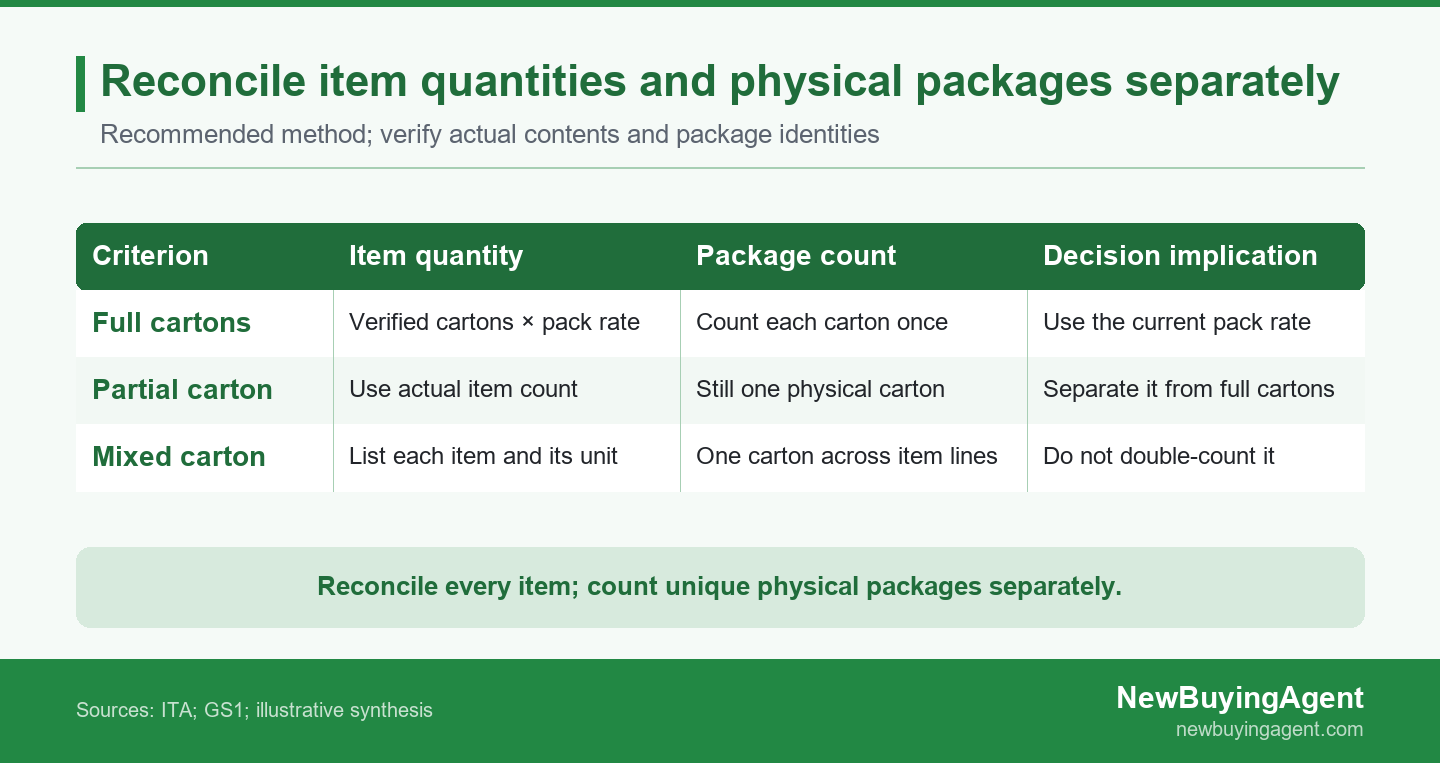
Count each item from verified package contents, and count a shared mixed carton only once.
Rebuild quantities from identifiable packages
Calculate each item from the packages in which it is actually packed. Use the current pack rate only for verified full cartons, count partial cartons separately, and expand mixed cartons into their item contents. Keep the package identity attached to each calculation so a reviewer can check an exception. Count distinct physical packages separately from the number of item rows in the list.
Assign carton numbers or other agreed unique package references that match the actual markings. A range is convenient for genuinely identical packs, while exceptions need their own rows. Reused, missing or duplicate identifiers prevent a reviewer from knowing whether two entries describe different cartons or the same carton twice.
Separate full cartons from partial cartons
Multiply a carton count by the standard pack quantity only after confirming that the listed cartons have the same actual contents. A partial carton, often the final carton of an item, needs its own quantity. The same applies when a carton has been opened for sampling, goods have been removed after inspection, or an earlier pack specification has changed. Copying the standard quantity into those rows conceals a physical difference.
Ask the factory for the packing tally and the evidence needed to resolve uncertain cartons. A photograph of a sealed carton can confirm a marking, but it cannot show an unseen internal count. Where the evidence is incomplete, arrange the appropriate recount or verification rather than converting an assumption into a confirmed quantity.
Package-level detail also has a destination-specific documentary role. For U.S. imports, the invoice rule on individual package contents requires adequate detail of what merchandise each package contains. Confirm with the responsible importer or declarant how the invoice and supporting packing information should meet that requirement. It does not establish one mandatory standalone packing-list layout for every destination.
Expand mixed cartons and defined sets by item
A mixed carton needs separate content entries for each product, variant or relevant lot, all linked to the same package identity. Add each entry to the appropriate item total, but count the shared carton only once in the physical package total. If cartons sit on pallets, preserve the parent-child relationship; adding pallet counts to carton counts creates a total that does not describe a single packaging level.
For products sold as sets, state what one complete set contains. Count complete sets using that definition and identify loose components or spare parts separately. A component count can support a conversion, but it cannot silently replace the sales unit on the invoice. The buyer’s product owner should resolve a set-definition change before the document preparer applies a new multiplier.
Where the parties use the GS1 system, the SSCC, or Serial Shipping Container Code, identifies a logistic unit. GS1 Sweden’s label guidance explains how this identity can reference content information, such as an electronic despatch advice. Use the identifier to connect the pallet or other unit to its current contents; scanning a recognizable code alone does not verify the physical count. Do not assume every China shipment is required to use GS1 labels.
Use a reconciliation sheet that exposes the discrepancy
Record what was observed, what it was compared with and what must happen when the two differ. The sheet below is a recommended working tool, not a universal customs form. Add actual values and file references beside each check, and retain the resolution. A checked box without the quantity, package identity or supporting evidence leaves the next reviewer with the original uncertainty.
Use the latest approved order as the expected shipment scope, then complete the quantity review from actual packing. For each discrepancy, add a named owner, the affected carton or item, the required correction and its completion record. Leave an unresolved difference visible. Do not overwrite the expected quantity with the packed quantity merely to make the variance disappear.
| Check | Actual evidence | Compare with | If different |
|---|---|---|---|
| Item / variant | Packing tally | Approved item | Confirm identity |
| Sales unit | Set definition | Order / invoice | Resolve conversion |
| Full / partial pack | Per-carton count | Current pack rate | Recount exception |
| Mixed contents | Items by carton | Item totals | Split contents |
| Package total | Unique references | Declared pack level | Remove duplicates |
| Mass / dimensions | Measured pack | Same-level record | Verify measurement |
| Shipment version | Current packed scope | Invoice / handoff | Update recipients |
Work through a partial and mixed-carton shipment
In this hypothetical shipment, cartons C01–C08 each contain 12 pieces of item A, contributing 96 pieces. Carton C09 contains 7 pieces of A. Mixed carton C10 contains 5 pieces of A and 6 sets of item B. Carton C11 contains 4 sets of B. The actual totals are therefore 108 pieces of A and 10 sets of B across 11 distinct cartons. The draft packing list instead shows 120 pieces of A and 10 sets of B.
| Package | A: pieces | B: sets | Physical cartons |
|---|---|---|---|
| C01–C08 | 96 | 0 | 8 |
| C09 | 7 | 0 | 1 |
| C10: mixed | 5 | 6 | 1 |
| C11 | 0 | 4 | 1 |
| Actual total | 108 | 10 | 11 |
First, rebuild each item independently. The full-carton range contributes its verified count; the partial and mixed packs supply their own quantities. Do not apply the full-carton pack rate to every carton associated with A. Comparing the reconstructed total with the draft exposes a shortage of 12 pieces against the listed expectation. B matches, so its correct total should not conceal A’s difference.
Next, count the distinct package identities. If the preparer separates the mixed carton into an A line and a B line, both lines still refer to C10. Summing a package column without removing that duplicated identity could produce 12 cartons even though only 11 exist. Keep the package ledger distinct from the item-total calculation to make this error visible.
Finally, ask what the difference represents. The example establishes a document-to-packing variance, not its cause. A recount might find incorrectly recorded contents, or confirm the actual shortage. The reviewer must resolve that branch before deciding whether a corrected list is sufficient. These assumed numbers illustrate the method; they are not a reported customer shipment or customs outcome.
Decide whether to correct the document or the shipment
If the actual goods are correct but the packing list is wrong, have the issuer correct the affected lines and recheck the totals. If the goods are actually short, a paperwork edit cannot supply the missing units. Obtain the buyer’s decision on completing the quantity, accepting a partial shipment or another agreed remedy, and update the commercial and shipment records accordingly. Do not hide the shortage by changing the packing list alone.
A discrepancy caused by last-minute factory changes needs reliable information from the source. NewBuyingAgent’s existing-factory management connects supplier communication, production progress, quality management and logistics coordination within the agreed scope. That support is relevant when rejected goods are removed or packing changes before dispatch. The buyer still approves the commercial disposition, and the responsible declarant confirms any declaration correction required.
Cross-check weights and dimensions without substituting them for counts
Use weight and dimensions to investigate discrepancies after establishing item and package identities. Compare measurements at the same packaging level and under the same unit definitions. An unexpected gross weight can direct attention to a carton, but it cannot identify the correct products or prove their count. A matching shipment weight likewise does not clear an unexplained item shortage.
Review measurements when the packaging, contents or pallet build changes. Preserve the actual measured record and its basis rather than adjusting a total until it resembles a previous shipment. The useful question is what physical change explains the difference and whether the related records need correction.
Compare measurements at the same packaging level
Distinguish product net weight from the gross weight of the packed handling unit, and state what packaging is included in the recorded figure. Compare a carton with a carton and a loaded pallet with the same loaded pallet. A sum of carton gross weights will not automatically equal a pallet gross weight if the pallet and wrapping are outside the carton figures. Record that boundary before interpreting the difference as an error.
Check the measurement units and decimal placement, and use the actual outside dimensions of the shipping pack when reviewing volume. Product dimensions or an earlier carton design may describe a different object. Where package types vary, use their respective measured dimensions rather than multiplying every carton by the most convenient size.
Unexpected mass or volume is a reason to investigate. Look for changed protective packing, a partial carton treated as full, an omitted package or a unit-entry error. Document the actual explanation and correction. Do not set an arbitrary permitted weight difference as a universal quantity tolerance; different products and packing conditions need their own valid basis.
Keep cargo measurements distinct from container verification
For containerized sea transport, distinguish packing-list cargo figures from VGM, the verified gross mass of the packed container. VGM has a different boundary and does not establish how many pieces of a particular item are inside. Keep the package-count review complete even when the container’s mass has been verified.
The IMO explanation of container gross-mass verification describes weighing the packed container or using the applicable approved, certified summation method. The latter includes cargo packages, pallets, dunnage and securing material, plus container tare. Under the applicable SOLAS requirements, the shipper provides VGM for the vessel-loading process. A simple total of carton gross weights is therefore not automatically a valid container VGM.
Have the responsible shipper and logistics party confirm which measurements belong in each record and how verification is performed. The packing-list reviewer should flag a boundary mismatch and provide corrected cargo facts, while the party responsible for VGM completes its own required verification and submission. Do not relabel one number to imply that the other process has been completed.
Close discrepancies before handing over the shipment records
Release one current packing list after the factual differences and shipment decisions have been resolved. Check the affected invoice and transport inputs using the same shipment scope, while making packaging levels explicit where documents use different units. Tell the recipients what changed and which version supersedes the draft. If a declaration or transport instruction has already been submitted, ask its responsible owner what amendment is required.
A discrepancy record should end with an observable result: a corrected count verified against the carton, an approved shipment change reflected in the documents, or a required downstream correction confirmed by its owner. Retaining the question and its answer gives the next reviewer a usable correction trail.
Align the packing list, invoice and shipping instructions
Compare item identities and sales quantities between the packing list and invoice, then compare package identities, count levels and measurements with the transport handoff. The documents can serve different purposes without using unexplained or contradictory facts. If one record shows pallets and another cartons, retain the explicit relationship and have the transport or declaration owner confirm the required presentation. Do not force identical numbers into fields describing different levels.
For example, Maersk’s shipping-instruction checklist includes package count and type, cargo gross weight, description and shipment references, alongside party and applicable local requirements. This is a carrier-specific input list. Confirm the actual carrier and route requirements rather than treating it as one form for every movement; a packing revision can affect information already sent for the transport document.
On the China declaration side, the current declaration rules reproduced by MOFCOM require truthful, accurate and complete information and include packing lists among supporting documents, subject to the applicable exemptions. Give the responsible exporter or authorized declarant the corrected facts and records. Completing this buyer review does not replace their responsibilities or authorize a reviewer to amend a submitted declaration.
Keep the factory packing record current for the next shipment
Retain the superseded draft, corrected list, count evidence, approval of any commercial change and confirmations from affected recipients. Record who established the physical quantities and when. Keep a changed pack specification separate from a one-off partial carton: the former may affect future shipments, while the latter should not silently become a new standard pack rate.
For repeat orders, carry the confirmed item and packing definitions into the next production brief, then recheck actual packing exceptions at dispatch. A stable product can still have changed carton quantities, spare parts or pallet arrangements. Agree who reports these changes and who updates the documents before the next shipment begins moving.
If repeated packing discrepancies point to a wider supplier-management need, share your purchasing requirements with NewBuyingAgent. Include the product and specifications, quantities and sales units, target price, destination, delivery timing, current supplier situation and packing requirements. The team can assess an agreed factory-management scope for supplier communication, production follow-up, quality management and logistics coordination, so the shipment records are based on current factory facts.
Frequently Asked Questions
Can a packing list replace the commercial invoice for customs?
No; a packing list describes how the goods are packed, while the commercial invoice records the commercial transaction and charges. Confirm the actual document requirements with the responsible importer or declarant. Consistent item details help connect the two records, but a matching quantity does not make one a substitute for the other. Supply the appropriate current documents and supporting information for the route.
Does a correct total weight prove the item quantity?
No; a matching total weight cannot establish that every product, variant and quantity inside the shipment is correct. Different contents or packing changes can conceal an item-level difference. Use weight as a cross-check and investigate unusual results, but resolve the count from the relevant packing and verification evidence. If a sampling method was used, keep its actual scope visible rather than describing it as a complete count.
Can cartons with identical contents share a numbered range?
Yes, provided the range accurately identifies cartons with the same verified item contents and quantity, while every exception is listed separately. State the pack rate and confirm that the number of carton identities matches the range. Remove partial or mixed cartons from the uniform group. Grouping should shorten a reliable record, not hide differences or imply that an unverified carton has been checked.
What should happen if cartons are repacked after document approval?
Recheck the affected package identities, item quantities, packing configuration and measurements, then update the relevant records before they are used. Tell the recipients which version supersedes the approved draft and confirm any already-submitted declaration or transport amendment with its owner. Repacking does not necessarily change the sales quantity, but it can change carton count, package references, weights and dimensions even when all products remain included.
NewBuyingAgent
Related Resources


Get Started Today
Let's Turn Your Sourcing Goals into RealityWeChat:+86 15157124615
WhatsApp:+86 15157124615
Address:Building 10 #39 Xiangyuan Road, Hangzhou, China
