An assist is a specified buyer-supplied input, provided free or at reduced cost for production of imported goods, whose value may need to be added under the applicable customs valuation rules.
Start with what the buyer supplied, how the factory used it and whether its value is already included in the goods price. Then confirm the destination’s eligible cost base and allocation method. A separate tooling invoice does not automatically require adding its full amount to every shipment, and components supplied free to a factory do not automatically have zero customs value.
Look beyond the supplier’s goods invoice
For recurring China orders, connect buyer-provided tools, components and qualifying services to the goods they help produce. Establish the applicable valuation method before calculating an adjustment. Retain the cost, price-inclusion and production records behind the amount assigned to each shipment, so the importer can explain both what was added and why another amount was excluded.
- How it works: identify the input, confirm its treatment, then allocate the eligible amount.
- Cost: check destination-specific cost rules and value already included in the price.
- Risk: a missing adjustment and a duplicate addition can both distort the declared value.
- Decision: resolve uncertain facts with the importer’s valuation owner before using a shipment figure.
Identify buyer-supplied inputs and the applicable valuation rules
Begin with an inventory of what the buyer supplies directly or indirectly outside the ordinary goods payment. Match each input to the actual products and production process, then identify the importing destination and applicable valuation method. The inventory is a screening tool: it does not establish that every listed expense is an assist or that every assist has the same cost treatment.
Include buyer-owned molds, dies, production tools and supplied parts in the initial review, together with relevant design or engineering arrangements. Record who purchased or produced the input, who received it, where it was used and which goods benefited. Ask the factory to confirm actual use rather than relying on an invoice description such as “development fee.”
The WTO Customs Valuation Agreement, Article 8 provides for appropriately apportioned additions for specified goods and services supplied directly or indirectly by the buyer free or at reduced cost for production and sale for export, to the extent their value is not already included. Additions must rest on objective, quantifiable data. These conditions matter: a buyer’s expense is not an addition merely because it relates broadly to the product.
Establishing those facts requires a clear product definition and confirmation of what the factory actually uses. For recurring procurement, NewBuyingAgent’s local China factory resources and product-development and quality-control capability are relevant to identifying those physical inputs and their production purpose. The importer’s responsible valuation specialist uses the confirmed facts to determine the applicable customs treatment.
Keep three questions distinct: does the input qualify, what eligible value remains outside the price, and how much belongs to this shipment? An answer to the first question does not supply the evidence needed for the other two.
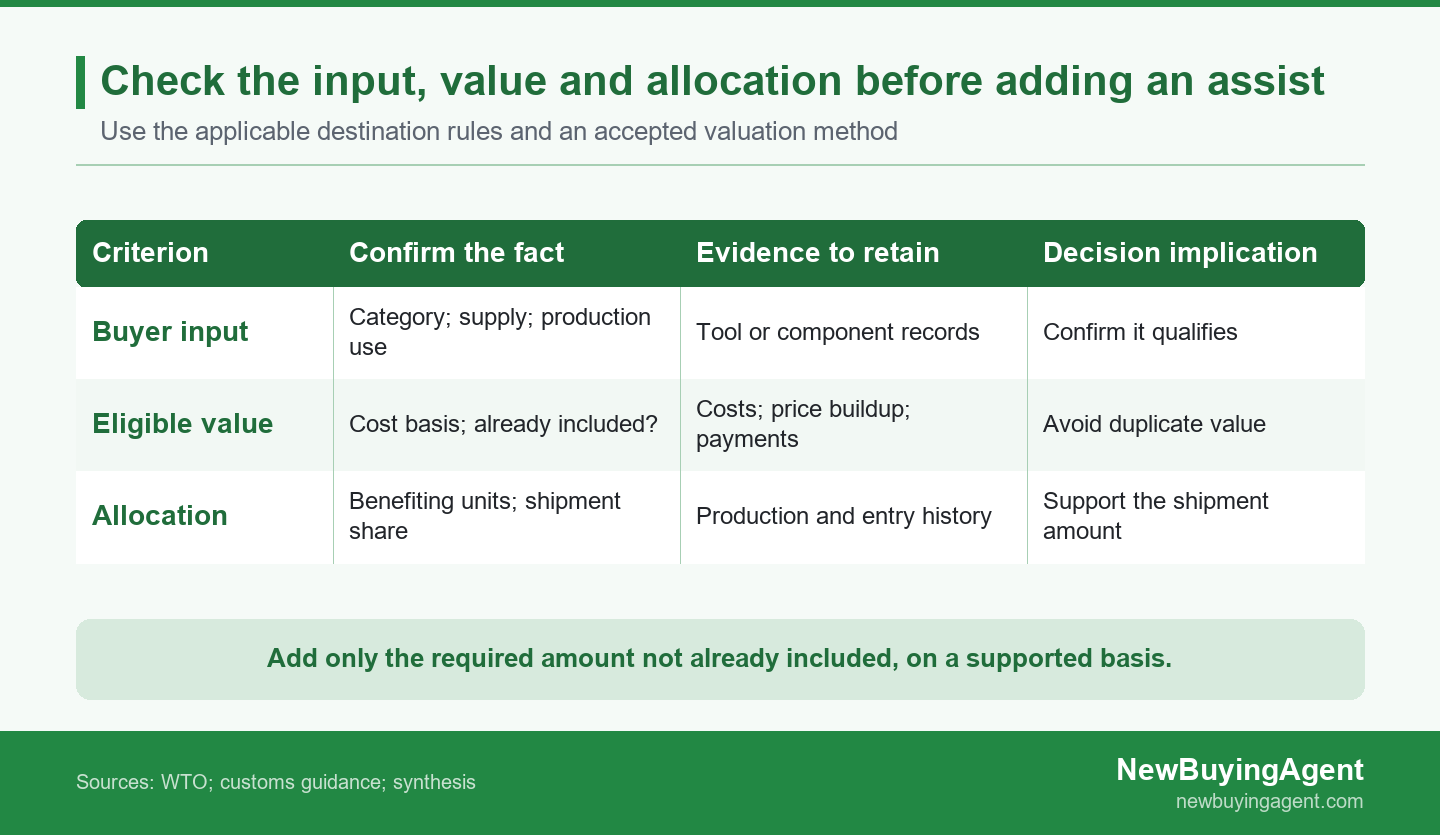
Confirm the buyer input, eligible value and prior inclusion before allocating any assist amount to a shipment.
Separate tooling, components and service inputs
Classify the input before deciding its treatment. A reusable mold, a component incorporated into the goods and a design service have different factual characteristics. Record the supply arrangement and production connection for each. Labels such as “free,” “buyer property” or “sample development” do not replace that review, and a condition attached to one legal category should not be applied to every other category.
A useful inventory keeps separate rows for each tool, component group or service deliverable. Link each row to a product or part revision and flag uncertain classifications. This avoids combining several different costs into one unexplained development charge.
Check the input category and how it is supplied
For tooling, identify the asset, its owner, acquisition or production arrangement, location and actual production use. A mold paid for by the buyer and placed with a factory needs review even if the factory never bills the buyer for it again. Ownership is useful evidence of the arrangement, but ownership alone does not decide whether the imported goods require an adjustment.
The U.S. assist definition in 19 CFR 152.102 distinguishes incorporated materials and parts, production tools, consumed materials, and qualifying engineering, development, artwork, design work, plans and sketches. The listed engineering and design category has geographical and other conditions. Do not transfer that service-category condition to every physical mold or component, or assume that the U.S. wording establishes the treatment in another importing country.
Ask for the actual deliverable behind a service invoice. A drawing, general commercial consultation and a production tool are not interchangeable inputs. Keep the agreement and evidence of where the relevant work was undertaken available for the destination-specific review.
Trace free-issue components into the imported product
Free-issue means that the buyer supplies an input to the factory without charging the factory. It describes the factory supply arrangement, not the eligible customs value. Connect the supplied component to the bill of materials, component revision and imported product. Reconcile what was delivered to the factory with what was incorporated into the shipment, without treating unused stock as though it had already entered the importing country.
Retain the buyer’s purchase or production cost records and the factory’s receipt and usage records. Identify returns, unused parts, replacements and any disputed usage separately. Their treatment depends on the facts and applicable rules; an unexplained difference should not simply be spread over the shipment to make the ledger balance.
This matters when similar products use different buyer-supplied parts. A standard unit cost copied across every SKU can assign value to goods that never used the component, while omitting value from the products that did. Confirm the actual production connection before choosing a per-unit amount.
Check what the price already includes before adding value
Compare the purchase agreement, goods-price buildup, tooling arrangement and payment records. Determine whether the relevant input value is already included in the price paid or payable for the goods. A separate invoice does not prove that it is excluded, and a single goods invoice does not prove that every buyer input is included. Obtain an explanation supported by records rather than relying on either invoice layout.
Where the arrangement includes existing-factory management, NewBuyingAgent can help coordinate supplier communication and production follow-up within the agreed scope. That connection is useful when a factory changes a component, adjusts a unit price or reports different tool use: procurement needs those changes recorded before the importer reviews their valuation effect.
Keep a written inclusion decision for each cost pool. If the supporting records conflict, identify the missing explanation and its owner. Adding the amount “to be safe” is not a sound substitute for establishing whether the same value has already been counted.
Build a documented value and allocation basis
Establish the eligible cost pool first, then decide how that pool relates to the goods and shipments. Keep the cost decision separate from the allocation decision so both can be checked. The worksheet below is a recommended preparation tool for the importer and its broker or valuation adviser; the actual destination rules determine which amounts and allocation methods are acceptable.
Copy these rows into the shipment file and add the actual values, source filenames, decision date and named reviewer. Mark unresolved items explicitly instead of filling them with an assumed zero. The completed record should show the reason for each inclusion or exclusion, not merely a total that happens to match a spreadsheet.
| Review item | Source record | Check | Owner |
|---|---|---|---|
| Input identity | Asset / part record | Category; actual use | Product team |
| Buyer supply | Contract; transfer | Free / reduced cost | Procurement |
| Eligible cost | Invoices; cost record | Destination treatment | Valuation owner |
| Price inclusion | Price buildup; payments | Already counted? | Finance |
| Production scope | Production program | Benefiting units | Production |
| Shipment share | Quantity; entry ledger | Current / prior allocation | Importer |
| Unresolved change | Revised facts | Decision before use | Named reviewer |
Confirm the eligible cost base for the destination
Build the cost pool from evidence that fits the input and the applicable rules. Purchased tooling, self-produced tooling, previously used equipment and leased equipment may require different supporting calculations. Do not substitute the accounting book value or a convenient depreciation percentage without checking whether that basis is appropriate for the customs review.
Under 19 CFR 152.103(d)–(e), U.S. assist valuation addresses acquisition or production cost, adjustments for previous use and lease cost as applicable. Transportation to the place of production is included in the assist value. The appropriate apportionment also depends on the circumstances and the importer’s documentation; a nominal tool capacity is not automatically the supported allocation denominator.
The UK’s HMRC Method 1 equipment-assist guidance provides a different treatment for freight and insurance to the manufacturer’s premises when those costs are separately distinguished: they are excluded from the equipment-assist value. This is a UK equipment rule, not a global rule for every input. Keep it separate from the treatment of transport of the finished imported goods.
Give the valuation reviewer the cost breakdown, not only the proposed total. That allows a destination-specific inclusion decision without reconstructing a mixed invoice after the goods arrive.
Choose and track a supportable allocation
The allocation should connect eligible value to the production that benefits and the goods being imported. Establish the product scope, relevant quantities and destination before using a denominator. A tool’s maximum technical capacity, an optimistic sales forecast and a supported production quantity are different facts. Do not choose whichever produces the smallest shipment adjustment.
Canada’s CBSA Memorandum D13-3-12 on assists calls for documentation supporting appropriate apportionment and a record of the number of units imported. The practical lesson for a recurring buyer is to retain the accepted basis alongside the shipment and entry history. That Canadian guidance does not itself authorize a particular allocation for another destination.
Maintain a running record of eligible value allocated, quantities covered and any remaining balance. Link revisions to the earlier decision so a new colleague does not restart recovery of the original tool cost. If production serves several markets, have the responsible valuation owner determine how the relevant benefit and quantities should be treated rather than dividing by worldwide volume without justification.
Test the value bridge with a disclosed numerical example
The following hypothetical example demonstrates arithmetic after the substantive valuation decisions have been made. Assume the responsible valuation owner has confirmed transaction-value eligibility, assist treatment, the eligible cost pool, the benefiting production denominator and the absence of price inclusion for this destination. None of those decisions follows merely from the numbers, and the example does not establish a universal allocation method.
Assume an eligible tooling pool of USD 12,000 benefits an accepted production quantity of 20,000 units. This shipment contains 2,000 units. The confirmed eligible free-issue component value is USD 0.40 per imported unit, and the seller’s goods price is USD 5 per unit, excluding both buyer inputs. All figures are illustrative, not a customer shipment or customs ruling.
Calculate the shipment share without treating it as a duty bill
Divide the USD 12,000 tooling pool by 20,000 benefiting units to obtain USD 0.60 per unit. For 2,000 shipped units, the tool allocation is USD 1,200. Components contribute USD 0.40 multiplied by 2,000 units, or USD 800. The resulting assist adjustment is USD 2,000. The seller’s invoice is USD 5 multiplied by 2,000 units, or USD 10,000; adding that adjustment produces a USD 12,000 subtotal.
| Calculation | Amount | Meaning |
|---|---|---|
| Tool: 12,000 ÷ 20,000 | USD 0.60 / unit | Accepted example allocation |
| Tool: 0.60 × 2,000 | USD 1,200 | Shipment tool share |
| Parts: 0.40 × 2,000 | USD 800 | Shipment component value |
| Assists: 1,200 + 800 | USD 2,000 | Example addition |
| Goods: 5 × 2,000 | USD 10,000 | Seller invoice |
| 10,000 + 2,000 | USD 12,000 | Subtotal before other adjustments |
The subtotal is before any other applicable valuation adjustments. It is not a complete customs value, tax base or duty amount. No tariff rate, tax rate or currency conversion has been assumed. The importer still needs the applicable treatment of other costs and the actual declaration requirements before using a final entry value.
To test your own file, replace each example input with the confirmed figure and its supporting record. Check that quantities share the same product scope and unit basis. A correct multiplication cannot rescue an unsupported cost pool or a denominator that covers unrelated production.
Resolve changed production and prior inclusion explicitly
If the component value is already included in the seller’s goods price, do not add the same value again. Rebuild the comparison using the actual inclusion decision rather than carrying the example’s adjustment forward unchanged. Likewise, do not repeat the full original tool cost on each shipment when the accepted treatment allocates that value across production.
If the tool is transferred, modified or retired early, or the supported production quantity changes, give the revised facts and prior allocations to the valuation owner. Establish what happens to the current shipment and earlier entries under the applicable procedure. Silently replacing the denominator can hide both the reason for a new amount and the effect on amounts already declared.
Keep the earlier calculation intact, identify the revision and record who approved its use. A repair invoice, for example, raises a new cost-treatment question; it should not automatically be added to every remaining unit or ignored because the original tool was already recorded.
Give the valuation owner a complete decision record
Send a connected record rather than a folder of unexplained invoices. The importer’s broker or valuation adviser needs to see what the buyer supplied, how it supported production, what eligible value remains outside the price and how the shipment share was determined. Resolve material gaps through the appropriate destination procedure instead of disguising uncertainty as a final figure.
Assign one owner to maintain the factual record and identify who can confirm the valuation treatment. Procurement, product, factory and finance colleagues supply different evidence; their operational sign-off is not interchangeable with the importer’s declaration responsibility.
Keep the source costs, production use and entry history connected
Retain the input inventory, agreements, cost evidence, factory receipt and usage records, price-inclusion explanation, accepted allocation basis and shipment history together. Use identifiers that connect the tool or component to the product revision and import entry. A reviewer should be able to trace an amount back to its source and see where that value has already been allocated.
The Australian Border Force trade and goods compliance guidance identifies omitted production-assist costs as a customs valuation compliance concern. For an Australian import, that makes unexplained buyer-provided inputs a concrete review issue. It does not establish that every development payment must be added, nor does it remove the need to establish the actual qualifying cost and allocation.
Record the outcome of each unresolved question, including the evidence relied on and the person responsible. Establish the retention period required by the importing jurisdiction and the business’s applicable obligations rather than assuming that one period applies worldwide.
Use recurring procurement records to prevent the next omission
Make buyer-provided inputs part of the product brief and order-change record. Before repeat production, ask whether the tool, component, supply arrangement, unit price or production scope has changed. Route the changed facts to the person maintaining the valuation record. This creates a practical trigger for review without asking the factory to decide another country’s customs law.
When recurring China purchasing also needs supplier communication, production follow-up, quality and logistics coordination, share your purchasing requirements with NewBuyingAgent. Include the product and specification, quantities, target price, destination, timing, current supplier and tooling or component arrangements. Those inputs support a discussion of product supply or agreed existing-factory management, with clear responsibilities for the procurement records the importer will need.
Frequently Asked Questions
Does owning the mold or paying for it locally remove assist treatment?
No. Ownership or local payment alone does not remove a physical mold from assist review. Identify who supplied it, its production use, the applicable category and whether its value is already included in the goods price. Do not apply a geographical condition for a particular engineering or design service category as a blanket exemption for physical tooling. The importing destination’s rules control the actual decision.
Are all design and development costs automatically customs assists?
No. Review the actual deliverable and the conditions for the relevant category under the destination’s rules. Engineering or design work can have specific geographical and production-related conditions; a generic development invoice does not establish that those conditions are satisfied. Retain the contract and evidence of the work performed so the valuation owner can distinguish qualifying inputs from other commercial expenses.
Can the buyer declare zero for components supplied free to the factory?
Not simply because the factory received them without a charge. Free-issue describes that supply arrangement, while the buyer may have incurred a purchase or production cost. Trace the components into the imported goods, establish the applicable eligible value and check whether that value is already included in the seller’s price. Use the confirmed treatment rather than a zero based only on the factory invoice.
What if the final assist value is unknown when the goods arrive?
Tell the importer’s broker or valuation adviser what is unknown and provide the available cost and production records before the declaration is finalized. Ask which destination procedure is available for the circumstances, including any required later adjustment. Do not invent a final amount or assume zero is acceptable. Keep the unresolved item, responsible person and follow-up obligation connected to the affected shipment and entry.
NewBuyingAgent
Related Resources
Get Started Today
Let's Turn Your Sourcing Goals into RealityWeChat:+86 15157124615
WhatsApp:+86 15157124615
Address:Building 10 #39 Xiangyuan Road, Hangzhou, China