

Bill of lading draft approval is the review and acceptance of a specific issuer’s proposed transport-document content and instructions before the relevant document is finalized.
Approve the exact draft only after the party names, routing, cargo facts and document or release instructions are confirmed by their responsible owners. A clean PDF is not enough. Keep draft approval separate from confirmation that the bill has been issued, that originals or electronic control have been handled correctly, and that the destination will release the cargo.
Approve the exact draft, not an assumption about release
A useful approval identifies the issuer, shipment and current version, then confirms the facts and authorized instructions in that version. Resolve uncertain consignee details, routing or document type before giving a blanket “approved.” Track issuance and cargo release as separate tasks, because approval of the wording does not prove that either has occurred.
- How it works: compare each material field with its current source record and named confirmer.
- Risk: a similar company name or convenient release label can describe the wrong arrangement.
- Timeline: verify the actual amendment deadline, time zone and charge conditions for the shipment.
- Decision: recheck the issuer’s revised draft before approving the corrected version.
Identify the issuer, shipment and approval authority
Begin by identifying whose draft is being reviewed, which shipment it covers and who may approve the relevant instructions. Check the booking reference and document level before comparing fields. A forwarder’s house bill and a carrier’s master bill can involve different parties and release requirements. Review the correct document against the correct instructions rather than treating every attachment as another copy of the same bill.
Collect the current booking confirmation, shipping instructions, invoice and packing list, plus any applicable buyer, bank or contract requirements for the transport document. Shipping instructions are the shipment and document details submitted to the issuer for preparation. Identify the person authorized to confirm commercial party details and document type; the colleague checking carton counts may not have that authority.
The DCSA shipment-process model distinguishes draft publication and approval, document issuance, amendment-related surrender and reissuance, and surrender for delivery. This is a useful process distinction, not a promise that a particular carrier implements every step identically. Record what has actually been confirmed instead of inferring later states from an approved draft.
The cargo description and packing figures depend on reliable information about the products leaving the factory. For recurring China procurement, NewBuyingAgent’s local China factory resources and product-development and quality-control capability are relevant to confirming those underlying product facts. The document issuer still controls its bill, while the buyer and any financing parties confirm their own document and release requirements.
Keep the approval record specific: the draft content has been checked against named inputs. Issuance, surrender or electronic control, and destination release each require the appropriate confirmation from the responsible party. That separation prevents a document-review message from being mistaken for a cargo-release instruction.
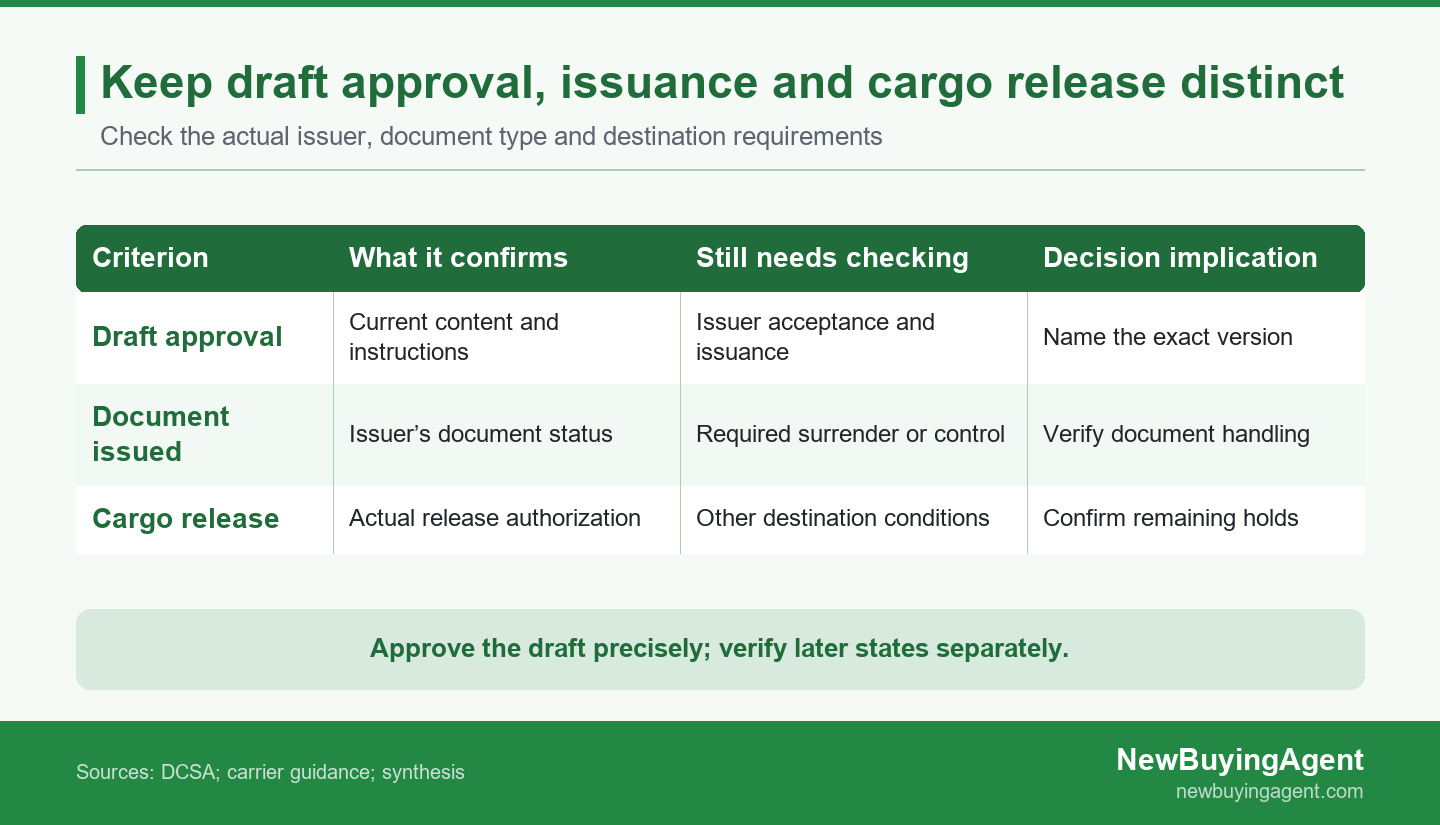
Draft approval checks content; issuance and cargo release each require separate confirmation from the responsible parties.
Check names, routing and cargo against their source records
Use a field review that shows both the evidence and the person able to confirm it. Check the latest agreed details, not a previous shipment’s template. The matrix below is a recommended buyer tool; the actual issuer and route may require additional fields. Where a material fact is unresolved, state the question and withhold approval of the affected draft until it has been answered.
Add the actual value, source file and revision, reviewer and resolution beside each row. Review every page and any attached clauses or requested notations. When a field is not applicable, establish why rather than leaving its meaning uncertain. Preserve the issuer’s document reference so confirmations cannot accidentally be applied to a different booking or version.
| Field | Check against | Confirm with | Stop if unclear |
|---|---|---|---|
| Issuer / reference | Booking; draft ID | Booking party | Wrong document |
| Shipper | Accepted instructions | Authorized party | Entity or role |
| Consignee / notify | Buyer / bank instructions | Buyer / issuer | Delivery party |
| Ports / places | Confirmed route | Logistics / issuer | Wrong location |
| Cargo / packages | Current packing facts | Supplier / logistics | Count or unit |
| Container / seal | Actual shipment record | Logistics / issuer | Wrong identifier |
| Document / release | Contract; bank needs | Buyer / bank / issuer | Unapproved change |
| Charges / requests | Agreed terms | Relevant parties | Unclear notation |
Confirm party roles instead of copying every name across documents
Check the full shipper, consignee and notify-party details against authorized instructions, including the correct legal entity and required address or contact information. A notify party is not automatically the consignee. Nor should the invoice buyer, factory name and transport-document party be made identical merely to remove a visible difference. Confirm the actual role and the document level before deciding whether a difference is legitimate or an error.
Where the instructions require an order bill or bank-related consignee wording, obtain the approved wording from the responsible buyer or financing party. Do not replace it with an easier named-consignee arrangement without that confirmation. A change to the consignee can affect the delivery arrangement, so treat it as a substantive instruction rather than a harmless address edit.
Maersk’s Verify Copy approval and amendment guidance describes approving the relevant transport document or submitting amendments and receiving a new copy with the revised details. The useful control is to inspect that new copy. A sent correction or a colleague’s marked-up PDF does not establish that the issuer has incorporated the change.
Keep ports and inland places in their correct fields
Compare the place of receipt, port of loading, port of discharge and place of delivery with the confirmed transport arrangement where those fields apply. They describe different parts of the movement. An inland delivery destination should not silently replace the discharge port, and a familiar nearby port is not an acceptable substitute for the booked one. Confirm the exact place and required code with the logistics party or issuer.
Check vessel and voyage references against the current booking or issuer information. If the intended routing has changed, first establish whether the carrier accepted the change and which document fields it affects. Editing a city name on the draft does not itself change the transport contract or arrange inland carriage.
Also distinguish a received-for-shipment document from an on-board notation. Do not invent or backdate a loading statement to satisfy a desired timeline. If a bank or customer needs a particular notation, have the issuer confirm the factual event and appropriate document treatment. A buyer’s draft review is not evidence that the goods have been loaded.
Reconcile the cargo facts and requests with the actual shipment
Check the description, package count and type, gross weight, measurements where used, and container or seal references against the latest shipment evidence. Keep package levels explicit: a pallet total and a carton total can both be valid if their relationship is clear. Do not force a number into a field merely because it matches the invoice; confirm what the field is intended to describe.
Resolve changes caused by rejected goods, substitutions or repacking before the document preparer works from an outdated list. Review freight-payment wording and additional requests against the actual agreements as well. An Incoterms rule, a prepaid or collect notation, and confirmation that every destination charge has been paid are different matters; ask the relevant parties to clarify a mismatch.
When those differences begin at an existing supplier, NewBuyingAgent’s existing-factory management connects supplier communication, production progress, quality management and logistics coordination within the agreed scope. That support is relevant to obtaining current cargo facts after packing or quality changes. The issuer accepts the transport-document correction, and the buyer retains approval of commercial changes.
Confirm the document type and the route to cargo release
Confirm the exact transport-document type, how it will be issued and what the issuer requires for delivery. Treat these as related but separate questions. A sea waybill, an original bill followed by a surrender process, and an electronic original are not interchangeable labels. The buyer’s commercial or bank requirements must be reconciled with the issuer’s actual procedure before the draft is approved.
Ask who receives the document, who can instruct any surrender or transfer, what evidence the destination agent requires, and which other holds remain. Record the answer for this issuer and shipment. Avoid a single instruction such as “release by email” when it leaves the document type and required authority unresolved.
Separate negotiability, document medium and delivery requirements
The ITA overview of transport documents distinguishes non-negotiable straight bills from negotiable order bills. Use that distinction carefully: it does not mean every non-negotiable bill is a sea waybill, or that presentation requirements for a straight bill are identical across carriers and jurisdictions. Confirm the document named by the actual issuer and the applicable delivery procedure.
Document medium is another question. A PDF copy sent by email is not automatically an electronic original bill with the required control or transfer mechanism. If an electronic original is intended, identify the accepted system, the relevant parties’ access and the process for transfer or surrender. Keep the issuer’s requirements distinct from the convenience of downloading a file.
UNECE’s discussion of electronic transferable records highlights reliable identification, control and integrity in its explanation of the UNCITRAL model-law framework. Check the applicable law and the issuer’s accepted system; the framework is not automatic legal recognition in every jurisdiction.
For a sea waybill, confirm the named delivery party and the issuer’s identification and release conditions. For an original bill, confirm how the required originals or valid electronic control will be handled. Do not assume that holding a copy guarantees control over delivery or that choosing originals guarantees payment. Have the buyer and any bank confirm whether the arrangement fits the transaction before it is substituted for another document type.
Verify the issuer’s release procedure and actual status
Telex release generally describes an issuer-arranged release process associated with surrender or equivalent handling of original bills under that issuer’s procedure. It is not simply another name for a sea waybill. Ask who can request it, which originals or acknowledgments are required, how acceptance is confirmed and what the destination office will recognize. Do not assume that every issuer follows the same paper or online process.
For example, OOCL Malaysia’s import procedure distinguishes original-bill, surrendered or telex, and sea-waybill statuses. It separately lists conditions for a delivery order, including relevant document or identity and payment requirements. That local carrier example shows why the document status and the remaining delivery conditions both matter; its exact labels and requirements should not be applied to every destination.
Obtain the actual issuer or destination-agent confirmation rather than relying only on a supplier’s statement that release has been requested. Ask about outstanding customs, carrier, terminal or payment conditions affecting delivery. A completed surrender process does not by itself establish that all those separate conditions have been satisfied, or that the consignee can collect immediately.
Return corrections through the issuer and verify the revised draft
Send a clear correction request through the channel accepted by the issuer, then inspect the revised document rather than stopping at submission. Identify the shipment, current draft, old value, replacement value and supporting instruction. Review the full new version for both the requested change and any related effects. Approval belongs to that corrected version, with its remaining tasks explicitly recorded.
Consolidate comments from the buyer, logistics party and any financing reviewer before sending contradictory requests. Name the person authorized to resolve conflicting instructions. If an original or electronic document has already been issued, ask the issuer which surrender, control, cancellation or reissuance steps apply; do not edit a downloaded copy and circulate it as the corrected original.
Check the amendment stage, deadline and charge basis
Hapag-Lloyd’s India documentation FAQ states that bill amendments are subject to relevant loading-port, discharge-port or customs approval. This is carrier-local guidance, not a global deadline. Its practical implication is that a submitted request may still need approval elsewhere. Ask the issuer whether a manifest or other downstream record must also be corrected and who confirms completion.
Maersk’s amendment-charge guidance explains that charge thresholds and fees vary by origin, and that a charge may apply to China-origin amendments after the Verify Copy has been issued. Conditions depend on the applicable contract, tariff and documentation requirements. Do not promise that corrections stay free until final issuance, or insert a universal fee into the buyer’s approval checklist.
Record the actual correction deadline with its local time zone, the document and manifest stage, any expected approval dependency, the quoted charge basis and the party responsible for it. Separate the issuer’s submission deadline from an internal review target. Escalate an unresolved material error before the deadline instead of approving an incorrect draft to avoid a possible fee.
Work a changed shipment through the approval decision
Consider a hypothetical shipment planned as 50 cartons. Quality checks hold back 2 cartons, leaving 48 cartons for the shipment. The draft still shows 50, uses a former consignee entity, lists Antwerp where the confirmed booking requires Rotterdam as the discharge port and Venlo as the delivery place, and indicates a sea waybill although the buyer’s bank instructions require an order bill. These are assumed training facts, not a customer shipment or a statement that a particular carrier offers this route.
| Draft issue | Confirm from | Required decision | Before approval |
|---|---|---|---|
| Old consignee | Authorized buyer details | Correct entity / role | Recheck wording |
| Wrong port / place | Confirmed booking | Issuer confirms route | Check both fields |
| Outdated carton count | Actual packing record | Update affected records | Reconcile cargo |
| Sea waybill mismatch | Buyer / bank instructions | Agree document type | Issuer confirms form |
The reviewer should withhold blanket approval. First, confirm the actual packed quantity and the buyer’s disposition of the held goods, then update the affected packing and commercial records. Separately obtain the correct consignee instruction and have logistics confirm the accepted route. Correcting the package count does not authorize a different destination or delivery party.
The document-type conflict needs its own decision from the buyer, bank and issuer. Do not accept the sea waybill merely because it avoids handling originals. Request a revised draft after the authorized instructions are settled, then review all the material fields again. If the revised copy fixes the count but leaves the document type unchanged, the draft is still not ready for approval.
Once the corrected version is confirmed, record its reference and approval scope. Keep any subsequent issuance, surrender or release task assigned separately, with the required issuer confirmation. The observable result is a current, checked draft and a clear remaining handoff, not an invented assurance of bank acceptance or cargo delivery.
Record the approved version and the remaining handoffs
An approval record should name the issuer and shipment reference, draft version or issue timestamp, file reviewed, approver and confirmed instructions. Retain the source records and resolved correction trail. State what the approval covers, and identify outstanding issuance or release tasks without implying that they have already been completed. Use the issuer’s required form or workflow where applicable.
For example, a buyer can confirm that the identified revised draft matches the approved party, routing, cargo and document-type instructions, while separately recording who will obtain the issued document and verify release status. If another revision arrives, compare it before assuming that the earlier approval still applies. Keep superseded copies clearly distinguishable in the working record.
Where recurring document corrections reflect unreliable factory information, share your purchasing requirements with NewBuyingAgent. Include product specifications, quantities, target price, destination, delivery timing, the existing supplier situation and packing requirements. The team can assess an agreed factory-management scope for supplier communication, production follow-up, quality management and logistics coordination, helping the shipment handoff start from current product and packing facts.
Frequently Asked Questions
Does approving a draft bill of lading prove that goods are on board?
No; approving a draft confirms the reviewed content and instructions, rather than establishing that the goods have actually been loaded. Check the issuer’s final document and the relevant on-board information against the actual shipment event. Do not invent a loading date to satisfy a preferred timeline. If a bank requires a particular notation, have the responsible parties confirm the correct factual and documentary treatment.
Should a house bill and master bill show identical parties?
Not necessarily, because each document can describe a different contractual level and party relationship in the transport chain. Identify the issuer and the role of each named party before treating a difference as an error. Ask the forwarder and carrier how the instructions and release conditions connect, and confirm what the buyer or bank needs. Do not assume that resolving one document automatically resolves the other.
Can a sea waybill replace an order bill required by a bank?
Do not substitute a sea waybill without the relevant buyer or bank approval and the issuer’s confirmation of the intended document arrangement. A simpler delivery process does not establish compliance with financing instructions. Ask the responsible financing reviewer to resolve the requirement and communicate the approved wording through the authorized channel. Check the revised issuer draft before accepting the change.
Does requesting telex release mean the consignee can collect immediately?
No; a request must be processed under the issuer’s procedure, and other destination conditions may still prevent collection. Confirm the completed document or surrender status with the issuer or its destination agent. Then check the relevant customs, terminal, carrier and payment requirements for delivery. A forwarded email saying that release was requested is not a substitute for those confirmations.
NewBuyingAgent
Related Resources
Get Started Today
Let's Turn Your Sourcing Goals into RealityWeChat:+86 15157124615
WhatsApp:+86 15157124615
Address:Building 10 #39 Xiangyuan Road, Hangzhou, China
