


Master carton assortment planning is the allocation of specified product variants and quantities to outer shipping cartons, with an approved packing arrangement and a record of each carton’s contents.
The useful output is an instruction the factory can follow and the receiver can check. It needs more than a shipment total: the SKU mix, full-carton quantity, treatment of remaining units and carton identification must agree before packing begins.
Approve the assortment, not just the carton count
A workable assortment plan starts with the receiving rules and an exact quantity recipe for each carton type. Complete recipe cartons and remaining units need separate decisions because the same order can produce different carton counts under different tail-packing rules. The final instruction should connect the approved mix to the physical pack, carton identifiers and actual packed quantities, so a correct overall total does not hide the wrong contents in individual boxes.
- Decision: Confirm which SKUs, variants and quantities may share a carton before calculating the number of boxes.
- How it works: Calculate complete recipe cartons using the limiting SKU, then allocate the remaining units separately.
- Risk: A mixed shipping carton and a fixed assortment sold as a product can have different identification requirements.
- Common mistake: Copying the planned contents onto every carton record when partial cartons or substitutions were actually packed.
Set the receiving rules before choosing a carton recipe
The receiving partner’s requirements determine which assortment recipes are usable, even when several products fit inside the same box. A retailer may need a fixed size or color mix, while another buyer may accept a variable mix supported by carton-level records. The packaging manager should settle the allowed combinations, quantity units and partial-carton rules before asking the factory to fill available space or quote a mixed-carton arrangement.
A stock keeping unit (SKU) is an internal inventory code for an item or variant in a business’s own system. GS1 US distinguishes the internal SKU from the GTIN, which identifies a product across trading partners. Map the buyer’s SKU to the factory’s product reference and any required GTIN so “blue,” “small” or a familiar supplier code does not become an ambiguous packing instruction.
Define the unit being counted: an individual item, a retail set or an inner pack. A carton containing several retail sets has a different unit total from the same number of individual pieces. Keep the unit consistent across the purchase order, recipe and packing record, and spell out the contents of a set when the factory could otherwise interpret it differently.
Trading-partner agreement also matters when consolidating goods. The apparel and general-merchandise GS1 US order-consolidation guideline recommends that trading partners agree which products or orders can be combined. That supports an explicit permission step; it does not give a factory blanket permission to mix any buyer’s products, departments or destinations.
For a home-textile importer replenishing colors and sizes, NewBuyingAgent’s local China factory resources and product-development capability are relevant to sourcing the range with its packing requirements defined. The approved variant list and receiving rules belong in the product brief, so the assortment decision remains connected to the products being supplied.
Tail cartons need their own rule. In the illustrative calculation below, the standard recipe produces full cartons and leaves units of two SKUs; allowing one mixed tail gives a different final box count from approving separate partial cartons. If neither arrangement is accepted, the remaining units need an explicit buyer decision rather than an improvised pack-out.
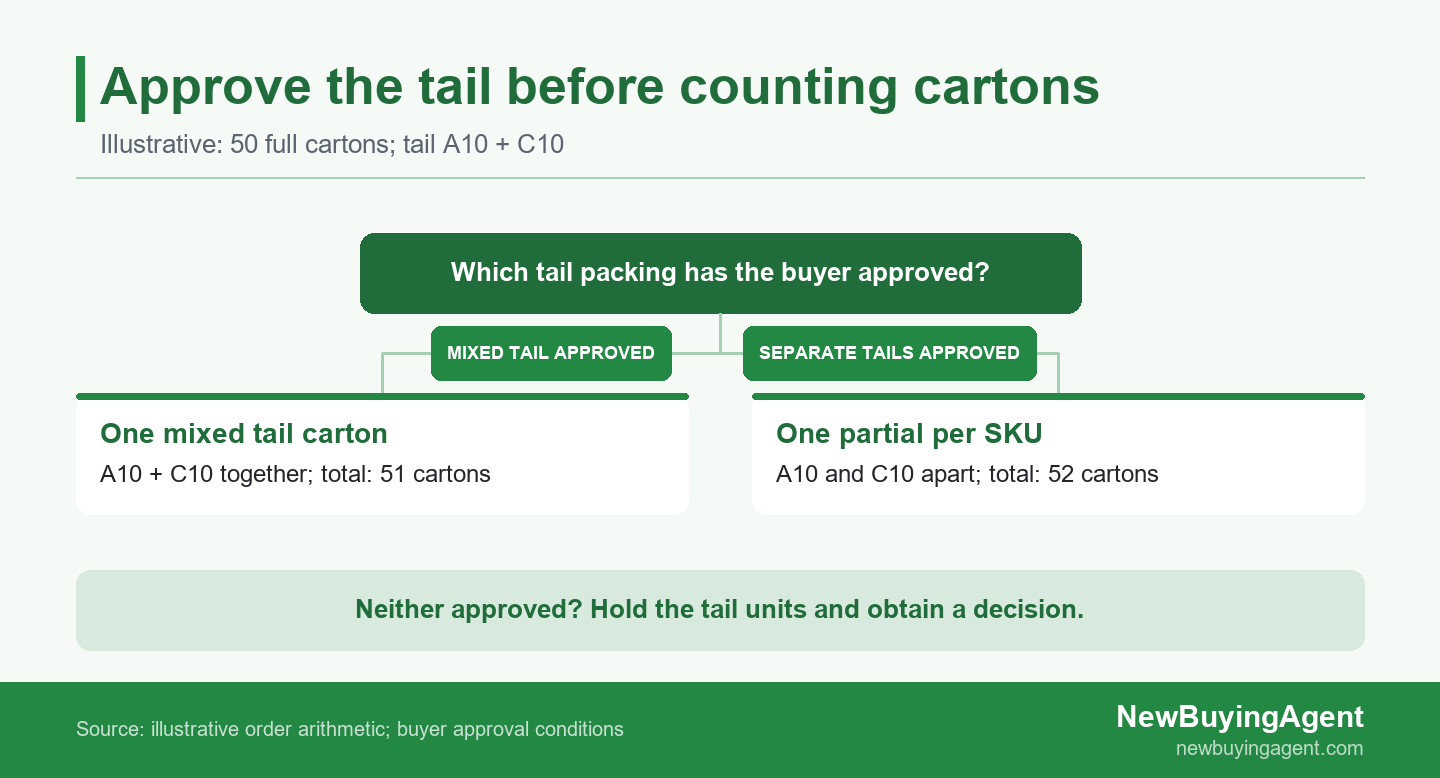
The approved tail rule changes the carton count without changing the SKU quantities.
Turn SKU quantities into full cartons and an explicit tail
The full-carton count is limited by the SKU that can supply the fewest complete approved recipes. Dividing the total order quantity by a nominal carton capacity can miss that constraint because it ignores the required mix inside each carton. A useful planning sheet therefore calculates each SKU’s contribution first, records the remaining units, and assigns those units only to a packing arrangement the receiver has accepted.
Work out complete recipe cartons before the tail
Consider an illustrative China order for kitchen towels: SKU A is blue, B is green and C is sand. The order contains 610 A, 400 B and 210 C, counted as individual towels. Assume the buyer has approved a full-carton recipe of 12 A, 8 B and 4 C, together with the corresponding packing arrangement. These are example inputs, not a client result or a universal capacity for textile cartons.
The recipe contains 24 units. A can supply 50 complete recipes, B can supply 50 and C can supply 52, after rounding each division down to a whole number. The limiting result is therefore 50 full cartons. Those cartons use 600 A, 400 B and 200 C; they do not use every unit simply because the combined order is large enough to fill more boxes.
The table reconciles the individual SKU quantities against those full cartons. “Full” means units allocated to the 50 standard-recipe cartons, while “Tail” means units still awaiting an approved packing decision.
| SKU | Order | Full | Tail |
|---|---|---|---|
| A | 610 | 600 | 10 |
| B | 400 | 400 | 0 |
| C | 210 | 200 | 10 |
| Total | 1,220 | 1,200 | 20 |
Allocate the remainder under the buyer’s actual rule
If the receiver approves the remaining 10 A and 10 C together in one suitably packed tail carton, the plan has 51 cartons: 50 standard cartons and one mixed partial. That last carton contains 20 units and has a different recipe. Its label and content record must show the actual mix rather than copying the 24-unit standard-carton description.
If mixed tails are not accepted but separate partial cartons are approved, the same remaining quantities occupy two cartons, giving 52 cartons in total. Each partial still needs an appropriate protective arrangement. Where only complete standard assortments are accepted, the buyer must decide whether to hold the remaining units, change the order or approve another destination; the factory should not silently round quantities or substitute colors.
Recalculate the plan when a SKU quantity changes. An unchanged total order quantity does not preserve the number of complete recipes if the distribution between variants changes. Keep planned, packed and unshipped quantities separate so the receiving team can distinguish an approved partial shipment from a packing shortage.
Check that the proposed mix works as a physical pack
An assortment recipe is workable only when the actual products, inner packaging and protective materials fit the approved carton arrangement. A count that works on a spreadsheet does not establish acceptable gross weight, restraint, carton strength or product condition after handling. The assembled full carton and any tail configuration need their own checks, because removing items can create movement or change support inside a box that worked when fully packed.
DHL’s multi-item packing guidance calls for individual wrapping and separation using inserts or dividers. The useful principle is that different items need protection from movement and contact, not merely enough combined empty volume. Actual materials and evaluation should suit the product and route; this guidance does not establish a universal divider or test specification for every master carton.
Check the largest or heaviest variants as well as the easiest sample. Differences in folded size, retail sleeves, accessory bags or product shape can change how the mix assembles. Record the finished outer dimensions and gross weight after closing the proposed pack. If a smaller tail carton is proposed, verify that specific configuration instead of assuming the original packing arrangement still applies.
For a pet-product brand ordering bowls and soft accessories, the relevant issue is whether the product combination can be supplied with suitable protection and clear SKU separation. NewBuyingAgent’s product supply from China draws on local factory resources and product-development and quality-control capability. A brief that identifies the items, intended mix and protection needs lets those requirements be considered together with the actual product order.
Include the added packing work and materials in the quotation. Fewer cartons alone do not establish lower delivered cost if the mix adds sorting, protective components or difficult receiving work. Where those inputs are unknown, request them rather than treating carton-count reduction as a measured saving.
Connect each actual carton to its contents and identifiers
Each physical carton needs an identity that points to its actual SKU quantities, while product identifiers describe the trade items involved. The receiver’s agreed system determines how those identities appear on labels and in electronic records. A useful plan keeps the carton reference, product codes and assortment definition separate, then connects them explicitly so a standard case, a mixed logistics carton and a partial carton are not mistaken for the same thing.
In the GS1 system, a Serial Shipping Container Code (SSCC) identifies an individual logistics unit. GS1 explains the SSCC’s role in linking that unit to transaction information. If the customer uses this system, follow the agreed allocation and label requirements; an internal carton number should not be presented as a valid SSCC merely because it is printed as a barcode.
A mixed shipping box is not automatically a predefined assortment sold as a single product. The GS1 GTIN Management Standard describes a predefined assortment as a fixed composition sold together as a single trade item, and requires a new GTIN when an included trade item is changed, added or replaced. Confirm which situation applies before changing a composition or assuming that every incidental shipping mix needs its own sellable-product identity.
The GS1 Logistic Label Guideline separately distinguishes a heterogeneous logistics unit that is not itself a trade item from a unit that is a trade item. For the former, one component’s GTIN should not be used to describe the mixed contents on the GS1 logistics label. Keep the content detail in the agreed records linked to the unit; the applicable label design depends on that unit’s status.
Give each carton type a controlled recipe reference and each actual carton the required unique reference. For the towel example, the standard cartons and the mixed tail need different content descriptions even if they use the same outer carton size. Where lot or batch separation is required, keep those details linked to the SKU and carton as well. A correct barcode scan establishes an identifier’s readability, not that the items inside match the record.
Release one packing instruction and reconcile what was packed
The packing instruction should identify the approved recipe, permitted exceptions and the person who can authorize a change before packing starts. The final carton-content record then needs to reflect what was actually packed, including tails and any approved quantity changes. Reconciliation by SKU and physical carton is the practical check: a matching shipment total cannot reveal every swapped variant, copied tail description or duplicate carton reference.
Copy this planning record into the product-order brief and fill it with the approved references. The quantity unit and tail rule are essential fields, not details to leave for the packer to interpret.
| Field | Approved entry |
|---|---|
| Order / receiver | PO ___; destination ___; receiver rules ___ |
| SKU / unit | Buyer code ___; factory code ___; unit ___ |
| Full recipe | Recipe ID ___; SKU and quantity ___ |
| Tail rule | Allowed mix ___; partial pack reference ___ |
| Carton record | Carton ID ___; actual SKU counts ___ |
| Pack approval | Layout / label revision ___; owner ___; date ___ |
The International Trade Administration’s packing-list guidance describes itemized contents for each package, along with weights and measurements. For a mixed order, keep that carton-level detail connected to the SKU totals. A statement such as “towels, total quantity” cannot explain whether a particular carton contains the standard recipe or an approved partial.
The GS1 Global Traceability Standard emphasizes recorded links between aggregated units and the trade items contained within them. If goods are repacked, update those links to the actual new carton contents rather than preserving a convenient but inaccurate original record.
Before release, check the instruction and assembled packs together:
- Product match: Buyer SKU, factory reference, variant and counting unit agree.
- Recipe match: Full cartons follow the released mix; partials follow the separately approved tail rule.
- Pack match: Actual materials, arrangement, dimensions and gross weight correspond to the approved configuration.
- Record match: Each carton reference links to actual SKU quantities; packed and unshipped balances reconcile to the order.
- Change control: Open exceptions have an owner and decision; superseded instructions are removed from use.
If a repeatable multi-SKU range is being sourced in China, bring the product specifications, SKU quantities, destination, timing and receiving rules to NewBuyingAgent to discuss the multi-SKU product requirements. Those inputs support a quoted product-supply discussion with the assortment and packing needs defined alongside the goods.
FAQ
Can different purchase orders share the same master carton?
Different purchase orders can share a carton only when the receiving partner accepts that arrangement and the carton-content records preserve each order’s allocation. Confirm how the receiver expects those order references in the label or shipment data before combining them. Goods going to the same address do not by themselves establish that the receiving system can process a multi-order carton correctly.
Does mixing SKUs in a carton reduce factory minimum orders?
Mixing products in a shipping carton does not by itself reduce the production minimum order for any of those products or variants. Production quantities may depend on materials, color runs, tooling or the supplier’s actual quotation, while carton assortment concerns how ordered goods are packed. Confirm the product-level commercial terms separately instead of treating a mixed shipping plan as evidence of pooled production or a lower MOQ.
Can the buyer approve a mix using photographs alone?
Photographs can show layout and visible marks, but they cannot by themselves establish every SKU quantity, scan result or required protection performance. Specify the additional observations or evaluation needed for the actual product and receiving rules, such as recorded counts, label scans or an agreed packing assessment. A photograph of one open carton also does not prove that all other cartons contain the same approved recipe.
How should an approved assortment change be handled during production?
An assortment change during production needs a new controlled instruction for the affected cartons, with the previous version stopped before further packing continues. Identify which cartons were already packed and whether they will remain approved, be relabeled or require repacking. Update the content records and relevant product-identification decisions together, so the receiver can distinguish the changed allocation from cartons that correctly retain the earlier instruction.
NewBuyingAgent
Related Resources



Get Started Today
Let's Turn Your Sourcing Goals into RealityWeChat:+86 15157124615
WhatsApp:+86 15157124615
Address:Building 10 #39 Xiangyuan Road, Hangzhou, China
