

An export cut-off is the latest date and time for completing a specified shipment task, such as submitting information or delivering cargo to an agreed facility.
For a China order, the useful question is which unfinished task could prevent the intended sailing. A booking confirmation gives the team a starting point, but factory packing, documentation and transport still have to meet their own commitments. Build the calendar around those separate requirements, then assign the next action to someone who can complete it.
Keep the next China sailing tied to confirmed deadlines
Start a China export plan with the earliest unresolved deadline and the work needed to meet it. Give each cargo or information task an owner, an earlier team target and a specific confirmation record. A later vessel departure may allow a recovery, but the relevant receiving party still needs to confirm the changed acceptance arrangements for that booking.
- Timeline: Copy actual dates, times and time zones from the current shipment instructions.
- How it works: Separate information submission from physical cargo acceptance.
- Risk: Keep rejected or unanswered submissions open until someone resolves them.
- Decision: Recheck dependent tasks when quantity, packing, routing or an accepted deadline changes.
Build the export calendar from the confirmed booking
Build the China export calendar from the confirmed booking and the other parties’ actual requirements, with a separate row for each task. Record the external cutoff, its source version, the person doing the work and an earlier internal target. Close a row against the required response or delivery record, so a completed upload cannot conceal an unfinished cargo handoff.
Gate-in, documentation and VGM deadlines serve different operations. DCSA’s cutoff explanation says the times vary with the terminal, carrier, shipment and equipment. Use that distinction when collecting dates: an advertised sailing is useful for planning, while the calendar needs the requirements for the actual booking and cargo.
Use the table below as a working calendar, adding the actual date, time and time zone beside every applicable row. It covers ordinary container-shipment coordination; dangerous goods, refrigerated cargo and special equipment need their own confirmed requirements. The rows are task categories, not a universal sequence or a fixed number of days before departure.
| Task | Time source | Assign to | Close with |
|---|---|---|---|
| Booking acceptance | Carrier or booking party | Booking contact | Confirmed booking and routing |
| Shipping instructions | Current booking or portal | Authorized document submitter | Submission response; issues resolved |
| Verified container weight | Booking and terminal requirements | Shipper and authorized submitter | Correct container weight received |
| Full container gate-in | Named terminal’s acceptance window | Transport coordinator | Terminal acceptance record |
| Consolidated cargo delivery, if applicable | Consolidator’s named facility | Factory and forwarder | Receipt for the agreed cargo |
| Broker documents and route filings | Responsible broker or filing party | Named preparer and filer | Required documents or filing status confirmed |
For each row, add a team target early enough to prepare, check, submit and correct that item. Choose the allowance with the people doing the work, including their operating hours and actual transport arrangements. If a cutoff is missing, identify who will obtain it and when; an empty date is an unresolved planning dependency, not permission to proceed.
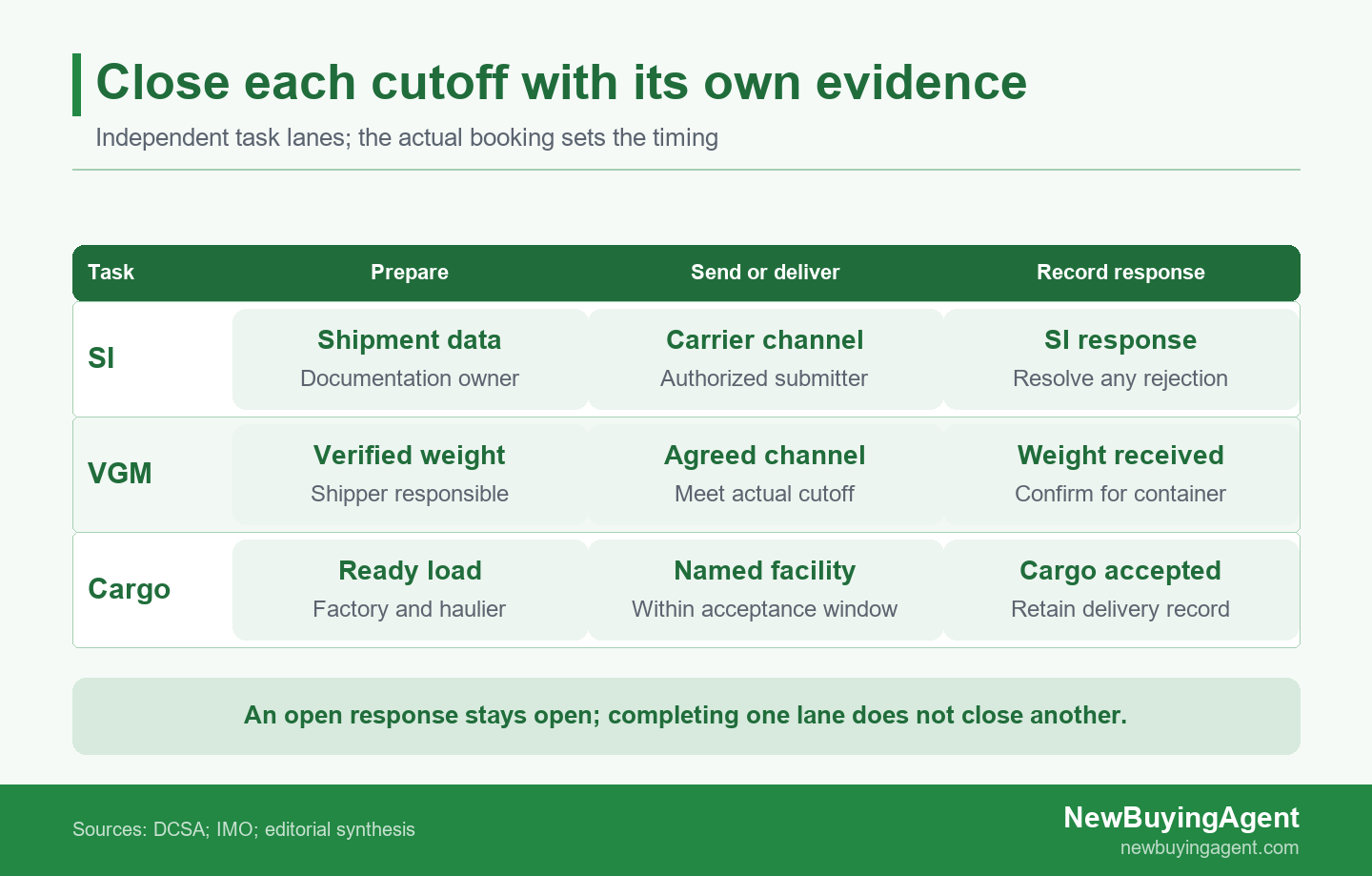
Shipping instructions, verified container weight and cargo delivery each need their own receiving-party confirmation.
Assign the work before the first deadline approaches
Assign preparation, authorized submission and follow-up before the first export deadline approaches. These responsibilities may sit with different people, even when one forwarder coordinates the shipment. The buyer should know who supplies the factory data, who is authorized to send it, and who checks the response, with an available backup for each time-sensitive handoff.
The calendar also needs requirements outside the carrier’s list. DCSA’s published cutoff code notes that customs brokers can set additional document deadlines. It distinguishes the earliest terminal delivery date from the final delivery cutoff, and identifies cargo delivery to a container freight station for the relevant less-than-container-load arrangement. Confirm the actual facility and receiving window rather than sending a truck whenever the goods are ready.
Ask the forwarder to identify the booking party, the document contact and the cargo-receiving contact. Then ask the factory which person can finalize quantities, packing details and loading arrangements. A contact list becomes useful when it says who can answer a particular question: whether a booking change is accepted, whether a data error is corrected, or whether a vehicle can deliver within the agreed window.
For a furniture importer, unfinished protective packing or a held product variant can change the quantity available for loading. NewBuyingAgent’s local factory network and product development and quality-control capability are relevant to the factory and product evidence behind that commitment. Keep the export calendar tied to the quantity actually released for shipment, with any unfinished work identified, rather than carrying the original purchase-order quantity forward unchanged.
Prepare shipment data before the calendar becomes urgent
Prepare shipment data while factory and booking details can still be checked, then finalize each submission when its required inputs are available. Stable party and product information can be reviewed early; the verified weight depends on the actual packed container. An earlier preparation target helps only if the team understands which inputs are reliable and which still require physical work or confirmation.
Check shipping instructions against the actual shipment
Shipping instructions (SI) provide the carrier with the shipment information used for the bill of lading and related customs submissions. Maersk’s SI guidance explains these purposes and says a duplicate shipment copies the earlier details. That shortcut deserves a deliberate check: a repeat product order can still have a different consignee, quantity, container, destination or payment arrangement.
Have the documentation owner compare the draft against the actual shipment: party names and addresses, product descriptions, package counts, cargo weights, container and seal information where required, and the agreed document and freight-payment instructions. Resolve differences with the person responsible for the underlying information. Do not guess a missing value just to make a form submit successfully.
Set a preparation target that leaves time for the buyer to answer document questions across time zones. After sending the SI through the agreed channel, retain the response and assign any returned error. Check the resulting transport-document draft when it becomes available. That later document review has a different purpose from submitting the initial information, so give it its own follow-up task instead of assuming the first upload completed everything.
Obtain the packed container weight through the agreed method
Verified gross mass (VGM) is the verified total weight of a packed container. For applicable SOLAS packed-container shipments, IMO’s explanation of the VGM requirements makes the shipper responsible for providing it early enough for stowage planning. Availability to the master or representative and the terminal representative is a loading prerequisite, not an entitlement to loading; the master retains discretion.
Agree how that weight will be obtained and who will communicate it. IMO describes weighing the packed container, or using the approved certified method that combines the cargo, packages, pallets, securing materials and container tare weight. The latter method needs approval by the competent authority where packing was completed. A product’s net weight or an estimated booking weight does not establish the final packed-container VGM.
The physical sequence also needs checking. Hapag-Lloyd’s VGM FAQ says its cutoffs are determined locally and that its booking confirmation identifies terminals requiring VGM before gate-in. For such a terminal, planning to provide the weight only after delivery creates a dependency problem. Confirm the actual booking condition and arrange weighing and transmission before dispatching against an impossible sequence.
Keep the verified value, unit, container identifier and authorized submission details together. If the packed load changes, ask the responsible parties what must be reweighed or corrected before relying on the previous declaration. Close the calendar item using the applicable response for that container, while keeping cargo acceptance and loading status separate. A weight submission is one necessary input, not evidence that the container has sailed.
Close calendar items with the right confirmation
Close export-calendar items with a dated response that matches the task and shipment, retaining both the event time and the time the update reached the team. Use clear statuses such as prepared, submitted, confirmed or blocked. A rejected submission needs a correction owner, while an unanswered one needs a follow-up owner; neither should disappear behind a general “documents done” message.
The distinction between the event and its update is reflected in UN/CEFACT’s transport-event vocabulary, which separates actual and estimated occurrence from when information was received. Apply that distinction to a practical record: a truck may have entered earlier than the buyer received the terminal message. Save both times so the team can tell what happened and how current its information is.
Copy the following fields for each applicable deadline. Keep the original external cutoff beside any accepted revision, and attach or link the actual response rather than replacing it with someone’s summary.
- Shipment: order scope, booking, vessel/voyage or leg, container or cargo reference, and receiving facility.
- Requirement: task, external date/time/time zone, source document or portal version, and when checked.
- Execution: earlier team target, preparer, authorized submitter or haulier, and follow-up contact.
- Progress: present status, actual submission or delivery time, receiving response and when the team received it.
- Exception: blocker, requested change, accepted scope if any, next action, responsible person and decision deadline.
A kitchenware wholesaler retaining several Chinese factories may need local follow-up when inspection findings, finished quantities and packing updates arrive separately. NewBuyingAgent’s existing-factory management connects production and quality management with China-side supplier communication and logistics coordination. Agree that service scope around the recurring order, including who provides release information, so the calendar reflects factory progress the buyer can act on.
Resolve a threatened cutoff while alternatives remain feasible
Escalate a threatened export cutoff while a practical alternative can still be arranged. Identify the unfinished input, the time needed to complete it and the party that can accept a change. Compare the confirmed recovery with the next feasible sailing or a revised quantity, including the affected transport and handling costs, instead of treating a requested extension as an approved plan.
Confirm an extension instead of inferring it from a later ETD
Estimated time of departure (ETD) is the forecast time a vessel will leave the named port. A revised ETD is a reason to check the calendar, rather than move all its entries by the same interval. Terminal acceptance, document processing and broker work can still depend on their separately communicated deadlines and operating arrangements.
For its China shipments, Hapag-Lloyd’s documentation FAQ points customers to booking-confirmation or To Do deadlines and to customer service for an SI extension. It warns that late SI can bring a fee and loading risk. Use that as a carrier-specific reason to obtain an actual response; it does not establish a universal charge or an automatic right to more time.
Send the booking reference, affected task, reason, proposed completion time and cargo scope to the relevant contact. Ask which deadline is accepted, whether any linked cutoff also needs changing, and what charges or conditions apply. If two notices disagree, preserve both and ask the booking party to resolve the conflict. Keep the last confirmed requirement visible until the replacement is verified.
Use the calendar to decide whether a late quantity can travel
Illustrative example: a kitchenware importer has a Ningbo shipment with SI due Thursday morning, VGM due Friday morning and terminal gate-in closing Friday afternoon. These are hypothetical booking inputs, not standard Ningbo times. On Thursday, the factory reports that part of the order will not finish packing until Friday afternoon; a separate message moves the vessel’s ETD to Saturday.
The calendar now exposes the issue: unfinished packing leaves weighing, collection and gate-in unresolved for the late quantity. The logistics manager asks the booking party whether later cargo acceptance is possible and asks the factory and haulier for a feasible completion and delivery plan. The documentation owner checks what the proposed quantity change would affect, rather than marking the SI and VGM rows complete from the sailing update.
If the relevant parties confirm revised acceptance and the remaining work can meet it, record the accepted deadlines and revised actions. If an extension remains unconfirmed, do not plan the late quantity as accepted on that sailing. Check a later departure, or assess a ready-only shipment if the carrier arrangements, documentation changes, added costs and buyer’s replenishment needs support it. Confirm those conditions before committing to the split.
The observable result is a revised calendar with an accepted move, or a specific unresolved quantity awaiting a new plan. It is not a promised delivery outcome. Keep any late-handling, amendment or extra transport quote tied to its actual service and cargo scope, and obtain commercial approval where required.
When the recurring problem starts with supplier production or packing, include it in the wider purchasing brief. Share product specifications, quantities, destination, delivery needs and the existing supplier situation, along with the current booking constraint, to discuss the purchasing and existing-factory support scope with NewBuyingAgent. The next step is an agreed procurement or factory-management scope and quotation, with the topic-specific responsibilities made clear.
Frequently Asked Questions
Can a booking be made before final packing is complete?
Yes, a booking can be arranged using the required preliminary information, but final shipment data still needs a named update plan. Ask the booking party what it needs at the request stage and what can be completed later. Keep estimated quantities or weights clearly identified, then reconcile them with the actual shipment before the relevant submissions. An early booking does not remove packing, weighing or documentation dependencies.
Does submitting VGM inside an SI form close both deadlines?
A combined submission route does not make the SI and VGM deadlines identical. Check whether the agreed channel transmits both sets of information and which responses show they were received for the right booking and containers. If one part is rejected or incomplete, leave that item open. Do not resend blindly: first query the existing submission or ask the receiving contact how to correct it.
Does sending shipping instructions complete destination security filings?
Shipping instructions alone do not establish that a separate destination security filing has been completed. For covered U.S. vessel cargo, 19 CFR 149.2 requires the ISF Importer or authorized agent to submit Importer Security Filing information, and the filing party updates changed information. Identify the applicable filing, responsible party, actual timing and confirmation for the route. Keep its status separate from the carrier’s SI response.
How should supplier holidays affect the export calendar?
Move the team’s preparation targets to times when the responsible people and services are actually available. Check factory closure, document-signing cover, weighing arrangements, trucking and the receiving facility’s working window. Ask for backups before key contacts leave. A holiday allowance belongs in the internal plan unless the relevant party confirms a changed external cutoff; it does not by itself extend the booking requirement.
NewBuyingAgent
Related Resources



Get Started Today
Let's Turn Your Sourcing Goals into RealityWeChat:+86 15157124615
WhatsApp:+86 15157124615
Address:Building 10 #39 Xiangyuan Road, Hangzhou, China
