


Cargo ready date (CRD) is the date goods are expected to be available for an agreed handoff at a named location. Estimated time of departure (ETD) is the forecast time a vessel will leave a named port on a specified transport leg.
For an importer planning recurring orders from China, CRD organizes the supplier handoff while ETD organizes the expected sailing. The gap contains real work: collection, terminal delivery, shipment information and loading. Treating either date as proof that this work is complete can turn an apparently comfortable schedule into a missed departure.
Plan the cargo handoff and the sailing separately
A workable shipment plan keeps cargo readiness and vessel departure in separate fields, with a named place and current source for each. Supplier follow-up should establish what can actually be handed over, while freight follow-up should establish the booked route and its remaining deadlines. Actual pickup, loading and departure then require their own confirmations rather than being inferred from either forecast.
- Definition: CRD describes cargo availability; ETD describes an expected transport departure.
- Timeline: connect readiness to the current collection and terminal handoffs.
- Risk: a later ETD does not independently confirm a deadline extension.
- Decision: choose recovery from the missed handoff and verified alternatives.
Cargo ready date and ETD answer different questions
Cargo ready date answers when the agreed goods should be available for their named handoff, while ETD answers when the specified vessel leg is expected to depart. Neither establishes that the cargo has been loaded or that the vessel has sailed. An importer needs both dates because the factory’s readiness and the carrier’s departure plan concern different parts of the same shipment.
The comparison below uses the same containerized shipment and the named location or leg attached to each milestone. It compares what the date describes, who normally supplies the update and which decision it informs. These are complementary milestones, not alternative services or measured rankings.
| Date | Scope | Source | Decision |
|---|---|---|---|
| CRD | Expected cargo availability | Factory or agreed handoff party | Plan collection |
| ETD | Expected departure of named leg | Carrier or booking party | Plan sailing |
| ATD | Actual time of departure | Transport event record | Confirm vessel progress |
| ETA | Expected arrival at named location | Current transport plan | Plan next handoff |
Based on this comparison, supplier collection should be planned from a defined CRD and the relevant pickup arrangement, while ocean routing should use the current ETD. Use actual time of departure (ATD) for a completed departure event. Estimated time of arrival (ETA) forecasts the next named arrival; it does not automatically describe final warehouse receipt.
The distinction between forecast and fact is reflected in DCSA’s event classifications, which separate actual, planned, estimated and requested events. Read the status alongside the date. A portal can display a detailed future timestamp without claiming that the event has already happened, and an earlier planned value may remain visible in its history.
Match the location and leg as well as the acronym. A feeder departure, main-vessel departure and transshipment departure can all appear in one itinerary. If an update says only “ETD changed,” ask which movement changed before revising the rest of the order plan.
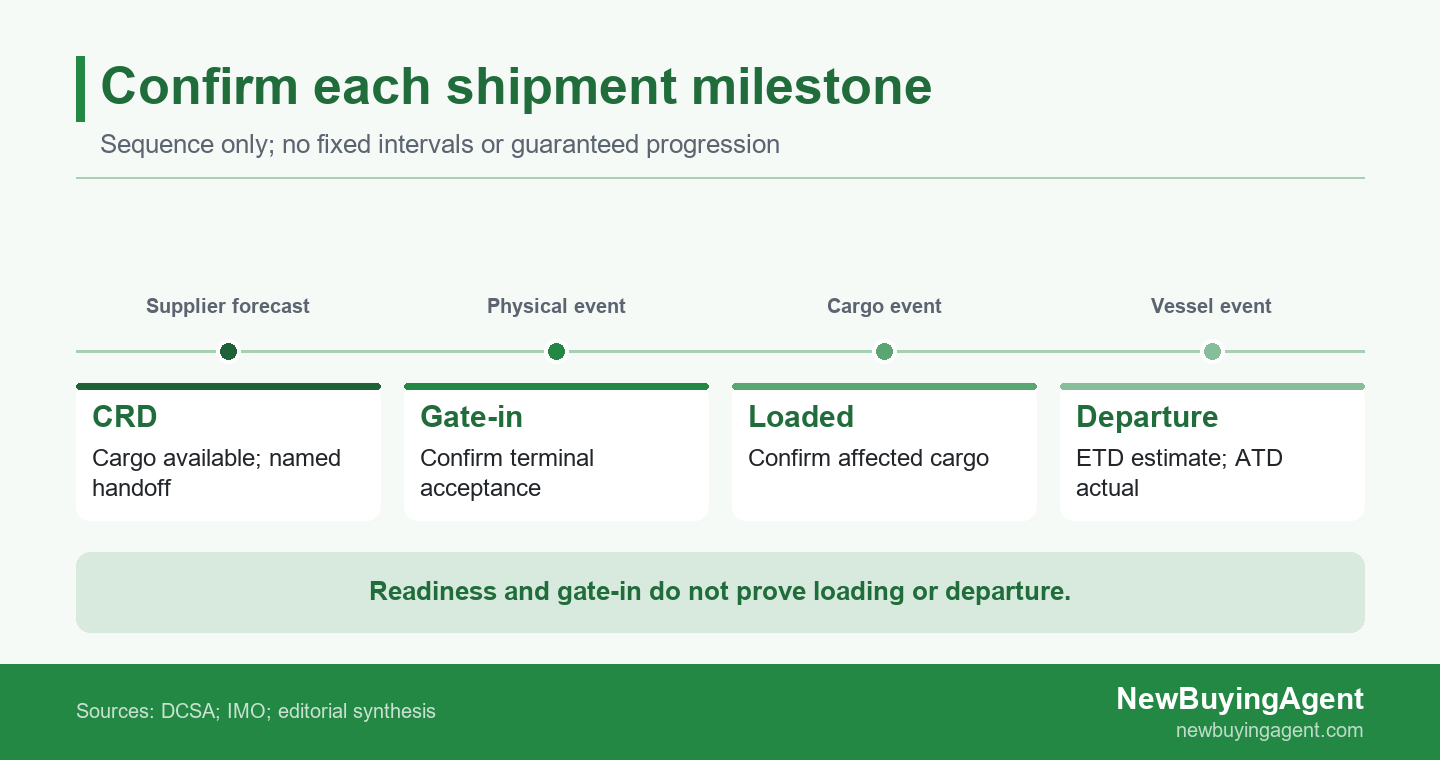
Cargo readiness, gate-in, loading and actual departure need separate evidence; ETD forecasts the vessel’s departure.
Make the cargo ready date a checkable supplier commitment
A useful cargo ready date identifies the goods, handoff location, expected availability and conditions still needed before collection. Ask the factory whether its date covers the agreed packed quantity and release requirements, rather than assuming that production completion means immediate pickup. The buyer and supplier should resolve any difference between a manufacturing forecast and the availability needed by the booked transport arrangement.
For example, a furniture order may be assembled while export cartons or agreed corrective work remain unfinished. A date based on the last assembly operation does not tell the trucker when the shipment can be collected. Ask which remaining task controls collection and who will confirm its completion. Keep the initial forecast visible when it is revised so the reason for movement can be understood.
Set the order scope explicitly. If the factory can release only part of the assortment, record the ready items and quantities separately from the balance. That information allows the importer to assess a split shipment; a general “ready” message cannot show whether the available goods form a commercially useful delivery.
For a retailer replenishing furniture from retained China factories, readiness depends on the actual product and packing condition. NewBuyingAgent’s local factory resources and product development and quality-control capability are relevant to obtaining and interpreting that manufacturing evidence. The supplier update should identify unfinished product or packaging work so the buyer can judge collection readiness before committing the downstream arrangement.
Test whether readiness can meet the booked departure
The test between CRD and ETD is whether the physical cargo and required information can meet the current handoffs for the booked shipment. Start with those deadlines and work back to a feasible factory collection, allowing for the actual inland arrangement. Keep physical acceptance and document submission separate, because completing one does not establish that the other is finished.
DCSA’s cut-off guidance identifies distinct gate-in, documentation and VGM deadlines and explains that their details vary by carrier, terminal, shipment and equipment. Operational changes can also generate updated cutoffs. Obtain the values for the actual booking instead of applying a universal gap between factory readiness and departure.
Check collection and terminal acceptance as separate events
First identify who collects the goods and where the next party accepts them. For a full-container move, confirm the relevant equipment, loading and terminal-delivery arrangement with the transport provider. For a consolidated shipment, the cargo may need acceptance at an origin facility before the container moves onward. The supplier’s readiness statement should match the handoff that has actually been purchased.
Maersk’s LCL terms illustrate why the service boundary matters: warehouse-delivery arrangements require delivery within the booking confirmation’s cutoff, while specified door-pickup arrangements require goods to be ready on the confirmed pickup date. Those are terms for that carrier’s LCL product, not a rule that every China shipment uses the same handoff.
Confirm terminal acceptance from the relevant event or receipt. A truck dispatch message proves that a movement was arranged or started; it does not by itself prove that the terminal received the intended container. Where an appointment or receiving window applies, include that constraint in the collection plan rather than treating the published vessel ETD as the delivery deadline.
After acceptance, continue following the affected cargo through loading. Gate-in describes a terminal event, while loading describes placement aboard the vessel. Keep these observations separate so a vessel’s later departure cannot hide a container that did not make the intended sailing.
Complete the required shipment information before its deadline
Shipping instructions (SI) are the shipment information sent to the carrier for transport-document preparation. Their submission has its own deadline and responsible party. Ask who supplies the commercial details, who checks them and who submits the instructions. A factory may have finished the products while the booking party is still waiting for information needed to process the shipment.
Verified gross mass (VGM) is the verified total mass of a packed container. IMO’s guidance explains that, for containers within the applicable SOLAS scope, the shipper provides VGM to the master or representative and terminal representative sufficiently early for stowage planning. It is a prerequisite for loading, but its availability does not create an entitlement to loading; the master retains the relevant discretion.
Hapag-Lloyd’s China FAQ directs customers to their booking confirmation or shipment tasks for VGM and shipping-instruction deadlines, and to customer service when seeking an SI extension. A revised ETD on a schedule is therefore not independent confirmation that a particular information deadline has been extended. Obtain the applicable response for that booking.
Record submission and any required acceptance separately if the provider’s process distinguishes them. A draft saved in a portal or an email prepared internally may not mean that the receiving party has the required information. When a field remains unresolved, identify the responsible person and the decision time instead of filling the gap with an assumed completion date.
Keep one dated shipment record with named update owners
A shared shipment record should say which event each date describes, where it applies, whether it is estimated or actual, and who supplied the latest information. Assign an update owner for supplier readiness and another for the transport plan when those responsibilities differ. Retaining the previous value and reason for change helps the importer see what moved and which dependent action needs attention.
UN/CEFACT’s transport-event vocabulary distinguishes the time an event occurs from the time information about it is received. That is a useful distinction for ordinary order tracking too. An update received this morning may describe yesterday’s pickup or a future expected departure; the message timestamp should not replace the event time.
Copy this record for each material update. Replace the bracketed entries with the current shipment information, leaving unknown facts explicitly unresolved:
- Order scope: [Order, items, quantities and affected container or consignment]
- Milestone and place: [CRD, pickup, gate-in, loading, ETD, ATD or ETA; named location and leg]
- Current value: [Date, local time, time zone and estimated/planned/actual status]
- Evidence: [Supplier confirmation, current booking, provider event or other relevant reference]
- Update received: [Timestamp, source party and person responsible for checking it]
- Change: [Previous value, reason, affected handoff and unresolved information]
- Next action: [Responsible person, decision deadline and confirmation needed]
For an importer reordering kitchenware from established factories, scattered supplier and freight messages make this record difficult to maintain. NewBuyingAgent’s existing-factory management can cover agreed production follow-up, QC reporting and logistics coordination as the buyer’s local China support. Share the supplier situation and order references so responsibilities for those updates can be defined within the management scope.
Use a clear exception message when a fact is missing: “Factory readiness revised; collection feasibility not yet confirmed.” That tells purchasing and sales what can be relied on without upgrading an unverified forecast into a promise. Close the exception when the responsible party supplies the relevant evidence.
Replan the affected handoff when either date changes
A date change should trigger a check of the affected handoffs rather than an automatic shift of every entry in the plan. When CRD moves, test collection and cargo acceptance against current deadlines; when ETD moves, obtain the revised transport plan and confirm which related deadlines changed. Update the customer-facing expectation only after identifying the actual movement and remaining uncertainty.
Choose a feasible recovery from the actual missed milestone
Consider an illustrative homewares shipment. The factory initially expects packed goods to be collectible on Tuesday, but unfinished cartons move availability to Thursday. The booking’s cargo handoff is Wednesday, with the vessel expected to depart Friday. The buyer cannot preserve that sailing simply by replacing Tuesday with Thursday in the order sheet: the current physical handoff is already incompatible with the new readiness forecast.
Now suppose ETD moves to Saturday. That creates a possible recovery question, not an accepted recovery. The booking party checks whether the relevant terminal or origin facility will accept the later handoff, whether collection is feasible and whether the information deadlines remain achievable. If those confirmations are missing, the buyer keeps the sailing at risk and requests alternatives.
If the revised handoff is accepted and the supplier can meet it, retain the sailing with the new evidence. Otherwise compare a later departure with a split of genuinely ready goods, checking product usefulness, added handling and the buyer’s required receipt date. Confirm revised charges and capacity before authorizing a change; the example does not imply that splitting or extending acceptance is always available.
A dated change record is more useful than an undated schedule image. For example, Maersk’s Transport Plan Change Notice identifies the updated vessels, ports and ETD/ETA by leg in a timestamped, booking-specific document available to the booked-by party. Ask the actual booking party for the corresponding current evidence when communicating a changed plan.
Use route evidence to size time and cost allowances
Time allowances should reflect the work and uncertainty on the actual route. Separate the factory’s remaining tasks, collection availability, origin receiving constraints and later transport connections. Review relevant prior shipments and current provider information when available. A repeated fixed gap between CRD and ETD can conceal different bottlenecks on different orders.
The World Bank’s Container Port Performance Index benchmarks container-port performance using vessel time in port, including waiting and berth time, and calls for contextual interpretation. Such evidence helps explain port conditions, but it does not measure a particular factory’s readiness or the full journey to the buyer’s warehouse. Use it as context alongside the booking and route evidence rather than as a substitute lead-time promise.
For each recovery option, compare the same scope of cost. Ask whether the revised quotation includes the affected collection, handling, storage and freight items, and identify unconfirmed charges. Keep inventory or customer-delay exposure visible alongside transport costs. The lowest freight line alone cannot show which option best protects the order’s commercial purpose.
For recurring orders from retained China suppliers, discuss the existing-factory support scope with NewBuyingAgent. Provide the products and specifications, quantities, destination, required receipt date and current supplier situation, with readiness and booking references. Those inputs support an agreed management scope and quotation covering the relevant factory follow-up, quality and logistics coordination.
Frequently Asked Questions
Can an importer book freight before the goods are ready?
An importer can plan or request freight before cargo is ready when the readiness forecast and booking assumptions are explicit and the relevant parties accept them. Confirm the current booking window, equipment and capacity situation with the provider. Keep the supplier forecast under review and check the applicable amendment or cancellation terms before committing. An early booking request should not be recorded as proof of completed factory readiness.
Does actual vessel departure prove that every ordered carton shipped?
Actual vessel departure establishes a transport event, while confirmation of the shipment’s loaded scope requires matching container or consignment evidence for the affected order. Reconcile the ready and collected quantities with the relevant loading and shipment records. If part of an assortment was held back, show that balance separately. A vessel can depart while the buyer still needs confirmation of which ordered goods traveled on it.
Should an ETA be treated as the warehouse delivery appointment?
An ETA should be treated as the expected arrival at its named location, while warehouse receipt requires a separate plan for the remaining handoffs. Identify whether the estimate refers to a port, intermediate connection or another place. Then check the applicable clearance, release, onward collection and receiving arrangements. Share an updated warehouse expectation only when those remaining steps have been considered with the responsible parties.
Can an Incoterm alone settle what the cargo ready date means?
An Incoterm alone does not give a shipment-specific operational definition of cargo readiness; record the named handoff and responsibilities against the agreed contract and booking. The parties still need to identify the available goods, relevant place and release conditions. If supplier and transport instructions conflict, resolve that difference with the responsible commercial and booking parties before arranging collection. Do not settle it by relabeling one date.
NewBuyingAgent
Related Resources



Get Started Today
Let's Turn Your Sourcing Goals into RealityWeChat:+86 15157124615
WhatsApp:+86 15157124615
Address:Building 10 #39 Xiangyuan Road, Hangzhou, China
