

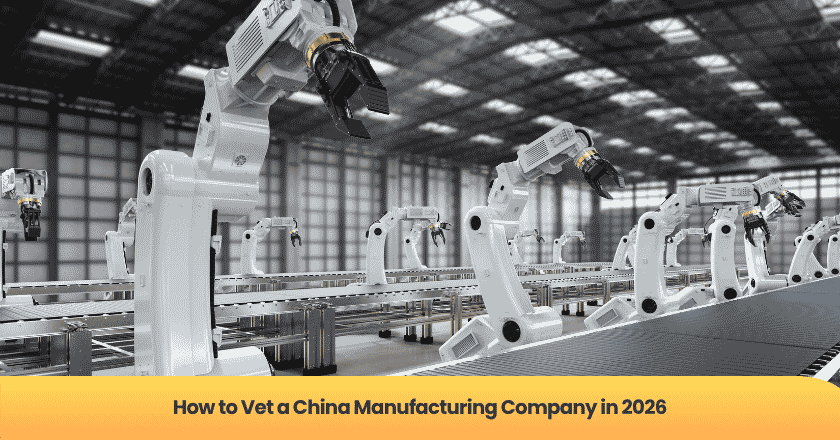
Introduction
A confident quote and a polished catalog tell you almost nothing about whether a China manufacturing company can actually deliver. The gap between a company that looks credible in an email thread and one that holds up under a real order is where most sourcing money gets lost. Vetting is the work of closing that gap before your deposit leaves your account, and in 2026 the tools to do it well — remote audits, verifiable certificates, traceable payment records — are better than ever. What follows is the sequence that separates a company you can trust with production from one you only hope you can.
Key Takeaways
• "Manufacturing company" is a loose label that can mean a real factory, a trading company, or a hybrid — and which one you're dealing with changes your price, your quality control, and your accountability.
• Documents prove a company exists and is licensed; they don't prove it can make your product, so paper checks and capability checks are two separate jobs.
• The registered company name on the business license should match the bank account you pay, and a mismatch is one of the clearest middleman warning signs.
• Certifications and audit reports only count if they're current, verifiable with the issuing body, and tied to the facility actually making your goods.
What "Manufacturing Company" Actually Covers
The phrase "manufacturing company" gets stretched to cover businesses that operate in completely different ways, and the differences decide who is accountable when something goes wrong. A true factory owns production lines and makes goods in-house. A trading company buys from factories and resells, sometimes adding useful service and sometimes just a markup. Between them sits the industry-and-trade hybrid (gongmao yiti), a company that runs its own production and also trades — a legitimate, common model that still requires you to confirm which role it's playing for your order.
None of these is inherently wrong. A trading company that consolidates several components can be genuinely useful. The danger isn't the model; it's not knowing which model you've hired — a trading company quoting as a factory hides a markup you can't see and a production process you can't inspect, because the people making your goods are one step removed from the company you signed with.
Why the distinction drives everything else
Who you contract with determines how directly you can influence quality, how transparent your pricing is, and who answers when a shipment fails. Deal directly with the maker and a quality problem is a conversation with the people who can fix it. Deal through an undisclosed intermediary and it becomes a game of telephone, with your influence diluted at every step. Establishing the company type isn't a formality — it's the foundation every later check is built on.
Common Mistake: Assuming a company is a factory because it says "manufacturer" in its name or shows you a factory video. Names are unregulated and videos can belong to anyone. The only reliable signal is documentary and operational evidence — a business license whose scope includes production, plus verifiable proof that the lines shown are theirs — not the label the company chooses for itself.
The Documents That Prove a Company Is Real
Paperwork is where vetting starts, because it's the cheapest filter and it weeds out the companies that can't pass even a basic check. The core document is the Chinese business license, which lists the registered name, a unified social credit code (the 18-character national business ID), the registered capital, the legal representative, and — critically — the business scope. The scope tells you whether the company is licensed to manufacture or only to trade, and it's the first place a trading-company-posing-as-a-factory gives itself away.
Ask for the business license and verify the unified social credit code rather than accepting the document at face value. The registered name on that license should appear on your contract and on the bank account you pay. A company that invoices from one entity but asks you to pay a differently named account is showing you something worth pausing over, because that gap is a frequent signature of an intermediary routing money.
Beyond the license
For export orders, confirm the company holds the import-export rights needed to ship internationally, or understand who handles export on its behalf. Where relevant, ask for a recent third-party audit — a BSCI, Sedex, SMETA, or similar report — and treat it as a lead to verify, not a verdict to accept. An audit proves something only when the issuing body confirms it's real, current, and tied to the facility producing your goods.
Expert Tip: Match three names before you pay anything: the company on the business license, the company on your sales contract, and the holder of the bank account receiving your money. When all three align, you've closed the most common route a middleman uses to sit invisibly between you and the factory. When they don't, ask why in writing and keep the answer — a legitimate explanation exists for some mismatches, but you want it documented before funds move.
Verifying Capability Beyond Paper
A company can be entirely real, properly licensed, and still wrong for your product. Documents prove existence; they don't prove the business can make what you need at the quality and volume you require. This is the second, separate phase of vetting, and the one buyers most often shortchange because it takes more effort than reading a PDF.
Start with specific production questions a real maker answers easily and a reseller fumbles: which machines run your product type, how many units of that equipment they operate, their typical defect rate on comparable orders, and where their materials come from. Vague answers, or answers that pivot to reassurance instead of detail, tell you the knowledge sits somewhere other than the company you're talking to.
Seeing the floor, in person or remotely
A factory visit remains the strongest verification, and in 2026 a live remote audit is a credible substitute when travel isn't practical. A real-time video walkthrough — not a pre-recorded tour — lets you see the lines running, the equipment that matches your product, the in-line quality checks, and the material store that backs up the claims. Insist it's live and unscripted, and ask to see the specific machinery your order depends on rather than a general sweep of an impressive floor.
The subcontracting question
A company short on capacity may accept your order and quietly hand part of it to a workshop you never assessed, which means your audit covered a facility that isn't making your goods. Some subcontracting is legitimate and disclosed; the risk is the undisclosed kind. Ask plainly whether any part of production happens off-site, require disclosure of subcontractors, and reserve the right to inspect them too. Your order is only as verified as the least-checked place it passes through.
Common Mistake: Treating an approved sample as proof of production capability. A sample is made under ideal conditions by the company's best people with unlimited time. It confirms the company can make one good unit, not that it can reproduce that unit ten thousand times under deadline. Verify the system that produces consistency — equipment, staffing, in-line checks — not just the showpiece that came back looking perfect.
Compliance, Quality Systems, and Risk in 2026
Vetting a manufacturing company now includes confirming it can meet the regulatory and quality demands of your specific market, because a technically functional product you can't legally sell is worthless. Confirm the company has produced for your target market and understands the certification path your product needs — CE marking for the EU, FCC for US electronics, CPSIA for children's products, or the labeling and restricted-substance rules your category carries. A company that treats compliance as your problem alone, rather than a shared requirement it has navigated before, will hand you surprises at customs.
Quality systems deserve the same scrutiny as the product itself. Ask how the company handles defects found in-line, whether it works to an AQL (Acceptable Quality Limit — the agreed maximum defect rate an order may contain) standard, and how it documents and corrects problems. A company with a real quality system describes its process specifically; one without will speak only in reassurances.
Pricing the Real Cost of Vetting
Thorough due diligence has a cost — your time, possibly an inspection fee, perhaps a paid sample — and buyers chasing the lowest quote often skip it to save those small sums. That math works only until the first failed order, at which point the saving is dwarfed by the loss. A misjudged manufacturing company doesn't just cost you the bad batch; it costs the freight to ship it, the customs and storage on goods you can't sell, the customers who don't return, and the months spent restarting with a new supplier.
Price vetting against that downside, not against the unit quote. An inspection that catches a defect before shipment, a license check that exposes a middleman before money moves, or a capability audit that steers you away from a company that can't make your product — each pays for itself many times over the first time it works. The cheapest-looking company is rarely the lowest true cost once the risk of getting it wrong is counted, and the best partners tend to welcome the scrutiny rather than resent it.
A simple sequence to follow
Run the checks in an order that fails fast and cheap: confirm the company type and license first, match the names on license, contract, and bank account, then verify capability through specific questions and a live or on-site audit, confirm the compliance your market demands, and only then commit — with payment tied to an independent inspection rather than released on trust. Each step filters out a category of risk before you've spent much, so the companies reaching your shortlist have already cleared the bars that matter most.
How NewBuyingAgent Helps You Vet a Manufacturing Company
Running document checks, capability audits, and compliance verification well from another country is demanding work, and getting any single step wrong can undo the rest — which is why many buyers run the process through a sourcing partner. NewBuyingAgent is your perfect partner for global sourcing from China, backed by 30 years of expertise in trade, manufacturing and quality control.
Reaching past the resellers to a genuine, verifiable maker is the foundation the whole vetting process is built on: with 100% Access to China's Factories, you use their 50,000+ cooperated partner factories—no language/region/time zone barriers. Their local reputation gets you full factory cooperation. That breadth of selection also leaves room to choose well on price, not just on fit: with Lower Prices Than Direct Sourcing, their wide factory network lets us pick low-cost, high-cooperation suppliers. Even with their margin included, they cut your costs by 5%-10%. And because a company's real quality shows in production rather than in a sample or a certificate, the verification has to be held independently: NewBuyingAgent's 20,000+ product development & QC experts ensure your products match market needs and stay high-quality. Contact now.
Frequently Asked Questions
How do I tell a factory from a trading company?
Check the business scope on the company's Chinese business license — it states whether the company is licensed to manufacture or only to trade. Back that up with specific production questions and a live or on-site audit. A real factory answers detailed questions about its own equipment and process easily; a trading company tends to deflect to reassurance or relay answers from elsewhere.
Is a remote audit good enough, or do I need to visit in person?
For many orders, a live, unscripted video audit is a credible verification in 2026, especially paired with independent inspection during production. For a first order in a high-value or technically demanding category, having a qualified third party physically present closes the gap a screen can't fully cover.
Why does the bank account name matter so much?
The account receiving your payment should match the company named on your contract and business license. A mismatch is one of the most common signs that an intermediary is routing your money, and it can also complicate any future dispute or claim. Align all three names before funds move, and document any explanation for a difference.
How much does proper vetting cost?
Far less than a failed order. The direct costs — your time, a possible inspection fee, a paid sample — are modest next to the freight, customs, storage, and lost customers a wrong-company order can generate. Treating vetting as insurance priced against the downside, rather than an expense measured against the quote, is the way to think about it.
Conclusion
Vetting a China manufacturing company is a sequence, not a hunch: establish what kind of company it really is, prove it on paper, prove it can actually make your product, confirm it meets your market's rules, and price the check against the risk it removes. Run those steps in order and most sourcing disasters never get started, because the companies that can't pass fall away before your money is exposed. The quote is the easy part to compare; the company behind it is the thing worth verifying.
NewBuyingAgent
Related Resources
Get Started Today
Let's Turn Your Sourcing Goals into RealityWeChat:+86 15157124615
WhatsApp:+86 15157124615
Address:Building 10 #39 Xiangyuan Road, Hangzhou, China
