

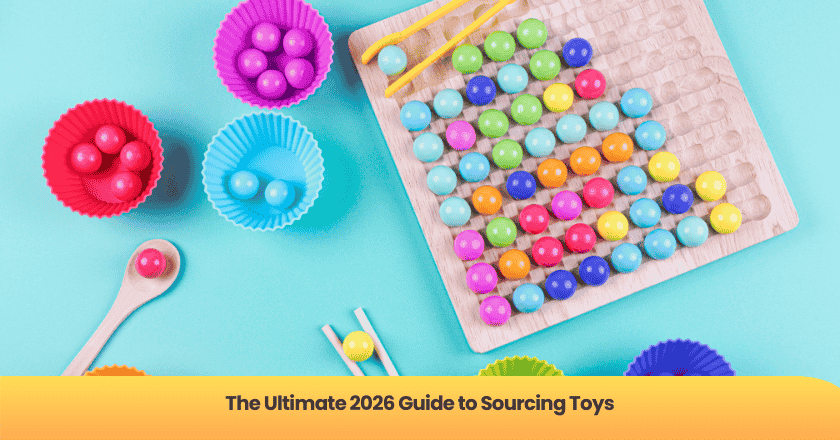
Navigating the global toy sourcing landscape in 2026 requires far more than simply finding a supplier with the lowest unit price on a B2B platform. The industry is currently undergoing a massive structural shift. Driven by aggressive environmental mandates, the rapid integration of artificial intelligence in interactive play, and highly volatile global supply chain dynamics, buyers must adopt a sophisticated and data-driven approach.
Whether you are an established retail buyer, a high-volume cross-border e-commerce seller, or an independent brand developer, securing reliable and compliant inventory today demands a rigorous understanding of geopolitical manufacturing shifts, advanced material sciences, and unforgiving safety protocols. This comprehensive guide is engineered to provide industry professionals with the precise architectural knowledge needed to build a resilient, legally secure, and highly profitable toy sourcing strategy in 2026.
Macro-Trends Dictating Toy Sourcing in 2026
Before issuing a single Request for Quotation (RFQ), buyers must intimately understand what the modern consumer is demanding. Procuring outdated product categories guarantees dead stock. The 2026 market is heavily bifurcated between hyper-advanced digital integration and a nostalgic return to sustainable, physical play.
The Phygital Ecosystem and AI Integration
Toys are no longer strictly physical or entirely digital; they exist in a blended reality. Sourcing phygital toys—physical items equipped with NFC chips, computer vision modules, or basic local AI models that interact with companion apps—is dominating the educational and action figure sectors. Buyers must source not just the plastic shell, but the embedded logic. This requires vetting suppliers who possess robust PCBA (Printed Circuit Board Assembly) capabilities alongside traditional injection molding lines.
Aggressive Transition to Biodegradable and Post-Consumer Recycled (PCR) Materials
European and North American legislative frameworks have virtually eliminated the tolerance for virgin single-use plastics in toy packaging, and the regulatory pressure is now squarely on the product itself. Sourcing teams are aggressively seeking manufacturers certified in utilizing PHA (polyhydroxyalkanoates), ocean-bound recycled plastics, and FSC-certified wood. Procuring these materials requires strict chain-of-custody verification, such as the Global Recycled Standard (GRS), to avoid devastating greenwashing allegations from consumer watchdogs.
The Unstoppable Kidult Market
The fastest-growing demographic for toy purchases in 2026 is adults buying for themselves. This encompasses premium collectible action figures, intricate blind-box designer toys, and complex mechanical building sets. Sourcing for the adult collector market completely flips traditional quality control paradigms. Tolerance for paint bleed, visible injection gates, or slightly misaligned joints drops to zero. Buyers must target factories specializing in high-precision engineering and premium finishing techniques, rather than standard mass-market toy plants.
Expert Sourcing Tip: When sourcing smart toys with embedded software, do not rely solely on the factory's in-house tech team. The most successful procurement managers in 2026 separate the hardware manufacturing from the firmware development. Source the physical toy and basic circuitry from an electronics-capable toy factory, but contract an independent, localized software firm to develop the app and manage data encryption. This completely neutralizes the risk of foreign data compliance breaches under strict privacy laws.
The 2026 Global Sourcing Map - Identifying the Right Hubs
The phrase Made in China is no longer a monolith. The manufacturing ecosystem has hyper-specialized into distinct regional clusters, while the China Plus One strategy has elevated Southeast Asia as a critical sourcing counterweight. Knowing exactly where to place your purchase orders based on your specific product category is the ultimate competitive advantage.
Chenghai, Shantou (China) - The Epicenter of Smart and Mechanical Toys
Often referred to as the toy capital of the world, Chenghai has successfully transitioned from cheap plastic molding to high-tech manufacturing. If you are sourcing RC drones, complex motorized vehicles, robotic pets, or interactive educational tablets, this is your primary destination. The supply chain density here is unmatched. A single factory can source micro-motors, localized AI chips, and lithium batteries within a three-mile radius, drastically compressing lead times.
Dongguan, Guangdong (China) - The Capital of Premium Collectibles
For buyers targeting the lucrative designer market, Dongguan is irreplaceable. This city houses the world's most elite molding engineers and hand-painting assembly lines. When sourcing vinyl figures, high-end resin statues, or complex blind-box series, Dongguan factories offer the excruciating attention to detail and precise Pantone matching that premium brands demand.
Yiwu, Zhejiang (China) - The King of High-Volume Commodities
If your strategy relies on sourcing high-volume party favors, unbranded plush toys, stress-relief fidgets, or seasonal holiday decorations, Yiwu remains undefeated. The Yiwu International Trade City offers unparalleled ready-to-ship inventory. It is the ideal hub for e-commerce sellers needing to test market demand rapidly with extremely low Minimum Order Quantities (MOQs) before committing to custom injection molds.
Vietnam and India - The Strategic Diversifiers
By 2026, major global buyers have heavily shifted their sourcing of labor-intensive toys out of China to mitigate tariff risks and supply chain shocks. Vietnam has become a powerhouse for cut-and-sew operations, making it a top destination for sourcing high-quality plush toys and textile-based infant products. Meanwhile, India, fueled by aggressive government subsidies, is rapidly scaling its injection molding capabilities, becoming a highly viable alternative for sourcing large, bulky plastic items like ride-on cars and outdoor playhouses.
Common Mistake to Avoid: Treating an entire country or province as a uniform manufacturing base is a severe error. A buyer who attempts to source an intricate, high-tech electronic robot from a factory located in a textile-heavy region of Vietnam will experience catastrophic failure. Always map your product's specific material and engineering requirements to the localized industrial cluster that specializes in that exact vertical.
The Professional Toy Sourcing Protocol - From Validation to Fulfillment
Sourcing toys is an exercise in rigorous risk management. The days of finding a supplier on a B2B directory, negotiating via chat apps, and wiring a 30% deposit without intensive due diligence are over. A professional sourcing workflow must be methodical, data-driven, and legally secure.
Supplier Qualification and Deep Auditing
A visually appealing online storefront is not a qualification. Before requesting samples, professional buyers demand a factory's Business License, ISO 9001 certification, and most importantly, recent ICTI (International Council of Toy Industries) Ethical Toy Program audits. In 2026, you must also utilize third-party auditing firms like SGS, TÜV Rheinland, or QIMA to conduct unannounced on-site capability assessments. This verifies actual production line capacity, confirming you are dealing with a direct manufacturer and not a trading company masking as a factory.
Sample Iteration and the Golden Sample Lock-in
The sampling phase is where product expectations are forcefully aligned. Begin with a pre-production sample (PPS) to evaluate aesthetics and basic function. Once refined, demand a production-grade sample created using the actual materials and machinery intended for mass production. Once this final sample is approved, it becomes the Golden Sample. This item must be physically signed, dated, and kept in a sealed environment. It serves as the absolute legal and physical benchmark for all subsequent quality control inspections.
Contractual Architecture and IP Protection
Never issue a purchase order without a comprehensive Manufacturing Agreement. In 2026, this must include an internationally enforceable NNN (Non-Disclosure, Non-Use, Non-Circumvention) agreement tailored to the jurisdiction of the factory. The contract must explicitly outline Bill of Materials (BOM) transparency, penalty clauses for delayed shipments, and strict terms regarding who owns the physical injection molds once the production run is complete.
Implementing AQL-Based Quality Control (QC)
Quality cannot be inspected into a product; it must be manufactured into it. However, rigorous QC is your final safety net. Implement inspections based on Acceptable Quality Limit (AQL) standards. For toys, industry standard dictates AQL levels of 0 for critical defects (safety hazards like sharp edges or loose batteries), 1.5 for major defects (non-functioning electronics), and 4.0 for minor defects (slight packaging scuffs). Inspections must occur at the DUPRO (During Production) stage at 20% completion, and the FRI (Final Random Inspection) stage at 100% completion and 80% packed.
Expert Sourcing Tip: Link your payment terms directly to third-party QC pass rates. Instead of the traditional 30% advance and 70% before shipment model, negotiate terms that stipulate the final 70% balance is only released to the factory upon the issuance of a Pass report from your designated independent inspection agency. This forces the factory to prioritize your production run and absorb the cost of reworking any defective units before they leave the dock.
Navigating the 2026 Toy Safety and Compliance Labyrinth
If a product fails compliance testing, it is not a toy; it is a liability. Customs agencies in North America and the EU have deployed advanced AI screening tools in 2026 to detect fraudulent test reports, making compliance the most critical pillar of toy sourcing. Ignorance of regional standards will result in entire shipping containers being destroyed at the port of entry.
Physical and Mechanical Integrity
The foundational standards—ASTM F963 in the United States and EN71 in Europe—have become increasingly stringent. Buyers must mandate that suppliers test products at certified, globally recognized laboratories. Critical testing includes the bite and tear test to prevent choking hazards in items meant for children under 36 months, extreme tension tests on sewn seams of plush toys, and drop tests to ensure plastic casings do not shatter into sharp, lacerating shards.
The Chemical Minefield and PFAS Bans
Chemical compliance has moved far beyond basic lead and phthalate restrictions. In 2026, buyers must aggressively police their supply chains for PFAS (per- and polyfluoroalkyl substances), commonly known as forever chemicals, which have been strictly banned in children's products across multiple global jurisdictions. Flame retardants in plush toys and heavy metals in surface coatings must be continuously monitored via batch-level chemical analysis.
Digital Safety and Privacy (COPPA & GDPR)
The rise of connected toys has introduced immense legal exposure regarding data privacy. If you are sourcing a toy that features a microphone, a camera, or connects to the internet via an app, physical safety is only half the battle. The product must comply with the US Children's Online Privacy Protection Act (COPPA) and the European GDPR-K. You must ensure the manufacturer uses encrypted data transmission protocols and guarantees that no biometric data of minors is being stored on unsecure, offshore servers.
Mandatory Tracking and Labeling
Sourced toys must possess flawless traceability. In the US, a Children's Product Certificate (CPC) is legally required, supported by actual test reports. Furthermore, the product and its packaging must feature permanent tracking labels indicating the manufacturer's name, location, date of production, and a specific batch or run number. In the event of a safety anomaly, this allows you to execute a surgical recall of a specific batch rather than destroying your entire inventory.
Common Mistake to Avoid: Accepting a factory's pre-existing test report for a similar product is a fast track to customs seizure. Test reports are inherently tied to the exact Bill of Materials (BOM) and production batch. If a factory changes the paint supplier to save pennies, the old test report is instantly invalidated. You must factor the cost and timeline of custom, third-party lab testing—conducted on randomly selected units from your actual production run—into your initial sourcing budget.
Frequently Asked Questions (FAQ) for Toy Sourcing in 2026
What is the typical lead time when sourcing a custom-designed plastic toy from Asia in 2026?
A custom project requires careful timeline management. Assuming no major supply chain disruptions, expect 16 to 24 weeks from final design approval to delivery. This breaks down to approximately 4 to 6 weeks for metal tooling and mold making, 2 to 3 weeks for T1/T2 sample iterations, 4 to 5 weeks for mass production, 1 to 2 weeks for lab testing and QC, and 4 to 6 weeks for ocean freight and customs clearance.
How do I handle minimum order quantities (MOQs) when testing a new toy concept?
Factories generally demand high MOQs—often 3,000 to 5,000 units—to justify the setup costs of injection molding machines. If you are a newer buyer, negotiate a pilot run. Offer to pay a slight premium on the unit price for a lower initial volume, perhaps 1,000 units, with an agreement that the price drops to the standard rate for the larger restock order once the product is proven in the market.
Are trade shows still relevant for sourcing toys, or is everything done online now?
Trade shows are more critical than ever, specifically for vetting a manufacturer's true engineering capability. While initial contact might happen online, attending events like the Spielwarenmesse in Nuremberg, the Hong Kong Toys & Games Fair, or the China Toy Expo allows you to physically handle products, assess the engineering quality of a factory's portfolio, and negotiate directly with decision-makers, entirely bypassing online trading intermediaries.
Should I buy toys under FOB or EXW Incoterms?
For the vast majority of international buyers in 2026, FOB (Free On Board) is the recommended standard. Under FOB, the factory is responsible for the cost and risk of transporting the toys to the local port and clearing them for export. EXW (Ex Works) leaves the buyer responsible for picking the goods up from the factory floor, which exposes you to immense logistical headaches and hidden local trucking costs in a foreign country.
What documentation do I need to clear my sourced toys through US Customs?
To prevent your shipment from being impounded, you must present a commercial invoice, a detailed packing list, a Bill of Lading from your freight forwarder, and crucially, a valid Children's Product Certificate (CPC). The CPC must explicitly list the safety standards the toy has been tested against—such as ASTM F963—and cite the accredited third-party laboratory that conducted the testing.
NewBuyingAgent
Related Resources
Get Started Today
Let's Turn Your Sourcing Goals into RealityWeChat:+86 15157124615
WhatsApp:+86 15157124615
Address:Building 10 #39 Xiangyuan Road, Hangzhou, China
