

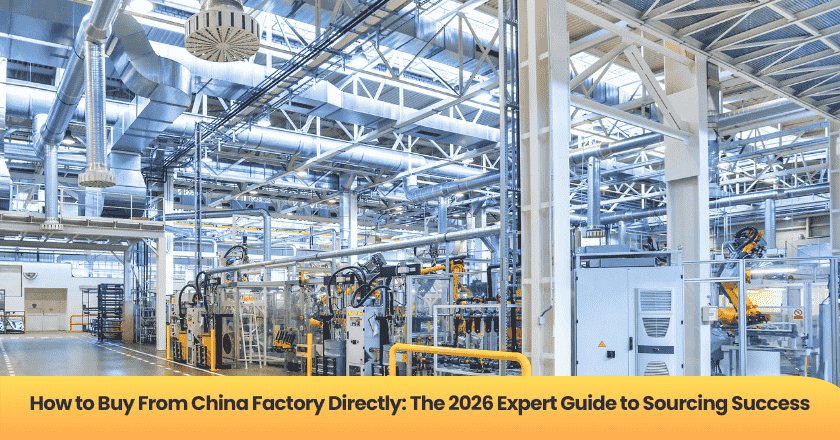
In the rapidly shifting landscape of global commerce, the year 2026 marks a significant turning point for businesses sourcing from the "World’s Factory." While much has been said about supply chain diversification, China's dominance remains unshaken, albeit transformed. It has moved beyond being a mere source of low-cost labor to becoming a powerhouse of high-tech automation and integrated supply chain ecosystems. For the modern entrepreneur or procurement manager, the question is no longer just how to find a supplier, but how to master the sophisticated infrastructure of direct factory sourcing to maintain a competitive edge.
This guide provides a roadmap for navigating these complexities. We will move beyond the surface-level advice of the past decade and dive into the tactical realities of 2026 manufacturing. You will learn how to identify genuine manufacturers amidst a sea of middlemen, how to leverage the latest digital procurement tools, and why a strategic partnership with a professional support entity like NewbuyingAgent is often the difference between a high-margin success and a logistical nightmare.
The 2026 Sourcing Landscape
By 2026, the traditional image of a Chinese factory—rows of manual assembly lines—has largely been replaced by smart manufacturing hubs. To buy directly from a factory today, you must understand that you are engaging with a highly digitized partner. The rise of industrial IoT (Internet of Things) and AI-driven production scheduling means that factories are more efficient but also more selective about the clients they take on. They prefer "smart buyers" who come prepared with digital specifications and a clear understanding of production cycles.
The most significant shift in the past few years has been the internal stratification of the Chinese market. On one hand, you have massive export-oriented factories listed on Alibaba that are well-versed in Western standards but often command higher premiums. On the other hand, there is the massive domestic ecosystem found on platforms like 1688.com. Historically, this domestic market was inaccessible to foreign buyers due to language barriers and payment restrictions. However, in 2026, savvy importers are bypassing the "export markup" by sourcing from these domestic-facing factories. This is where a support service like NewbuyingAgent becomes invaluable, acting as a bridge to tap into local pricing that was previously reserved for Chinese domestic companies.
Expert Tip: Lean into the "China+1" Strategy Within China
While many companies look to move production to other countries, the most successful 2026 strategy is finding factories in China’s inland provinces or specialized industrial clusters. Coastal cities like Shenzhen are now high-tech hubs, but for cost-effective mass production of traditional goods, look toward provinces like Jiangxi or Anhui. These regions offer the infrastructure of China at a price point that rivals emerging markets in Southeast Asia.
Identifying the "True" Factory in a Digital Haystack
One of the most persistent challenges in sourcing is the "hidden middleman." Trading companies in 2026 have become incredibly sophisticated, often using high-end photography and AI-generated "factory tours" to mimic the appearance of a manufacturer. To buy directly, you must look for specific markers of manufacturing capability that cannot be faked easily.
First, scrutinize the company’s business license. In China, every registered entity has a defined "Business Scope." A genuine manufacturer will include terms like "Produce" , "Manufacture" , or "Processing" . If the scope only mentions "Wholesale"or "Trade", you are dealing with a reseller. Second, look at the product depth. A real factory usually specializes in a narrow range of products using similar raw materials or machinery. If a supplier offers everything from silicone spatulas to electronic drones, they are almost certainly a trading company.
Direct factories also have a different communication style. They are often more technical and less "salesy." While a trading company will say "Yes" to every request immediately, a factory engineer might push back on certain design specifications because they understand the limitations of their machinery. Embracing this technical friction is often the key to finding a partner who will actually deliver a high-quality product.
Common Mistake to Avoid
Many buyers assume that a "Gold Supplier" or "Verified" badge on B2B platforms is a guarantee of manufacturing status. In reality, these are often paid memberships or surface-level audits. In 2026, always demand a live, unscripted video call from the factory floor or hire a local agent to perform a spot-check. Verification is a process, not a badge you can buy.
The Strategic Choice — DIY Sourcing vs. Procurement Support
As you scale your direct buying operations, you will inevitably reach a crossroads: should you manage every detail yourself or utilize a procurement support partner? This decision shouldn't be based on "can I do it?" but rather "is my time best spent doing it?"
The Solo Path (DIY)
Managing the process solo requires a deep commitment to learning the nuances of Chinese business culture (Guanxi), logistics, and quality control. You will be responsible for vetting every supplier, negotiating terms, and most importantly, handling the fallout when things go wrong. While this saves you a service commission, it often leads to higher "hidden costs" in the form of travel, time, and the potential for catastrophic quality errors. This path is generally only viable for large corporations with their own dedicated sourcing offices in cities like Guangzhou or Ningbo.
The Support Path (The NewbuyingAgent Advantage)
For most small-to-medium enterprises and growing e-commerce brands, the "Procurement Support" model is the gold standard for 2026. This isn't about adding a middleman; it's about hiring a professional team to act as your local office. NewbuyingAgent provides a comprehensive suite of services that a remote buyer simply cannot replicate.
Beyond just finding the product, a support partner manages the "messy" parts of the trade. By delegating these tasks to NewbuyingAgent, you focus on your core competency—marketing and selling—while your supply chain remains robust and transparent.
Expert Tip: When choosing a sourcing partner, look for those who offer "Net Cost" transparency. In the past, agents made money by hiding markups. In 2026, the best partners like NewbuyingAgent charge a flat, transparent service fee. This aligns your interests: the agent wants the best quality for you, rather than trying to squeeze a margin out of the factory price.
Negotiation and the Art of the 2026 Contract
Negotiating with a Chinese factory in 2026 is less about haggling over pennies and more about securing "Total Value." If you push a factory to a price point that leaves them with no profit, they will not go out of business; they will simply find a way to lower their costs by using cheaper components or skipping critical QC steps.
Instead of just asking for a lower price, negotiate on terms that affect your cash flow and risk. For example, try to negotiate a lower deposit (e.g., 20% instead of 30%) or better lead times for repeat orders. In 2026, "Supply Chain Agility" is more valuable than a 2% price discount. Furthermore, your contract must be drafted in both English and Chinese to be legally enforceable in a Chinese court. A Western-style contract is often viewed as a "statement of intent" rather than a binding legal document unless it is localized and stamped with the factory’s official "Chop" (Company Seal).
Ensure your contract includes a detailed "Defect List." This should categorize issues into Critical, Major, and Minor defects, and specify exactly what happens if the defect rate exceeds the agreed-upon AQL (Acceptable Quality Limit). When the factory knows you have a clear, enforceable standard, they are naturally more diligent in their production.
Common Mistake to Avoid
Never sign a contract that just says "Plastic Chair." You need to specify the exact grade of plastic, the weight of the finished product, and the UV-resistance rating. Without a detailed BOM, a factory might switch materials mid-production to save on rising commodity costs, and you will have no legal recourse because the contract was too vague.
Advanced Quality Control and ESG Compliance
The "Direct from Factory" model lives or dies by quality control. In 2026, quality control has evolved into a high-tech discipline. While physical inspections are still the backbone of the industry, many factories now offer "Glass Pipeline" transparency, where you can view real-time data from the production line.
However, technology is not a substitute for human presence. A professional QC inspection should happen at three stages:
1. Initial Production Check (IPC): Checking the raw materials before they are processed. This prevents the use of "scrap" materials that can ruin an entire batch.
2. During Production (DUPRO): Inspecting the first finished units to ensure the settings are correct.
3. Pre-Shipment Inspection (PSI): This is the most vital step. A random sample of the completed order is checked against your specifications.
Furthermore, 2026 has brought a massive wave of ESG (Environmental, Social, and Governance) requirements. Whether you are selling in the EU or North America, you may be required to prove that your factory follows fair labor practices and environmental regulations. Buying direct means you are responsible for this audit trail. Utilizing a partner like NewbuyingAgent allows you to conduct these social audits efficiently, ensuring your brand isn't tarnished by supply chain scandals.
Expert Tip: Do not aim for 0% defects, as this is statistically impossible and will drive your costs to unsustainable levels. Instead, use the industry standard AQL (Acceptable Quality Limit) 2.5 for major defects and 4.0 for minor ones. This provides a realistic, professional framework for both you and the factory to operate within.
Logistics, Tariffs, and the "Last Mile" Strategy
The final hurdle in buying direct is getting the goods from the factory floor to your warehouse. In 2026, the logistics landscape is defined by volatility. Freight rates can swing wildly based on geopolitical shifts and energy costs.
To manage this, you must master "Incoterms." While many beginners prefer DDP (Delivered Duty Paid) because the supplier handles everything, it is often the most expensive option because the supplier adds a significant "risk premium" to the shipping cost. As you grow, moving to FOB (Free On Board) or EXW (Ex-Works) allows you to work with your own freight forwarder or a service to optimize shipping routes.
Consolidation is the secret weapon of the high-margin importer. If you are buying from three different factories in the Pearl River Delta, shipping three separate LCL (Less than Container Load) shipments is a waste of money. Instead, have your goods sent to a central warehouse, consolidated into one Full Container Load (FCL), and shipped as a single unit. This can reduce your per-unit shipping cost by as much as 40%.
Common Mistake to Avoid: The Harmonized Tariff Schedule (HTS) code determines the duty rate you pay at customs. Many factories will provide a generic code that might not be accurate for your specific country. If you use the wrong code, you could be hit with massive back-taxes or fines during a customs audit. Always verify your HTS codes with a professional customs broker or your sourcing agent before the ship leaves the port.
FAQ: Mastering Direct Sourcing from China
Q: Is it still possible to buy small quantities directly from a factory in 2026?
A: Yes, but with caveats. Most large factories have a high MOQ (Minimum Order Quantity). However, the rise of "micro-factories" in China caters to smaller orders. Alternatively, using a partner like NewbuyingAgent allows you to combine your buying power or access domestic platforms where MOQs are significantly lower than on international B2B sites.
Q: How do I handle payments securely to avoid scams?
A: Never use wire transfers (T/T) to personal bank accounts or to companies that don't match the name on the business license. In 2026, many buyers use secure escrow services or work through their sourcing agents who can pay the factory in local RMB only after quality milestones are met.
Q: What if the product is defective after I receive it in my country?
A: Once the goods have left China, your leverage is essentially zero. This is why Pre-Shipment Inspection is non-negotiable. Returns to China are logistically complex and tax-heavy. The goal of direct sourcing is to ensure the goods are perfect before they board the ship.
Q: How has the "Green Trade" movement affected buying from China?
A: Significant. By 2026, many Chinese factories have transitioned to renewable energy to meet international export standards. You should ask for "Carbon Footprint" certificates if you plan to market your products as sustainable.
Conclusion: Building a Future-Proof Supply Chain
Buying directly from a China factory in 2026 is no longer a simple transaction; it is a strategic operation that requires technical knowledge, cultural fluency, and rigorous oversight. The rewards, however, are immense. By cutting out the traditional export markups and engaging directly with the source of production, you unlock margins that allow your business to thrive in a crowded market.
Success in this arena comes down to your choice of strategy. You can spend your nights navigating the complexities of Chinese industrial zones and your days worrying about quality drift, or you can leverage the expertise of a dedicated procurement partner. NewbuyingAgent exists to bridge this gap, providing the local presence and professional rigor needed to make "buying direct" a seamless, profitable reality for your business.
The era of effortless sourcing is over, but the era of smart sourcing has just begun. Are you ready to take control of your supply chain?
NewBuyingAgent
Related Resources
Get Started Today
Let's Turn Your Sourcing Goals into RealityWeChat:+86 15157124615
WhatsApp:+86 15157124615
Address:Building 10 #39 Xiangyuan Road, Hangzhou, China
