

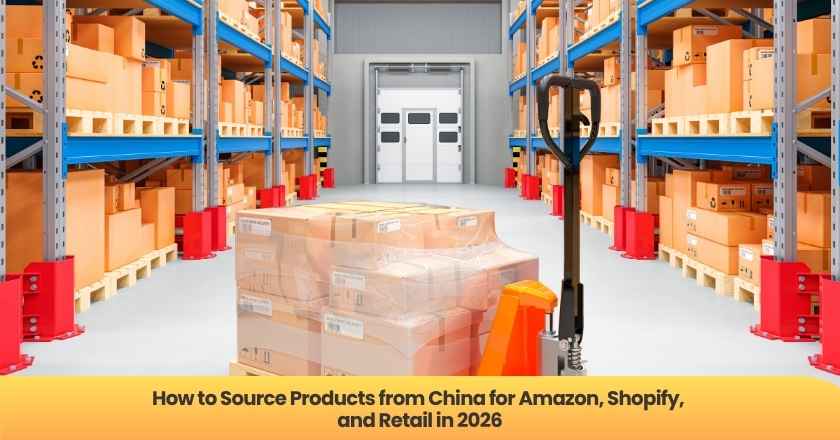
The same product, sourced from the same Chinese factory, can succeed on Amazon and fail on Shopify — or land you a compliance violation in retail — depending on how you handled the details each channel demands. Sellers who treat “sourcing from China” as one generic process, regardless of where they sell, are the ones who get their FBA shipment rejected over labeling or discover their margin evaporated once duties hit.
Sourcing products from China in 2026 means more than finding a supplier — it means meeting the specific requirements of your sales channel, vetting factories properly, and pricing on the new tariff reality. Get the channel details right and the same supplier relationship serves whichever platform you sell on. If you'd like help sourcing and landing products to your channel’s exact requirements, NewBuyingAgent supports ecommerce and retail sellers across the process.
Key Takeaways
• The core sourcing process is the same across channels, but Amazon, Shopify, and retail each add their own requirements.
• Amazon FBA demands precise labeling, packaging, and prep, and rewards differentiated private-label products over generic resale.
• Shopify gives you control but puts fulfillment, returns, and quality reputation entirely on you.
• The end of US de minimis means every import carries duty, reshaping margins for all three channels.
• Vet suppliers and price on landed cost the same rigorous way regardless of where you ultimately sell.
The Sourcing Foundation Every Channel Shares
Before the channel-specific details, there's a common foundation: finding and verifying a supplier who can actually deliver. This part doesn’t change whether you sell on Amazon, Shopify, or in stores, and getting it right is the precondition for everything else.
Find and vet the supplier
Build a shortlist from multiple channels, then verify each: business license, production scope, export records, and a live floor walkthrough. These checks screen out trading companies and underqualified workshops. A verified manufacturer is the foundation no channel strategy can substitute for.
Sample before you commit
Order two sample rounds against a written spec — a first sample for baseline quality, then a pre-production sample from the actual line. Sign and seal a golden sample as your reference. This catches the substitutions that show up once an order is confirmed, regardless of where you’ll sell.
Use safe payment terms
Structure payment as a 30% deposit with the balance on a passed inspection, keeping money tied to acceptable goods. Avoid full prepayment with an untested supplier. These protections apply identically whether you're sourcing for FBA, a Shopify store, or a retail buyer.
Expert Tip: Whatever channel you sell on, choose a supplier capable of OEM (Original Equipment Manufacturer — building to your design) or private-label customization rather than one selling a generic catalog item. In 2026, with duties added to everyone's landed cost, reselling an identical product competitors can source just as cheaply leaves almost no margin to defend. A factory that can put your branding, packaging, or design tweaks on the product gives you something to charge for and a listing or shelf presence rivals can't simply undercut. The customization capability matters more than a marginally lower price on a commodity. NewBuyingAgent sources differentiated, brandable products for sellers, its 20,000+ specialists landing them to each channel's exact requirements.
Sourcing for Amazon FBA
Amazon's fulfillment network is powerful but unforgiving about requirements. Sourcing for FBA means building Amazon's rules into your supplier instructions from the start, since a shipment that doesn't meet prep and labeling standards can be rejected, charged, or held.
Labeling and prep requirements
FBA (Fulfillment by Amazon — Amazon stores, picks, packs, and ships your inventory) requires specific FNSKU labels, polybagging, and packaging standards. Have your factory apply these at production so goods arrive ready for Amazon’s warehouses. Getting prep done at the source is cheaper than a prep service or a rejected shipment.
Differentiate to win the listing
Amazon rewards products that stand out, and private-label or improved products outperform generic resale where dozens of sellers list the identical item. A factory that customizes lets you build a brand and a defensible listing. On Amazon, differentiation is what separates a profitable product from a price war.
Compliance and certifications
Amazon enforces category-specific compliance — safety certifications, documentation, and testing for regulated products. Confirm your factory can supply valid, product-specific certificates verified by number before sampling. Non-compliant goods risk listing suspension as well as customs problems, a double penalty on FBA.
Common Mistake to Avoid: Sourcing a generic product and sending it to FBA expecting to compete in a crowded listing on price. When many sellers offer the identical factory item, Amazon's dynamics push you into a margin-destroying price war, made worse in 2026 by duties on every unit. The sellers who profit on FBA source differentiated, private-label products — their own branding, improved features, better packaging — that competitors can't simply match. Treating FBA as a place to resell commodities, rather than to build a brand, is how sellers end up with inventory they can’t move at a profit.
Sourcing for Shopify and Direct-to-Consumer
Shopify hands you control and margin but also full responsibility — you own fulfillment, returns, and the quality reputation that drives repeat business. Sourcing for a direct-to-consumer store means optimizing for those realities rather than a marketplace's rules.
Quality drives your reputation
Without a marketplace's buyer protections cushioning you, product quality directly shapes your reviews, returns, and repeat purchases. Rigorous QC (Quality Control — the inspection steps that catch defects during and after production) matters even more for a DTC brand. A defect that reaches customers damages a reputation you’ve paid to build.
Branding and packaging
A DTC brand lives on differentiation, so source products you can customize and package distinctively. The unboxing experience is part of your brand. A factory offering private-label and custom packaging supports the premium positioning that makes a Shopify store viable against marketplace pricing.
Fulfillment and inventory planning
You handle fulfillment, so plan inventory and reorder lead times carefully — production and freight in 2026 remain less predictable than pre-2020. Decide whether you hold stock, use a third-party logistics provider, or another model. Running out of a winning product on your own store is a self-inflicted wound with no marketplace to fall back on.
Expert Tip: For a Shopify or DTC brand, invest in inspection and a sealed golden sample even more rigorously than a marketplace seller would. On a marketplace, a bad unit triggers a return through the platform; on your own store, it triggers a negative review, a refund you process, and often a lost customer — all hitting a brand you spent marketing dollars to build. The economics of DTC make quality failures disproportionately expensive. Spending a few hundred dollars on inspection to protect a reputation that drives your repeat-purchase rate is among the highest-return decisions in your whole sourcing process.
Sourcing for Brick-and-Mortar Retail
Selling into physical retail — your own stores or as a supplier to others — brings its own demands: volume, consistency, retail-ready packaging, and often stricter compliance. Sourcing for retail means meeting standards that ecommerce can sometimes skip.
Volume and consistency
Retail typically means larger, recurring orders and a hard need for consistency across runs, since shelves must look identical batch to batch. This rewards a verified manufacturer with real capacity and a documented quality system. A factory that wobbles between runs is a liability in a retail context.
Retail-ready packaging and labeling
Products may need retail packaging, barcodes, and labeling that meet your or your buyer's requirements. Specify these as precisely as the product itself and have the factory apply them at source. Retail buyers reject goods that aren’t shelf-ready, so packaging is part of the spec, not an afterthought.
Stricter compliance
Physical retail, especially through established chains, often enforces stricter safety and compliance standards than online channels. Confirm your product meets the relevant certifications for your market and buyer before production. A compliance gap that an online listing might survive can block a retail placement entirely.
Common Mistake to Avoid: Sourcing for retail with the same loose packaging and compliance approach that worked for a small ecommerce operation. Retail buyers and chains have firm requirements — retail-ready packaging, accurate barcodes, specific certifications — and goods that miss them get rejected at the door, leaving you with inventory and no buyer. Treat retail packaging and compliance as hard specifications confirmed with the factory before production, not details to sort out later. The standards are higher than ecommerce, and discovering a gap after the goods are made is an expensive way to learn it.
Margin Math and the 2026 Tariff Reality
Across all three channels, the cost environment has shifted, and margins now depend on getting the landed-cost math right under current rules. The platform you sell on changes the fees and requirements, but the underlying duty reality applies to every channel.
The end of de minimis
The US suspended the $800 de minimis duty-free exemption for all countries, so every import now carries duty and formal customs entry regardless of value. The cheap, duty-free small-parcel model that powered some dropshipping and small ecommerce no longer works. Build current duties into every channel’s pricing.
Channel fees plus landed cost
Each channel layers its own costs — FBA fees, payment processing, retail margins — on top of landed cost. Calculate landed cost on FOB price (Free On Board — the cost of goods loaded onto the vessel at the Chinese port, before freight and insurance), duty, freight, and fees, then add channel costs before setting price. The product must profit after both.
Favor value that absorbs the duty
With duty on every unit, higher-value, differentiated products absorb the tariff better than cheap commodities, on any channel. This pushes smart 2026 sourcing toward branded, customizable goods across Amazon, Shopify, and retail alike. The duty is a smaller share of a product that commands a real price.
Expert Tip: Build a separate landed-cost-plus-channel-fees calculation for each platform you sell on, since the same product can be profitable on one channel and a loser on another. An item that clears margin on your Shopify store at full retail might lose money on Amazon once FBA fees, referral fees, and duty stack up, or vice versa. In 2026's tighter environment, with duty on every unit, the channel economics decide as much as the product. Modeling each channel separately tells you not just whether to source a product, but where to sell it for the margin you actually need.
Frequently Asked Questions
Is sourcing from China different for Amazon versus Shopify?
The core process — finding, vetting, sampling, and paying a supplier — is the same, but the channels add different requirements. Amazon FBA demands specific labeling, prep, and packaging plus category compliance, while Shopify puts fulfillment, returns, and quality reputation entirely on you. Source to the same rigorous standard, then layer each channel’s specific requirements onto your factory instructions and your margin math.
Can I use the same supplier for Amazon, Shopify, and retail?
Often yes — a good, verified manufacturer can serve multiple channels if it handles the channel-specific requirements, like FBA prep labels or retail-ready packaging. The supplier relationship is reusable; what changes is the prep, packaging, and compliance you specify for each channel. Confirm the factory can meet the strictest channel’s requirements, since retail compliance is often tougher than ecommerce.
How does the end of de minimis affect ecommerce sourcing from China?
With the $800 duty-free exemption suspended for all countries, every import now carries duty and formal customs entry regardless of value. The cheap, duty-free small-parcel model that powered some dropshipping no longer works. Sellers on all channels must build current duty rates into landed cost and favor higher-value, differentiated products that absorb the tariff better than cheap commodities.
What's the most important thing when sourcing for FBA?
Differentiation plus compliance. Amazon pushes generic, identical products into margin-destroying price wars, so private-label or improved products win, while category-specific certifications and correct FBA prep prevent rejected shipments and listing suspensions. Source a product you can brand, confirm certifications by number before sampling, and have the factory apply FBA labeling and packaging at production so goods arrive warehouse-ready.
Do I need a sourcing agent for ecommerce sourcing?
It depends on your volume and capacity to vet suppliers, inspect quality, and manage channel-specific requirements remotely. Sellers scaling across SKUs or channels, or unable to handle verification and QC themselves, often find an agent pays for itself in avoided mistakes. Smaller, focused sellers may manage direct. Match the model — direct, agent, or blended — to how much of the process you can reliably handle.
Conclusion
Sourcing products from China in 2026 starts with the same foundation for every channel — a verified supplier, two sample rounds, safe payment, differentiated product — then adds what Amazon, Shopify, or retail each demand in prep, packaging, and compliance. Price on landed cost under current duties plus each channel's fees, and favor value that absorbs the tariff. Get the foundation and the channel details right and one supplier relationship serves wherever you sell.
If you'd like help sourcing to your channel's exact requirements, that's exactly what NewBuyingAgent supports. Backed by 20,000+ QC specialists and 50,000+ partner factories, it sources differentiated products and lands them to each channel's exact requirements.
NewBuyingAgent
Related Resources
Get Started Today
Let's Turn Your Sourcing Goals into RealityWeChat:+86 15157124615
WhatsApp:+86 15157124615
Address:Building 10 #39 Xiangyuan Road, Hangzhou, China
