


A Chinese-facing name is not merely an English brand name written another way. The exact characters customers will see, the applicant that will own them, and the goods or services connected to them need a deliberate decision before a supplier prints packaging or a launch team publishes the name.
The useful goal is modest and practical: give qualified China trademark support a coherent filing brief, while keeping an unresolved Chinese name out of product artwork. That approach is far safer than discovering, after sampling or production begins, that marketing, a distributor, and a factory have each been using a different Chinese expression.
Choose the Chinese Mark Set Before You Choose a Filing Route
A Chinese-facing brand should be handled as a mark set of defined forms, not as an informal translation of the English word mark. A Chinese-character mark means the specific Chinese characters a business uses as a brand identifier. It may be chosen for sound, for meaning, or for both, but it must be selected by the owner rather than improvised in a product conversation.
Before anyone asks for a filing quote, make one short record with four columns: the English word mark, the intended Chinese-character mark, any separate logo or stylized version, and the product lines that will carry each form. The record does not decide legal availability. It simply stops teams from talking about “the brand name” as though one phrase covers every commercial use.
- Choose the customer-facing Chinese form. Record the exact characters, intended pronunciation, and the meaning you want customers to associate with the name.
- Name the owner. Confirm which legal entity should be the applicant before artwork, distributor agreements, or supplier documents use the mark.
- Connect the form to planned use. Identify the products, services, packaging, online listings, or channel materials that make the name commercially relevant.
- Freeze unapproved alternatives. A supplier's helpful translation, a distributor nickname, and a social-media shorthand should not become a production instruction by default.
For a Chinese-facing launch, the practical unit of preparation is not “our brand.” It is a defined mark, a named applicant, and a defined commercial scope.
Why the Filing Brief Should Exist Before Packaging Does
CNIPA states that China adopts first-to-file for trademark registration, with a specified same-day procedure for a narrow timing tie. In plain language, first-to-file is a registration system in which application timing is an important part of the analysis. For a buyer, the operational consequence is straightforward: settle the Chinese mark set and filing brief before packaging, product listings, or factory artwork turn an open question into an urgent one.
The point is not to treat an early application as an automatic win. Prior rights, similarity, goods or services, evidence, and procedure can all matter. It is to prevent an avoidable sequencing error: asking a factory to choose what the business itself has not yet approved. That is especially important when the Latin-letter name is already familiar to the team but the Chinese-facing name is still changing between marketing and product files.
Document the Chinese Name as Its Own Commercial Asset
Documenting exact Chinese characters, intended pronunciation, and commercial use is a practical way to prevent a supplier phrase from becoming an accidental brand choice. A sound-led choice may help customers connect the Chinese name to the existing brand. A meaning-led choice may explain the intended position. A combined choice can do both. None is inherently the right legal answer; the key is that the owner can explain which exact form is intended for the market.
Keep the choice in a version-controlled brand record. Include the characters, romanization if relevant, a short plain-language explanation, the approved logo file if there is one, and the date of owner approval. When the sourcing team receives an artwork request, it should be able to point to this approved record rather than reconstruct the decision from emails or chat messages.
Treat Same-Day Filing as an Exception, Not a Safety Net
CNIPA describes evidence, negotiation, and drawing stages for the defined same-day application procedure. Its guidance says that applicants can be asked to submit prior-use evidence or a negotiated agreement within 30 days of the relevant notice before a drawing stage can arise. That procedural detail is a reason to avoid a last-minute race, not a tactic to build into a launch calendar. Keep dated records of use and approval, then let qualified advisers assess whether any particular deadline or priority path matters.
Priority questions are also separate from a supplier's packaging deadline. CNIPA's priority-document guidance shows that filing-date issues are procedural and specific. A home-market registration or a public launch may be commercially important, but neither should be translated into an assumed China filing result without qualified review.
Turn the Brand Decision Into a Filing Brief
The law text connects a trademark application to listed goods or services and requires a new application when protection is sought outside the registered scope. That is why a filing brief should describe actual planned use with enough precision for a qualified adviser to evaluate it. “We sell consumer products” is a commercial summary, not a usable scope instruction.
| Brief item | What the owner should decide | Why the factory should not decide it |
|---|---|---|
| Applicant | The entity expected to own and control the filing | Supplier names, invoicing entities, and distributors can change without changing brand ownership. |
| Mark forms | English word mark, Chinese-character mark, and any logo form to be reviewed | An informal translation can create inconsistent packaging and online use. |
| Goods or services | The real commercial scope that qualified support should assess | A product list may be too vague, too broad, or unrelated to the intended filing scope. |
| Use plan | Where the mark is expected to appear and who approves artwork | Production can reproduce approved artwork; it should not infer legal rights from a purchase order. |
CNIPA states that a foreign company without a China business domicile shall entrust a lawfully established trademark agency, and it points readers to WIPO for Madrid System procedures. Those are routes to discuss with qualified support, not a reason for a sourcing provider or a factory to select a route for you.
Give the agency or counsel one clean brief: approved mark forms, applicant details, the commercial scope, known launch markets, prior filing information, dated artwork records, and the questions you want answered. That short preparation reduces the risk that a legal conversation starts from conflicting brand files. NewBuyingAgent's supply-execution role starts with the owner's approved product brief; it does not replace trademark counsel or an eligible agency.
Search in Three Views, Then Ask for a Qualified Read
A three-view screen of exact characters, plausible sound expressions, and visual mark forms is more useful than an exact-text search alone, but none of those checks guarantees availability. Use the search to make ambiguity visible, not to announce availability. A useful search log records the date, the query form, the database or source checked, a screenshot or export where appropriate, and the question it raises for qualified review.
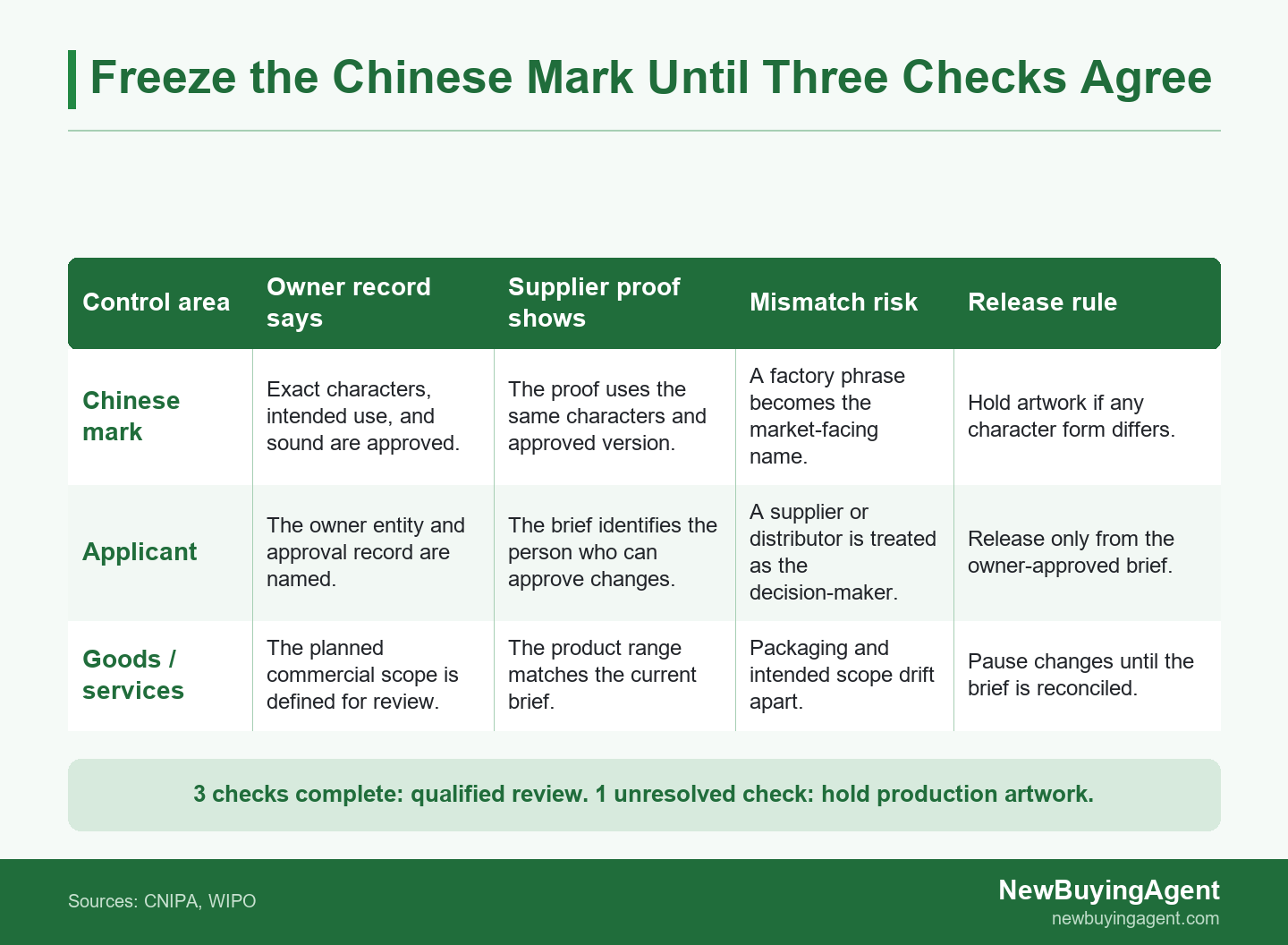
Conflict matrix showing Chinese characters, applicant, and goods scope must align before brand artwork enters production.
- Exact-character view: Search the exact Chinese characters that the owner intends to use. Save the search spelling exactly as entered.
- Sound view: Screen reasonable sound-alikes, romanized forms, and pinyin expressions that could be encountered in the market. Do not try to make a legal similarity finding from a simple list.
- Visual-form view: Compare the word form with the intended logo, stylization, and packaging presentation. A word mark and a logo can raise different practical questions.
For each potential conflict, record facts rather than labels: the mark as found, the visible owner information, the relevant goods or services shown, the date, and the reason it needs a qualified read. This discipline helps marketing avoid launching a Chinese expression that has not been reviewed, while avoiding the much stronger and unsupported statement that a quick search “cleared” the name.
Build an Evidence Pack Before a Conflict Forces the Question
CNIPA reports that the Trademark Law revision adopted in June 2026 will take effect on January 1, 2027. That date is not a filing instruction. It is a reminder to ask qualified support which rule set and procedure apply to the particular issue, especially if planning or a conflict crosses the transition.
A practical evidence pack does not turn a brand owner into a lawyer. It gives the right people a dated, consistent factual record. Keep it separate from the factory's production folder, but make the approved artwork version easy for the product team to identify. CNIPA's trademark information hub is a useful official starting point for current application, Madrid, and FAQ materials; case-specific questions still need qualified guidance.
In common business use, trademark squatting describes a bad-faith registration that can exploit another party's brand reputation or legitimate interests. It is not a conclusion a factory, distributor, or sourcing team can make from a name match. The relevant facts, records, goods or services, and procedure still need qualified assessment.
Save the Records That Explain Your Choice
A useful pre-filing record should show who chose the mark, when the artwork was approved, and how it connects to intended commercial use. Save dated candidate-name discussions, final approval, logo source files, packaging versions, domain and social-handle decisions, product briefs, early marketing materials, and any relevant prior filings. The purpose is not to collect every message. It is to keep a clear chain from the chosen Chinese name to the owner-approved commercial plan.
Give each record an owner and a version date. If the Chinese name changes, log the reason and retire the previous artwork from the production folder. This is a simple control, but it prevents an old translation from moving through sampling, quotation, carton design, and final production as though it were still the approved identity.
Escalate Facts, Not a Requested Outcome
CNIPA's Q&A distinguishes squatting that harms particular parties' interests from bad-faith applications not filed for use and notes multiple fact patterns and provisions. If you find a potentially conflicting filing, do not start by demanding a particular outcome. Preserve the application information, your dated brand records, the planned goods or services, and the exact Chinese mark forms. Then ask qualified China trademark counsel or an eligible agency to assess the route and time limits that apply to those facts.
This boundary matters because “squatting” is a useful warning label, not a substitute for a legal analysis. It is safer to say, “Here is what we used, planned, approved, and found,” than to tell a supplier, distributor, platform, or authority that a legal conclusion is already settled.
Illustrative Scenario: Freeze Artwork Until the Mark Set Is Real
The First Safe Decision Is an Artwork Hold
In an illustrative two-class production plan, conflicting Chinese artwork should remain on hold until the owner reconciles the mark form, applicant instruction, and filing brief with qualified support. The brand is preparing 6,000 units across two product classes and owns an English word mark. Marketing has used one Chinese transliteration in social posts, while the supplier has proposed a different Chinese phrase for carton artwork. The owner has three candidate Chinese names, but no final applicant, mark forms, or goods-and-services brief. None of these facts proves a conflict; they show that the commercial identity is not ready for production.
The English mark, a phonetic Chinese name, and a descriptive Chinese phrase are being treated as interchangeable. The order covers two product classes and 6,000 units, yet the applicant and final goods or services scope have not been set. These forms are not automatically interchangeable as market-facing instructions. If the supplier's phrase is printed first, the team may later need to explain why the product, carton, social account, and filing materials refer to different forms of the brand.
In the illustrative case, the factory receives no Chinese-facing artwork until the owner reconciles the mark form, applicant instruction, and filing brief with qualified support. Marketing records the intended sound and meaning; qualified support reviews the route; and the product team releases only the owner-approved artwork version. The hold concerns artwork, not a prediction that the brand will or will not register. It prevents a short production decision from selecting a long-term market identity by accident.
A 6,000-unit print run makes the scope visible, but the rule is the same for a sample carton or a large retailer launch: if one of the three checks is unresolved, use placeholders that do not create a Chinese-facing brand claim, or delay that artwork component. Preserve the old versions rather than overwriting them. A clean record of the decision is more useful than a rushed promise of legal certainty.
Put the Approved Mark Into the China Product Brief
NewBuyingAgent can work from owner-approved product and packaging requirements in China supply execution, while trademark scope and filing decisions remain with the owner and qualified legal support. Once the brand owner has fixed the usable Chinese artwork, a sourcing brief can specify the approved file, version date, placement, print locations, product range, and the person authorized to approve any change.
That distinction is useful in practice. A factory may need to know whether a Chinese word mark belongs on a carton, a hangtag, a product surface, or a listing image. It should receive a clear production instruction, not an invitation to invent or revise the brand expression. Buyers launching a new product line can ask NewBuyingAgent to supply products from China once the product brief includes the owner-approved packaging and identity requirements.
For existing suppliers, the same discipline applies to change control. Keep the approved brand file alongside the product specification, but do not describe a factory manager as a trademark representative. China-side coordination can preserve the version history and request confirmation before a supplier substitutes artwork; it cannot decide what legal protection the owner has or whether a third party's filing should be challenged.
Use a 21-Day Brand-Execution Freeze Before Production
A 21-day ownership sequence can keep an unresolved Chinese name from drifting into supplier artwork and production instructions. This is an illustrative operating framework, not a statutory filing deadline. Adjust it to your launch date, product lead time, and the instructions of qualified legal support.
- Days 1-3: choose the mark set. Record the exact Chinese characters, intended commercial use, applicant candidate, and logo forms that need review.
- Days 4-7: create the filing brief and search record. Put the mark forms, intended goods or services, prior filings, and dated search notes into one review pack.
- Days 8-14: obtain qualified route advice. Confirm the appropriate next action with China trademark counsel or an eligible agency. Keep the advice separate from the supplier's production schedule.
- Days 15-21: release one artwork version. Send the owner-approved file into the product brief, identify the approver for future changes, and remove unapproved alternatives from active production folders.
When a buyer already has China factories, the approved-artwork control can become part of normal supplier follow-up. Ask NewBuyingAgent to manage your China factories when the owner has fixed the product brief and needs its approved packaging version followed through the production process. The legal mark decision remains with the owner and qualified support.
Use one named file owner for the product brief and one named approver for artwork changes. The factory should receive the approved filename, file format, version date, product reference, print location, and a clear instruction to pause if a different Chinese phrase appears in a quotation, artwork proof, or supplier message. A request to change a translation, logo form, product label, or carton copy should return to the owner-approved record before it enters a new sample or production batch. This small control also makes factory follow-up easier: the team can check the brief, the current proof, and the approval trail instead of asking several people which version is valid. Keep commercial timing decisions visible, but do not let an urgent shipment date silently replace the ownership and filing review that the Chinese-facing identity needs. Before each artwork release, compare the supplier proof against the current product brief, confirm the named approver, and save the approval with the order record. If a buyer changes a product range, label location, or logo version, create a fresh decision record before a factory carries the change into a sample, a carton, or a listing image.
When the mark form, product specification, quantity, destination, timeline, and approved packaging artwork are ready, Contact NewBuyingAgent about a China sourcing project.
Frequently Asked Questions
Should I register my English name and Chinese name?
Often, a brand should evaluate its English word mark and the Chinese-character name it expects customers to use as separate filing decisions. They may be connected commercially, but they are different mark forms and can create different search, scope, and use questions. Start by deciding which exact Chinese characters the business intends to use, who will own the application, and which products or services are relevant. Then ask qualified China trademark support to assess the appropriate filing approach for those facts.
Can a Foreign Company File Directly in China?
CNIPA says a foreign company without a business domicile in China must use a lawfully established trademark agency for trademark matters. That is why a foreign buyer should prepare a concise mark and product brief before asking for filing advice. The agency or counsel can then assess the applicant's situation, the mark forms, and the available route. A supplier, sourcing agent, or marketing team can provide factual inputs, but should not be asked to replace qualified legal representation.
Does a Trademark Search Guarantee My Chinese Name Is Available?
No; a search is an important screening input, but registrability and any conflict assessment depend on the specific mark, goods or services, records, and procedure. Search the exact characters, plausible sound expressions, and intended visual forms so that a qualified reviewer can see the relevant questions. Keep the results dated and complete. Do not describe a quick exact-name search as a legal clearance, and do not release production artwork merely because one search result looks favorable.
What Should I Do if Someone Has Already Filed My Name?
Preserve the application details and your dated brand records, then obtain advice from qualified China trademark counsel or an eligible agency on the applicable route and deadlines. Provide the exact Chinese and English mark forms, prior filing information, product or service context, dated artwork approvals, and the search record. Avoid accusing the other applicant of bad faith in supplier communications or making promises about opposition or invalidation. The responsible next step depends on the facts and the current procedure.
When Should Chinese Brand Artwork Reach My Factory?
Send Chinese brand artwork into production only after the owner has approved the mark form, artwork version, and instructions that belong in the product brief. The factory should receive one current file, clear placement rules, and a named approver for any change. If legal review is still unresolved, hold the Chinese-facing artwork rather than asking the supplier to choose a translation. Product execution can preserve an approved instruction; it does not create or confirm trademark rights.
NewBuyingAgent
Related Resources



Get Started Today
Let's Turn Your Sourcing Goals into RealityWeChat:+86 15157124615
WhatsApp:+86 15157124615
Address:Building 10 #39 Xiangyuan Road, Hangzhou, China
