

Introduction
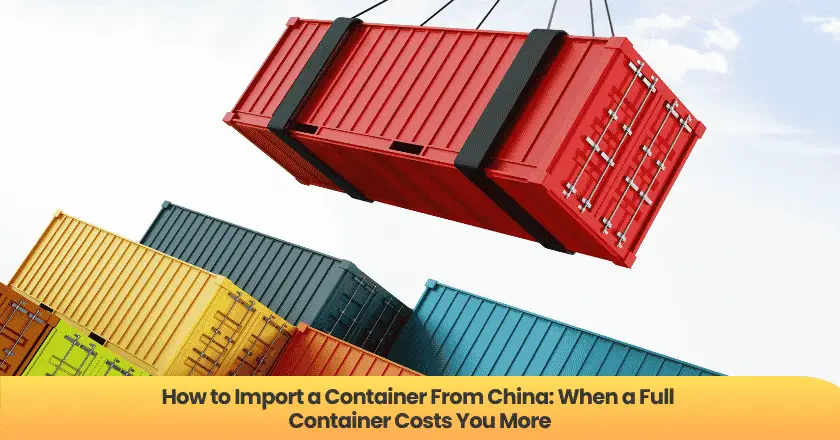
Your order fills about two thirds of a forty-foot container. The freight quote for a full container works out cheaper per cubic metre than a part load, so you add three more products to fill the space. Eleven months later two of those three are still on the shelf, and the money they are sitting on is considerably more than the freight you saved.
Buyers treat a full container as a shipping method with a better rate. It behaves more like a purchasing constraint, because the volume is fixed and somebody has to fill it. The rate comparison is easy and usually gets done. The cost of the stock bought to reach that rate is harder to see and frequently larger.、、
Key Takeaways
• A full container is a fixed volume you have committed to fill, which turns a freight decision into a buying decision.
• Work out your break-even in cubic metres before assuming a full container is cheaper.
• Filler stock carries capital, storage and obsolescence costs that usually exceed the freight saving.
• Multi-supplier consolidation adds coordination cost and lead time that belong in the comparison.
• Part loads are the right answer more often than experienced importers admit.
The Constraint Nobody Names
A container has a volume and you are paying for all of it regardless of how much goes inside, which creates pressure in one direction only.
What the fixed volume does to buying decisions
Once a container is booked, every empty cubic metre looks like waste. Buyers respond by finding something to put in it, and the something is usually chosen for its ability to fill space rather than its ability to sell. The decision feels like optimisation and functions as an unplanned purchase.
The pressure is real and it is worth naming, because it operates on experienced buyers too. Nobody books a container intending to buy products they did not want. The sequence simply runs in an order that makes it almost inevitable, starting with the box and working backwards to the catalogue.
Capacity in practical terms
A forty-foot high cube offers roughly seventy-six cubic metres of internal space, and practical loading lands lower once pallets, carton dimensions and stacking limits are accounted for. Ask your forwarder for a realistic loaded figure for your carton size rather than working from the nominal capacity, since the gap between the two is where over-ordering starts.
Twenty-foot containers are worth considering at the point where a forty-foot would need filling artificially. The rate per cubic metre is less favourable, and it is frequently better than paying for space you fill with products you did not plan to buy. Ask for both quotes rather than only the one you expect to use.
Expert Tip: Decide your order quantities before you look at any freight quote. Work out what you actually want to buy on demand forecasts alone, measure the cubic volume that represents, and only then compare shipping options for that volume. Buyers who look at the container first end up reverse-engineering a purchase plan from a box size, which is a strange way to run a catalogue and a common one.
Working Out the Break-Even
The calculation is simple and it answers the question properly, which is more than the rate comparison does on its own.
The figures you need
Four numbers produce the answer for your lane and your product.
• The all-in cost of a full container, door to door, including origin and destination charges.
• The all-in cost per cubic metre of a part load on the same lane, which is priced differently.
• The realistic loaded volume of a container given your carton dimensions.
• The volume your actual demand-based order occupies.
Reading the result
Divide the full container cost by its realistic loaded volume to get a cost per cubic metre, then compare that against the part load rate. The volume at which the two meet is your break-even. Below it, a part load is cheaper even before any stock costs are considered. Above it, a full container wins on freight alone and the question becomes whether you wanted that much stock anyway.
Run the calculation for a twenty-foot container at the same time. Three options compared on one basis takes no longer than two and frequently produces a middle answer that neither of the obvious choices would have suggested.
Common Mistake to Avoid: Comparing a full container price against a part load price without converting both to the same unit. A number for a container and a number per cubic metre are not comparable, and buyers regularly conclude a container is dramatically cheaper because the two figures were never put on the same basis. Convert first, then decide, and the gap is frequently narrower than it appeared.
What Filler Stock Actually Costs
This is the number that decides most of these situations and the one almost nobody calculates.
Three costs on unsold inventory
Capital, which is money unavailable for anything else for as long as the stock sits. Storage, which is space, handling and sometimes rent you are paying monthly. And obsolescence, which is the risk that the item is eventually sold at a discount, written off or disposed of. Together these routinely run to a meaningful percentage of stock value per year. The figure varies by business and the direction never does.
Comparing the two numbers
Take the freight saved by going full rather than part, then take the value of the stock you bought purely to fill the space and apply an annual holding cost to it for the period you expect to hold it. Worth knowing: for slow-moving filler lines, the holding cost frequently exceeds the freight saving within the first six months.
Expert Tip: Track your filler lines separately from your planned lines for a full year, and record what actually happened to them. Most buyers have never separated the two and carry a general impression that filling the container was sensible. Twelve months of data on sell-through for products bought to fill space tends to settle the argument permanently, in one direction or the other.
When a Full Container Genuinely Wins
None of this argues against full containers, which are the right answer in plenty of situations and the default for a reason.
Four conditions that favour it
Your demand-based order already fills most of the space without invented additions. The products are staples with predictable year-round sell-through. Your storage cost is low or already paid for. And you order frequently enough that a slightly deeper stock position simply shifts your next order rather than creating dead inventory.
The handling advantage
A full container is also handled less. Part loads are consolidated at origin, deconsolidated at destination and moved between warehouses, which raises damage rates on fragile goods and typically adds several days to transit at each end. For products that damage easily, that difference can justify a full container even when the rate comparison is neutral. Furniture, glassware and anything with a painted or plated finish sit firmly in this group.
Expert Tip: If your genuine order fills seventy percent or more of a container, look at deepening the quantities on your proven sellers rather than adding new lines. Buying more of something you already know sells carries a fraction of the risk of introducing an untested product, and it fills exactly the same cubic metres. The instinct to add variety at this moment is usually the expensive instinct.
The Coordination Cost of Consolidation
Filling a container from several suppliers is the standard approach for wide catalogues, and it carries costs that rarely appear in the freight comparison.
What multi-supplier loading involves
Each supplier must produce to a common deadline, deliver to a consolidation point, and have its goods received, checked and stored until everything arrives. One late supplier delays the whole container. Somebody has to manage that, and whether it is you at a distance or a paid party locally, it is work with a cost attached.
Lead time effects
A consolidated container ships when the slowest supplier finishes, which means your fastest products wait. Where one line is seasonal or urgent, that waiting can cost more than shipping it separately would have. Splitting urgent items into a small part load while consolidating the rest is a common and underused compromise. Air freight on a single fast-moving line while the container follows by sea works on the same principle.
Common Mistake to Avoid: Assuming consolidation is free because the warehouse fee looks small. The real cost includes chasing several factories to a common date, the storage days while early arrivals wait, the checking of goods on receipt and the delay imposed on whichever products were ready first. Price the whole arrangement rather than the line item, particularly when one supplier has a history of running late.
A Decision Rule Worth Adopting
The practical version of everything above fits into a short sequence you can run each time.
The order of operations
Decide what to buy on demand alone. Measure the volume. Calculate the break-even between full and part on that lane. If your volume is above it, ship a full container. If it is below, compare the freight saving against the holding cost of whatever you would add, and ship a part load whenever the second number is larger. Through 2026 that comparison has favoured part loads more often than most buyers expect.
Revisiting the number
Freight rates move, sometimes sharply, and a break-even calculated eighteen months ago may be badly out of date. Recalculate once or twice a year and whenever rates shift noticeably, since the rule is only useful if the number underneath it is current. Peak season rates in particular can move the break-even far enough to change the answer for the same order.
Expert Tip: Write your break-even volume on the same document as your reorder planning, so the two decisions are made together rather than in sequence by different people. Purchasing teams that see the number while choosing quantities naturally round toward it when the demand case is close, which is the right behaviour, and stop inventing products when the demand case is not there.
Filling a Container Without Filler: NewBuyingAgent
The pressure to invent products comes from having too few good options rather than too much space. NewBuyingAgent is your perfect partner for global sourcing from China, backed by 30 years of expertise in trade, manufacturing and quality control.
A wider field means the volume can be filled with things worth selling rather than things that fit. It can supply products from China across all categories to you at better price, quality and service. The underlying reach is what makes that range available. 100% Access to China's Factories. Use its 50,000+ cooperated partner factories—no language/region/time zone barriers.
Consolidating across several suppliers to a common date is the coordination work that grows fastest with catalogue width. NewBuyingAgent handles all factory communication—perfect for multi-category buyers. Free up your time to focus on expanding your local market sales.
Frequently Asked Questions
Is a full container always cheaper when learning how to import a container from china?
Per cubic metre it usually is, once you are filling most of it. The comparison that matters is between the freight saved and the cost of any stock bought purely to fill space. Convert both options to a cost per cubic metre first, since a container price and a part load rate are not directly comparable as quoted.
How much volume do I need to justify a full container?
Divide the all-in container cost by its realistic loaded volume for your carton size, then compare against the part load rate per cubic metre. The crossover is your break-even and it differs by lane, season and carton dimensions. Recalculate it once or twice a year, since freight rates move enough to shift the answer.
What is wrong with adding products to fill the space?
Nothing, provided those products would have earned a place anyway. The problem is products chosen for their volume rather than their sell-through, which then carry capital, storage and obsolescence costs for as long as they sit. For slow-moving lines those costs often exceed the freight saving within months.
Can NewBuyingAgent consolidate from several factories?
Coordinating multiple suppliers to a single loading date is the recurring load that grows fastest as a catalogue widens. 20,000+ product development & QC experts ensure your products match market needs and stay high-quality. That applies across product types rather than one line, since its wide factory network lets it pick low-cost, high-cooperation suppliers.
Conclusion
Decide the order on demand, measure its volume, then calculate the break-even rather than assuming the container is cheaper. Where you fall short, compare the freight saving against the holding cost of whatever would fill the gap, and take the part load when the second number wins. If your order already fills most of the space, deepen proven lines instead of adding new ones. If having enough good options that filler never tempts you is the real fix, NewBuyingAgent is worth a conversation.
Partial Sources
1. Incoterms 2020 – International Chamber of Commerce — https://iccwbo.org/business-solutions/incoterms-rules/incoterms-2020/
2. Procedures and Formalities – Access2Markets, European Commission — https://trade.ec.europa.eu/access-to-markets/en/content/procedures-and-formalities
3. New Buying Agent in China | NewBuyingAgent — https://www.newbuyingagent.com/
4. We Manage Your Factories | NewBuyingAgent — https://www.newbuyingagent.com/what-we-do/we-manage-your-supply-chain
5. What We Do | NewBuyingAgent — https://www.newbuyingagent.com/what-we-do
6. Trending Products | NewBuyingAgent — https://www.newbuyingagent.com/trending-products
NewBuyingAgent
Related Resources
Get Started Today
Let's Turn Your Sourcing Goals into RealityWeChat:+86 15157124615
WhatsApp:+86 15157124615
Address:Building 10 #39 Xiangyuan Road, Hangzhou, China
