

A DAP or DDP price becomes comparable only after the named place, import-clearance owner, duty and tax route, unloading boundary, and document handoff are written beside it.
That is why “seller takes full risk” is too broad a shorthand for DDP. The rule shifts important delivery and import tasks, but it does not erase product obligations, payment terms, destination eligibility, or the buyer’s need to understand what has actually been priced. For China-sourced goods, a useful comparison starts with the delivery record, not with the lowest invoice.
Where DAP and DDP Really Separate
Incoterms 2020 are ICC trade rules that allocate delivery tasks, cost points, and risk between seller and buyer. They are not a complete purchase contract. They do not, by themselves, settle title, payment, product acceptance, tax recovery, or every local-law question. Their value is that they force a buyer and seller to state where the goods are delivered and who carries the import side.
- Delivery point: DAP and DDP both need a named place of destination, not merely a country name.
- Import route: DAP leaves import clearance with the buyer; DDP assigns it to the seller.
- Price meaning: a DDP invoice can include a seller-managed import route that a DAP invoice leaves outside the price.
- Approval test: confirm the import actor and the total obligation before approving either term.
A buyer therefore needs six fields beside each quote: the exact named place, transport scope, clearance actor, duty and tax assumptions, unloading boundary, and document handoff. If one quote says “DDP warehouse” and another says “DAP Australia,” the commercial comparison is incomplete even if the products, quantities, and currencies match.
The Named Place Is the Risk Handover
Incoterms are internationally recognised trade terms that clarify which delivery responsibilities sit with the seller and buyer. The UK government’s Incoterms guide makes the same allocation point.
Trade.gov lists DAP and DDP as Incoterms 2020 rules for any mode or modes of transport, each used with a named place of destination. A Trade.gov overview is helpful for the rule family; the sales contract still needs the operational location.
Write the place so that a logistics team can act on it: a named warehouse, terminal, or other agreed point, plus whether goods are delivered on the arriving vehicle. “Delivered to Melbourne” does not tell either party where the delivery risk changes. A precise named place also makes it easier to spot when a supplier has priced an inland move, a port move, or only the main carriage.
DAP Gives the Buyer the Import Side
Under DAP, the seller brings the goods to the agreed destination ready for unloading, while the buyer manages and pays for import clearance. The ICC Academy comparison sets out this delivery boundary.
In plain language, DAP can work well when the buyer already has an import-capable entity, a broker relationship, and a clear duty and tax route in the destination. The buyer has more control over the import side, but that control brings work: commodity classification, declarations, broker instructions, payment of applicable border charges, and records needed for the buyer’s own accounting.
“Ready for unloading” matters. The seller brings the goods to the agreed destination, but the buyer normally takes unloading risk and expense unless the transport arrangement states a different cost treatment. Put the unloading method beside the quote—dock appointment, pallet handling, tail-lift, liftgate, or container unloading—rather than assuming it sits inside the word DAP. When a buyer works with NewBuyingAgent on a China product-supply request, these DAP details should travel with the product specification.
DDP Makes Seller Import Capability the Test
Under DDP, the seller clears the goods for import, pays the relevant duties, and completes customs formalities before delivery at the named place ready for unloading. HMRC describes that DDP allocation in its Incoterms guidance.
That can reduce the number of destination-side activities the buyer manages, but it makes the seller’s import route a commercial dependency. Before accepting DDP, ask who will make the customs entry, what registration or representation is being used, which party will receive the import documents, and how the price treats duties, taxes, broker charges, inspection costs, and a failed clearance. A DDP quote should identify a feasible route, not merely add the term to a pro forma invoice.
For a new product requirement, buyers can shape a China product-supply request around the delivery term once the product, quantity, destination, named place, and preferred commercial boundary are known. That gives the China supply conversation a usable delivery context without implying that a sourcing partner becomes the destination importer.
A Delivered Price Can Hide a Different Cost Model
For UK imports, the commodity code determines the duty rate and whether an import licence may be required. The UK import guidance is a destination-specific example of why a product description alone is not enough to price the border route.
Under UK guidance, eligible VAT-registered businesses may account for import VAT on a VAT Return or pay it at importation. The HMRC import VAT guidance explains the UK alternatives; eligibility and recovery are transaction-specific.
A higher DDP invoice can be a price for the seller carrying a different import route and uncertainty; it is not proof that DAP is cheaper in every destination.
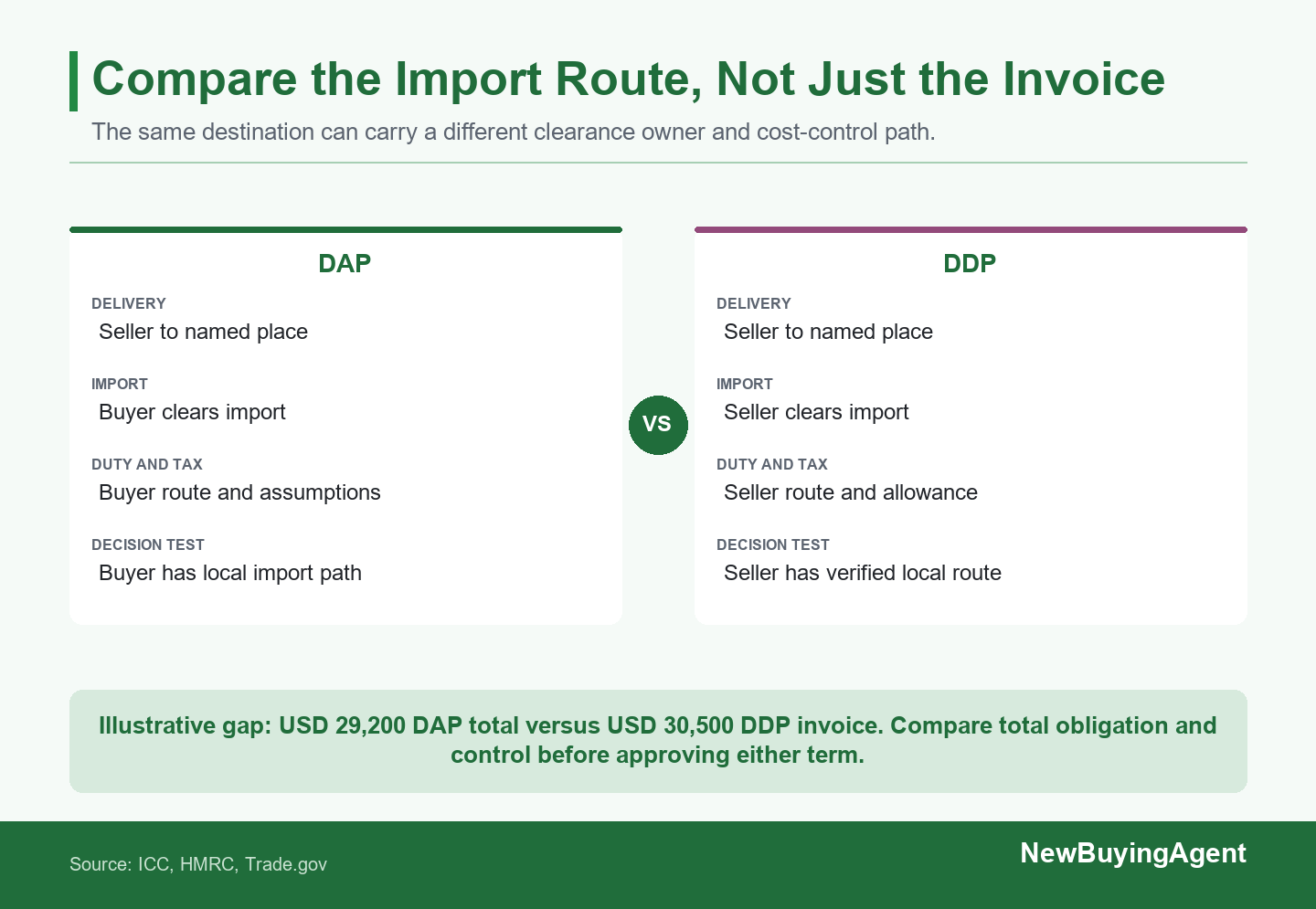
The comparison becomes commercial only after the buyer names the place, clearance actor, border-cost assumptions, and document handoff.
Use a normalized comparison record instead of trying to turn every line into a single landed-cost number. Under DAP, the buyer should list the declared invoice, main carriage scope, broker and clearance cost assumptions, duties and taxes, any inspection or storage exposure, and the document route. Under DDP, the buyer should list the seller’s named clearance route, what is embedded in the invoice, any excluded local charges, the recipient of import evidence, and the contingency if the route cannot be used.
| Comparison field | DAP record | DDP record | Buyer check |
|---|---|---|---|
| Named place | Exact destination, ready for unloading | Exact destination, ready for unloading | Is the physical handover identical? |
| Import clearance | Buyer or buyer-appointed route | Seller-managed route | Who can lawfully and practically clear? |
| Duty and tax | Buyer assumption outside invoice | Seller price assumption inside invoice | Which amounts and exclusions are written? |
| Unloading and evidence | Buyer normally unloads; buyer needs entry records | Buyer normally unloads; document recipient must be named | Can operations and accounting use the handoff? |
The table is an execution record. The visual is a high-level ownership comparison. Neither replaces a destination-specific customs or tax review, but together they prevent a common quote error: comparing a buyer-managed import path with a seller-managed one as though only freight had changed.
DDP Fails When the Seller Cannot Clear the Import
The ICC cautions that practical realities may prevent a seller from undertaking import clearance under DDP. Its Incoterms checklist is a useful reminder to verify the destination route before accepting the promise.
In the United States, an importer number identifies the entity responsible for imported goods for customs clearance, duties, and compliance. This CBP explanation is a U.S. example, not a rule for every market.
The import feasibility check should happen before purchase-order release. An importer of record is the destination-country party identified in the customs entry process; the exact legal role varies by jurisdiction. Confirm the actual goods and classification, the destination entity or representative, the broker authority, registrations where applicable, the document recipient, and the plan for an examination, delay, or rejected entry. If any of those answers is unknown, DDP is not yet a completed operational route. The correct action is to hold the term decision or use a documented alternative—not to assume an invoice label solves the gap.
A Quote Scenario: Invoice Price Versus Total Obligation
In this illustrative scenario, the USD 26,000 DAP invoice plus USD 3,200 in buyer-side border assumptions totals USD 29,200, compared with a USD 30,500 DDP invoice for the same stated destination.
The arithmetic does not make the DAP route automatically better. It shows why an invoice comparison alone is misleading: the USD 1,300 difference represents a different stated allocation of the import path. The buyer still has to test whether it can operate the DAP route and whether the seller can operate the DDP route.
The Same Goods, Two Different Ownership Models
In this illustrative scenario, the buyer should compare the confirmed import actor and total obligation before selecting DAP or DDP.
An Australian home-goods buyer is comparing two offers for the same China-made storage product delivered to one nominated warehouse.
This comparison covers 1 product, 1 named warehouse, and 1 destination-side import route.
The illustrative order is 1,200 units with a DAP quote of USD 26,000 and a DDP quote of USD 30,500.
The buyer has a destination warehouse but has not yet confirmed the importer, broker authority, or tax recovery route.
The DAP quote includes carriage to the named destination but leaves buyer-side border charges outside the invoice.
The DDP quote embeds a seller-managed import route, but the buyer cannot accept it until that route is feasible in the destination.
The illustrative DAP total becomes USD 29,200 after USD 3,200 in stated buyer-side border assumptions. The USD 1,300 gap to DDP is not automatically waste; it is the stated commercial cost of a different import-clearance allocation.
Do not choose the lower invoice. Choose DAP only if the buyer can own the local import path; consider DDP only after the seller's destination route is verified.
Require both quotes to name the delivery point, importer or clearance actor, duty and tax assumptions, unloading boundary, and document handoff.
A destination customs or tax adviser confirms the party and method permitted for the actual product and transaction before purchase order release.
This composite scenario is illustrative. It is not a tax calculation, a seller quote, or advice for Australia or any other destination.
Where a buyer already works with China factories, it can see the existing-factory management route for China-side coordination. That route can help keep product, packing, production, and logistics handoffs clear while the destination import role stays with the buyer or another eligible party.
Put the Delivery Term Into the Purchasing Brief
For a new China-sourced requirement, NewBuyingAgent can use the buyer's product, quantity, destination, timing, and stated delivery-term assumptions to shape the product-supply route.
A term-ready purchasing brief does not need to decide destination law. It needs to make the commercial question clear enough to price and verify. State the product specification and intended use, quantity, destination country, named place, requested arrival timing, proposed DAP or DDP term, and whether a destination-side importer and broker route are already confirmed. Add any classification, licence, inspection, or tax question that remains open.
For DAP, the brief should name the buyer-side clearance contact and the records the buyer expects after entry. For DDP, it should require the seller to state the proposed import route, included and excluded charges, document recipient, and escalation path if clearance cannot proceed. That turns “please quote delivered” into a request that commercial, sourcing, and operations teams can review together.
Keep China-Side Coordination Separate From Import Ownership
For buyers already using China factories, NewBuyingAgent can coordinate China-side supplier communication, production progress, quality, and logistics handoffs without becoming the destination importer.
That separation is useful. A China-side team can help keep packing details, shipment timing, supplier communication, and document handoffs aligned with the buyer’s chosen term. It does not make that team the importer of record, customs broker, or the party that determines destination eligibility. The buyer should retain a named destination-side owner for those decisions before treating either DAP or DDP as approved.
The resulting discussion can focus on a China product-supply or factory-coordination route that respects the stated delivery boundary. If the product, quantity, destination, named place, timing, existing-factory status, and intended import owner are clear, buyers can contact NewBuyingAgent with a destination-ready purchasing brief.
Frequently Asked Questions
The remaining DAP and DDP questions concern delivery risk, unloading, destination feasibility, and comparable total obligation.
Does DDP remove every risk for the buyer?
DDP shifts delivery, import-clearance, and duty responsibilities to the seller up to the named delivery point, but it does not replace the sales contract or destination-law analysis. The buyer still needs to confirm the actual route, understand what documents it receives, and keep product, payment, and destination obligations clear. Treat DDP as an allocation rule with a verified operating path, not as a blanket transfer of every commercial risk.
Who unloads goods under DAP or DDP?
Under both DAP and DDP, delivery normally occurs with goods ready for unloading on the arriving vehicle, so the buyer normally takes unloading risk and expense unless the transport contract changes the cost allocation. The purchase order should therefore state the physical unloading arrangement and any equipment, appointment, or labour requirements instead of leaving them to an assumption.
Can a China supplier always offer DDP?
A supplier may quote DDP only if it can lawfully complete import clearance and the required destination-side formalities for that transaction, which must be checked before the term is accepted. Product classification, importer eligibility, registrations, broker authority, documents, and local rules can all affect the route. If the route cannot be confirmed, the buyer should not approve DDP merely because it appears on a quotation.
Should buyers compare DAP and DDP invoice totals?
Buyers should compare the same product, named place, transport scope, clearance owner, duty and tax assumptions, unloading boundary, and document route before deciding which quote is economically better. The goal is not to make every cost identical; it is to make the ownership difference visible, then choose the term the buyer and seller can actually perform.
NewBuyingAgent
Related Resources
Get Started Today
Let's Turn Your Sourcing Goals into RealityWeChat:+86 15157124615
WhatsApp:+86 15157124615
Address:Building 10 #39 Xiangyuan Road, Hangzhou, China
