

A sourcing agent should not pick the cheapest tier or the highest tier by instinct; the right tier is the one where the expected failure cost is lower than the extra cost of better evidence, better materials, and better production control. That is the core idea behind the Cost-Quality Trade-off Matrix.
For buyers sourcing from China, the matrix is useful because price and quality rarely move in a straight line. A cheaper product can be the best decision when the product is simple, repeatable, and low-risk. A higher tier can be the cheaper decision when defects, returns, compliance gaps, carton damage, or launch delays would cost more than the unit-price difference.
Key Takeaways
- Definition: The Cost-Quality Trade-off Matrix compares unit cost against failure cost, evidence strength, production control, and landed-value risk.
- Decision: The right tier is not always premium; it is the tier that protects the buyer's margin at the product's risk level.
- Common mistake: Buyers compare quotes before defining defects, inspection evidence, packaging, delivery terms, and failure-cost assumptions.
- Service fit: A tier-aware sourcing brief should connect price, evidence, market fit, and delivery before the buyer compares product offers.
The Matrix Is Really About Failure Cost, Not Premium vs Cheap
The Cost-Quality Trade-off Matrix starts with a simple question: what will it cost if this product fails after the buyer has committed money, packaging, freight, or channel trust? ASQ's cost of quality resource defines cost of quality as a method for understanding resources used to prevent poor quality, appraise quality, and deal with internal and external failures. That framework matters in sourcing because the cheapest quote may reduce purchase cost while increasing appraisal, rework, replacement, returns, or customer service cost.
Quality systems also point buyers toward process evidence. ISO 9001:2015 specifies quality management system requirements, while ISO's quality management principles emphasize customer focus, process approach, improvement, and evidence-based decision making. In sourcing terms, that means quality should be built into the tier decision before production, not discovered as an afterthought.
The matrix is therefore not a price ladder. It is a risk translation tool. It asks whether the product's likely failure cost justifies more expensive materials, tighter tolerances, stronger packaging, more production evidence, or a more controlled delivery path.
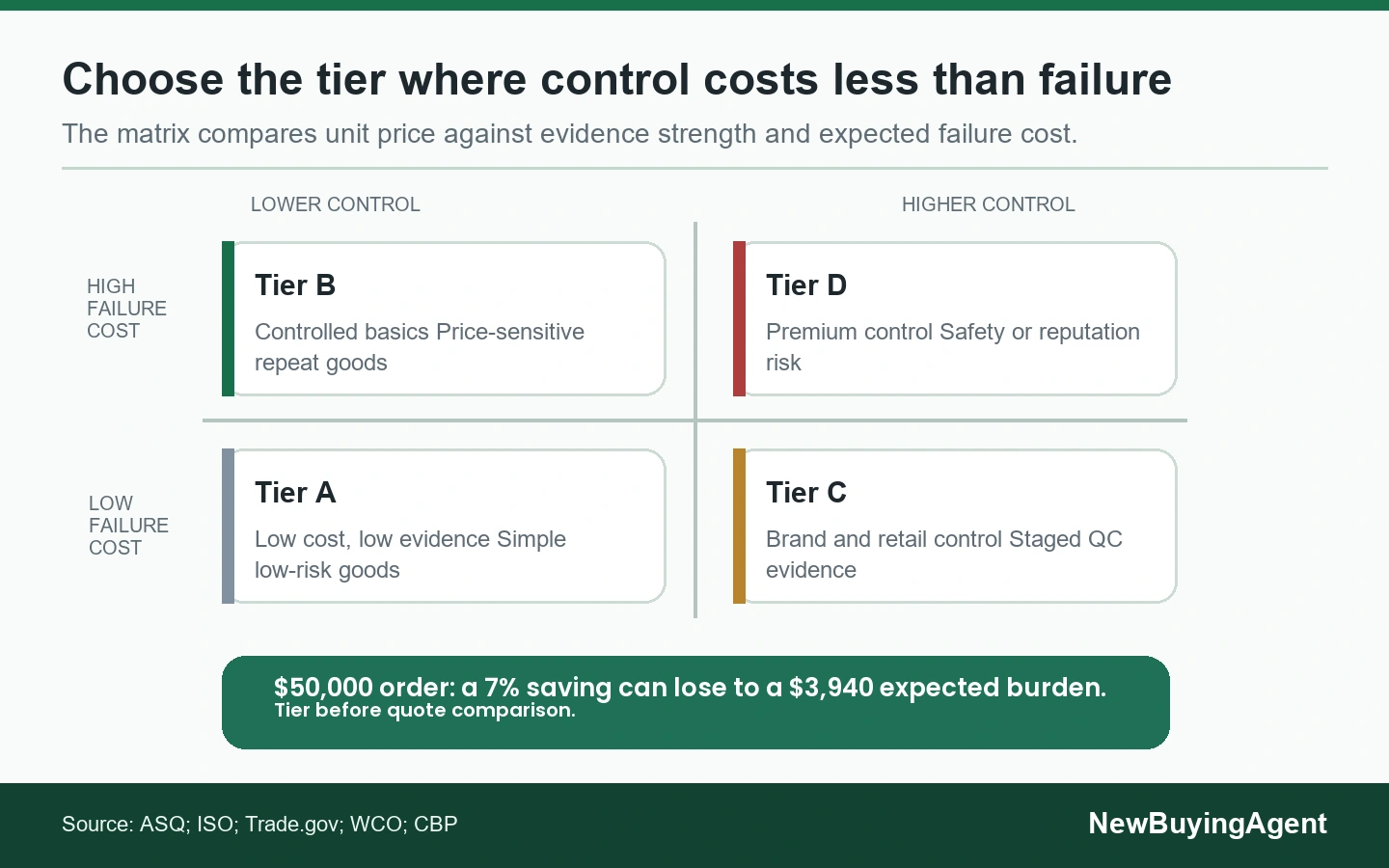
The Cost-Quality Trade-off Matrix chooses the tier where evidence and production control are strong enough for the product's expected failure cost.
The Cost-Quality Trade-off Matrix Tiers
1. Tier A: Low Cost, Low Evidence
Tier A can be right for simple, low-risk, non-safety-critical products with familiar materials, stable production, low customer-return sensitivity, and limited claim exposure. Examples may include basic accessories, simple packaging items, low-complexity seasonal fillers, or test-market goods where the buyer accepts limited durability and limited documentation.
The risk is pretending Tier A can do Tier C work. If the product has strict dimensions, safety expectations, branded retail packaging, electronics, load-bearing function, child-adjacent use, or high return cost, low evidence becomes expensive. A sourcing agent should pick Tier A only when the buyer understands the limits and has no hidden performance promise.
2. Tier B: Competitive Cost, Controlled Basics
Tier B is often the right starting point for price-driven buyers. It keeps cost discipline but adds enough control to reduce avoidable failure: written specs, approved sample, material confirmation, packaging plan, basic inspection, and clear delivery terms. It is practical for many consumer goods when the product is not technically demanding but still needs repeatability.
The danger is underestimating carton, label, and production-version risk. A product can look acceptable and still fail through weak packaging, inconsistent color, missing accessories, wrong instruction sheets, or late shipment documents. Tier B works when the sourcing agent can keep the basics visible from quote through shipment release.
3. Tier C: Higher Control for Brand, Retail, and Repeat Orders
Tier C is appropriate when the buyer's cost of failure is higher than the extra unit cost. Branded products, retailer programs, repeat SKUs, products with moving parts, functional claims, heavier packaging risk, or stronger customer-review exposure often need Tier C. The quote may be higher, but the control package should be stronger: better materials, clearer tolerances, staged QC, approved packaging, inspection records, and defined hold/release rules.
ISO 2859-1 is a reminder that sampling inspection has formal logic indexed by acceptance quality limit for lot-by-lot inspection. Buyers do not need to turn every order into a technical standards exercise, but they should expect the sourcing agent to connect inspection scope to the product's defect risk and order size.
4. Tier D: Premium Control for High-Failure-Cost Products
Tier D is not "best" for every buyer. It is right when failure would damage safety, brand trust, legal exposure, channel access, installation, or a fixed launch. Examples include baby products, electronics, load-bearing outdoor goods, project furniture, regulated components, and products where one defect can trigger returns, claims, or public reviews that cost more than the purchase saving.
The sourcing agent should recommend Tier D only with a clear reason. Premium control should name what it buys: stronger materials, documented testing, more disciplined production process, better packaging, tighter sample approval, or better release evidence. Without that explanation, premium pricing can become as weak as bargain pricing.
How a Sourcing Agent Picks the Right Tier
A sourcing agent should start with buyer inputs, not with a price target alone. Product specs, volume, target price, destination, channel, timeline, packaging, claims, and acceptable defect risk should determine which tier is rational. Trade.gov's China standards guidance shows why standards and conformity assessment can matter in China trade, while Trade.gov's Incoterms overview explains how shipment responsibilities affect cost and risk.
The Cost-Quality Trade-off Matrix works best when each tier is connected to a buyer decision. If the buyer's real constraint is cash flow, Tier B may be better than Tier C as long as failure cost is controlled. If the real constraint is a retailer launch date, Tier C may beat Tier B because rework would cost more than the savings. If the real constraint is product safety or brand trust, Tier D may be the only rational choice.
| Tier | Best use | Evidence needed | Hold/release rule |
|---|---|---|---|
| A | Simple, low-risk, test-market goods | Basic specs, sample, carton confirmation | Release only if no hidden claim exists |
| B | Price-sensitive repeatable consumer goods | Written spec, approved sample, basic QC | Release when final lot matches approved basics |
| C | Branded, retail, repeat, functional products | Staged QC, packaging proof, defect limits | Hold if evidence is incomplete or current lot fails |
| D | Safety, compliance, high-reputation-risk goods | Testing basis, documented controls, release file | Hold unless proof matches the claim and market |
Based on this matrix, tier choice should happen before quote comparison. If the sourcing agent does not know the product's failure cost, the quote can only optimize purchase price, not buyer margin.
The matrix also prevents over-engineering. A buyer does not need premium documentation for every simple accessory, but the buyer does need to know why the lighter control level is acceptable. The sourcing agent should write that boundary into the brief: the product has no safety claim, the packaging is simple, the destination does not require special documentation, the channel can accept normal cosmetic variation, and the order can be repeated only after the first lot confirms sell-through. If those assumptions are not true, the tier should move up before the buyer negotiates price.
Scenario Calculation: When Better Quality Costs Less
Use an illustrative calculation. A buyer compares two quotes for a $50,000 order. Tier B is 7% cheaper than Tier C, saving $3,500 at purchase. But Tier B has weaker packaging control and a higher chance of customer returns. If 4% of units create returns, replacements, support time, and markdowns averaging $18 per unit on a 2,000-unit order, the failure cost is $1,440. If the weak packaging also creates one partial rework and two weeks of delay costing another $2,500 in warehouse and launch pressure, the total expected burden becomes $3,940. Under these assumptions, the higher-control tier is already cheaper than the cheaper quote.
This does not prove Tier C is always better. It proves the matrix must include failure cost. ASQ's cost-of-quality categories separate prevention, appraisal, internal failure, and external failure costs, which is exactly the distinction sourcing buyers need. Prevention and appraisal may look like added cost before production; external failure can become a much larger cost after customers see the defect.
Trade documentation affects the same calculation. The WCO Harmonized System overview explains the role of product nomenclature in tariffs and trade statistics, and CBP basic importing guidance notes that imported merchandise must clear customs and may be subject to duties, taxes, and fees. A sourcing tier that ignores documentation quality can look cheaper until clearance, duties, or corrections affect landed cost.
Where NewBuyingAgent Fits in Cost-Quality Tier Decisions
NewBuyingAgent is relevant when buyers need the cost-quality tier translated into a supplied product offer from China. The buyer provides product specs, quantity, target price, destination, and delivery timing. NewBuyingAgent then uses local China factory resources, industrial-cluster sourcing access, product development and quality-control capability, cost negotiation, production follow-up, and logistics coordination to supply products that fit price, quality, market demand, and delivery needs.
The Cost-Quality Trade-off Matrix helps buyers prepare better briefs for NewBuyingAgent's product-supply service. Instead of asking only for a lower quote, the buyer can name the desired tier, acceptable defect risk, packaging risk, inspection evidence, channel requirements, and delivery basis. That allows NewBuyingAgent to use its 50,000+ cooperated factory resources and product/QC capability toward buyer margin protection rather than a one-dimensional price chase.
When the buyer needs proof that cost control and quality control can work together, NewBuyingAgent success stories provide a useful reference point for how sourcing decisions can connect price, inspection savings, payment terms, and operational time. Case evidence should not be treated as a universal promise, but it can help buyers ask better questions about which tier is realistic for their own category and risk profile.
For buyers who already have a China source, the matrix also supports NewBuyingAgent's factory-management path. If the product should be Tier C or Tier D but current production evidence looks like Tier A or Tier B, the buyer can use local China follow-up, staged QC, real-time reporting, and logistics coordination to decide whether to release, revise, or hold the order.
Frequently Asked Questions
What is a cost-quality trade-off matrix?
A cost-quality trade-off matrix compares purchase price with failure cost, evidence strength, production control, packaging risk, and delivery responsibility. It helps buyers decide whether a lower quote is truly cheaper or whether a higher-control tier protects margin better. The matrix should be built before quote comparison, not after defects appear.
Should a sourcing agent always choose the highest-quality tier?
No. The highest tier can waste money when the product is simple, low-risk, and not tied to safety, brand trust, or strict channel requirements. A good sourcing agent chooses the tier that matches the buyer's failure cost. Tier B may be ideal for many price-sensitive goods, while Tier C or Tier D is justified when failure would be more expensive than better control.
How can buyers estimate failure cost before ordering?
Buyers can estimate failure cost by listing return handling, replacement units, rework, freight pressure, markdowns, customer service time, lost launch dates, and reputation risk. The number does not need fake precision. It only needs enough realism to show whether the cheaper quote still wins after defects, delays, and documentation corrections are considered.
How does NewBuyingAgent use cost and quality together?
NewBuyingAgent can use the buyer's product specs, quantity, target price, destination, timing, and risk tier to quote and supply China-sourced products with price, quality, market fit, and delivery considered together. Its local factory resources, product/QC capability, AI-driven product analysis, and flexible payment support help buyers avoid choosing a tier by unit price alone.
NewBuyingAgent
Related Resources


Get Started Today
Let's Turn Your Sourcing Goals into RealityWeChat:+86 15157124615
WhatsApp:+86 15157124615
Address:Building 10 #39 Xiangyuan Road, Hangzhou, China
