

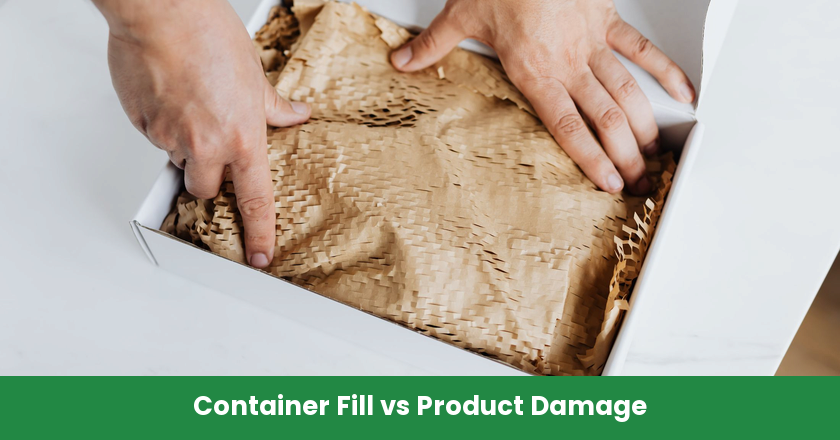
Container utilization is the share of a stated container resource used by a load, such as internal volume, floor area or permitted cargo weight. The economic optimum is the lowest credible cost per accepted product unit among feasible, requirement-compliant packing options; it is not automatically the highest fill percentage.
For recurring China imports, a smaller shipment invoice is useful only in the context of what the buyer receives and can use. Compare the actual product and pack changes, the work at both ends and the evidence behind the damage assumption. Without that evidence, a spreadsheet can show where a decision changes, but it cannot identify a universal packing optimum.
Optimize usable-product cost within a feasible load plan
Optimize the cost of usable products within a physically feasible load plan and the buyer’s quality requirements. Define the utilization measure, compare the same product and demand basis, and count each incurred cost once against the expected accepted output. A modeled freight saving is not sufficient when the changed pack has unverified protection, an unsafe unloading arrangement or a loss assumption that could reverse the result.
- Definition: Volume, floor-area and weight utilization are different measures.
- Cost comparison: Divide scoped incurred cost by expected accepted units, with acquisition cost counted once.
- Risk: A theoretical break-even loss rate does not permit defects or override packing constraints.
- Decision: Validate the changed product-pack system and the uncertain assumptions before choosing.
Define utilization before comparing the packing options
State what utilization measures before comparing the packing options: packed external volume, occupied floor area and used cargo-weight allowance answer different questions. Keep the same denominator and identify the actual equipment and pack revision behind each figure. A higher volume ratio does not prove that the goods fit through the doors, meet weight restrictions or remain protected during handling and transport.
Hapag-Lloyd’s published container specifications distinguish internal and door dimensions and capacity, and warn that the listed figures are fleet examples that vary by manufacturer. Treat published capacity as a reference for the equipment discussion, not a confirmed quantity of products that can be loaded. The actual arrangement still has to work.
Space-saving changes often begin in the product pack: a different insert, carton construction or product orientation can alter both occupied space and protection. NewBuyingAgent combines product-development and quality-control capability with local China factory resources. Those strengths are relevant when recurring product purchases need packing choices that support quality and delivered-cost goals together.
The table compares three packing configurations for the same product and route. It identifies what changes and what evidence is needed, rather than assigning invented utilization percentages or damage rankings to the options.
| Option | Main change | Needed proof | Decision |
|---|---|---|---|
| Current pack | Existing build | Current route data | Cost baseline |
| Denser pack | Less space per unit | Protection + loss | Test the saving |
| Redesigned pack | New build or insert | Fit + test + cost | Validate first |
Based on this comparison, retain the current pack as the reference and assess each proposed change on feasible capacity, product protection and complete cost. Denser packing is a candidate when those inputs support it; a redesign may recover space without the same protection trade-off. Neither change deserves a damage-rate assumption simply because it fits more neatly.
The illustrative cost graphic uses an equal-dispatch example developed below. It shows why a lower total bill can still produce a higher cost per accepted unit when fewer products remain usable. These are hypothetical outcomes, not observed damage rates or permission to accept defective goods.
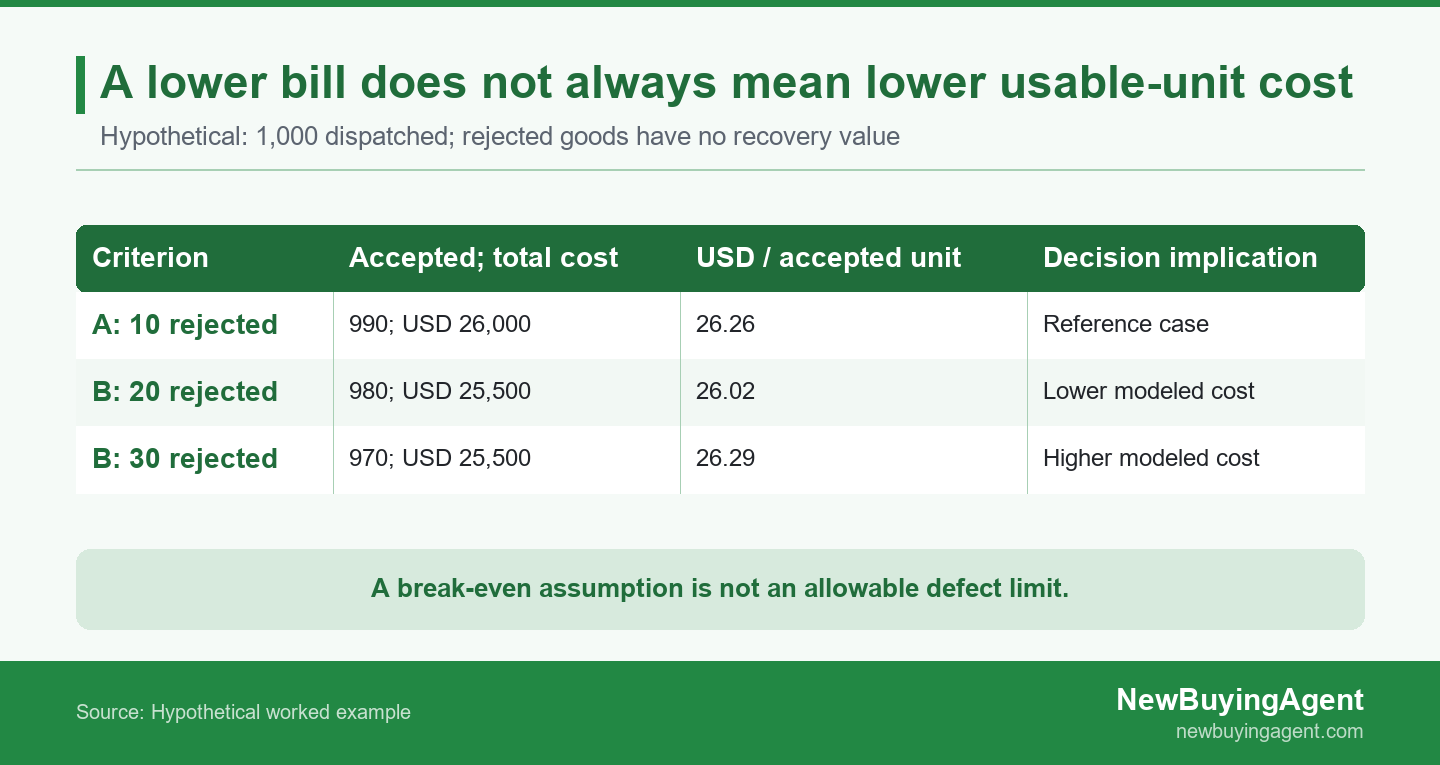
Under hypothetical equal-dispatch assumptions, a lower shipment bill can still produce a higher cost per accepted unit.
Build a cost model that counts usable products once
Build the model around a stated shipment scope and a clear definition of accepted units: products that meet the agreed usable and quality requirement at the chosen receiving checkpoint. Count all included incurred costs once, then divide by expected accepted output. Keep unknown consequences separate instead of silently setting them to zero or using a shipping quantity as though every dispatched product will be usable.
Use the finished shipping pack and a common demand basis
Start with the finished export pack, including the protective materials and handling-unit build that will actually travel. Record external measurements, gross weight, product units per pack and the intended arrangement. If the pack changes, recalculate the feasible count and quote assumptions rather than keeping an old carton quantity beside a new protection design.
The GS1 Package and Product Measurement Standard uses a defined natural base and maximum outer extents for non-consumer item measurements. Use a consistent finished-pack measurement basis instead of substituting unpacked product dimensions or an inner box’s size. That measurement record supports comparison; it does not approve the load’s orientation or stack arrangement.
State whether the comparison holds dispatched quantity or required usable quantity constant. Equal dispatch is a useful diagnostic model, but equal usable demand may require replacement goods and another shipment. If the revised quantity crosses a container-count threshold, obtain a new feasible arrangement and price rather than assuming that a unit-cost ratio will scale without changing the operation.
Separate acquisition cost from additional damage consequences
Include the acquisition cost of the dispatched products, packing materials, transport and handling through the stated receiving endpoint. Add only genuinely additional consequences such as separate rework, inspection, disposal or replacement-delivery costs that the chosen scope requires. Record salvage or recoveries on a consistent basis when they are supported, and make exclusions explicit.
If the purchase cost of the entire lot is already in the numerator, do not add the same purchase value of rejected goods again as a damage charge. Their acquisition cost has already been incurred; their unusability reduces the accepted-unit denominator. An additional disposal fee is a different cost, while a second write-off of the same product value would duplicate the loss.
For a continuing order, a pack change also needs to remain aligned with what the factory produces and releases. NewBuyingAgent’s existing-factory management includes supplier communication, production progress, quality management and logistics coordination within the agreed scope. That broader support is relevant when a proposed saving changes the supplied product’s protection and delivery assumptions.
Validate protection and the damage assumptions before choosing
Validate physical feasibility, product-pack performance and the damage assumptions as separate parts of the decision. A load may be inexpensive on paper while failing a support or unloading requirement, and a successful laboratory test does not supply a complete future loss forecast. Use relevant packing evidence and comparable observations to determine which assumptions are credible enough to support the proposed change.
Keep physical packing and safe unloading as firm constraints
Exclude a packing arrangement that fails the actual product, equipment, route or receiving requirements before comparing its economic benefit. Check carton support, permitted orientation and layers, load stability, restraint and handling access. Free space is not automatically waste: some clearance or protective material may be necessary, while unrestrained voids can create a different problem.
The IMO/ILO/UNECE CTU Code provides non-mandatory global guidance on packing and securing through sea and land transport, including receiving and unpacking. It supports looking beyond geometric fill. An attractive cost calculation does not establish that the proposed arrangement is suitable for that full chain.
UK HSE loading guidance says loading should allow safe unloading and that involved companies should agree arrangements in advance. Use those points to frame the packing and receiving discussion while checking the actual local obligations. Do not turn a commercial preference for more units into an instruction to unload an unsuitable arrangement.
Test the changed product-pack system against relevant hazards
Identify the physical change and the failure mechanisms it could affect, such as compression, vibration, impact or abrasion. Agree the product and packaging acceptance criteria, test specimens and relevant distribution conditions before testing. A test on a different insert, carton or product version cannot automatically validate the proposed shipping pack.
ISTA’s test-procedure guidance distinguishes screening tests from general simulations of transport hazards and emphasizes selecting a procedure for the intended outcome. A laboratory result supports the conditions and specimens tested; it does not by itself establish the future damage rate of a shipping program. Have a suitable test provider confirm the method and scope instead of choosing a protocol only because its name appears familiar.
For a recurring program, connect relevant test evidence with a controlled shipment trial and receiving observations where appropriate. Preserve the actual pack, handling route and inspection basis in the record. If the test or trial exposes a failure, revise the physical proposal before using a hopeful loss assumption to make the economic model pass.
Treat a small damage sample as uncertain evidence
Record the sample, denominator, inspection point and defect definition behind any loss estimate. Distinguish transit damage from pre-existing production defects, and avoid combining unlike products or routes into a single precise rate. A quiet shipment or a small successful trial is evidence to assess, not proof that future damage will be absent.
NIST’s binomial confidence-limit guidance notes that commonly used normal-approximation limits may be inaccurate with small failure counts or sample sizes. Estimation method and sample scope therefore matter. Do not assume every product in a damaged carton or pallet is an independent observation merely to obtain an apparently larger sample.
Where the loss estimate remains uncertain, calculate a range of plausible outcomes and identify the point at which the preferred option changes. Then ask what additional test, trial or comparable receiving evidence would reduce that uncertainty. A narrow modeled saving with an unresolved loss response is a reason to investigate, not a basis for announcing an economic optimum.
A lower shipment bill can still cost more per usable unit
The following hypothetical example holds dispatched quantity constant to isolate the effect of different accepted outputs. It assumes both packing arrangements are feasible and otherwise meet the applicable requirements, with acquisition and scoped shipment costs fully stated. The figures are invented for arithmetic, not current freight prices, a customer result, a measured damage response or a complete plan for meeting a fixed usable-product requirement.
Compare the same dispatched quantity on accepted units
Assume 1,000 products are dispatched at an acquisition cost of USD 20 each, totaling USD 20,000. Plan A adds USD 6,000 for the included packing, transport and handling, giving USD 26,000 incurred cost; assume 10 units are unusable, leaving 990 accepted units. Plan B reduces the included shipment costs to USD 5,500, giving USD 25,500 total incurred cost, with its unusable quantity treated as a sensitivity input.
Under these assumptions, Plan A costs USD 26,000 ÷ 990, or about USD 26.26 per accepted unit. If Plan B has 20 unusable units, it leaves 980 accepted and costs about USD 26.02 each. If Plan B has 30 unusable units, it leaves 970 accepted and costs about USD 26.29 each. The lower shipment bill therefore does not establish which plan has the lower usable-product cost.
| Case | Accepted units | Total USD | USD / accepted |
|---|---|---|---|
| A: 10 unusable | 990 | 26,000 | 26.26 |
| B: 20 unusable | 980 | 25,500 | 26.02 |
| B: 30 unusable | 970 | 25,500 | 26.29 |
The model assigns no recovery value to unusable goods and includes no additional rework, disposal, delay or replacement-delivery amounts. Those exclusions define this illustration; real missing costs must remain unresolved until a supported value or scenario is available. The acquisition cost of unusable goods is already included once in each total, so it is not added again.
Find the break-even assumption, then test its limits
Let d be Plan B’s expected unusable units and use the unrounded costs: 25,500 ÷ (1,000 − d) = 26,000 ÷ 990. Solving gives about 29.04 expected unusable units, or about 2.904% of the dispatched quantity. That is Plan B’s total break-even assumption in this model, about 19.04 more unusable units than Plan A, not an additional 2.904% loss allowance.
This threshold is not an allowable defect limit, an acceptance-sampling rule or a predicted outcome. Products still have to meet the agreed quality requirements, and an unsafe or nonconforming pack remains excluded. Use the result to ask whether credible evidence places the changed pack’s loss response on the favorable side of the comparison, allowing for uncertainty and any additional costs.
Do not select between close options using only rounded unit costs. A different rework charge, salvage value or expected loss can move the break-even. Nor does an equal-dispatch result fulfill a promise to deliver the same usable quantity: replacement products may change acquisition cost, shipment timing and container count, requiring a new comparison.
The practical outcome is a conditional choice. Keep the current validated pack as the reference when the changed pack lacks credible protection evidence. Progress a denser or redesigned option when its physical arrangement, quality evidence and complete scoped economics support it; if the data do not distinguish the options, identify the missing input rather than inventing a precise optimum.
Approve the product and packing brief with its evidence
Record the chosen pack revision, the actual loading assumptions and the conditions behind the cost decision. Assign an owner to unresolved evidence and identify which changes require the comparison to be reopened. The approval should connect the supplied products and their quality requirements with feasible packing and delivery, rather than approving a utilization percentage in isolation.
- Product and pack: Specifications, contents, external measurements, handling limits and the proposed change.
- Feasibility: Responsible packing and receiving confirmation for the actual equipment and route.
- Cost scope: Dispatch or usable-demand basis, included costs, supported recoveries and unresolved consequences.
- Evidence: Test scope, comparable observations, defect definition and uncertainty behind the loss estimate.
- Release: Approved version, decision owner, recipients and change triggers.
For recurring China purchasing, bring these findings together with product specifications, SKU quantities, target price, destination, timing and the current sourcing situation. To discuss complete product supply or agreed management of existing factories around the actual quality, packing and delivered-cost requirements, send the purchasing requirements to NewBuyingAgent.
Frequently Asked Questions
Is there a universal container utilization target that minimizes damage?
There is no defensible universal utilization target that minimizes damage across products and routes. Define the measure and evaluate the actual pack, loading arrangement, handling chain and receiving requirements. Without a supported relationship between those changes and damage, a fill percentage cannot establish an economic optimum. Compare feasible options using credible cost and usable-output assumptions instead.
Does unused space always reduce the risk of product damage?
Unused space does not automatically reduce product damage. Some clearance and protective material may be necessary, while poorly controlled gaps can permit movement or undermine the intended arrangement. Have the responsible packer assess support, protection and securing for the actual goods. Do not remove required protection to improve a ratio or assume that simply leaving more room makes a load safe.
Can a passing package test establish the future shipping damage rate?
A passing package test does not by itself establish the future damage rate for a shipping program. It provides evidence for the procedure, specimens and conditions tested. Confirm that these match the relevant product-pack change, and connect the result with suitable shipment and receiving evidence. Keep the uncertainty visible when route, handling or production conditions differ from the validation scope.
Should acquisition cost cancel when both options dispatch the same quantity?
Common acquisition cost does not cancel from a cost-per-accepted-unit comparison when expected usable output differs. Each total is divided by its own accepted quantity, so the shared purchase amount contributes differently to each ratio. Include it once, then add only genuinely additional consequences within the chosen scope. A comparison of shipment invoices alone answers a narrower question.
NewBuyingAgent
Related Resources
Get Started Today
Let's Turn Your Sourcing Goals into RealityWeChat:+86 15157124615
WhatsApp:+86 15157124615
Address:Building 10 #39 Xiangyuan Road, Hangzhou, China
